
News & AnalysisCareer

A 0.14% decline leaves the Australian Dollar (AUD) trading near 0.7040 against the US Dollar (USD) in Thursday’s European session. Having reached a fresh monthly high of 0.7068, AUD/USD is pulling back as the US Dollar recovers. The move comes ahead of the United States (US) flash Q3 Gross Domestic Product (GDP) release and September Personal Consumption Expenditure (PCE) Price Index figures, due at 12:30 GMT.

At the time of writing, a 0.1% gain puts the US Dollar Index (DXY) near 102.20. The index tracks the Greenback against six major currencies. Its recovery follows pressure on Wednesday after the Federal Reserve’s (Fed) monetary policy announcement, when the central bank left the Federal Fund Rate unchanged in the 3.75%-4.00% range.
TD Securities expects the forthcoming US activity figures to indicate that the economy “will likely show a resilient economy that can handle more restriction.” In the bank’s view, “Q3 GDP [will] show robust underlying growth.” On the headline figures, TD Securities observes that “GDP growth picked up in Q3 to 2.5% from 2.2% previously with underlying activity remaining robust,” an assessment broadly consistent with other forecasts. Those projections also stress firm consumption and investment, despite modest drags from some components, including net exports and inventories.
For the core PCE Index, the Fed’s preferred inflation measure, expectations point to a rise to 3.1% Year-on-Year (YoY), compared with the previous reading of 3%.
In Australia, strong Consumer Price Index (CPI) readings for the third quarter and September have increased financial markets’ confidence that the Reserve Bank of Australia (RBA) will raise interest rates at its November policy meeting.
The latest Australian inflation figures, Brown Brothers Harriman says, “beat expectations, strengthening the case for another RBA hike and underpinning AUD.” According to the bank, “September headline CPI rose 4.3% y/y (consensus: 4.2%) vs. 4.0% in August,” with the stronger-than-expected result “reflecting rising housing and transport costs,” adding weight to market pricing for further monetary tightening.
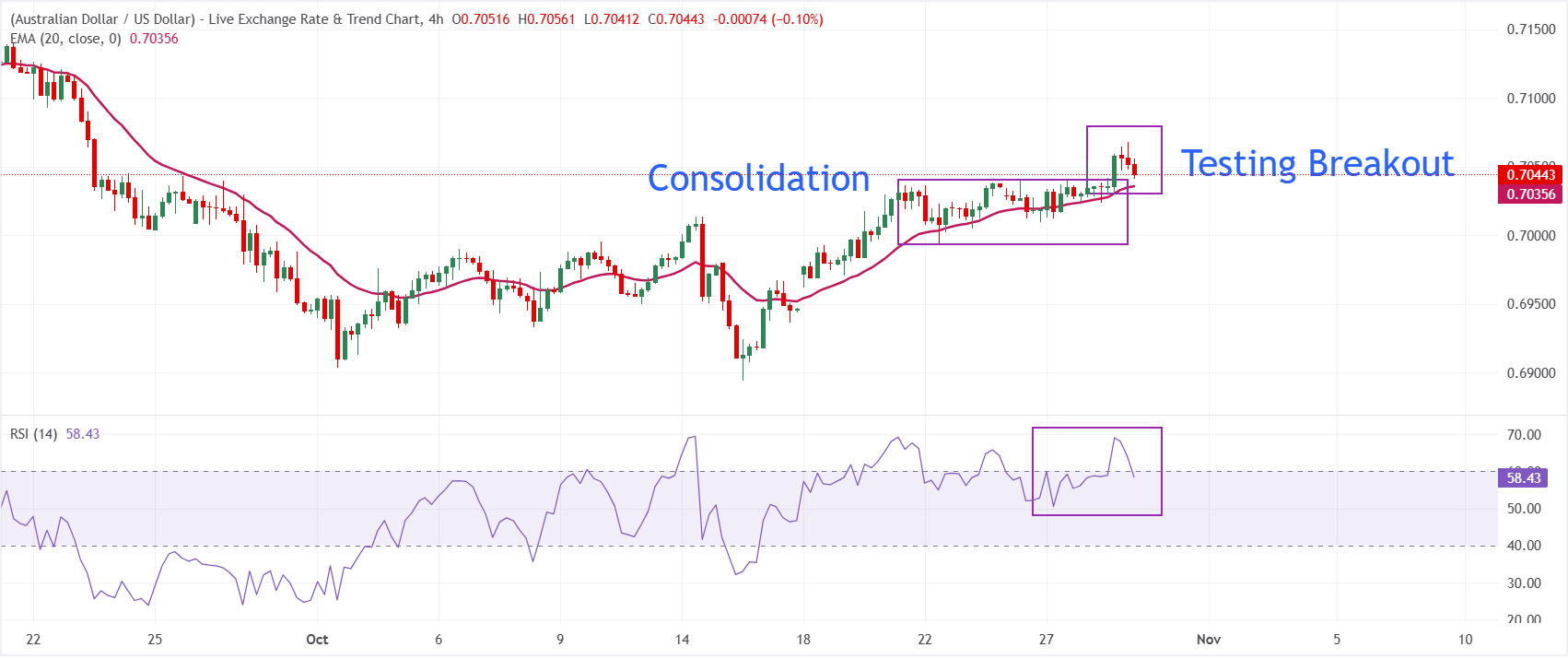
On the four-hour chart, the breakout from AUD/USD’s consolidation range between 0.6994 and 0.7040 is being tested.
Holding above the 20-period Exponential Moving Average (EMA) at 0.7036 leaves the pair with a modest bullish bias, pointing to underlying buying interest on shallow dips.
A Relative Strength Index (RSI) reading of 58 also suggests a mildly positive outlook: momentum remains favourable, but has not reached overbought territory.
Initial support lies at the 20-period EMA of 0.7036, followed by 0.6994, the lower boundary of the consolidation range noted above. If buyers emerge near the area being tested, the pair would look to extend its gains towards 0.7100.
(The technical analysis of this story was written with the help of an AI tool. Know more.)
Published quarterly by the Australian Bureau of Statistics, the Consumer Price Index (CPI) tracks price changes for a fixed basket of goods and services purchased by households. Each quarterly CPI figure is calculated by averaging the three corresponding monthly CPI readings. The QoQ measure compares prices in the reference quarter with those in the preceding quarter. A high reading is regarded as bullish for the Australian Dollar (AUD); a low reading is considered bearish.
Find out more.Latest release: Wed 28 Oct 2026 00:30
Release frequency: Quarterly
Actual reading: 1.3%
Consensus forecast: 1.3%
Previous reading: 0.6%
Data source: Australian Bureau of Statistics
Australia’s quarterly Consumer Price Index (CPI), compiled by the Australian Bureau of Statistics (ABS), significantly influences financial markets and the valuation of the AUD. With important implications for monetary policy, the measure is closely monitored by the Reserve Bank of Australia (RBA) as it seeks to fulfil its inflation mandate. Higher consumer prices generally support the AUD because the RBA could raise interest rates to keep inflation on target. Publication takes place around 25 days after the end of the quarter.







Phone: +61 2 8036 8388
Fax: +61 2 8036 8388
Email: support@tmgm.com



The information provided on this website is of a general nature only and does not constitute personal financial advice. Before acting on any information on this website, you should consider the suitability of the information in relation to your objectives, financial situation and needs. Investing in CFDs and FX Margin Contracts carries significant risks and is not suitable for all investors. You may lose more than your initial deposit. You do not own, or have, any interest in the underlying asset. We recommend that you seek independent advice and ensure you fully understand the risks involved before trading. It is important that you read and consider the disclosure document before you acquire any product listed on the website. The information and advertisements offered on this website are not intended for use by any person in any country or jurisdiction where such use would be contrary to local laws and regulations. The Products and Services offered on this website are not intended for residents of the United States, Malaysia and Thailand.
TMGM is authorized and regulated in various jurisdictions.
Trademax Australia Limited, trading as TMGM, is regulated by the Australian Securities and Investments Commission (ASIC), AFSL no. 436416 and is located at Level 28, One International Tower, 100 Barangaroo Avenue, 2000 Sydney, NSW Australia.
Email: support@tmgm.com.au
Trademax Global Limited, trading as TMGM, is authorized and regulated by the Vanuatu Financial Services Commission (VFSC), registration number 40356 and registered at 1276, Kumul Highway, Port Vila, Vanuatu, Republic of Vanuatu.
Email: support@tmgm.com
Trademax Global Markets (SE) Limited, trading as TMGM, is authorized and regulated by the Financial Services Authority (FSA) of Seychelles, with license number SD224. The company is registered at Office No 13, Providence Estate ABIS Centre, Mahe, Seychelles.
Email: support@tmgm.com
Trademax Global Markets (International) Pty Ltd, trading as TMGM, is authorized and regulated by the Financial Services Commission, Mauritius (FSC) with license no. GB22201012, and registered at 33, Edith Cavell Street C/o IQ EQ Fund Services (Mauritius) Ltd Port Louis, 11324 Mauritius.
Email: support@tmgm.com
Copyright © TMGM. All rights reserved


