
News & AnalysisCareer

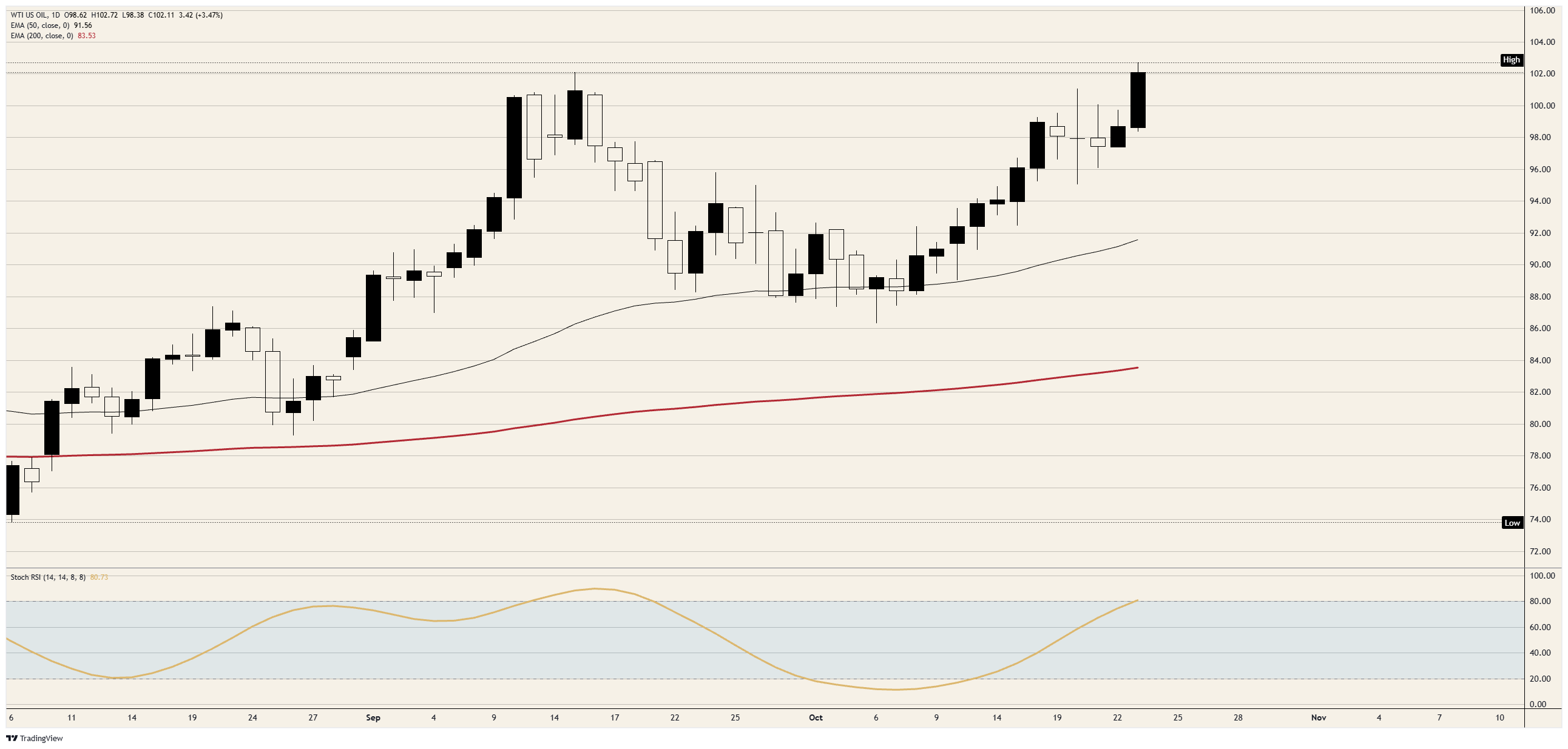
WTI has climbed from around $98.50 to a 22-week high just below $103.00, breaking out of the $95.00-$101.00 range that held from Monday to Thursday. The advance follows two days of Houthi attacks in Saudi Arabia and strikes against vessels departing the Strait of Hormuz. Prices are now trading within the upper fifth of the session’s range.
Following the deaths of two people from Houthi drone debris at the Shaybah field, Saudi Aramco (2222.SR) instructed its remaining employees on Thursday to evacuate its Dhahran headquarters. On Friday, UK Maritime Trade Operations reported that an unidentified projectile had struck a tanker departing Hormuz near Limah in Oman. With both attacks affecting supplies still making their way out of the Gulf, WTI advanced on Thursday and is extending those gains on Friday.
While President Trump said the US could bring the war to a very swift end, US Ambassador to the United Nations Waltz told the Financial Times that it could continue for another year. According to Ambassador Waltz, the Navy can maintain its blockade of Iran’s ports for the foreseeable future. Kpler expects the blockade to reduce Iran’s crude oil revenue to zero by mid-December. Either timescale leaves Iranian barrels absent from a market already facing a shortage of Gulf supplies.
After telling reporters that the US is taking all the crude oil it wants out of Hormuz, President Trump is holding a midterm rally in Fort Myers, Florida, on Friday. According to ABC News, The Atlantic and The New York Times, US and Israeli preparations for strikes against Iran after the 3 November midterms are proceeding. Although officials say a decision has yet to be taken, such strikes would affect Gulf supplies already under attack.
Having exceeded the 15 September peak just above $102.00, the price has returned close to that level. WTI has now gained about $28 from its 6 August low near $74.00, while the 50-day exponential moving average (EMA) has climbed to just above $91.50. For the first time since mid-September, daily momentum has just entered overbought territory.
Traded internationally, WTI oil is a grade of crude whose name stands for West Texas Intermediate. Alongside Brent and Dubai Crude, it is one of the three principal types. Its relatively low gravity and sulphur content earn it the descriptions “light” and “sweet”, respectively. WTI is regarded as a high-quality oil that can be readily refined. Produced in the United States, it is distributed through the Cushing hub, known as “The Pipeline Crossroads of the World”. Its role as an oil market benchmark means WTI prices are regularly cited in media coverage.
Supply and demand underpin the price of WTI oil, as they do for other assets. Global economic growth can therefore lift demand, whereas weak growth can have the reverse effect. On the supply side, political instability, wars and sanctions can cause disruption and affect prices. Decisions taken by OPEC, a group of major oil-producing countries, also play an important role. Because oil is traded predominantly in US dollars, changes in the currency’s value influence WTI crude prices: a weaker US dollar can make oil more affordable, while a stronger dollar can do the opposite.
WTI oil prices respond to the weekly inventory releases from the American Petroleum Institute (API) and the Energy Information Agency (EIA), as stock movements reflect shifts in supply and demand. A decline in inventories can signal stronger demand and lift oil prices; rising stocks can indicate greater supply and weigh on prices. The API releases its report each Tuesday, followed by the EIA the next day. The two sets of figures tend to be similar, with results within 1% of one another 75% of the time. As the EIA is a government agency, its figures are regarded as more reliable.
At meetings held twice a year, the 12 oil-producing nations that make up OPEC (Organization of the Petroleum Exporting Countries) jointly set production quotas for member states. These decisions frequently affect WTI oil prices. A reduction in quotas can constrain supply and lift prices, whereas an increase in production has the reverse effect. The broader OPEC+ group brings in ten additional countries outside OPEC, with Russia the most prominent.







Phone: +61 2 8036 8388
Fax: +61 2 8036 8388
Email: support@tmgm.com



The information provided on this website is of a general nature only and does not constitute personal financial advice. Before acting on any information on this website, you should consider the suitability of the information in relation to your objectives, financial situation and needs. Investing in CFDs and FX Margin Contracts carries significant risks and is not suitable for all investors. You may lose more than your initial deposit. You do not own, or have, any interest in the underlying asset. We recommend that you seek independent advice and ensure you fully understand the risks involved before trading. It is important that you read and consider the disclosure document before you acquire any product listed on the website. The information and advertisements offered on this website are not intended for use by any person in any country or jurisdiction where such use would be contrary to local laws and regulations. The Products and Services offered on this website are not intended for residents of the United States, Malaysia and Thailand.
TMGM is authorized and regulated in various jurisdictions.
Trademax Australia Limited, trading as TMGM, is regulated by the Australian Securities and Investments Commission (ASIC), AFSL no. 436416 and is located at Level 28, One International Tower, 100 Barangaroo Avenue, 2000 Sydney, NSW Australia.
Email: support@tmgm.com.au
Trademax Global Limited, trading as TMGM, is authorized and regulated by the Vanuatu Financial Services Commission (VFSC), registration number 40356 and registered at 1276, Kumul Highway, Port Vila, Vanuatu, Republic of Vanuatu.
Email: support@tmgm.com
Trademax Global Markets (SE) Limited, trading as TMGM, is authorized and regulated by the Financial Services Authority (FSA) of Seychelles, with license number SD224. The company is registered at Office No 13, Providence Estate ABIS Centre, Mahe, Seychelles.
Email: support@tmgm.com
Trademax Global Markets (International) Pty Ltd, trading as TMGM, is authorized and regulated by the Financial Services Commission, Mauritius (FSC) with license no. GB22201012, and registered at 33, Edith Cavell Street C/o IQ EQ Fund Services (Mauritius) Ltd Port Louis, 11324 Mauritius.
Email: support@tmgm.com
Copyright © TMGM. All rights reserved


