
News & AnalysisCareer

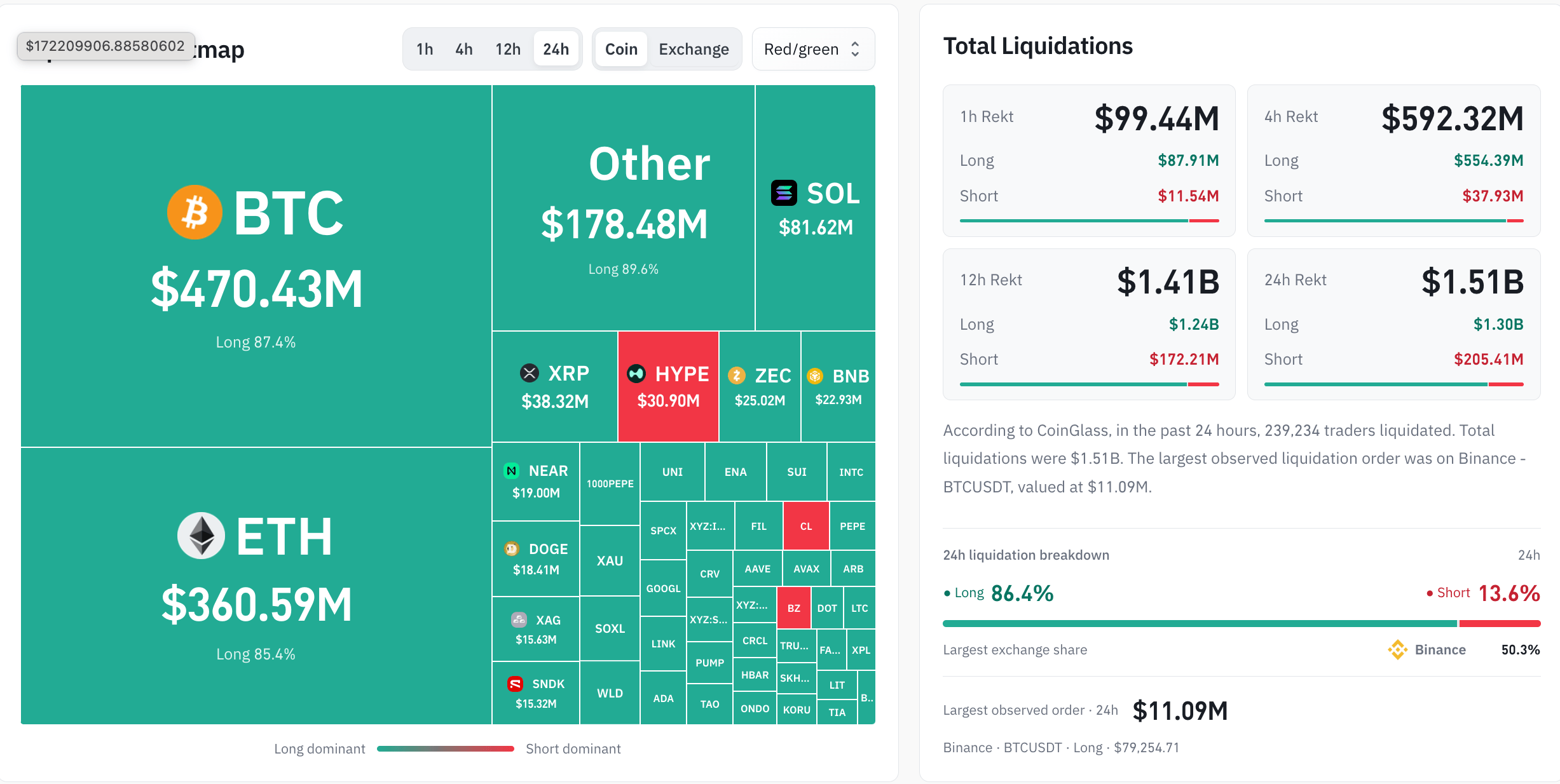
Potential losses of $1.45 billion in Bitcoin (BTC) and $875 million in Ethereum (ETH) from a reported hack of Binance wallets could make it the largest crypto hack on record. The news has left the wider cryptocurrency market in negative territory on Friday. With Bitcoin falling below $77,000, total liquidations in the derivatives market have exceeded $1.50 billion over the past 24 hours.

A possible breach of Binance's hot wallet was reported early on by Changpeng Zhao, the exchange's former CEO. Wallets on the Bitcoin, Ethereum, and Tron (TRX) networks are affected by the suspected hack, leaving $1.45 billion in BTC, $875 million in ETH, and other crypto assets at risk.
With assistance from Tether and Circle, leading issuers of US dollar-pegged stablecoins, Binance said in a recent X post that $3 billion in crypto assets had been frozen. Separate posts on X from Tether CEO Paolo Ardoino and Circle Co-founder Jeremy Allaire disclosed freezes of $1.567 billion in USDT and $800 million in USDC.
In every social media update, Binance has reiterated that user funds remain safe. Its internal teams are continuing to work closely with law enforcement, issuers, blockchain intelligence firms, and industry partners to track down and freeze further assets.
Reports of a hack worth more than $3 billion at Binance, the largest centralised crypto exchange (CEX) by trading volume, circulated rapidly among investors. On Friday, panic-driven selling has taken Bitcoin below $77,000, adding to the previous day's 4% fall.
More than $1.50 billion in leveraged market positions has also been wiped out by the sell-off. Of the $1.51 billion in total liquidations recorded by CoinGlass over the past 24 hours, long positions accounted for $1.30 billion, underscoring the near-term panic selling.
Below the 50-day Exponential Moving Average (EMA) at $80,556, Bitcoin retains a bearish near-term bias as it trades around $76,676 at the time of writing on Friday. It remains just above the 200-day EMA at $76,457. With the price sitting between long-term support and nearby overhead supply, the broader uptrend is still technically intact, though under pressure.
At 32, the Relative Strength Index (RSI) is close to oversold territory, suggesting that selling may be running out of steam. However, the Moving Average Convergence Divergence (MACD) remains firmly negative, indicating that downside risks have not receded.
The 200-day EMA near $76,457 offers immediate downside support, with the horizontal floor at $75,545 below it. Should the price close below this support cluster on a daily basis, $70,000 would come into view as the next downside target.
Any advance would first encounter resistance at the 50-day EMA of $80,556, followed by the horizontal barrier at $81,272. To temper the prevailing bearish tone and open the way back towards recent highs, a stronger recovery would have to break above $87,395.
(The technical analysis of this story was written with the help of an AI tool. Know more.)







Phone: +61 2 8036 8388
Fax: +61 2 8036 8388
Email: support@tmgm.com



The information provided on this website is of a general nature only and does not constitute personal financial advice. Before acting on any information on this website, you should consider the suitability of the information in relation to your objectives, financial situation and needs. Investing in CFDs and FX Margin Contracts carries significant risks and is not suitable for all investors. You may lose more than your initial deposit. You do not own, or have, any interest in the underlying asset. We recommend that you seek independent advice and ensure you fully understand the risks involved before trading. It is important that you read and consider the disclosure document before you acquire any product listed on the website. The information and advertisements offered on this website are not intended for use by any person in any country or jurisdiction where such use would be contrary to local laws and regulations. The Products and Services offered on this website are not intended for residents of the United States, Malaysia and Thailand.
TMGM is authorized and regulated in various jurisdictions.
Trademax Australia Limited, trading as TMGM, is regulated by the Australian Securities and Investments Commission (ASIC), AFSL no. 436416 and is located at Level 28, One International Tower, 100 Barangaroo Avenue, 2000 Sydney, NSW Australia.
Email: support@tmgm.com.au
Trademax Global Limited, trading as TMGM, is authorized and regulated by the Vanuatu Financial Services Commission (VFSC), registration number 40356 and registered at 1276, Kumul Highway, Port Vila, Vanuatu, Republic of Vanuatu.
Email: support@tmgm.com
Trademax Global Markets (SE) Limited, trading as TMGM, is authorized and regulated by the Financial Services Authority (FSA) of Seychelles, with license number SD224. The company is registered at Office No 13, Providence Estate ABIS Centre, Mahe, Seychelles.
Email: support@tmgm.com
Trademax Global Markets (International) Pty Ltd, trading as TMGM, is authorized and regulated by the Financial Services Commission, Mauritius (FSC) with license no. GB22201012, and registered at 33, Edith Cavell Street C/o IQ EQ Fund Services (Mauritius) Ltd Port Louis, 11324 Mauritius.
Email: support@tmgm.com
Copyright © TMGM. All rights reserved


