
News & AnalysisCareer

Support near $62,000 has provided a base for Bitcoin (BTC) to recover towards $64,000, as cryptocurrency prices gradually gather momentum on Thursday. Altcoins are broadly following Bitcoin higher: Ethereum (ETH) remains above $1,800, while Ripple (XRP) posts a modest gain above $0.98.

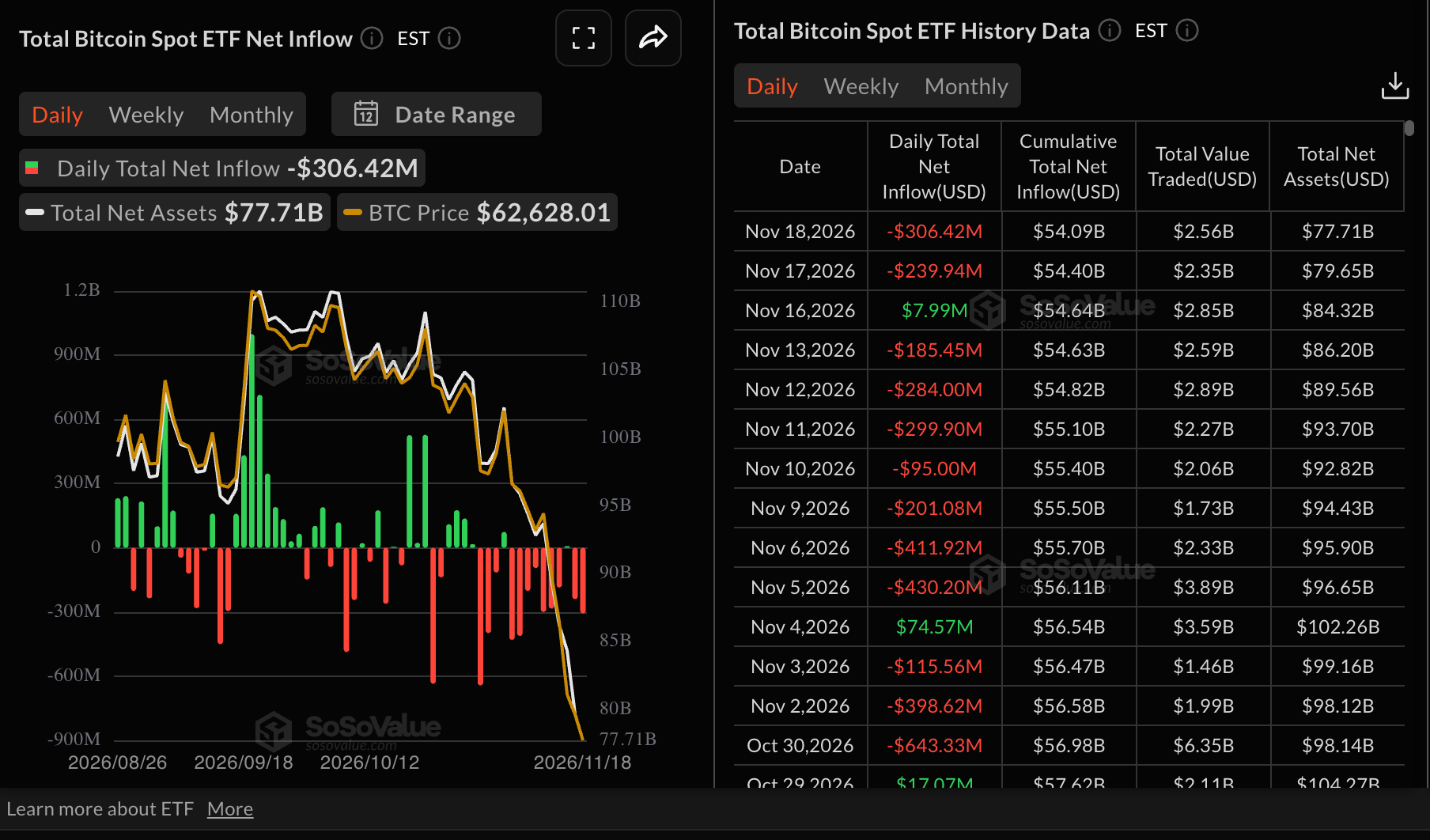
Wednesday brought $306 million in withdrawals from US-listed Bitcoin spot exchange-traded funds (ETFs), extending their run of outflows to two days. Total outflows through Wednesday have reached $538 million, highlighting the pressure on these products even as spot traders look for opportunities to buy the dip. Nevertheless, cumulative inflows of $54 billion underpin institutional investors’ positive long-term view of the underlying asset.
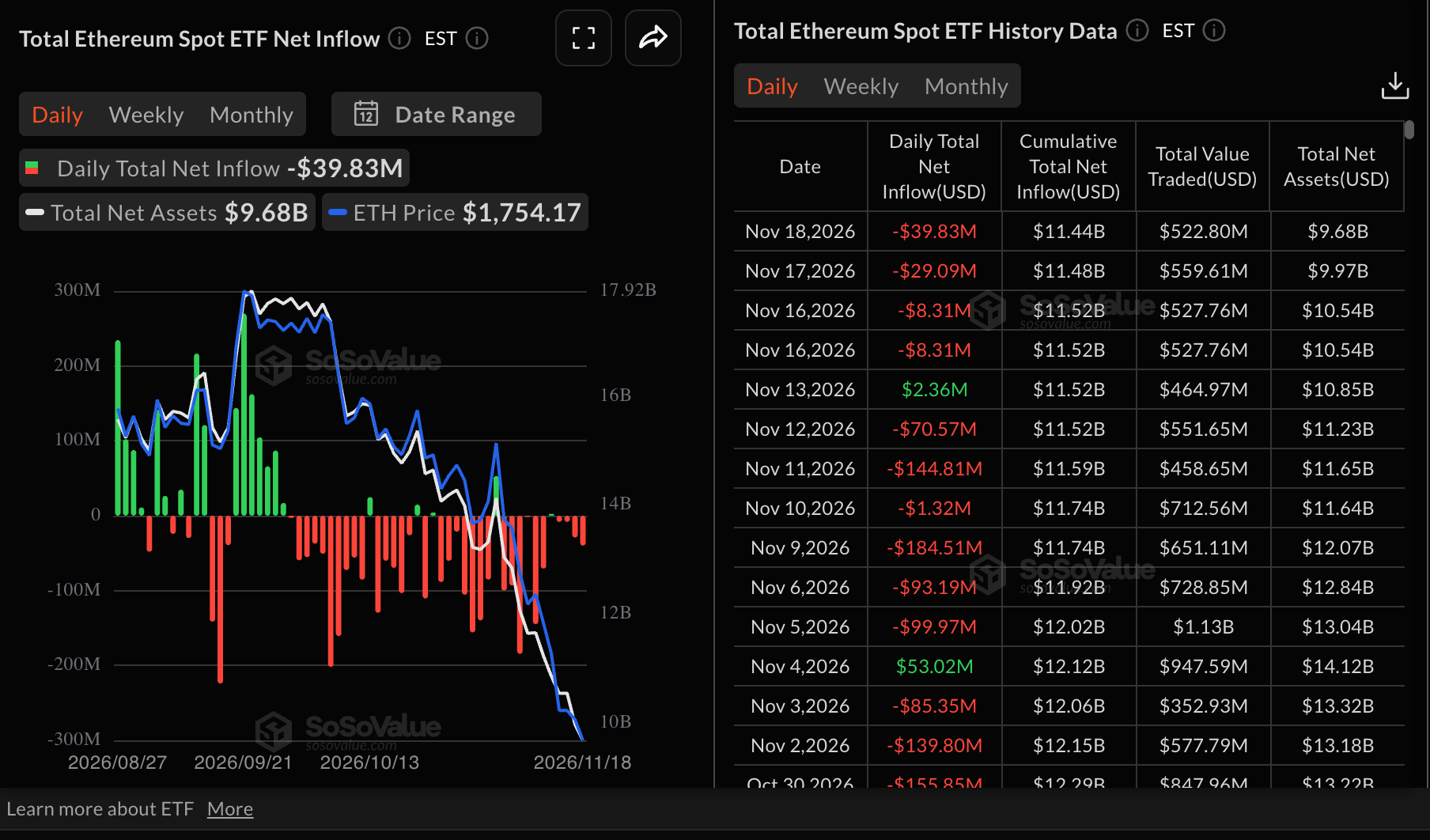
Withdrawals from Ethereum spot ETFs totalled $40 million on Wednesday, reducing net assets under management to $9.7 billion. Cumulative inflows, however, remain at $11.4 billion, indicating continued long-term interest in the asset class.
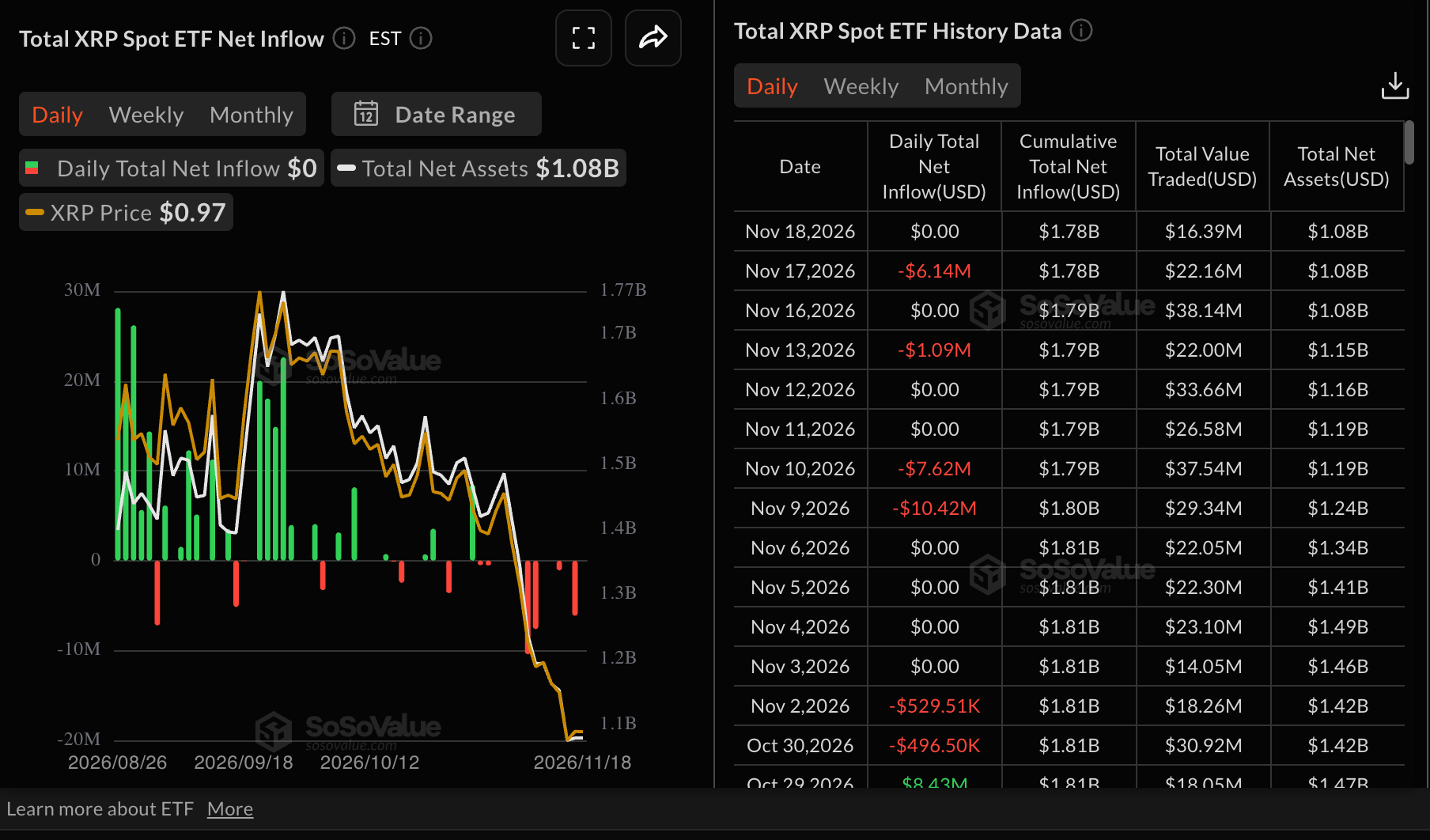
No flows were recorded by XRP spot ETFs on Wednesday, leaving activity subdued. Withdrawals of $6 million the previous day and $1 million last Friday point to a broadly bearish outlook. Although these products mark their first anniversary this month, cumulative inflows average $1.8 billion and net assets under management stand at $1.1 billion. Those figures suggest weaker subscription levels than for Bitcoin and Ethereum.
At $63,683, Bitcoin is making gradual gains, although the broader decline continues well beneath its short- and long-term exponential moving averages (EMAs). The near-term outlook therefore remains firmly bearish. Overhead, the 50-day EMA stands at $75,244, the 100-day EMA at $75,733 and the 200-day EMA at $75,942. As long as this closely grouped trend resistance caps the price, any rebound would be corrective.
Negative momentum adds weight to the bearish picture. The Moving Average Convergence Divergence (MACD) indicator remains below zero, while a Relative Strength Index (RSI) reading of around 24 points to oversold conditions and continued pressure, rather than an established base.
The first immediate hurdle is the 50-day EMA near $75,244. Above it lie the 100-day EMA at $75,733 and the 200-day EMA just below $75,943. Together, these levels form a broad supply zone that buyers must reclaim to soften the prevailing bearish structure.
Below the current price, the daily chart offers no clear nearby support from moving averages or momentum indicators, leaving the pair exposed to further tests lower. Recovery attempts are likely to face difficulty for as long as BTC stays below this layered daily EMA resistance.
A modest daily gain puts Ethereum at $1,804, but its bearish phase persists. The price remains well beneath the 50-day EMA at $2,209, the 100-day EMA at $2,256 and the 200-day EMA at $2,280. With these averages grouped closely above the spot price, the upside remains constrained and any recovery would initially encounter structural supply around this cluster.
The latest MACD reading is deeply negative, underlining weak momentum. Meanwhile, the RSI stands at 27: this oversold reading could temper the ongoing decline, but does not yet signal a reversal.
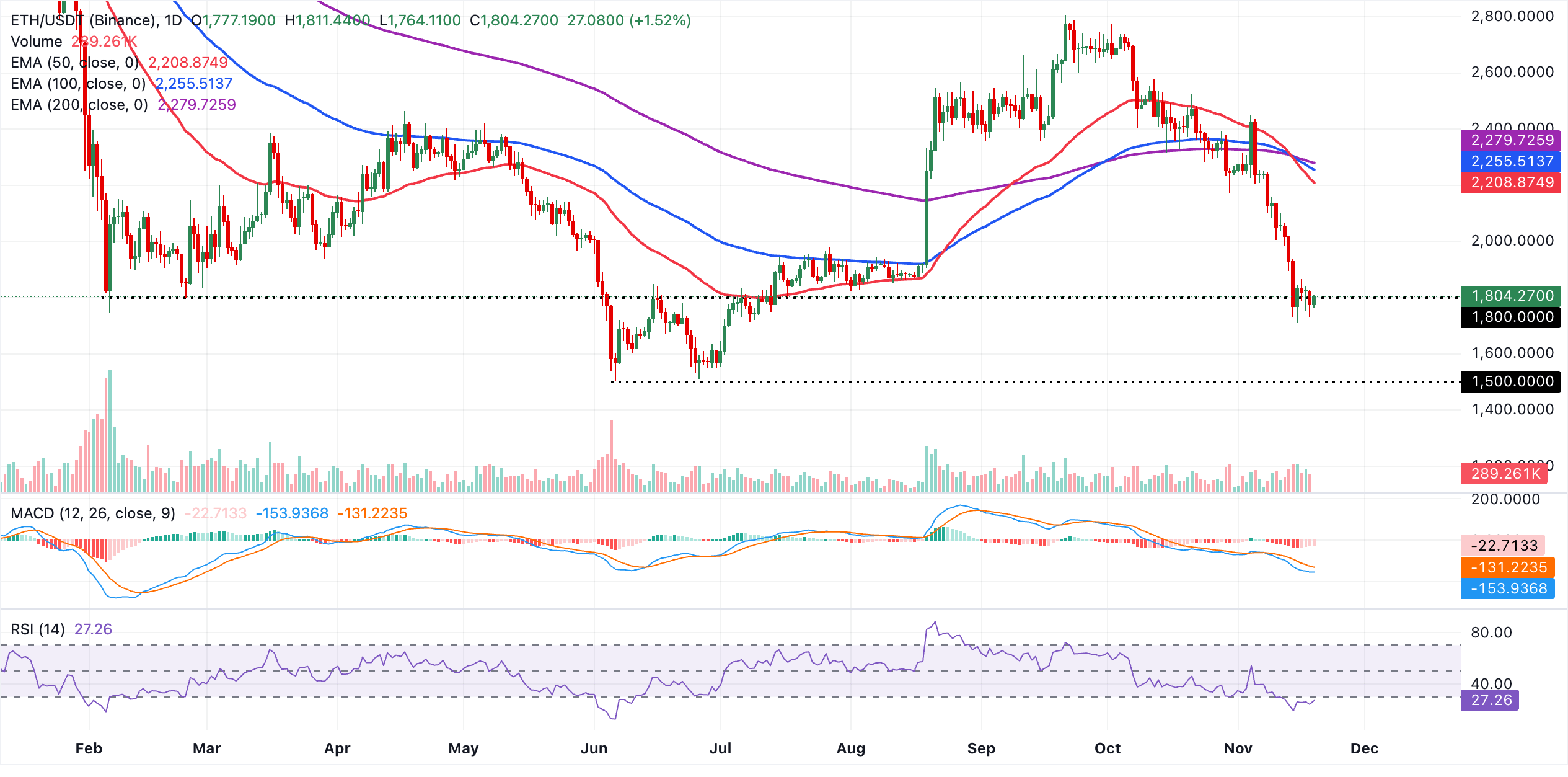
Buyers face an initial barrier at the 50-day EMA near $2,209, ahead of the 100-day EMA at $2,256 and the 200-day EMA at $2,280. This cluster represents a major obstacle to recovery. Below the market, the current dataset shows no nearby moving-average or Fibonacci support, making $1,800 and the recent swing lows the next psychological reference area. The oversold RSI suggests further losses could moderate unless the overhead EMA cluster is decisively reclaimed.
Trading at $0.99, XRP retains a distinctly bearish near-term outlook. It sits well below the 50-day, 100-day and 200-day EMAs, which stand at $1.20, $1.25 and $1.33 respectively. Multiple layers of overhead resistance continue to constrain the market, including the reclaimed descending resistance trendline, now projected around $1.22. At roughly 32, the RSI indicates persistent, though not extreme, oversold conditions.
Despite the recent effort to stabilise above $0.98, selling pressure still appears dominant. The MACD remains negative, with its line beneath the signal line and its histogram subdued.
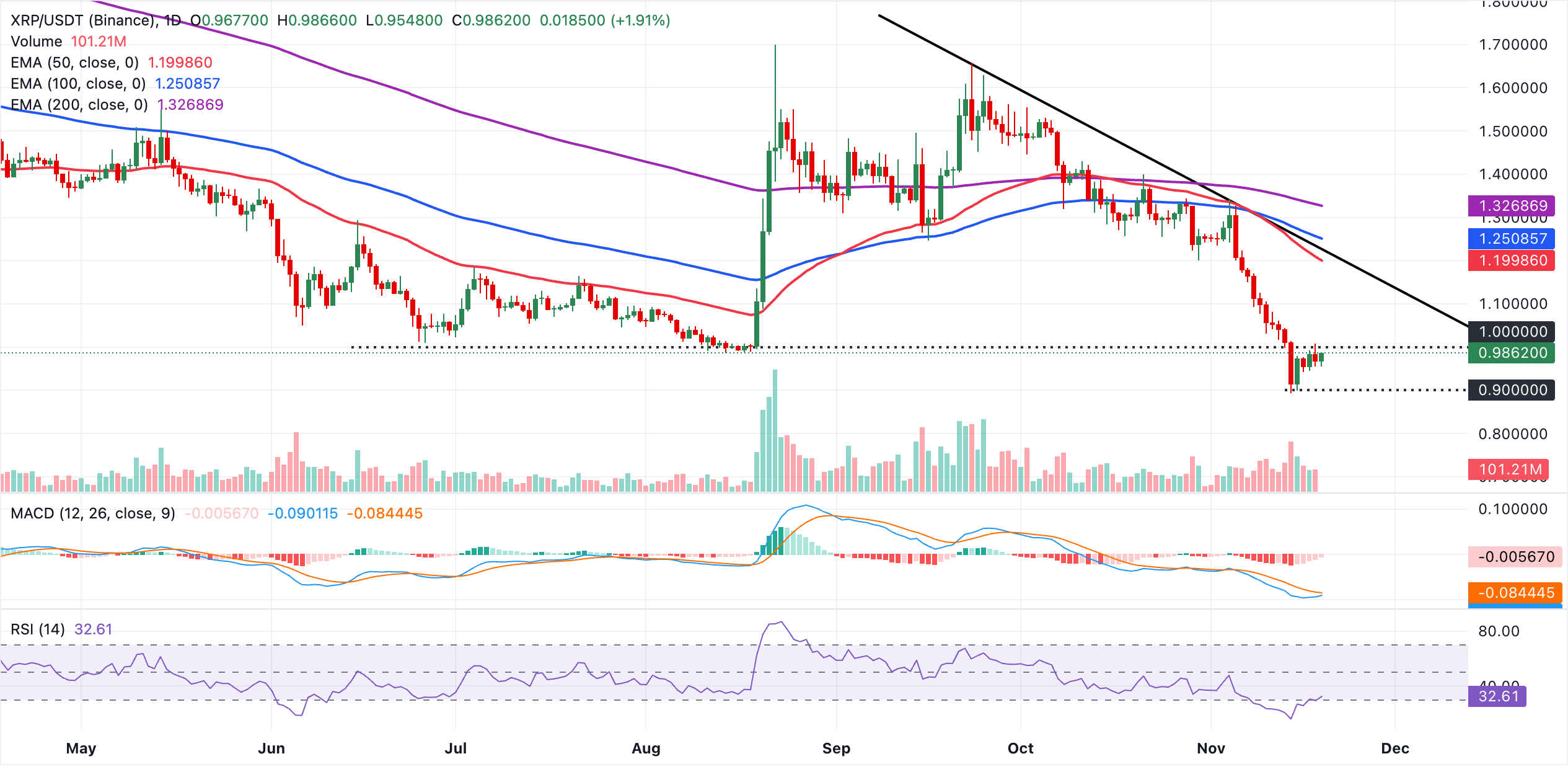
The 50-day EMA near $1.20 provides the nearest resistance, while the broken descending trendline around $1.22 adds to the crowded supply area just above it. Beyond that, buyers would encounter the 100-day EMA at $1.25, followed by the longer-term 200-day EMA at $1.33. Reclaiming the latter would be necessary to ease the broader bearish structure.
The daily chart identifies no clear technical support below the current price. Unless buyers secure a sustained recovery through the $1.20-$1.22 range, the pair remains at risk of fresh lows.
(The technical analysis of this story was written with the help of an AI tool. Know more.)
Investors use an exchange-traded fund (ETF) to obtain exposure to a particular asset. An ETF is an investment vehicle or index designed to follow the price of an underlying asset, but it can also track a basket of assets and sectors rather than a single holding. A Bitcoin ETF, for instance, follows the price of Bitcoin.
Yes. In October 2021, approval for the first US Bitcoin futures ETF was granted by the US Securities & Exchange Commission. Seven Bitcoin futures ETFs have received approval in total, while more than 20 still await the regulator’s permission. According to the SEC, the cryptocurrency industry is new and vulnerable to manipulation. This is why the regulator has delayed crypto-related futures ETFs over the past few years.
Yes. Several Bitcoin spot exchange-traded funds received SEC approval for listing and trading in January 2024. The move enabled institutional capital and mainstream investors to trade the leading cryptocurrency, prompting the industry to hail the decision as a game changer.
Gaining exposure to a cryptocurrency without owning it is the principal benefit of crypto ETFs, as this reduces the risks and costs of holding the asset. They also require less learning and offer investors greater security because the ETF takes responsibility for safeguarding the underlying holdings. The chief drawback is the absence of direct ownership, summed up by the crypto saying “not your keys, not your coins.” Fees for active management are another disadvantage, increasing the costs associated with holding crypto. Finally, although ETFs reduce the risks of holding an asset, movements in the underlying cryptocurrency’s price are still likely to feed through to the investment vehicle.







Phone: +61 2 8036 8388
Fax: +61 2 8036 8388
Email: support@tmgm.com



The information provided on this website is of a general nature only and does not constitute personal financial advice. Before acting on any information on this website, you should consider the suitability of the information in relation to your objectives, financial situation and needs. Investing in CFDs and FX Margin Contracts carries significant risks and is not suitable for all investors. You may lose more than your initial deposit. You do not own, or have, any interest in the underlying asset. We recommend that you seek independent advice and ensure you fully understand the risks involved before trading. It is important that you read and consider the disclosure document before you acquire any product listed on the website. The information and advertisements offered on this website are not intended for use by any person in any country or jurisdiction where such use would be contrary to local laws and regulations. The Products and Services offered on this website are not intended for residents of the United States, Malaysia and Thailand.
TMGM is authorized and regulated in various jurisdictions.
Trademax Australia Limited, trading as TMGM, is regulated by the Australian Securities and Investments Commission (ASIC), AFSL no. 436416 and is located at Level 28, One International Tower, 100 Barangaroo Avenue, 2000 Sydney, NSW Australia.
Email: support@tmgm.com.au
Trademax Global Limited, trading as TMGM, is authorized and regulated by the Vanuatu Financial Services Commission (VFSC), registration number 40356 and registered at 1276, Kumul Highway, Port Vila, Vanuatu, Republic of Vanuatu.
Email: support@tmgm.com
Trademax Global Markets (SE) Limited, trading as TMGM, is authorized and regulated by the Financial Services Authority (FSA) of Seychelles, with license number SD224. The company is registered at Office No 13, Providence Estate ABIS Centre, Mahe, Seychelles.
Email: support@tmgm.com
Trademax Global Markets (International) Pty Ltd, trading as TMGM, is authorized and regulated by the Financial Services Commission, Mauritius (FSC) with license no. GB22201012, and registered at 33, Edith Cavell Street C/o IQ EQ Fund Services (Mauritius) Ltd Port Louis, 11324 Mauritius.
Email: support@tmgm.com
Copyright © TMGM. All rights reserved


