
News & AnalysisCareer

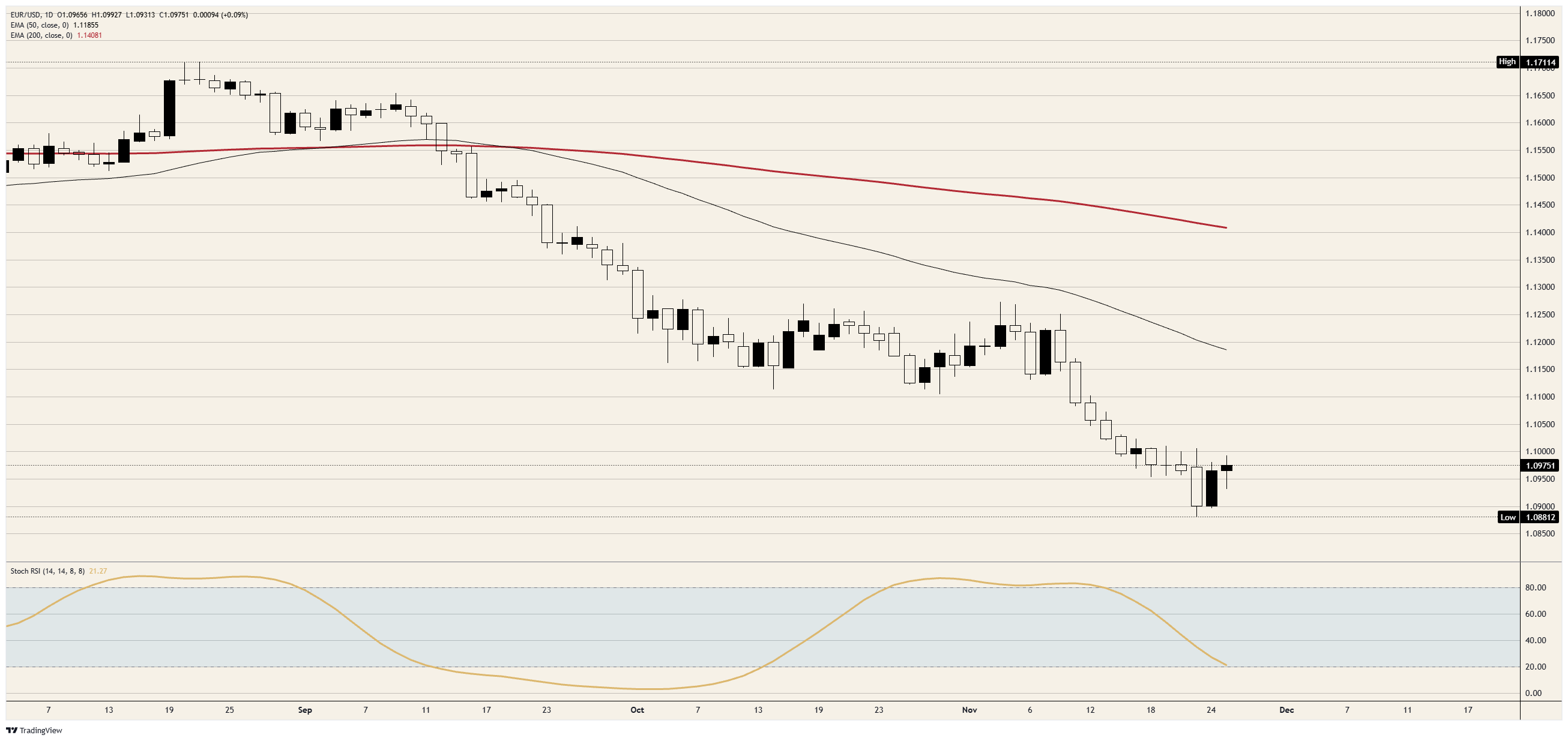
Market expectations of a December interest rate increase are not unreasonable, according to European Central Bank (ECB) Governing Council member Kocher, whose remarks drew no response from the Euro. Having slipped below 1.0950 ahead of the US figures and remained there during the releases, EUR/USD has subsequently advanced to just shy of 1.1000. The pair is heading for a second session of gains following Monday's dip to just below 1.0900, its weakest level since April 2025.

Following two increases in 2026, the ECB's deposit rate stands at 2.50%, with a further quarter-point rise widely anticipated on December 17. At that meeting, the ECB is also likely to revise its inflation projections upwards, Kocher said. Markets price in a Fed increase eight days beforehand. Rates on both sides of EUR/USD would therefore move higher together, leaving the differential unchanged.
October's US core Personal Consumption Expenditures Price Index (PCE) inflation reading was 3.3%, a tenth above expectations, while growth in the third quarter reached 4.3%. Markets lowered the implied probability of a December Fed rate increase to around 94%. As funds flowed out of technology shares, Treasury yields declined; the Dollar then surrendered its advance, allowing EUR/USD to recover.
At 12:30 GMT on Thursday, the ECB will publish the accounts of its October 28-29 meeting, at which rates were kept on hold. European Union leaders are also meeting on Thursday and Friday. The Economic Sentiment Indicator follows at 10:00 GMT on Friday, with a reading of 97.2 expected, up from 96.9. Bundesbank President Nagel is then scheduled for 12:50 GMT, followed by ECB Vice-President Vujcic at 14:15 GMT. These events will all inform the December 17 decision, which determines the European side of the rate differential.
US markets will be closed for Thanksgiving on Thursday, followed by an early finish for US equities at 18:00 GMT on Friday. With Fed officials entering their quiet period on Saturday before the December 8-9 meeting, Friday offers their final opportunity to influence expectations for the US side of the differential.
Around a quarter of EUR/USD's decline from its November 5 peak, just below 1.1300, has now been retraced. Since mid-September, the pair has remained beneath its 50-day Exponential Moving Average (EMA), currently around 1.1200. The 200-day EMA stands near 1.1400, while daily momentum continues to weaken and is approaching oversold territory.
Across the 20 European Union countries that make up the Eurozone, the shared currency is the Euro. Only the US Dollar is traded more actively worldwide. The Euro featured in 31% of all foreign exchange transactions in 2022, with average daily turnover exceeding $2.2 trillion. With an estimated 30% of all transactions, EUR/USD ranks as the world's most actively traded currency pair. Next come EUR/JPY (4%), EUR/GBP (3%) and EUR/AUD (2%).
Based in Frankfurt, Germany, the European Central Bank (ECB) acts as the Eurozone's reserve bank, determining interest rates and conducting monetary policy. Maintaining price stability is its central mandate, whether that requires bringing inflation under control or encouraging growth. Interest rate increases and reductions are its main policy instrument. Higher rates, or expectations that rates will rise, generally support the Euro; the reverse also applies. Monetary policy is decided by the ECB Governing Council at eight meetings each year. The decision-makers comprise the heads of the Eurozone's national banks and six permanent members, among them ECB President Christine Lagarde.
Measured using the Harmonised Index of Consumer Prices (HICP), Eurozone inflation is a key economic indicator for the Euro. An unexpectedly strong rise in prices, particularly above the ECB's 2% target, requires the central bank to increase interest rates to restore control over inflation. When the region offers higher interest rates than its counterparts, the Euro usually benefits, as global investors find it a more attractive destination for their funds.
By indicating the state of the economy, data releases can move the Euro. GDP figures, Manufacturing and Services PMIs, employment readings and consumer sentiment surveys can each affect the single currency's direction. Economic strength supports the Euro both by drawing in more overseas investment and by potentially prompting the ECB to raise interest rates, which directly strengthens the currency. Weak economic figures, by contrast, are likely to weigh on the Euro. Particular attention is paid to data from Germany, France, Italy and Spain. Together, these four largest euro area economies represent 75% of the Eurozone's economy.
The Trade Balance is another release of significance for the Euro, recording the gap between a country's export earnings and its spending on imports over a specified period. Strong overseas demand for a country's exports creates additional demand for its currency as foreign buyers seek to purchase those goods, lifting its value. A positive net Trade Balance consequently supports a currency, whereas a negative balance has the opposite effect.







Phone: +61 2 8036 8388
Fax: +61 2 8036 8388
Email: support@tmgm.com



The information provided on this website is of a general nature only and does not constitute personal financial advice. Before acting on any information on this website, you should consider the suitability of the information in relation to your objectives, financial situation and needs. Investing in CFDs and FX Margin Contracts carries significant risks and is not suitable for all investors. You may lose more than your initial deposit. You do not own, or have, any interest in the underlying asset. We recommend that you seek independent advice and ensure you fully understand the risks involved before trading. It is important that you read and consider the disclosure document before you acquire any product listed on the website. The information and advertisements offered on this website are not intended for use by any person in any country or jurisdiction where such use would be contrary to local laws and regulations. The Products and Services offered on this website are not intended for residents of the United States, Malaysia and Thailand.
TMGM is authorized and regulated in various jurisdictions.
Trademax Australia Limited, trading as TMGM, is regulated by the Australian Securities and Investments Commission (ASIC), AFSL no. 436416 and is located at Level 28, One International Tower, 100 Barangaroo Avenue, 2000 Sydney, NSW Australia.
Email: support@tmgm.com.au
Trademax Global Limited, trading as TMGM, is authorized and regulated by the Vanuatu Financial Services Commission (VFSC), registration number 40356 and registered at 1276, Kumul Highway, Port Vila, Vanuatu, Republic of Vanuatu.
Email: support@tmgm.com
Trademax Global Markets (SE) Limited, trading as TMGM, is authorized and regulated by the Financial Services Authority (FSA) of Seychelles, with license number SD224. The company is registered at Office No 13, Providence Estate ABIS Centre, Mahe, Seychelles.
Email: support@tmgm.com
Trademax Global Markets (International) Pty Ltd, trading as TMGM, is authorized and regulated by the Financial Services Commission, Mauritius (FSC) with license no. GB22201012, and registered at 33, Edith Cavell Street C/o IQ EQ Fund Services (Mauritius) Ltd Port Louis, 11324 Mauritius.
Email: support@tmgm.com
Copyright © TMGM. All rights reserved


