
News & AnalysisCareer

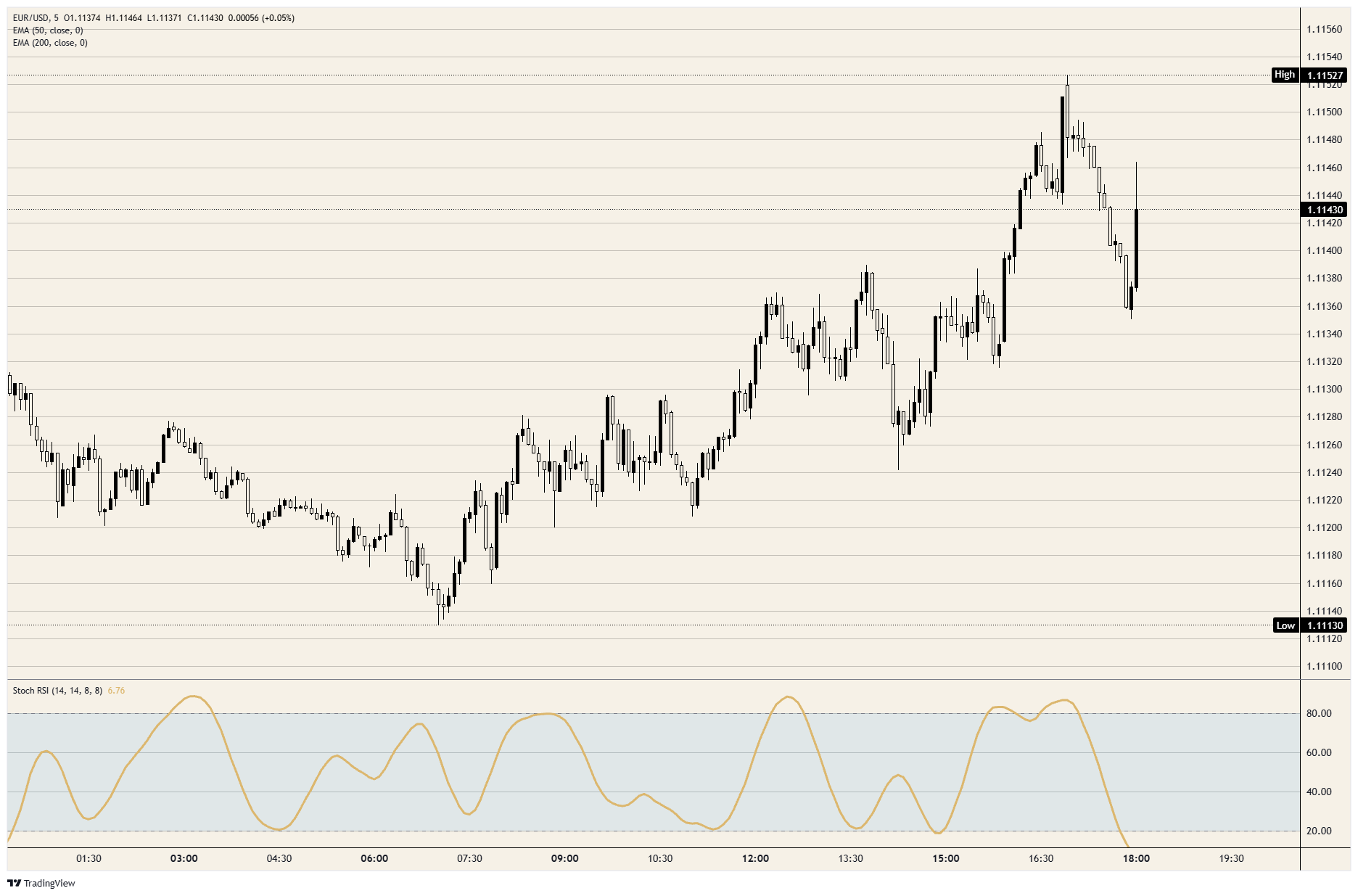
With the Fed leaving rates unchanged, the European Central Bank (ECB) decision on Thursday offers the final opportunity this week for a shift in the interest-rate differential underpinning EUR/USD. The ECB is also expected to hold. Following the Fed's statement, the pair advanced, recovering some of its decline from the session peak just above 1.1150. It remains short of that level but is trading in the upper half of Wednesday's range.

A September 10 decision by the ECB lifted its deposit rate to 2.50%, marking its second increase of the year. That rise became effective on September 16, coinciding with the Fed's move to 3.75%-4.00%. With both rates unchanged since then, the Fed retains a 1.25-1.50-point premium over the ECB. This is the differential that has shaped EUR/USD trading since mid-September.
An unchanged ECB rate on Thursday followed by an increase in December is the expectation of most economists. Before the Fed's decision, traders had assigned roughly an 80% probability to a Fed increase in December. Quarter-point rises by both central banks would leave the rate differential driving EUR/USD at year-end exactly where it has stood since September 16.
Thursday's releases at 12:30 GMT include the September Personal Consumption Expenditures Price Index (PCE) and US third-quarter Gross Domestic Product (GDP). After the ECB announces its decision at 13:15 GMT, ECB President Lagarde holds her press conference at 13:45 GMT. Friday brings the euro area's initial third-quarter GDP estimate at 10:00 GMT, meaning growth figures from both sides of EUR/USD's rate differential will be available before the weekend.
Before the ECB makes its decision, the final comments on US rates come from Fed Chair Warsh, who takes questions at 18:30 GMT on Wednesday. On October 16, he said stronger inflation had not altered his assessment of the economy. Any further remarks on December will feed into EUR/USD through the US side of the rate differential.
After falling from its opening level, EUR/USD found a session low just above 1.1100 and subsequently recovered. Almost half of that rebound was then surrendered in the bars preceding the statement. By the time the decision bar formed, intraday momentum was already oversold.
Responsibility for US monetary policy rests with the Federal Reserve (Fed), whose two mandates are price stability and full employment. Adjusting interest rates is its main means of pursuing those objectives. If prices increase too rapidly and inflation exceeds the Fed’s 2% target, the central bank raises rates. Borrowing becomes more expensive across the economy, while the greater appeal of the US as a destination for international investment strengthens the US Dollar (USD). Conversely, inflation below 2% or an excessively high unemployment rate may prompt the Fed to cut interest rates. Such a move encourages borrowing and puts downward pressure on the Greenback.
At the Federal Reserve’s (Fed) eight annual policy meetings, economic conditions are reviewed and monetary policy decisions taken by the Federal Open Market Committee (FOMC). Twelve Fed officials attend the FOMC: all seven members of the Board of Governors, the president of the Federal Reserve Bank of New York, and four of the other eleven regional Reserve Bank presidents. The latter serve rotating one-year terms.
When circumstances are extreme, the Federal Reserve may turn to Quantitative Easing (QE) to substantially expand the flow of credit through a stalled financial system. Reserved for crises or periods of exceptionally low inflation, this unconventional policy was the Fed’s preferred response during the Great Financial Crisis in 2008. Under QE, the Fed creates more Dollars to purchase high-grade bonds from financial institutions. The US Dollar typically weakens as a result.
By reversing QE, quantitative tightening (QT) generally supports the value of the US Dollar. Under this policy, the Federal Reserve ceases bond purchases from financial institutions and, as bonds in its portfolio mature, does not reinvest the repaid principal in new bonds.







Phone: +61 2 8036 8388
Fax: +61 2 8036 8388
Email: support@tmgm.com



The information provided on this website is of a general nature only and does not constitute personal financial advice. Before acting on any information on this website, you should consider the suitability of the information in relation to your objectives, financial situation and needs. Investing in CFDs and FX Margin Contracts carries significant risks and is not suitable for all investors. You may lose more than your initial deposit. You do not own, or have, any interest in the underlying asset. We recommend that you seek independent advice and ensure you fully understand the risks involved before trading. It is important that you read and consider the disclosure document before you acquire any product listed on the website. The information and advertisements offered on this website are not intended for use by any person in any country or jurisdiction where such use would be contrary to local laws and regulations. The Products and Services offered on this website are not intended for residents of the United States, Malaysia and Thailand.
TMGM is authorized and regulated in various jurisdictions.
Trademax Australia Limited, trading as TMGM, is regulated by the Australian Securities and Investments Commission (ASIC), AFSL no. 436416 and is located at Level 28, One International Tower, 100 Barangaroo Avenue, 2000 Sydney, NSW Australia.
Email: support@tmgm.com.au
Trademax Global Limited, trading as TMGM, is authorized and regulated by the Vanuatu Financial Services Commission (VFSC), registration number 40356 and registered at 1276, Kumul Highway, Port Vila, Vanuatu, Republic of Vanuatu.
Email: support@tmgm.com
Trademax Global Markets (SE) Limited, trading as TMGM, is authorized and regulated by the Financial Services Authority (FSA) of Seychelles, with license number SD224. The company is registered at Office No 13, Providence Estate ABIS Centre, Mahe, Seychelles.
Email: support@tmgm.com
Trademax Global Markets (International) Pty Ltd, trading as TMGM, is authorized and regulated by the Financial Services Commission, Mauritius (FSC) with license no. GB22201012, and registered at 33, Edith Cavell Street C/o IQ EQ Fund Services (Mauritius) Ltd Port Louis, 11324 Mauritius.
Email: support@tmgm.com
Copyright © TMGM. All rights reserved

