
News & AnalysisCareer

A hot US producer inflation report has left Gold (XAU/USD) on course for a weekly loss of nearly 4.50%. On Friday, however, the metal is 0.14% higher as the US Dollar (USD) limits its advance. XAU/USD stands at $3,879 at the time of writing, close to its lowest level in 13 months.

October’s Producer Price Index (PPI), released earlier, showed US headline producer prices rising 6.5% YoY. Although below forecasts, the reading exceeded September’s 6.3%, driven largely by higher transport and warehousing prices. Excluding items such as food and energy, core PPI held at 5%, unchanged from the previous month and matching estimates. Taken together, this week’s US inflation figures have made a December interest rate increase by the Federal Reserve (Fed) more likely.
Alongside Tuesday’s US Consumer Price Index (CPI) release, these figures drew responses from most Fed officials. Many of those speaking this week anticipated higher interest rates and observed that financial conditions were not restrictive.
Further rate rises are needed as firms seek to pass on higher costs, San Francisco Fed Mary Daly said on Friday. Boston Fed Susan Collins, meanwhile, warned that inflation was spreading and warranted additional increases. Earlier, Chicago Fed Austan Goolsbee said the inflation figures pointed to a worsening situation, which “would make the Fed more aggressive.”
The continued rise in US Treasury yields over the week signals expectations among market participants for higher interest rates. With the US 10-year Treasury yield almost two basis points higher at 5.15%, the Greenback has received support.
After setting a fresh 19-month peak of 103.42, the US Dollar Index (DXY) stands 0.23% higher at 103.41. The index tracks the American currency against a basket of six other currencies.
According to CME FedWatch, markets assigned a nearly 90% probability to a 25-basis-point Fed rate increase in December, alongside a 10% probability of a 50-point rise.
For Gold traders, next week’s focus will be the Federal Open Market Committee meeting minutes, Retail Sales figures and speeches from Fed officials.
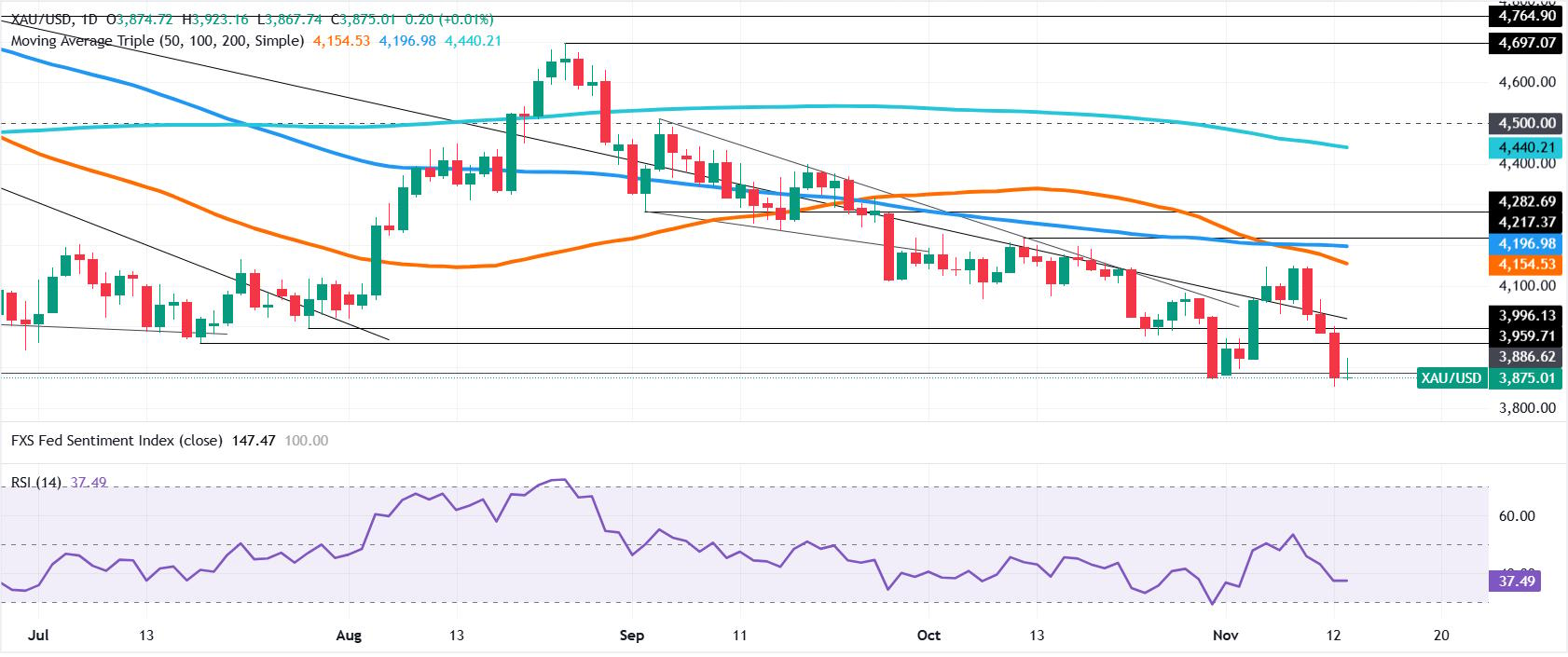
Following the weekly sell-off, Gold seems to have found a bottom around $3,873, just above the day’s $3,867 low. Further losses nevertheless lie ahead. An extended sequence of lower highs and lower lows leaves the year-to-date trough of $3,852 open to a test. Below that level, the psychological $3,800 mark comes into view, followed by $3,500, the swing high from 22 April 2025 that has since become support.
Initial resistance, by contrast, stands at $3,900. A break above this area could bring Thursday’s intraday high of $4,000 into reach. Beyond that lies $4,100, followed by the confluence of the 50-day Simple Moving Average (SMA) at $4,154 and the 100-day SMA at $4,196.
Throughout human history, Gold has served extensively as both a store of value and a means of exchange. Beyond its lustre and use in jewellery, the precious metal is now widely regarded as a safe-haven asset: an investment considered attractive during periods of turbulence. Its independence from any particular issuer or government also underpins its widespread appeal as a hedge against inflation and currency depreciation.
The largest holders of Gold are central banks. To support their currencies during unsettled periods, they typically diversify reserves and purchase Gold, reinforcing perceptions of economic and currency strength. Substantial Gold reserves can also bolster confidence in a country’s solvency. World Gold Council data show that central banks increased their reserves by 1,136 tonnes in 2022, worth around $70 billion. No higher annual purchase has been recorded since records began. Emerging economies’ central banks, including those of China, India and Turkey, are rapidly expanding their Gold reserves.
Both the US Dollar and US Treasuries are major reserve and safe-haven assets, and Gold is inversely correlated with them. A fall in the Dollar generally accompanies a rise in Gold, allowing investors and central banks to diversify their holdings in turbulent periods. The relationship with risk assets is also inverse: rising stock markets tend to weigh on Gold prices, whereas sell-offs in riskier markets generally support the precious metal.
A broad range of influences can shift Gold prices. Its safe-haven appeal means geopolitical instability or concerns about a deep recession can trigger a rapid increase. Because Gold pays no yield, lower interest rates generally support it, while a higher cost of borrowing usually weighs on the metal. Even so, the US Dollar (USD) drives most price movements, since Gold is quoted in dollars (XAU/USD). Dollar strength tends to restrain Gold prices; a weaker Dollar, by contrast, is likely to lift them.







Phone: +61 2 8036 8388
Fax: +61 2 8036 8388
Email: support@tmgm.com



The information provided on this website is of a general nature only and does not constitute personal financial advice. Before acting on any information on this website, you should consider the suitability of the information in relation to your objectives, financial situation and needs. Investing in CFDs and FX Margin Contracts carries significant risks and is not suitable for all investors. You may lose more than your initial deposit. You do not own, or have, any interest in the underlying asset. We recommend that you seek independent advice and ensure you fully understand the risks involved before trading. It is important that you read and consider the disclosure document before you acquire any product listed on the website. The information and advertisements offered on this website are not intended for use by any person in any country or jurisdiction where such use would be contrary to local laws and regulations. The Products and Services offered on this website are not intended for residents of the United States, Malaysia and Thailand.
TMGM is authorized and regulated in various jurisdictions.
Trademax Australia Limited, trading as TMGM, is regulated by the Australian Securities and Investments Commission (ASIC), AFSL no. 436416 and is located at Level 28, One International Tower, 100 Barangaroo Avenue, 2000 Sydney, NSW Australia.
Email: support@tmgm.com.au
Trademax Global Limited, trading as TMGM, is authorized and regulated by the Vanuatu Financial Services Commission (VFSC), registration number 40356 and registered at 1276, Kumul Highway, Port Vila, Vanuatu, Republic of Vanuatu.
Email: support@tmgm.com
Trademax Global Markets (SE) Limited, trading as TMGM, is authorized and regulated by the Financial Services Authority (FSA) of Seychelles, with license number SD224. The company is registered at Office No 13, Providence Estate ABIS Centre, Mahe, Seychelles.
Email: support@tmgm.com
Trademax Global Markets (International) Pty Ltd, trading as TMGM, is authorized and regulated by the Financial Services Commission, Mauritius (FSC) with license no. GB22201012, and registered at 33, Edith Cavell Street C/o IQ EQ Fund Services (Mauritius) Ltd Port Louis, 11324 Mauritius.
Email: support@tmgm.com
Copyright © TMGM. All rights reserved

