
News & AnalysisCareer

With oil prices under pressure from hopes of a United States (US)-Iran agreement, Gold is holding on to the previous day’s recovery around $3,945 during Tuesday’s Asian session. Nevertheless, the metal remains near the yearly low of $3,870.23 reached on Friday.
WTI Oil is trading near $95.00 at the time of writing, retaining the previous day’s losses. The pullback in oil prices has been substantial since Friday’s five-month high of $104.03.

In theory, a correction in oil prices helps to anchor inflation expectations, easing concerns that central banks will keep interest rates higher for longer. Non-yielding assets such as Gold stand to benefit from that backdrop.
A preference for an agreement with Iran rather than renewed military action has emerged from comments by several United States (US) officials about President Donald Trump’s position.
Speaking over the weekend, US Secretary of State Marco Rubio said President Donald Trump favours a diplomatic solution and that Washington had not decided to resume strikes on Tehran.
According to The Associated Press (AP), US Vice President JD Vance said on Monday that he had just discussed the Iran talks with President Trump, adding that “the president and I both feel pretty good about the prospects for potentially coming to a negotiated settlement,”
Separately, Iran’s Islamic Revolutionary Guard Corps (IRGC) reported the interception and downing of two US MQM-170 drones south of Qeshm Island in the Strait of Hormuz, as well as the destruction of the 55th US MQ-9 drone east of the Hormuz Strait. The attack, however, appears to have had no material effect on oil prices.
The US midterm elections and a series of employment-related releases are set to provide the main catalysts for Gold this week, with September’s Nonfarm Payrolls (NFP) report particularly important.
For ING’s Chris Turner, the US midterm elections represent this week’s principal event risk for FX. He points to betting markets assigning the Democrats a “70-72% chance of taking both the House and the Senate.” In his view, a clean sweep by the Democrats would probably “lead to gridlock on the debt ceiling, a prolonged government shutdown next year and could encourage President Trump to pursue an even more activist foreign policy agenda.”
September’s US JOLTS Job Openings figures, due at 15:00 GMT later in the day, will also draw investors’ attention. Estimates suggest US employers advertised 7.13 million new jobs, a modest increase from August’s 7.097 million.
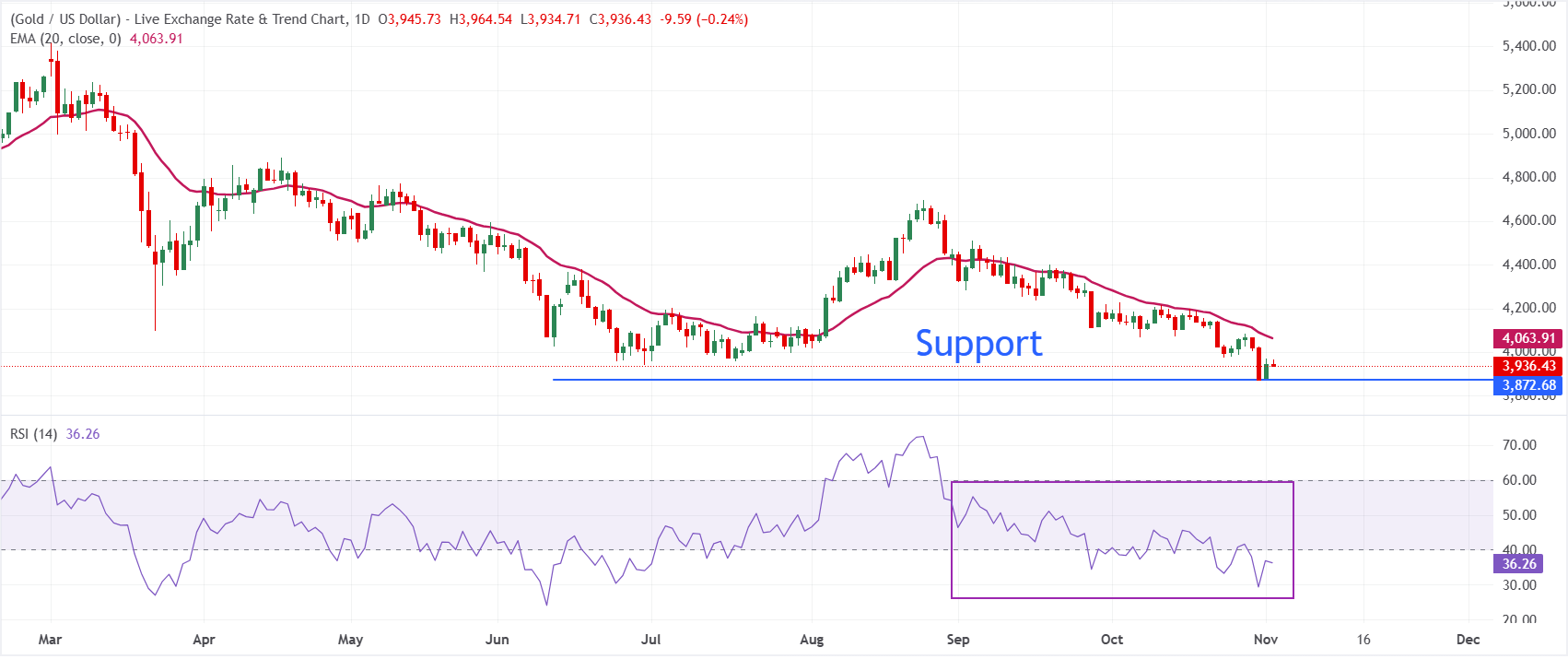
At $3,935.94 on the daily chart, XAU/USD retains a bearish near-term outlook, trading beneath the 20-period Exponential Moving Average (EMA) of $4,063.86. Sellers remain in control while this short-term trend gauge caps the metal, leaving attempted advances vulnerable.
With a reading of 36.24, the Relative Strength Index (14) is just above oversold territory. This points to subdued but continuing downward pressure, rather than clear signs that the decline has run its course.
The 20-period EMA at $4,063.86 provides the first resistance level. A daily close above it would be required to relieve immediate bearish pressure and pave the way for a more durable recovery. On the downside, the yearly low of $3,870.23 remains crucial support. A clear break beneath that level would leave Gold exposed to $3,800 and then $3,700.
(The technical analysis of this story was written with the help of an AI tool. Know more.)
Widely used both to preserve wealth and as a means of exchange, Gold has occupied an important place throughout human history. Beyond its lustre and use in jewellery, the precious metal is now commonly regarded as a safe-haven asset, making it an investment considered attractive during periods of upheaval. Because it is not dependent on a particular issuer or government, Gold is also widely viewed as protection against inflation and currency depreciation.
The largest holders of Gold are central banks. To bolster their currencies during unsettled periods, they typically spread their reserves across different assets and purchase Gold to strengthen perceptions of their economy and currency. Substantial Gold reserves can help to underpin confidence in a country’s solvency. World Gold Council data show that central banks increased their reserves by 1,136 tonnes of Gold, valued at around $70 billion, in 2022. No larger annual purchase has been recorded. Emerging-economy central banks, including those in China, India and Turkey, are rapidly expanding their Gold reserves.
Both the US Dollar and US Treasuries are major reserve and safe-haven assets, and Gold is inversely correlated with them. A weaker Dollar tends to lift Gold, allowing investors and central banks to diversify their holdings when conditions are turbulent. The metal also has an inverse relationship with risk assets: rising equity markets typically weigh on Gold prices, whereas selling in riskier markets generally supports the precious metal.
Numerous influences can drive Gold prices. Its safe-haven appeal means that geopolitical unrest or concerns about a severe recession can prompt rapid gains. Since Gold pays no yield, falling interest rates tend to support it, while higher borrowing costs usually put pressure on the metal. Most price movements nevertheless hinge on the US Dollar (USD), as Gold is quoted in dollars (XAU/USD). Dollar strength generally restrains Gold prices; a softer Dollar, by contrast, is likely to lift them.







Phone: +61 2 8036 8388
Fax: +61 2 8036 8388
Email: support@tmgm.com



The information provided on this website is of a general nature only and does not constitute personal financial advice. Before acting on any information on this website, you should consider the suitability of the information in relation to your objectives, financial situation and needs. Investing in CFDs and FX Margin Contracts carries significant risks and is not suitable for all investors. You may lose more than your initial deposit. You do not own, or have, any interest in the underlying asset. We recommend that you seek independent advice and ensure you fully understand the risks involved before trading. It is important that you read and consider the disclosure document before you acquire any product listed on the website. The information and advertisements offered on this website are not intended for use by any person in any country or jurisdiction where such use would be contrary to local laws and regulations. The Products and Services offered on this website are not intended for residents of the United States, Malaysia and Thailand.
TMGM is authorized and regulated in various jurisdictions.
Trademax Australia Limited, trading as TMGM, is regulated by the Australian Securities and Investments Commission (ASIC), AFSL no. 436416 and is located at Level 28, One International Tower, 100 Barangaroo Avenue, 2000 Sydney, NSW Australia.
Email: support@tmgm.com.au
Trademax Global Limited, trading as TMGM, is authorized and regulated by the Vanuatu Financial Services Commission (VFSC), registration number 40356 and registered at 1276, Kumul Highway, Port Vila, Vanuatu, Republic of Vanuatu.
Email: support@tmgm.com
Trademax Global Markets (SE) Limited, trading as TMGM, is authorized and regulated by the Financial Services Authority (FSA) of Seychelles, with license number SD224. The company is registered at Office No 13, Providence Estate ABIS Centre, Mahe, Seychelles.
Email: support@tmgm.com
Trademax Global Markets (International) Pty Ltd, trading as TMGM, is authorized and regulated by the Financial Services Commission, Mauritius (FSC) with license no. GB22201012, and registered at 33, Edith Cavell Street C/o IQ EQ Fund Services (Mauritius) Ltd Port Louis, 11324 Mauritius.
Email: support@tmgm.com
Copyright © TMGM. All rights reserved


