
News & AnalysisCareer

Accelerating inflationary pressures in the United States (US) are fuelling concerns that the Federal Reserve (Fed) will tighten monetary policy more aggressively, sustaining the US Dollar’s (USD) outperformance. Against that backdrop, the Indian Rupee (INR) continues the previous day’s correction on Friday following several weeks of gains. Having recovered from a five-week low of 93.61, USD/INR advances further towards 94.19.

During Asian trading, the US Dollar Index (DXY) remains close to Thursday’s 19-month high of 103.24. The index tracks the Greenback against a basket of six major currencies.
Describing the US Dollar as having “continued to strengthen,” MUFG analysts say the move has taken the Dollar Index to “a fresh year-to-date high.” In their assessment, the Dollar’s “renewed upward momentum has been encouraged by expectations that the Fed is likely to speed up the pace of rate hikes in response to the recent run of stronger US inflation data.”
Tuesday’s US Consumer Price Index (CPI) release showed monthly increases of 0.4% in headline inflation and 0.3% in core inflation, both exceeding expectations.
Attention now turns to October’s US Producer Price Index (PPI) figures, due at 13:30 GMT.
Robust demand from foreign portfolio investors has helped make the Indian Rupee “the surprise star performer in EMs this month,” according to strategists at Societe Generale, who cite a total return of “+1.6% vs USD”. With investors diversifying their market exposure “beyond AI-themed markets like South Korea and Taiwan,” the strategists note that FPI inflows have already “topp[ed] $5bn”. Sentiment has also benefited from “optimism over Iran truce following US mid-term election that has deflated Brent toward $90/b.”
India’s October CPI reading, released on Thursday, put annual inflation at 6.09%, above both the 5.93% forecast and the previous reading of 5.54%. Retail inflation has now accelerated for 12 consecutive months.
The figures bolster the argument for the Reserve Bank of India (RBI) to raise interest rates at its December policy meeting. At its October meeting, the Indian central bank also increased its key Repo Rate by 25 basis points (bps), taking it to 5.5%.
Commerzbank Research analysts warn that, “more worryingly for RBI, this low base effect will persist into November and December, which is likely to keep inflation elevated above 6.0% throughout Q4 2026.” Their wider assessment remains that price pressures will stay close to the upper end of the central bank’s target range well into the medium term, supporting expectations of additional monetary tightening.
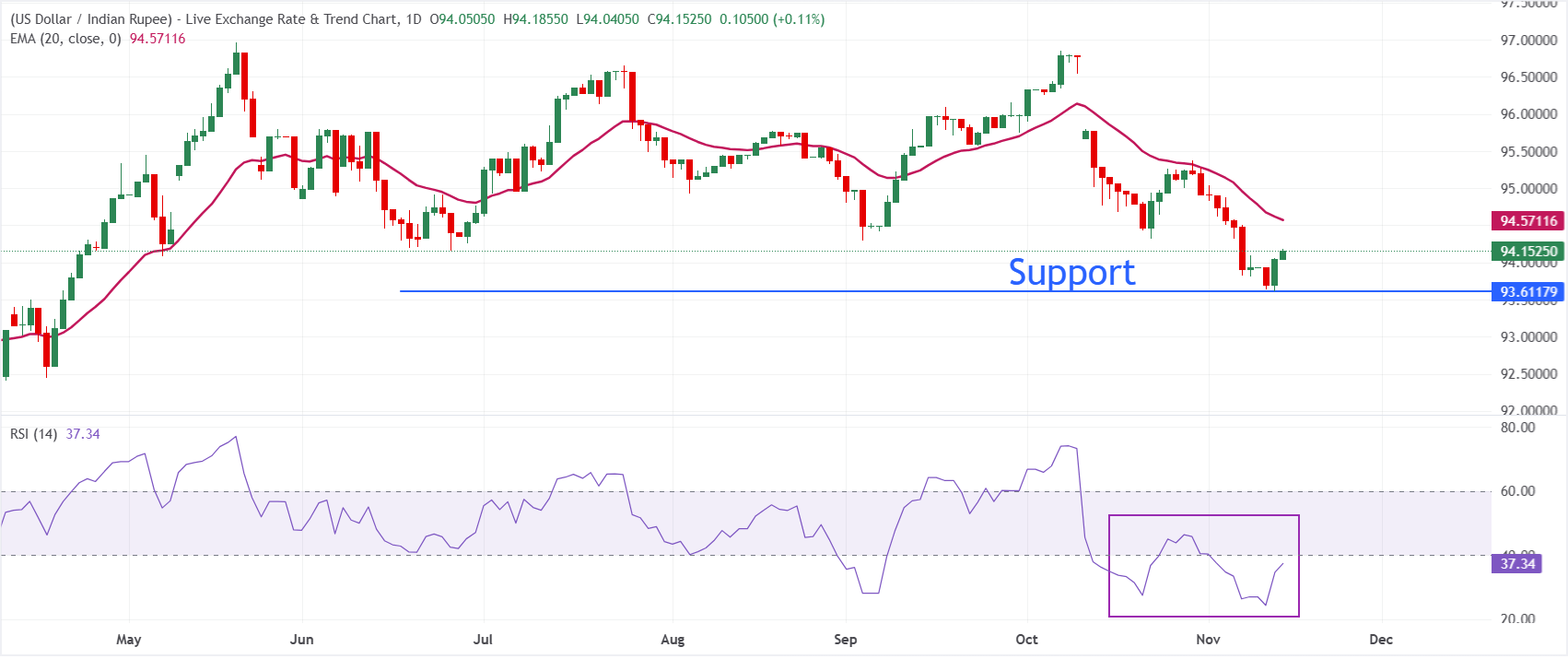
Trading at 94.1525 on the daily chart, USD/INR retains a bearish short-term bias below the 20-day exponential moving average (EMA) of 94.5712, which limits the upside. Although the Relative Strength Index (14) has recovered to 37.34, taking the pair out of oversold territory, bullish momentum remains muted as the price stays beneath this key EMA resistance.
The 20-day EMA at 94.5712 provides the first resistance level. A sustained move above it would be required to temper the prevailing downside bias. Below that average, the pair remains exposed to further declines, with neither moving averages nor Fibonacci levels providing nearby technical support. Momentum indicators point only to the possibility of consolidation, rather than a convincing rebound.
(The technical analysis of this story was written with the help of an AI tool. Know more.)
External developments have a particularly strong influence on the Indian Rupee (INR). Among the main drivers are Crude Oil prices, given India’s heavy reliance on imported Oil; the US Dollar’s value, as most trade is settled in USD; and foreign investment levels. The Reserve Bank of India’s (RBI) interest rate decisions and its direct intervention in FX markets to stabilise the exchange rate are also major factors affecting the Rupee.
To facilitate trade, the Reserve Bank of India (RBI) intervenes actively in foreign exchange markets to keep the exchange rate stable. It also adjusts interest rates in an effort to keep inflation at its 4% target. Rate increases tend to support the Rupee through the ‘carry trade’: investors borrow in countries where rates are lower and invest the proceeds in countries offering relatively higher rates, earning the difference.
Inflation, interest rates, economic growth (GDP), the trade balance and foreign investment inflows all help determine the Rupee’s value. Faster growth can attract additional overseas investment and increase demand for the currency, while a narrowing trade deficit will ultimately strengthen it. Higher interest rates are another source of support, particularly when real rates, calculated as interest rates minus inflation, rise. A risk-on backdrop can encourage larger inflows of Foreign Direct and Indirect Investment (FDI and FII), providing a further benefit to the Rupee.
When inflation rises, especially above the rates seen among India’s peers, it generally undermines the Rupee by reflecting a loss of value through oversupply. It also makes exports more expensive, resulting in more Rupees being sold to pay for foreign imports and putting pressure on the currency. However, higher inflation typically prompts the Reserve Bank of India (RBI) to increase interest rates. The resulting demand from international investors can support the Rupee. Lower inflation has the opposite effects.







Phone: +61 2 8036 8388
Fax: +61 2 8036 8388
Email: support@tmgm.com



The information provided on this website is of a general nature only and does not constitute personal financial advice. Before acting on any information on this website, you should consider the suitability of the information in relation to your objectives, financial situation and needs. Investing in CFDs and FX Margin Contracts carries significant risks and is not suitable for all investors. You may lose more than your initial deposit. You do not own, or have, any interest in the underlying asset. We recommend that you seek independent advice and ensure you fully understand the risks involved before trading. It is important that you read and consider the disclosure document before you acquire any product listed on the website. The information and advertisements offered on this website are not intended for use by any person in any country or jurisdiction where such use would be contrary to local laws and regulations. The Products and Services offered on this website are not intended for residents of the United States, Malaysia and Thailand.
TMGM is authorized and regulated in various jurisdictions.
Trademax Australia Limited, trading as TMGM, is regulated by the Australian Securities and Investments Commission (ASIC), AFSL no. 436416 and is located at Level 28, One International Tower, 100 Barangaroo Avenue, 2000 Sydney, NSW Australia.
Email: support@tmgm.com.au
Trademax Global Limited, trading as TMGM, is authorized and regulated by the Vanuatu Financial Services Commission (VFSC), registration number 40356 and registered at 1276, Kumul Highway, Port Vila, Vanuatu, Republic of Vanuatu.
Email: support@tmgm.com
Trademax Global Markets (SE) Limited, trading as TMGM, is authorized and regulated by the Financial Services Authority (FSA) of Seychelles, with license number SD224. The company is registered at Office No 13, Providence Estate ABIS Centre, Mahe, Seychelles.
Email: support@tmgm.com
Trademax Global Markets (International) Pty Ltd, trading as TMGM, is authorized and regulated by the Financial Services Commission, Mauritius (FSC) with license no. GB22201012, and registered at 33, Edith Cavell Street C/o IQ EQ Fund Services (Mauritius) Ltd Port Louis, 11324 Mauritius.
Email: support@tmgm.com
Copyright © TMGM. All rights reserved


