
News & AnalysisCareer

An unexpected interest rate cut by the Bank of Mexico (Banxico), described by the bank as a “one-time adjustment,” has weakened the Mexican peso against the US dollar. Having reached an intraday low of 18.96, USD/MXN is trading at 19.74.

A 25-basis-point reduction took Banxico’s main reference rate to 6.25% on Thursday, surprising market participants who had anticipated a hold at 6.50%. The 3-2 decision exposed a split: Deputy Governors Galia Borja and Jonathan Heath preferred to leave rates at 6.50%.
Mexico’s central bank also raised its inflation forecasts for the period towards the end of 2026. It now expects inflation to reach its 3% target in Q4 2027.
According to Prime Terminal, money markets consequently assigned an 88% probability to a further Banxico rate cut towards the end of the year.
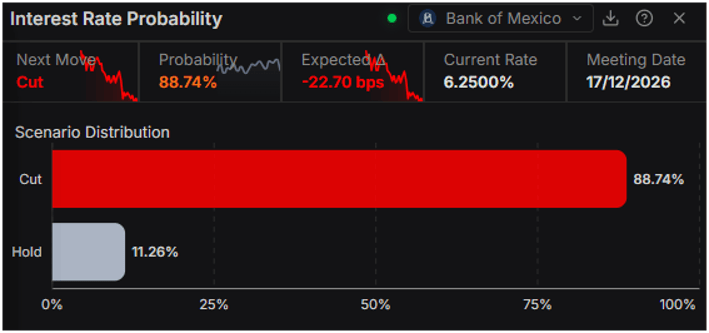
USD/MXN climbed towards 19.00 following the announcement before pulling back. Nevertheless, expectations among market participants of another reduction by December make a near-term test of 19.00 more likely for the exotic currency pair.
US jobless claims fell to 189K in the week ending 31 October, from 195K, coming in below the 196K forecast and marking a better-than-expected result. An earlier report from Challenger, Grey and Christmas showed October job cuts rising by just 2%, to 43.994K from 43.281K. Companies expected to hire more than 444.692 workers last month, a 57% increase on the 2025 figures.
Comments also came from Federal Reserve (Fed) officials. With further work still needed at the Fed, Cleveland Fed President Beth Hammack favoured a gradual approach to interest rate increases. Richmond Fed President Thomas Barkin echoed that call for gradualism, saying “broad-based” inflation remained too high.
Attention now turns to October’s Nonfarm Payrolls report, with traders expecting a rise to 65K from the previous month’s 29K. The Unemployment Rate, meanwhile, is forecast to remain at 2.9%.
At 18.7545 on the daily chart, USD/MXN remains well clear of the cluster of simple moving averages, most recently around 17.89. It also sits comfortably above the long-term breakout zone associated with the former descending trend line, keeping the bullish outlook intact. Although the Relative Strength Index (14) has eased from earlier overbought extremes to around 60, it continues to indicate positive underlying momentum rather than a confirmed top.
The simple moving average area around 17.89 offers the first downside support, with buyers potentially emerging on an initial test during a pullback. Further below, horizontal support at 16.89 provides a more distant but significant medium-term floor. Around 14.70, the earlier trend-line breakout area forms a major structural base; this would become relevant only if the broader bullish cycle unwound substantially.
(The technical analysis of this story was written with the help of an AI tool. Know more.)
Among Latin American currencies, the Mexican peso (MXN) has the highest trading volume. Its value largely reflects Mexico’s economic performance, central bank policy and foreign investment inflows, alongside remittances from Mexicans living overseas, especially in the United States. Geopolitical developments can influence MXN as well. Nearshoring, for instance, involves some companies moving manufacturing operations and supply chains closer to their home countries. This is viewed as a potential catalyst for the currency because Mexico is regarded as a major manufacturing hub in the Americas. Oil prices are another driver of MXN, given Mexico’s position as a key exporter.
Keeping inflation low and stable is the primary aim of Mexico’s central bank, Banxico. Its target is 3%, at the centre of a tolerance band running from 2% to 4%, and it seeks to keep inflation at or near that level by setting interest rates appropriately. If inflation becomes too high, Banxico seeks to curb it through rate rises. These increase borrowing costs for households and businesses, dampening demand and cooling the wider economy. By offering higher yields and making Mexico more appealing to investors, higher interest rates are generally supportive of the Mexican peso (MXN). Rate reductions, by contrast, typically put pressure on MXN.
By helping investors gauge the health of the economy, macroeconomic releases can influence the valuation of the Mexican peso (MXN). Robust growth, low unemployment and strong confidence underpin a healthy Mexican economy and tend to support MXN. Such conditions draw in more foreign investment and may also prompt the Bank of Mexico (Banxico) to raise interest rates, especially when economic strength is accompanied by high inflation. Weak economic figures, in contrast, are likely to weigh on MXN.
Risk-on conditions generally favour the Mexican peso (MXN), an emerging-market currency. When investors see wider market risks as limited, they are more willing to take on higher-risk investments. In periods of market disruption or economic uncertainty, however, investors typically sell riskier assets and seek more stable safe havens, tending to weaken MXN.







Phone: +61 2 8036 8388
Fax: +61 2 8036 8388
Email: support@tmgm.com



The information provided on this website is of a general nature only and does not constitute personal financial advice. Before acting on any information on this website, you should consider the suitability of the information in relation to your objectives, financial situation and needs. Investing in CFDs and FX Margin Contracts carries significant risks and is not suitable for all investors. You may lose more than your initial deposit. You do not own, or have, any interest in the underlying asset. We recommend that you seek independent advice and ensure you fully understand the risks involved before trading. It is important that you read and consider the disclosure document before you acquire any product listed on the website. The information and advertisements offered on this website are not intended for use by any person in any country or jurisdiction where such use would be contrary to local laws and regulations. The Products and Services offered on this website are not intended for residents of the United States, Malaysia and Thailand.
TMGM is authorized and regulated in various jurisdictions.
Trademax Australia Limited, trading as TMGM, is regulated by the Australian Securities and Investments Commission (ASIC), AFSL no. 436416 and is located at Level 28, One International Tower, 100 Barangaroo Avenue, 2000 Sydney, NSW Australia.
Email: support@tmgm.com.au
Trademax Global Limited, trading as TMGM, is authorized and regulated by the Vanuatu Financial Services Commission (VFSC), registration number 40356 and registered at 1276, Kumul Highway, Port Vila, Vanuatu, Republic of Vanuatu.
Email: support@tmgm.com
Trademax Global Markets (SE) Limited, trading as TMGM, is authorized and regulated by the Financial Services Authority (FSA) of Seychelles, with license number SD224. The company is registered at Office No 13, Providence Estate ABIS Centre, Mahe, Seychelles.
Email: support@tmgm.com
Trademax Global Markets (International) Pty Ltd, trading as TMGM, is authorized and regulated by the Financial Services Commission, Mauritius (FSC) with license no. GB22201012, and registered at 33, Edith Cavell Street C/o IQ EQ Fund Services (Mauritius) Ltd Port Louis, 11324 Mauritius.
Email: support@tmgm.com
Copyright © TMGM. All rights reserved


