

Trading
Explore a wide range of markets with competitive pricing, deep liquidity, and advanced trading tools.
Learn More 
Platform
Trade seamlessly with TMGM's powerful platform, built for speed, precision, and a superior trading experience.
Learn More Trading Platform
Academy
Learn the fundamentals of trading with beginner-friendly resources, including guides, webinars, and market insights.
Learn More News & Analysis
Get real-time market updates and expert analysis to stay ahead of trading opportunities
Learn More News & Analysis
About
Learn what sets TMGM apart — our global presence, regulatory strength, and commitment to innovation in trading.
Learn More Why Choose TMGM
Sponsorship
1.1100: EUR/USD key support in focus ahead of US CPI release
- 1.1222: EUR/USD retains gains before US CPI release.
- Falling oil prices continue to exert significant pressure on the US Dollar.
- October US CPI figures are firmly in investors’ focus.
EUR/USD is holding near 1.1222. During Tuesday’s Asian session, the Euro (EUR) retains the previous day’s advance against the US Dollar (USD). Falling oil prices are easing heightened expectations for global inflation and weighing on the US Dollar, underpinning the major currency pair.
Near 101.67 at the time of writing, the US Dollar Index (DXY) remains close to the previous day’s losses. The index tracks the Greenback against six major currencies. WTI Oil, meanwhile, has fallen towards $84.65, the low recorded on Monday and its weakest level in over two months.

US Dollar loses support as oil falls and US-Iran deal hopes build
According to MUFG analysts, pressure on the US Dollar persists, with the currency “continu[ing] to weaken by the sharp decline in the price of oil, which is helping to ease market concerns over upside inflation risks.” On prospects for an agreement, MUFG added that “overall, the latest developments have clearly boosted investor optimism over the prospect of a deal to end the US-Iran conflict,” and argued that “a less prolonged energy price shock would help to dampen the case for a stronger US dollar.”
Expectations that monetary tightening by the Federal Reserve (Fed) will persist are also likely to weaken as oil prices decline.
Due at 13:30 GMT, October’s United States (US) Consumer Price Index (CPI) figures are being closely watched for fresh indications of inflation’s current trajectory. Wednesday’s headline US CPI reading is expected at 3.9% year-on-year (YoY), up from 3.7% previously. Excluding volatile food and energy items, core CPI is also forecast to rise, reaching 2.8% compared with the previous 2.6%.
For the Eurozone, the continent’s position as a major energy importer means cheaper oil is providing support.
1.1223: EUR/USD Technical Outlook
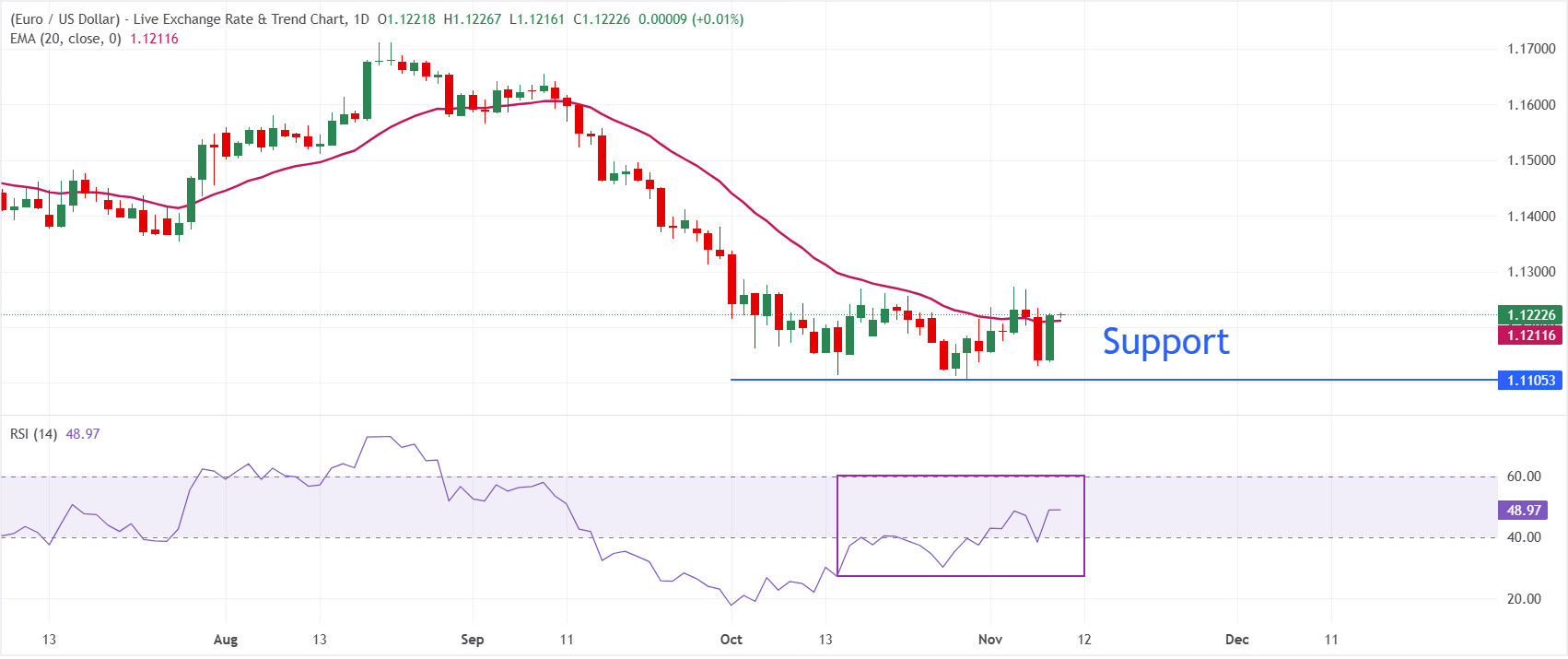
Price trend: With EUR/USD at 1.1223 on the daily chart, the pair remains near its 20-day exponential moving average (EMA) of 1.1212. The immediate bias is therefore broadly neutral.
Momentum balance: Neither buyers nor sellers appear to have a clear advantage for now. At 48.97, the Relative Strength Index (RSI) is close to its midpoint, signalling balanced momentum.
Downside levels: Monday’s low of 1.1138 provides the first support, followed by the more substantial floor at 1.1104. Losing that latter level would leave 1.1000 exposed.
Upside barrier: The principal obstacle on the upside appears to be 1.1273, the high recorded on 4 November.
(The technical analysis of this story was written with the help of an AI tool. Know more.)
Inflation: Key Questions
A rise in the cost of a representative basket of goods and services is measured as inflation. Headline inflation is generally reported as a percentage change month-on-month (MoM) and year-on-year (YoY). Food and fuel, whose prices can shift with geopolitical and seasonal factors, are among the more volatile components excluded from core inflation. Economists concentrate on the core measure. It is also the measure targeted by central banks, whose mandate is to maintain manageable inflation, typically around 2%.
Changes over time in the prices of a basket of goods and services are tracked by the Consumer Price Index (CPI). The index is generally presented as a month-on-month (MoM) and year-on-year (YoY) percentage change. Central banks target core CPI, which removes volatile food and fuel components. A core CPI reading above 2% usually leads to higher interest rates, while a reading below 2% tends to have the reverse effect. Higher rates support a currency, so rising inflation usually strengthens it. Falling inflation generally has the opposite effect.
A country’s currency tends to strengthen when inflation is high and weaken when it is low, even if that relationship appears counter-intuitive. To tackle higher inflation, the central bank will normally increase interest rates. Those higher rates draw in more global capital from investors seeking attractive returns on their money.
Gold historically attracted investors during periods of high inflation because it retained its value. Investors still often seek its safe-haven qualities during extreme market turmoil, but this is not usually the case. High inflation prompts central banks to raise interest rates in response. For Gold, higher rates are a headwind: they raise the opportunity cost of holding the metal rather than an interest-bearing asset or money in a cash deposit account. Lower inflation, by contrast, tends to support Gold because it brings interest rates down, improving the metal’s appeal as an alternative investment.
POPULAR ARTICLES
1Forex Today: German Inflation and ECB Commentary Take Centre Stage2$4,000 approaches as gold plunges and hot US inflation pushes Treasury yields above 5%3US CPI beats estimates: XAG/USD retreats | Silver Price Forecast4Above-forecast US CPI weighs on Japanese Yen as Fed officials favour further rate hikes5Two more hikes expected by Fed’s Logan, who flags faster winter tightening6October US Inflation Rise: Bitcoin vs Gold Outlook as BTC and XAU retreat7December ECB rate hike obvious despite energy relief, says Nagel8Below 1.34: British Pound slides as hot CPI raises prospect of 50-bps Fed hike9US CPI bolsters hawkish Fed outlook, weighing on Canadian Dollar


Get Started!
Sign up and access the Global Markets in less than 3 minutes

Connect With Us









Contacts
Phone: +61 2 8036 8388
Fax: +61 2 8036 8388
Email: support@tmgm.com



The information provided on this website is of a general nature only and does not constitute personal financial advice. Before acting on any information on this website, you should consider the suitability of the information in relation to your objectives, financial situation and needs. Investing in CFDs and FX Margin Contracts carries significant risks and is not suitable for all investors. You may lose more than your initial deposit. You do not own, or have, any interest in the underlying asset. We recommend that you seek independent advice and ensure you fully understand the risks involved before trading. It is important that you read and consider the disclosure document before you acquire any product listed on the website. The information and advertisements offered on this website are not intended for use by any person in any country or jurisdiction where such use would be contrary to local laws and regulations. The Products and Services offered on this website are not intended for residents of the United States, Malaysia and Thailand.
TMGM is authorized and regulated in various jurisdictions.
Trademax Australia Limited, trading as TMGM, is regulated by the Australian Securities and Investments Commission (ASIC), AFSL no. 436416 and is located at Level 28, One International Tower, 100 Barangaroo Avenue, 2000 Sydney, NSW Australia.
Email: support@tmgm.com.au
Trademax Global Limited, trading as TMGM, is authorized and regulated by the Vanuatu Financial Services Commission (VFSC), registration number 40356 and registered at 1276, Kumul Highway, Port Vila, Vanuatu, Republic of Vanuatu.
Email: support@tmgm.com
Trademax Global Markets (SE) Limited, trading as TMGM, is authorized and regulated by the Financial Services Authority (FSA) of Seychelles, with license number SD224. The company is registered at Office No 13, Providence Estate ABIS Centre, Mahe, Seychelles.
Email: support@tmgm.com
Trademax Global Markets (International) Pty Ltd, trading as TMGM, is authorized and regulated by the Financial Services Commission, Mauritius (FSC) with license no. GB22201012, and registered at 33, Edith Cavell Street C/o IQ EQ Fund Services (Mauritius) Ltd Port Louis, 11324 Mauritius.
Email: support@tmgm.com
Copyright © TMGM. All rights reserved