

Trading
Explore a wide range of markets with competitive pricing, deep liquidity, and advanced trading tools.
Learn More 
Platform
Trade seamlessly with TMGM's powerful platform, built for speed, precision, and a superior trading experience.
Learn More Trading Platform
Academy
Learn the fundamentals of trading with beginner-friendly resources, including guides, webinars, and market insights.
Learn More News & Analysis
Get real-time market updates and expert analysis to stay ahead of trading opportunities
Learn More News & Analysis
About
Learn what sets TMGM apart — our global presence, regulatory strength, and commitment to innovation in trading.
Learn More Why Choose TMGM
Sponsorship
Over 1% decline: Gold retreats on hawkish Fed comments ahead of US CPI
- More than 1% lost in Gold as profit-taking and hawkish Fed remarks weigh ahead of US CPI.
- 50-basis-point December rate hike remains an option for Fed Governor Waller.
- $4,061 area provides 20-day SMA support for XAU/USD; RSI points to neutral momentum.
Gold (XAU/USD) is down more than 1% on Tuesday. Profit-taking has erased much of the previous day’s advance, while hawkish comments from Federal Reserve (Fed) Governor Christopher Waller have added selling pressure. Markets await US consumer inflation figures at 13:30 GMT. XAU/USD is trading around $4,075 at the time of writing, below Monday’s high near $4,148.

Even if October inflation eased, Waller said he would “still support a 25 basis point increase” in December. If October core CPI registers “around 0.3% or higher.”, he said a “half-point Fed rate hike may be needed in December”. According to the CME FedWatch Tool, traders now fully price in a December increase of 25 basis points (bps).
For October, economists forecast a 0.3% MoM increase in the headline Consumer Price Index (CPI), compared with 0.6% in September. They also anticipate a slowdown in core CPI, which strips out food and energy, to 0.2% from 0.3%.
The US Dollar Index (DXY) has also recovered with support from Waller’s comments. It had lost 0.60% on Monday as prospects for US-Iran diplomacy drove crude prices down. Measuring the Greenback against a basket of six major currencies, the DXY now stands around 101.70 after touching an intraday low of 101.49.
Following Monday’s White House talks with Qatar’s prime minister, US President Donald Trump cited “positive momentum” towards ending the war with Iran. West Texas Intermediate (WTI) has since eased towards $83 a barrel, its weakest level since 31 August.
Near-term support for the Dollar remains the expectation of analysts at ING, who argue that “the dollar should stay supported by strong US growth, high inflation and a Fed threatening to tighten” further. Their assessment is that “our base case assumes that the Federal Reserve stays hawkish in the first quarter, as decent US growth and above-3% inflation keep money markets pricing in the threat of an extended tightening cycle.”
Higher interest rates increase the opportunity cost of owning non-yielding Gold, leaving the hawkish Fed outlook a continuing drag. An above-forecast CPI release could reinforce expectations of a December rate increase and strengthen the US Dollar. Conversely, a softer result could pressure the Greenback and ease the strain on Gold.
Technical Analysis: $4,000 in view below the 20-day SMA
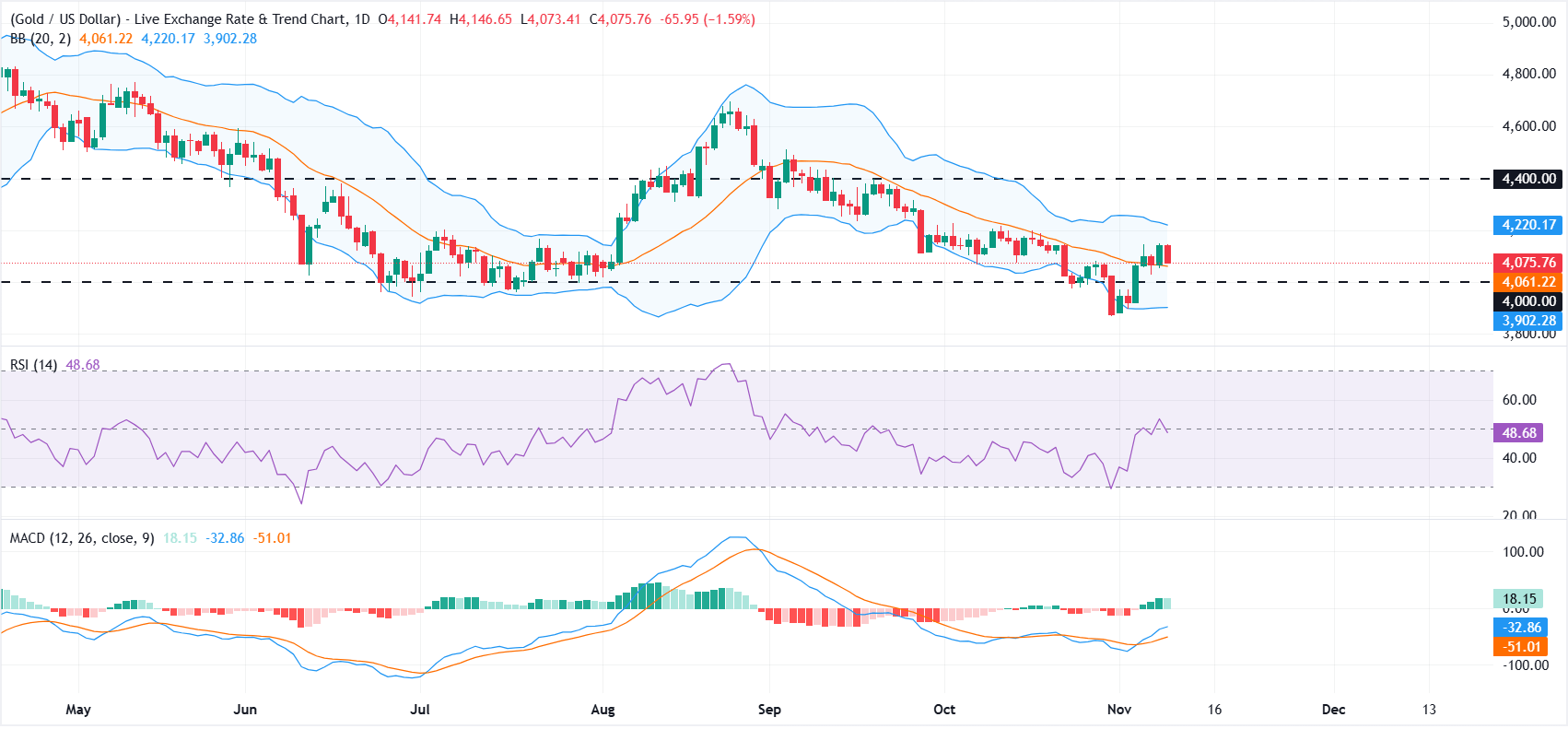
Around $4,061, the 20-day Simple Moving Average (SMA) forming the Bollinger Bands’ middle line provides immediate support on the daily XAU/USD chart. Spot prices remain just above it, leaving the near-term bias neutral, with the upper band around $4,220 limiting gains. A Relative Strength Index (RSI) reading of about 49 reinforces the range-bound picture. Although the Moving Average Convergence Divergence (MACD) has moved firmly into positive territory, suggesting improving upward momentum, nearby resistance continues to restrict the advance.
The first upside hurdle is the upper Bollinger Band near $4,220. Beyond it, sellers could regain control at the more substantial horizontal resistance of $4,400. Initial downside support lies around $4,061 at the mid-Bollinger 20-day SMA, before the psychological and technical floor at $4,000. A deeper decline could bring the lower Bollinger Band near $3,902 into play, followed by the year-to-date low of $3,870.
(The technical analysis of this story was written with the help of an AI tool. Know more.)
Inflation: key questions
The increase in the cost of a representative basket of goods and services is measured by inflation. Headline readings are generally reported as percentage changes month-on-month (MoM) and year-on-year (YoY). Food and fuel are excluded from core inflation because geopolitical developments and seasonal factors can make their prices more volatile. Economists concentrate on this core measure. It is also the measure targeted by central banks, whose mandate is to maintain manageable inflation, typically around 2%.
Changes in the prices of a basket of goods and services over time are tracked by the Consumer Price Index (CPI). Readings are generally presented as percentage changes month-on-month (MoM) and year-on-year (YoY). Central banks target Core CPI because it removes volatile food and fuel components. Interest rates usually rise when Core CPI exceeds 2% and fall when it drops below 2%. As higher rates support a currency, stronger inflation generally leads to currency appreciation; weaker inflation tends to have the reverse effect.
A country’s currency tends to appreciate when inflation is high and weaken when inflation is low, despite what might initially seem logical. To tackle higher inflation, its central bank will normally increase interest rates. Those higher returns draw more international capital from investors seeking an attractive destination for their funds.
Historically, investors sought Gold during periods of high inflation for its ability to retain value. They still often buy it as a safe haven during severe market turbulence, but that pattern does not apply most of the time. High inflation prompts central banks to raise interest rates to contain price pressures. Those higher rates weigh on Gold by increasing the opportunity cost of holding it rather than an interest-bearing asset or cash in a deposit account. Lower inflation, by contrast, tends to support Gold: it brings interest rates down and makes the metal a more attractive investment alternative.
POPULAR ARTICLES
1Democrats’ takeover of Congress could bring legislative scrutiny for crypto executives27 biggest weekly crypto losers: RAIN, ZEC, BTW post steepest declines as market sell-off deepens3Below $2,000: Ethereum Price Forecast as inflation and AI slump weigh on ETH4High US yields boost Fed rate hike bets, leaving gold facing weekly rout5XAG/USD confined to descending channel: Silver Price Forecast6Low interest rates weigh on Swiss Franc across the board7Further rate hikes expected as firms try to pass on costs, says Fed’s Daly8Another rate hike in view as second-round risks grow, ECB’s Nagel says9Rising US yields and Fed tightening outlook put Australian Dollar under pressure


Get Started!
Sign up and access the Global Markets in less than 3 minutes

Connect With Us









Contacts
Phone: +61 2 8036 8388
Fax: +61 2 8036 8388
Email: support@tmgm.com



The information provided on this website is of a general nature only and does not constitute personal financial advice. Before acting on any information on this website, you should consider the suitability of the information in relation to your objectives, financial situation and needs. Investing in CFDs and FX Margin Contracts carries significant risks and is not suitable for all investors. You may lose more than your initial deposit. You do not own, or have, any interest in the underlying asset. We recommend that you seek independent advice and ensure you fully understand the risks involved before trading. It is important that you read and consider the disclosure document before you acquire any product listed on the website. The information and advertisements offered on this website are not intended for use by any person in any country or jurisdiction where such use would be contrary to local laws and regulations. The Products and Services offered on this website are not intended for residents of the United States, Malaysia and Thailand.
TMGM is authorized and regulated in various jurisdictions.
Trademax Australia Limited, trading as TMGM, is regulated by the Australian Securities and Investments Commission (ASIC), AFSL no. 436416 and is located at Level 28, One International Tower, 100 Barangaroo Avenue, 2000 Sydney, NSW Australia.
Email: support@tmgm.com.au
Trademax Global Limited, trading as TMGM, is authorized and regulated by the Vanuatu Financial Services Commission (VFSC), registration number 40356 and registered at 1276, Kumul Highway, Port Vila, Vanuatu, Republic of Vanuatu.
Email: support@tmgm.com
Trademax Global Markets (SE) Limited, trading as TMGM, is authorized and regulated by the Financial Services Authority (FSA) of Seychelles, with license number SD224. The company is registered at Office No 13, Providence Estate ABIS Centre, Mahe, Seychelles.
Email: support@tmgm.com
Trademax Global Markets (International) Pty Ltd, trading as TMGM, is authorized and regulated by the Financial Services Commission, Mauritius (FSC) with license no. GB22201012, and registered at 33, Edith Cavell Street C/o IQ EQ Fund Services (Mauritius) Ltd Port Louis, 11324 Mauritius.
Email: support@tmgm.com
Copyright © TMGM. All rights reserved