

Trading
Explore a wide range of markets with competitive pricing, deep liquidity, and advanced trading tools.
Learn More 
Platform
Trade seamlessly with TMGM's powerful platform, built for speed, precision, and a superior trading experience.
Learn More Trading Platform
Academy
Learn the fundamentals of trading with beginner-friendly resources, including guides, webinars, and market insights.
Learn More News & Analysis
Get real-time market updates and expert analysis to stay ahead of trading opportunities
Learn More News & Analysis
About
Learn what sets TMGM apart — our global presence, regulatory strength, and commitment to innovation in trading.
Learn More Why Choose TMGM
Sponsorship
October US CPI expected to ease as markets reprice Fed rate hike prospects
- A 0.3% MoM increase is forecast for the US Consumer Price Index in October.
- Core CPI inflation is forecast to ease to 0.2% on a monthly basis, down from September’s 0.3%.
- Alongside geopolitical developments and equity market movements, the inflation figures could shape the US Dollar’s near-term valuation.
October’s US Consumer Price Index (CPI) figures are due on Tuesday. The US Bureau of Labor Statistics (BLS) release could affect the US Dollar (USD) as investors review their expectations for Federal Reserve (Fed) interest rates.

Most CPI series will have no 12-month percentage change in this report. October 2025 monthly data are missing because collection was suspended during the government shutdown from 1 October 2025 to 12 November 2025.
Explaining the gap in a press release, the BLS stated: “For most CPI series, BLS could not publish October 2025 indexes. As a result, BLS will not publish 12-month percent changes for October 2026 for indexes where October 2025 data are not available,”
Forecasts put the monthly headline CPI increase at 0.3%, below September’s 0.6%. Core CPI is projected to advance 0.2%, following a 0.3% rise in the preceding month.
A marked slowdown is expected in the forthcoming US inflation figures by economists at Deutsche Bank. Their forecast is for “headline CPI [is] to rise by 0.20% month-on-month, down from 0.65% previously, with core CPI also up 0.20% after 0.33% last time.” Even with softer readings anticipated, the bank’s economists “continue[s] to expect 25bp rate increases at the December and March FOMC meetings, absent a further material tightening in financial conditions.”
Economic Data Indicator
Consumer Price Index: MoM Change
By periodically aggregating prices across a representative basket of goods and services, the Consumer Price Index (CPI) tracks inflationary or deflationary trends. The US Department of Labor Statistics compiles and publishes the figures monthly. For the MoM reading, goods prices in the reference month are compared with those in the preceding month. As a key inflation gauge, CPI also tracks shifts in purchasing trends. A higher reading is generally regarded as bullish for the US Dollar (USD); a lower reading is generally considered bearish.
View details.Next scheduled release: Tue 10 Nov 2026 13:30
Release frequency: Every month
Consensus forecast: 0.3%
Prior reading: 0.6%
Data source: US Bureau of Labor Statistics
Around 2% YoY is the inflation rate sought under the US Federal Reserve’s (Fed) mandate. The central bank has two objectives: price stability and maximum employment. Since the pandemic, price stability has remained the weakest element of that mandate. Supply-chain disruptions and bottlenecks continue to drive prices higher, keeping the Consumer Price Index (CPI) at multi-decade highs. Having already acted to curb inflation, the Fed is expected to retain an aggressive policy stance for the foreseeable future.
80% Rate-Hike Probability: US Consumer Price Index Implications for EUR/USD
About an 80% probability of another 25 basis points (bps) increase is currently priced in for the Federal Reserve’s (Fed) final meeting of the year. That is the market assessment shown by the CME FedWatch Tool.
After the Fed held interest rates at 3.75%-4.00% in October, Fed Chair Kevin Warsh used his news conference to characterise labour market conditions as “positive,” adding that policymakers’ discussions centred mainly on the price stability mandate. Evidence of labour market resilience followed in the October employment report. Nonfarm Payrolls (NFP) increased by 165K, while the Unemployment Rate fell to 4.1% even as the Labor Force Participation Rate edged higher.
Last week’s sharp decline in crude oil prices reflected growing market optimism over a diplomatic settlement to the Middle East conflict after the Republicans’ midterm election defeat. That decline will not appear in October’s inflation figures. However, a substantial downside surprise in monthly CPI, at 0.1% or lower, alongside a further fall in energy prices could prompt investors to stop pricing in a December rate increase. Such an outcome could trigger sudden selling in the US Dollar (USD), allowing EUR/USD to build bullish momentum in the near term.
An inflation reading matching or exceeding market expectations would point the other way. Combined with stalled ceasefire negotiations with Iran, it could strengthen the case for an interest rate increase next month. Market positioning, however, suggests limited scope for USD gains under those conditions, potentially leaving EUR/USD with only a brief bearish response.
Equity trading could also shape the USD’s valuation and EUR/USD’s direction. Should the sell-off in technology shares continue, it could underpin the USD and restrict EUR/USD gains, even with soft inflation figures supporting a cautious approach to Fed policy tightening.
For ING strategists, risk sentiment is a major condition underpinning the US Dollar’s recent strength: “we think the dollar rally requires the risk-off mood to persist this week.” Their warning that “Friday’s move looked a bit too stretched relative to short-term market drivers,” points to “some moderate correction risk” should market anxiety subside. ING nevertheless regards the wider environment as supportive of the Dollar, citing the “macro story”
Setting out their inflation forecast, they add: “We expect tomorrow’s October US CPI to come in at 0.3% month-on-month for both headline (consensus 0.3%) and core (0.3%),” and argue that this result “should help cement expectations for a December Fed hike (19bp priced in), making the swap curve more protected from other equity market shocks.”
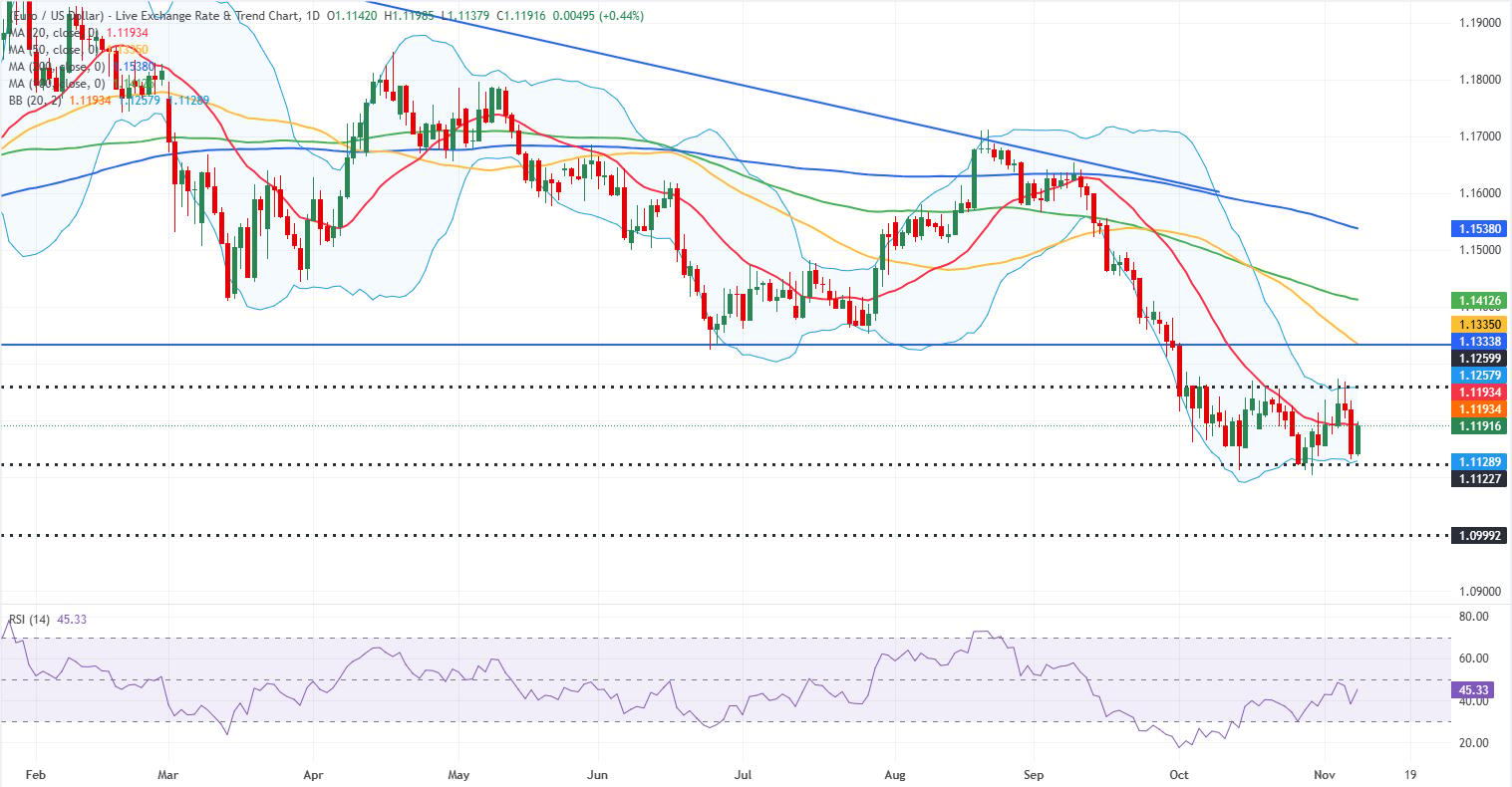
A short technical assessment of EUR/USD comes from Eren Sengezer, European Session Lead Analyst:
“The EUR/USD pair has been moving in a relatively narrow channel since the beginning of October. During last week’s post-midterm elections rally, the Relative Strength Index (RSI) indicator on the daily chart recovered toward 50 but failed to clear this level, highlighting buyers’ hesitancy.”
“On the upside, 1.1260 (upper arm of the Bollinger Bands, static level) aligns as the first resistance level ahead of 1.1335 (50-day Simple Moving Average (SMA), static level) and 1.1410 (100-day SMA). Looking south, the first support level could be spotted at 1.1130 (lower arm of the Bollinger Bands, static level). If this support fails and gets confirmed as resistance, technical sellers could take action and open the door for an extended drop toward 1.1000 (static level, round level).”
Inflation: Key Questions Answered
The increase in the cost of a representative basket of goods and services is measured by inflation. Headline inflation is generally reported as a percentage change, both month-on-month (MoM) and year-on-year (YoY). By excluding volatile components such as food and fuel, which are sensitive to geopolitical developments and seasonal influences, core inflation provides the measure economists concentrate on. It is also the measure targeted by central banks, whose mandate is to contain inflation at a manageable rate, typically around 2%.
Changes in the cost of a basket of goods and services over time are tracked by the Consumer Price Index (CPI). The index is generally reported in percentage terms on both a month-on-month (MoM) and year-on-year (YoY) basis. Central banks target Core CPI because it strips out volatile food and fuel components. A rise in Core CPI above 2% typically leads to higher interest rates; a fall below 2% tends to produce the reverse. Higher rates support a currency, so rising inflation generally strengthens it, while falling inflation has the opposite effect.
A country’s currency tends to appreciate when inflation is high and weaken when inflation is low, despite this relationship seeming counter-intuitive. The explanation lies in interest rates: central banks normally raise them to tackle higher inflation. Those higher rates draw in more international capital from investors seeking attractive returns on their money.
Historically, investors sought Gold during periods of high inflation for its ability to retain value. They still frequently buy it as a safe haven during extreme market turbulence, but this is not the prevailing pattern most of the time. High inflation typically prompts central banks to raise interest rates to bring it under control. For Gold, higher rates are a negative: they raise the opportunity cost of holding it rather than an interest-bearing asset or money in a cash deposit account. Lower inflation, by contrast, tends to favour Gold. It brings rates down and makes the precious metal a more attractive investment alternative.
POPULAR ARTICLES
1US Dollar: Fundamental support counters deficit concerns – Rabobank2Two-week low: euro slides on expectations of aggressive Fed rate hikes3October UK inflation set to rise, says Deutsche Bank4US Dollar: Support holds on US data – Societe Generale51.4230: Fed tightening bets lift Greenback, pushing Canadian Dollar to four-week lows6160.00 in sight: Why are strategists backing Japanese Yen strength despite its slide?7160 in sight: Japanese Yen weakens as US inflation fuels Fed hike bets8Above $85: WTI Oil holds steady as hopes for a Middle East peace deal begin to fade9EUR/USD: Dollar outperformance leaves pair rangebound – Societe Generale


Get Started!
Sign up and access the Global Markets in less than 3 minutes

Connect With Us









Contacts
Phone: +61 2 8036 8388
Fax: +61 2 8036 8388
Email: support@tmgm.com



The information provided on this website is of a general nature only and does not constitute personal financial advice. Before acting on any information on this website, you should consider the suitability of the information in relation to your objectives, financial situation and needs. Investing in CFDs and FX Margin Contracts carries significant risks and is not suitable for all investors. You may lose more than your initial deposit. You do not own, or have, any interest in the underlying asset. We recommend that you seek independent advice and ensure you fully understand the risks involved before trading. It is important that you read and consider the disclosure document before you acquire any product listed on the website. The information and advertisements offered on this website are not intended for use by any person in any country or jurisdiction where such use would be contrary to local laws and regulations. The Products and Services offered on this website are not intended for residents of the United States, Malaysia and Thailand.
TMGM is authorized and regulated in various jurisdictions.
Trademax Australia Limited, trading as TMGM, is regulated by the Australian Securities and Investments Commission (ASIC), AFSL no. 436416 and is located at Level 28, One International Tower, 100 Barangaroo Avenue, 2000 Sydney, NSW Australia.
Email: support@tmgm.com.au
Trademax Global Limited, trading as TMGM, is authorized and regulated by the Vanuatu Financial Services Commission (VFSC), registration number 40356 and registered at 1276, Kumul Highway, Port Vila, Vanuatu, Republic of Vanuatu.
Email: support@tmgm.com
Trademax Global Markets (SE) Limited, trading as TMGM, is authorized and regulated by the Financial Services Authority (FSA) of Seychelles, with license number SD224. The company is registered at Office No 13, Providence Estate ABIS Centre, Mahe, Seychelles.
Email: support@tmgm.com
Trademax Global Markets (International) Pty Ltd, trading as TMGM, is authorized and regulated by the Financial Services Commission, Mauritius (FSC) with license no. GB22201012, and registered at 33, Edith Cavell Street C/o IQ EQ Fund Services (Mauritius) Ltd Port Louis, 11324 Mauritius.
Email: support@tmgm.com
Copyright © TMGM. All rights reserved