

Trading
Explore a wide range of markets with competitive pricing, deep liquidity, and advanced trading tools.
Learn More 
Platform
Trade seamlessly with TMGM's powerful platform, built for speed, precision, and a superior trading experience.
Learn More Trading Platform
Academy
Learn the fundamentals of trading with beginner-friendly resources, including guides, webinars, and market insights.
Learn More News & Analysis
Get real-time market updates and expert analysis to stay ahead of trading opportunities
Learn More News & Analysis
About
Learn what sets TMGM apart — our global presence, regulatory strength, and commitment to innovation in trading.
Learn More Why Choose TMGM
Sponsorship
Below $85: WTI subdued amid US-Iran deal hopes
- $84.25 marks oil’s 10-week low. Prices remain near that level as hopes grow for a US-Iran deal.
- Fresh military strikes against Iran are “highly unlikely”, according to US President Trump.
- Limits on funding for the Iran war would be sought by Democrats, the party has indicated.
A 1.5% decline leaves West Texas Intermediate (WTI) futures on NYMEX just below $85.00. During Tuesday’s Asian session, oil remains near the 10-week low of $84.25 reached on Monday.
Growing optimism about an agreement between the United States (US) and Iran is putting oil prices under substantial selling pressure.

US-Iran tone softens as oil sentiment stabilises
A softer message from Washington gave investor optimism a further lift over the weekend, according to analysts at MUFG. President Trump told CNN that ordering new military strikes against Iran would be “highly unlikely” if negotiations continue to advance. However, MUFG also points to Trump’s emphasis on the quality of any deal: “it depends on whether or not they sign a very strong agreement,” he said. The bank regards that qualification as critical to maintaining the recent decline in geopolitical risk premia.
Since Democrats won both the House and the Senate in the United States (US) midterm elections, energy prices have faced intense pressure. The result also bolstered hopes for a US-Iran agreement. Expectations are that Democrats would restrict Washington’s funding for further military action against Iran.
The Hill reported that Senate Minority Leader Chuck Schumer (D-N.Y.) said last week: “We are going to end the war. We have some Republicans already who have joined us in ending the war, and the Founding Fathers had the power of the purse as one of the ways of deterring a president who does war without the consent of the American people,”
$84.81 WTI: Bearish Technical Bias Persists
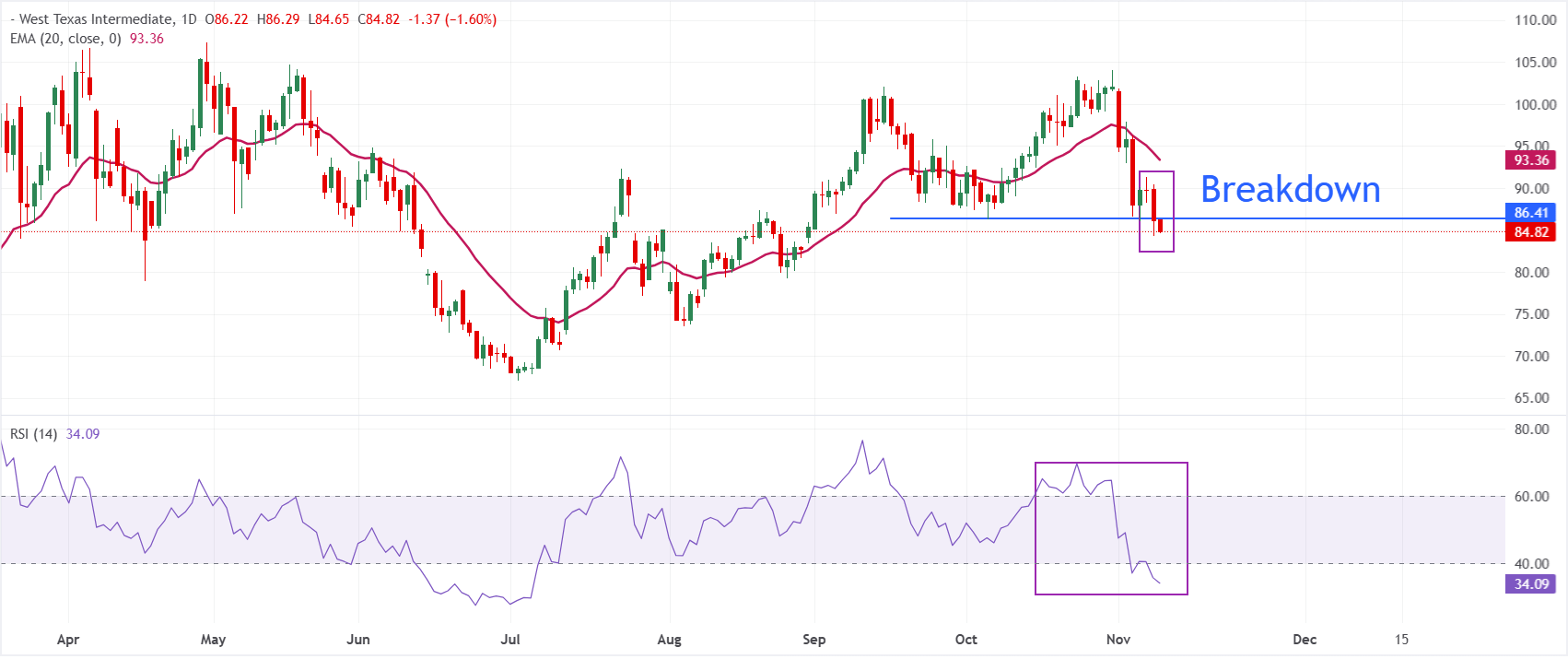
At $84.81 on the daily chart, WTI US Oil remains well below its 20-day Exponential Moving Average (EMA) of $93.36. This keeps the near-term outlook bearish, with overhead trend resistance capping the market following its recent retreat from above $100. A break beneath the 6 October low of $86.32 has also established a fresh lower low, reinforcing the bearish bias.
At 34, the Relative Strength Index (RSI) sits just above oversold territory. Downward momentum therefore remains evident, although the decline could slow if selling pressure subsides.
Resistance first comes at the 6 October low of $86.32, followed by $90.00. Beyond those barriers, the 20-day EMA at $93.36 represents ultimate resistance. On the downside, the 28 August high of $83.11 provides key support, followed by the 26 August low of $79.28.
(The technical analysis of this story was written with the help of an AI tool. Know more.)
WTI Oil: Key Questions Answered
Among the crude oils traded internationally, WTI stands for West Texas Intermediate. Alongside Brent and Dubai Crude, it is one of three major types. Its relatively low gravity and sulphur content earn it the descriptions “light” and “sweet”, respectively. This high-quality oil is considered easy to refine. Produced in the United States, it is distributed through the Cushing hub, known as “The Pipeline Crossroads of the World”. WTI serves as an oil-market benchmark, and its price is widely cited by the media.
Supply and demand drive WTI oil prices, as they do for other assets. Stronger global growth can raise demand, while weaker growth can have the reverse effect. Supply disruptions caused by political instability, wars or sanctions can also affect prices. Another major influence is policy set by OPEC, a group of leading oil-producing countries. As oil is traded mainly in US Dollars, the currency’s value also matters for WTI crude prices. A weaker US Dollar can make oil more affordable; a stronger one can have the opposite effect.
WTI oil prices respond to weekly inventory releases from the American Petroleum Institute (API) and the Energy Information Agency (EIA). Inventory movements capture shifts in supply and demand. Falling stocks can signal stronger demand and lift prices, whereas rising stocks can indicate greater supply and weigh on prices. The API publishes its report every Tuesday, followed by the EIA the next day. The two sets of figures are generally close: 75% of the time, they differ by no more than 1%. As the EIA is a government agency, its data is regarded as more reliable.
At meetings held twice a year, the 12 oil-producing nations in OPEC (Organization of the Petroleum Exporting Countries) jointly set production quotas for members. These decisions frequently influence WTI oil prices. Lower quotas can restrict supply and lift prices; increased production can have the reverse effect. The broader OPEC+ grouping adds ten non-OPEC members, with Russia the most notable.
POPULAR ARTICLES
1Banxico rate cut sends wrong signal on inflation, Heath warns2Bitcoin and crypto market losses deepen after Jensen Huang's resignation3$3,850 area: gold tumbles to one-year low as Fed hawks take control4Fed’s Daly sees further rate hikes ahead, warning AI is fuelling inflation5Forex Today: US inflation returns to the spotlight6Over 3% slide in silver as Fed rate hike bets drive US Dollar rally7Hot inflation no fluke: Fed’s Goolsbee warns as economy overheats81.32 in sight as British Pound slides and Fed hawks overshadow solid UK growth910-month low: Australian Dollar falls as Fed tightening bets build


Get Started!
Sign up and access the Global Markets in less than 3 minutes

Connect With Us









Contacts
Phone: +61 2 8036 8388
Fax: +61 2 8036 8388
Email: support@tmgm.com



The information provided on this website is of a general nature only and does not constitute personal financial advice. Before acting on any information on this website, you should consider the suitability of the information in relation to your objectives, financial situation and needs. Investing in CFDs and FX Margin Contracts carries significant risks and is not suitable for all investors. You may lose more than your initial deposit. You do not own, or have, any interest in the underlying asset. We recommend that you seek independent advice and ensure you fully understand the risks involved before trading. It is important that you read and consider the disclosure document before you acquire any product listed on the website. The information and advertisements offered on this website are not intended for use by any person in any country or jurisdiction where such use would be contrary to local laws and regulations. The Products and Services offered on this website are not intended for residents of the United States, Malaysia and Thailand.
TMGM is authorized and regulated in various jurisdictions.
Trademax Australia Limited, trading as TMGM, is regulated by the Australian Securities and Investments Commission (ASIC), AFSL no. 436416 and is located at Level 28, One International Tower, 100 Barangaroo Avenue, 2000 Sydney, NSW Australia.
Email: support@tmgm.com.au
Trademax Global Limited, trading as TMGM, is authorized and regulated by the Vanuatu Financial Services Commission (VFSC), registration number 40356 and registered at 1276, Kumul Highway, Port Vila, Vanuatu, Republic of Vanuatu.
Email: support@tmgm.com
Trademax Global Markets (SE) Limited, trading as TMGM, is authorized and regulated by the Financial Services Authority (FSA) of Seychelles, with license number SD224. The company is registered at Office No 13, Providence Estate ABIS Centre, Mahe, Seychelles.
Email: support@tmgm.com
Trademax Global Markets (International) Pty Ltd, trading as TMGM, is authorized and regulated by the Financial Services Commission, Mauritius (FSC) with license no. GB22201012, and registered at 33, Edith Cavell Street C/o IQ EQ Fund Services (Mauritius) Ltd Port Louis, 11324 Mauritius.
Email: support@tmgm.com
Copyright © TMGM. All rights reserved