

Savdo
Raqobatbardosh narxlar, chuqur likvidlik va ilg‘or savdo vositalari bilan keng turdagi bozorlarni kashf eting.
Batafsil ma’lumot 
Platforma
TMGM’ning tezlik, aniqlik va yuqori savdo tajribasi uchun yaratilgan kuchli platformasi bilan uzluksiz savdo qiling.
Batafsil ma’lumot Savdo platformasi
Savdo vositalari
Akademiya
Boshlovchilar uchun qulay resurslar, jumladan qo‘llanmalar, vebinarlar va bozor tahlillari orqali savdoning asoslarini o‘rganing.
Batafsil ma’lumot Yangiliklar va tahlil
Savdo imkoniyatlaridan oldinda bo‘lish uchun bozor yangilanishlari va ekspert tahlillarini real vaqt rejimida oling
Batafsil ma’lumot Yangiliklar va tahlil
Haqida
TMGMni boshqalardan ajratib turadigan jihatlarni bilib oling — bizning global mavjudligimiz, tartibga solishdagi mustahkamligimiz va savdoda innovatsiyalarga sodiqligimiz.
Batafsil ma’lumot Nega TMGMni tanlash kerak
Euro rebounds against British Pound as UK Budget takes centre stage
- EUR/GBP recovers modestly as investors reduce Sterling exposure ahead of the UK Budget.
- The BoE is expected to raise rates in November, while the ECB is seen holding steady on Thursday.
- The technical outlook remains bearish, although oversold RSI conditions suggest selling pressure could ease.
EUR/GBP bears take a breather on Wednesday, pausing a two-day losing streak as traders trim their exposure to the British Pound ahead of the UK Autumn Budget at 12:30 GMT. At the time of writing, the cross trades around 0.8375, up 0.17% on the day, but remains near its lowest levels since May 2025.

UK budget seen as key driver for GBP and gilts
Strategists at Brown Brothers Harriman stress that “GBP and gilts will take their cue from today’s UK budget,” with market attention centred on whether the government “preserves the planned fiscal tightening and keeps gilt issuance in check.” They argue that “maintaining or increasing the fiscal squeeze should support gilts by easing inflation pressure and tempering BoE hike expectations.” However, for the Pound, they caution that “stronger fiscal credibility would compete with lower rate support and limit upside,” whereas “fiscal slippage and heavier gilt issuance can drive gilt yields up and GBP down.”
The BoE announces its interest rate decision on November 5, with traders fully pricing in a 25 bps hike. The central bank has kept rates unchanged so far this year as policymakers saw limited signs of higher energy costs spreading into broader prices and wages. However, the latest rise in inflation, alongside steady labour market and growth figures, has strengthened expectations of an increase.
On the Euro side, concerns over France’s public finances keep sentiment fragile. Separately, attention turns to the European Central Bank’s (ECB) policy decision on Thursday. The ECB is widely expected to leave its deposit rate unchanged at 2.50%, having already raised rates by a cumulative 50 bps this year to counter inflation pressures from higher energy costs. Traders will look for clues on whether policymakers are leaning towards another hike in December.
Technical Analysis
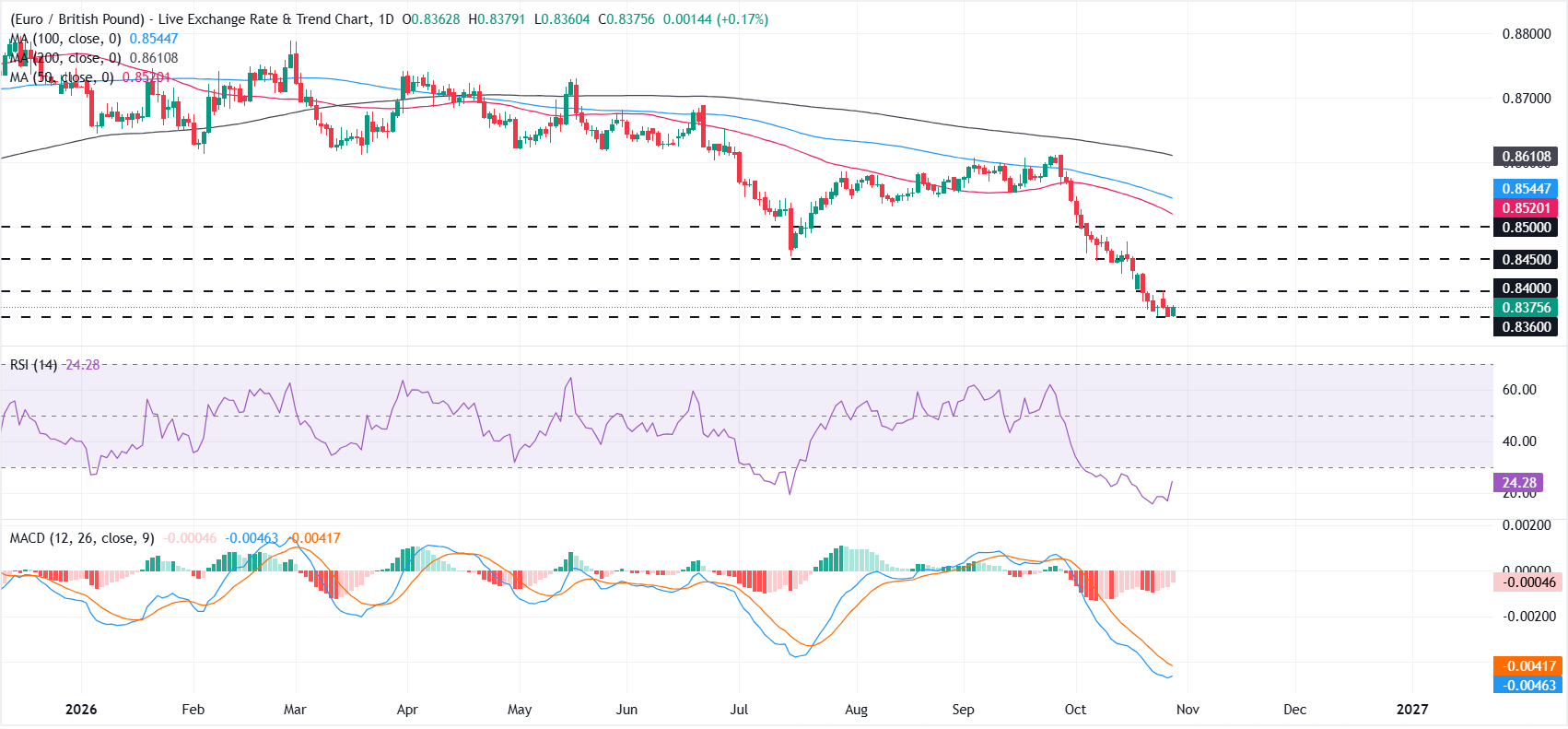
On the daily chart, EUR/GBP extends a bearish bias as spot holds well below the 50-day, 100-day and 200-day Simple Moving Averages (SMAs) clustered from roughly 0.8520 up to 0.8611. The pair is pressurized by this dense overhead supply, while the Relative Strength Index (RSI) around 24 signals oversold conditions that could slow immediate downside, but the negative Moving Average Convergence Divergence (MACD) histogram still hints at persistent selling pressure.
On the topside, initial resistance is seen at the nearby 0.8400 horizontal level, followed by 0.8450 and 0.8500, ahead of the 50-day SMA at 0.8520 and the 100-day SMA at 0.8545, with the 200-day SMA at 0.8611 acting as a more distant cap.
On the downside, immediate support is located at the 0.8360 horizontal line. A clear break below this floor would open the way for an extension of the downtrend, while holding above it could encourage a corrective bounce toward the mentioned resistance band.
(The technical analysis of this story was written with the help of an AI tool. Know more.)
Pound Sterling Price Today
The table below shows the percentage change of British Pound (GBP) against listed major currencies today. British Pound was the strongest against the New Zealand Dollar.
| USD | EUR | GBP | JPY | CAD | AUD | NZD | CHF | |
|---|---|---|---|---|---|---|---|---|
| USD | -0.07% | 0.12% | -0.05% | -0.15% | -0.14% | 1.19% | 0.04% | |
| EUR | 0.07% | 0.19% | 0.00% | -0.08% | -0.07% | 1.25% | 0.12% | |
| GBP | -0.12% | -0.19% | -0.17% | -0.26% | -0.26% | 1.07% | -0.08% | |
| JPY | 0.05% | 0.00% | 0.17% | -0.10% | -0.10% | 1.23% | 0.08% | |
| CAD | 0.15% | 0.08% | 0.26% | 0.10% | 0.00% | 1.33% | 0.19% | |
| AUD | 0.14% | 0.07% | 0.26% | 0.10% | 0.00% | 1.33% | 0.19% | |
| NZD | -1.19% | -1.25% | -1.07% | -1.23% | -1.33% | -1.33% | -1.12% | |
| CHF | -0.04% | -0.12% | 0.08% | -0.08% | -0.19% | -0.19% | 1.12% |
The heat map shows percentage changes of major currencies against each other. The base currency is picked from the left column, while the quote currency is picked from the top row. For example, if you pick the British Pound from the left column and move along the horizontal line to the US Dollar, the percentage change displayed in the box will represent GBP (base)/USD (quote).
Eng yaxshi maqolalar
1US Dollar: Hawkish risks keep support – OCBC2Euro rebounds against British Pound as UK Budget takes centre stage3The RBNZ surprised markets with a pause and the Kiwi sank 1.6%: Why December hike bets may not save it4Canadian Dollar: BoC tightening and forecasts to back currency – BBH5India M3 Money Supply came in at 16%, above expectations (0%) in October 126British Pound: Neutral budget, higher BoE rates ahead – ABN AMRO7NZD/USD Price Forecast: Bears eye 18-months low at 0.55648Euro: Fed focus keeps pressure against US Dollar – Commerzbank9WTI Price Forecast: Fears of fresh escalation in Middle East conflicts boost prices above $100
JONLI KOTIROVKALAR


FOREX HAQIDA HAMMA NARSA
Stop Loss: What It Is, How It Works and How to Set One
Margin Call Meaning: What It Is, What Triggers It and How to Avoid One
Top 15 Weakest Currencies in the World
Top 15 Strongest Currencies in the World
Is Forex Trading Halal?
Best Time to Trade Forex
Forex Trading vs Futures Trading
Forex Trading vs Stock Trading
Forex Trading vs Crypto Trading
Boshlang!
Ro‘yxatdan o‘ting va 3 daqiqadan kamroq vaqt ichida Global bozorlariga kirish imkoniga ega bo‘ling

Biz bilan bog‘laning









Kontaktlar
Telefon: +61 2 8036 8388
Faks: +61 2 8036 8388
Email: support@tmgm.com



Ushbu veb-saytda taqdim etilgan ma’lumotlar faqat umumiy xususiyatga ega bo‘lib, shaxsiy moliyaviy maslahat hisoblanmaydi. Ushbu veb-saytdagi har qanday ma’lumot asosida harakat qilishdan oldin, ma’lumotning sizning maqsadlaringiz, moliyaviy ahvolingiz va ehtiyojlaringizga mosligini ko‘rib chiqishingiz kerak. CFD va FX Margin shartnomalariga sarmoya kiritish sezilarli xavflarni o‘z ichiga oladi va barcha investorlar uchun mos emas. Siz boshlang‘ich depozitingizdan ko‘proq yo‘qotishingiz mumkin. Siz asosiy aktivga egalik qilmaysiz va unda hech qanday manfaatga ega emassiz. Savdo qilishdan oldin mustaqil maslahat olishni va ishtirok etuvchi xavflarni to‘liq tushunishingizni tavsiya qilamiz. Veb-saytda keltirilgan har qanday mahsulotni xarid qilishdan oldin oshkor qilish hujjatini o‘qib chiqishingiz va ko‘rib chiqishingiz muhimdir. Ushbu veb-saytda taklif etilgan ma’lumotlar va reklama materiallari bunday foydalanish mahalliy qonunlar va qoidalarga zid bo‘ladigan har qanday mamlakat yoki yurisdiksiyadagi shaxslar tomonidan foydalanish uchun mo‘ljallanmagan. Ushbu veb-saytda taklif etilgan Mahsulotlar va Xizmatlar AQSh, Malayziya va Tailand rezidentlari uchun mo‘ljallanmagan.
TMGM turli yurisdiksiyalarda vakolatli va tartibga solinadi.
Trademax Australia Limited, TMGM nomi ostida faoliyat yuritadi, Avstraliya Qimmatli qog‘ozlar va investitsiyalar komissiyasi (ASIC) tomonidan tartibga solinadi, AFSL raqami 436416 va manzili: Level 28, One International Tower, 100 Barangaroo Avenue, 2000 Sydney, NSW Australia.
Email: support@tmgm.com.au
Trademax Global Limited, TMGM nomi ostida faoliyat yuritadi, Vanuatu Moliyaviy Xizmatlar Komissiyasi (VFSC) tomonidan vakolatli va tartibga solinadi, ro‘yxatga olish raqami 40356 va ro‘yxatdan o‘tgan manzili: 1276, Kumul Highway, Port Vila, Vanuatu, Vanuatu Respublikasi.
Email: support@tmgm.com
Trademax Global Markets (SE) Limited, TMGM nomi ostida faoliyat yuritadi, Seyshel orollari Moliyaviy Xizmatlar Boshqarmasi (FSA) tomonidan 224-sonli SD litsenziyasi bilan vakolatli va tartibga solinadi. Kompaniya Office No 13, Providence Estate ABIS Centre, Mahe, Seychelles manzilida ro‘yxatdan o‘tgan.
Email: support@tmgm.com
Trademax Global Markets (International) Pty Ltd, TMGM nomi ostida faoliyat yuritadi, Mauritius Moliyaviy Xizmatlar Komissiyasi (FSC) tomonidan GB22201012 litsenziya raqami bilan vakolatli va tartibga solinadi hamda 33, Edith Cavell Street C/o IQ EQ Fund Services (Mauritius) Ltd Port Louis, 11324 Mauritius manzilida ro‘yxatdan o‘tgan.
Email: support@tmgm.com
Mualliflik huquqi © TMGM. Barcha huquqlar himoyalangan