

Savdo
Raqobatbardosh narxlar, chuqur likvidlik va ilg‘or savdo vositalari bilan keng turdagi bozorlarni kashf eting.
Batafsil ma’lumot 
Platforma
TMGM’ning tezlik, aniqlik va yuqori savdo tajribasi uchun yaratilgan kuchli platformasi bilan uzluksiz savdo qiling.
Batafsil ma’lumot Savdo platformasi
Savdo vositalari
Akademiya
Boshlovchilar uchun qulay resurslar, jumladan qo‘llanmalar, vebinarlar va bozor tahlillari orqali savdoning asoslarini o‘rganing.
Batafsil ma’lumot Yangiliklar va tahlil
Savdo imkoniyatlaridan oldinda bo‘lish uchun bozor yangilanishlari va ekspert tahlillarini real vaqt rejimida oling
Batafsil ma’lumot Yangiliklar va tahlil
Haqida
TMGMni boshqalardan ajratib turadigan jihatlarni bilib oling — bizning global mavjudligimiz, tartibga solishdagi mustahkamligimiz va savdoda innovatsiyalarga sodiqligimiz.
Batafsil ma’lumot Nega TMGMni tanlash kerak
WTI Price Forecast: Fears of fresh escalation in Middle East conflicts boost prices above $100
- The Oil price jumps to near $100 as energy supply risks heighten further.
- The US and Israel signal that they are prepared for fresh attacks on Iran.
- Iran-backed Houthis attacks Saudi’s biggest oil refinery.
West Texas Intermediate (WTI), futures on NYMEX, are up 1.42% to near $101.00 during the European trade on Wednesday. The oil prices strengthen as warnings from the United States (US) and Israel that they prepared for attacking Iran again post elections in their respective economies have prompted fears of fresh escalation in Middle East conflicts.

Brent climbs as Iran risk comes back into focus
Strategists at Deutsche Bank point out that Brent crude is extending its recent gains, noting that it is “+1.48% higher again overnight as the WSJ reported the Trump administration warning Gulf states to be prepared for a new operation against Iran after the midterms.” Adding to the geopolitical bid, Danske Bank’s research team highlights that, in his post-election speech, “Netanyahu raised the prospects of renewed joint action with President Trump against Iran.”
Meanwhile, Deutsche Bank has also highlighted that tighter energy supply in the US has also lend strength to the oil price. “The API data showed a decline in US crude inventories of around 2 million barrels last week, pointing to continued tighter supply,” bank wrote in a note.
Additionally, rising tensions between Saudi Arabia and Yemen’s Iran-aligned Houthis have also triggered energy supply risks.
On Tuesday, a military spokesperson from Yemen's Iran-aligned Houthis said that it launched a ballistic missile toward the Ras Tanura oil refinery in eastern Saudi Arabia, the kingdom’s largest refinery, Reuters report.
WTI Technical Analysis
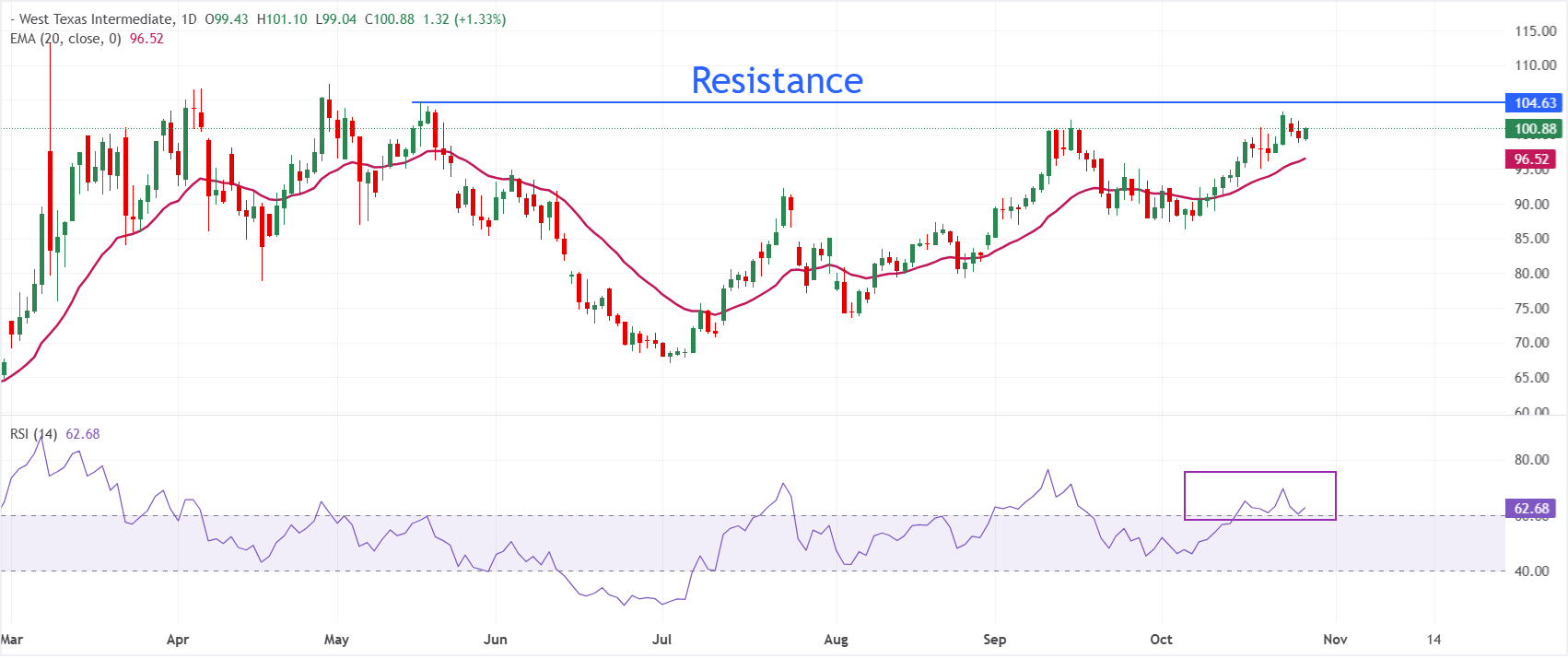
In the daily chart, WTI US Oil trades near $101, maintaining a bullish near-term bias as price holds decisively above the 20-day Exponential Moving Average (EMA) at $96.52. The short-term trend structure remains constructive while spot stays above this dynamic support, with the Relative Strength Index (RSI) near 63 hinting at firm, but not yet overbought, upside momentum.
On the downside, immediate support is seen at the 20-day EMA near $96.52, where a daily close below would signal fading bullish control and expose a deeper corrective phase. Looking up, the October 23 high at $103.28 is the immediate hurdle before the crucial barrier of May 18 high at $104.74.
(The technical analysis of this story was written with the help of an AI tool. Know more.)
WTI Oil FAQs
WTI Oil is a type of Crude Oil sold on international markets. The WTI stands for West Texas Intermediate, one of three major types including Brent and Dubai Crude. WTI is also referred to as “light” and “sweet” because of its relatively low gravity and sulfur content respectively. It is considered a high quality Oil that is easily refined. It is sourced in the United States and distributed via the Cushing hub, which is considered “The Pipeline Crossroads of the World”. It is a benchmark for the Oil market and WTI price is frequently quoted in the media.
Like all assets, supply and demand are the key drivers of WTI Oil price. As such, global growth can be a driver of increased demand and vice versa for weak global growth. Political instability, wars, and sanctions can disrupt supply and impact prices. The decisions of OPEC, a group of major Oil-producing countries, is another key driver of price. The value of the US Dollar influences the price of WTI Crude Oil, since Oil is predominantly traded in US Dollars, thus a weaker US Dollar can make Oil more affordable and vice versa.
The weekly Oil inventory reports published by the American Petroleum Institute (API) and the Energy Information Agency (EIA) impact the price of WTI Oil. Changes in inventories reflect fluctuating supply and demand. If the data shows a drop in inventories it can indicate increased demand, pushing up Oil price. Higher inventories can reflect increased supply, pushing down prices. API’s report is published every Tuesday and EIA’s the day after. Their results are usually similar, falling within 1% of each other 75% of the time. The EIA data is considered more reliable, since it is a government agency.
OPEC (Organization of the Petroleum Exporting Countries) is a group of 12 Oil-producing nations who collectively decide production quotas for member countries at twice-yearly meetings. Their decisions often impact WTI Oil prices. When OPEC decides to lower quotas, it can tighten supply, pushing up Oil prices. When OPEC increases production, it has the opposite effect. OPEC+ refers to an expanded group that includes ten extra non-OPEC members, the most notable of which is Russia.
Eng yaxshi maqolalar
1Silver Price Forecast: Descending channel keeps sellers in control ahead of Fed2New Zealand Dollar: RBNZ split keeps December hike in play - UOB3Swiss Franc ticks up from two-week lows with Fed decision on tap4Canadian Dollar: BoC guidance key to CAD outlook - Commerzbank5British Pound: Budget may boost Sterling against Euro - ING6Australian Dollar: RBA may hike again as inflation persists - Standard Chartered7XRP recovery stalls as Ripple and Robinhood expand partnership scope8US Dollar: Hawkish risks keep support – OCBC9Euro rebounds against British Pound as UK Budget takes centre stage
JONLI KOTIROVKALAR

INDICES HAQIDA HAMMA NARSA
The FTSE 100 Index Forecast for 2025: Insights for Investors
How to Invest in the S&P 500 for Beginners: A Step-by-Step Guide to Buying SPY
What is Index Trading? A Clear Guide to How to Trade Indices (SPX, Nasdaq, Dow Jones)
The Best FTSE 100 Dividend Stocks to Watch
How to Trade the Hang Seng Index (HSI)
Trading the CAC 40 Index: A Comprehensive Guide
Boshlang!
Ro‘yxatdan o‘ting va 3 daqiqadan kamroq vaqt ichida Global bozorlariga kirish imkoniga ega bo‘ling

Biz bilan bog‘laning









Kontaktlar
Telefon: +61 2 8036 8388
Faks: +61 2 8036 8388
Email: support@tmgm.com



Ushbu veb-saytda taqdim etilgan ma’lumotlar faqat umumiy xususiyatga ega bo‘lib, shaxsiy moliyaviy maslahat hisoblanmaydi. Ushbu veb-saytdagi har qanday ma’lumot asosida harakat qilishdan oldin, ma’lumotning sizning maqsadlaringiz, moliyaviy ahvolingiz va ehtiyojlaringizga mosligini ko‘rib chiqishingiz kerak. CFD va FX Margin shartnomalariga sarmoya kiritish sezilarli xavflarni o‘z ichiga oladi va barcha investorlar uchun mos emas. Siz boshlang‘ich depozitingizdan ko‘proq yo‘qotishingiz mumkin. Siz asosiy aktivga egalik qilmaysiz va unda hech qanday manfaatga ega emassiz. Savdo qilishdan oldin mustaqil maslahat olishni va ishtirok etuvchi xavflarni to‘liq tushunishingizni tavsiya qilamiz. Veb-saytda keltirilgan har qanday mahsulotni xarid qilishdan oldin oshkor qilish hujjatini o‘qib chiqishingiz va ko‘rib chiqishingiz muhimdir. Ushbu veb-saytda taklif etilgan ma’lumotlar va reklama materiallari bunday foydalanish mahalliy qonunlar va qoidalarga zid bo‘ladigan har qanday mamlakat yoki yurisdiksiyadagi shaxslar tomonidan foydalanish uchun mo‘ljallanmagan. Ushbu veb-saytda taklif etilgan Mahsulotlar va Xizmatlar AQSh, Malayziya va Tailand rezidentlari uchun mo‘ljallanmagan.
TMGM turli yurisdiksiyalarda vakolatli va tartibga solinadi.
Trademax Australia Limited, TMGM nomi ostida faoliyat yuritadi, Avstraliya Qimmatli qog‘ozlar va investitsiyalar komissiyasi (ASIC) tomonidan tartibga solinadi, AFSL raqami 436416 va manzili: Level 28, One International Tower, 100 Barangaroo Avenue, 2000 Sydney, NSW Australia.
Email: support@tmgm.com.au
Trademax Global Limited, TMGM nomi ostida faoliyat yuritadi, Vanuatu Moliyaviy Xizmatlar Komissiyasi (VFSC) tomonidan vakolatli va tartibga solinadi, ro‘yxatga olish raqami 40356 va ro‘yxatdan o‘tgan manzili: 1276, Kumul Highway, Port Vila, Vanuatu, Vanuatu Respublikasi.
Email: support@tmgm.com
Trademax Global Markets (SE) Limited, TMGM nomi ostida faoliyat yuritadi, Seyshel orollari Moliyaviy Xizmatlar Boshqarmasi (FSA) tomonidan 224-sonli SD litsenziyasi bilan vakolatli va tartibga solinadi. Kompaniya Office No 13, Providence Estate ABIS Centre, Mahe, Seychelles manzilida ro‘yxatdan o‘tgan.
Email: support@tmgm.com
Trademax Global Markets (International) Pty Ltd, TMGM nomi ostida faoliyat yuritadi, Mauritius Moliyaviy Xizmatlar Komissiyasi (FSC) tomonidan GB22201012 litsenziya raqami bilan vakolatli va tartibga solinadi hamda 33, Edith Cavell Street C/o IQ EQ Fund Services (Mauritius) Ltd Port Louis, 11324 Mauritius manzilida ro‘yxatdan o‘tgan.
Email: support@tmgm.com
Mualliflik huquqi © TMGM. Barcha huquqlar himoyalangan