

Trading
Erkunden Sie eine breite Palette von Märkten mit wettbewerbsfähigen Preisen, tiefer Liquidität und fortschrittlichen Trading-Tools.
Mehr erfahren 
Plattform
Handeln Sie nahtlos mit TMGMs leistungsstarker Plattform, die für Geschwindigkeit, Präzision und ein überlegenes Trading-Erlebnis entwickelt wurde.
Mehr erfahren Trading-Plattform
Akademie
Lernen Sie die Grundlagen des Tradings mit anfängerfreundlichen Ressourcen, einschließlich Leitfäden, Webinaren und Markteinblicken.
Mehr erfahren Nachrichten & Analyse
Erhalten Sie Echtzeit-Markt-Updates und Expertenanalysen, um Trading-Gelegenheiten voraus zu sein
Mehr erfahren Nachrichten & Analyse
Über uns
Erfahren Sie, was TMGM auszeichnet — unsere globale Präsenz, regulatorische Stärke und unser Engagement für Innovation im Trading.
Mehr erfahren Warum TMGM wählen
Yen gains for a third session as Tokyo's warnings hold 160.00
- USD/JPY is on track for a third lower close after stalling at 160.00.
- US stocks fell and the Yen gained, with a December BoJ hike still expected.
- Japan's trade data is due Tuesday, and national inflation on Thursday.
The Yen is gaining on the Dollar for a third session, and the first two came while the Dollar was rising against almost everything else. USD/JPY stalled at 160.00 on November 12 and 13, fell to just under 159.00 on Tuesday, and is trading just under 159.50.
Tokyo has warned against Yen selling since the pair reached 160.00, and Japan's finance ministry said it is watching one-sided moves and talking to the US Treasury. Tokyo bought Yen in late July, when the pair was near 164.00, and this time statements alone have kept every daily close under 160.00.
US stocks fell for a second session on Tuesday, and analysts at Brown Brothers Harriman said risk aversion was keeping USD/JPY below 160.00 and bringing haven buying to the Yen. Japan's economy shrank in the third quarter, and most economists still expect the Bank of Japan (BoJ) to raise its 1.25% rate on December 17-18. The Fed is priced to raise its 3.75%-4.00% rate nine days earlier, so a quarter-point from each leaves the gap at 2.50-2.75 percentage points.
On the calendar
Japan's October trade figures are due at 23:50 GMT on Tuesday, with exports forecast up 20% from a year earlier, after 16.7%, and imports up 25.8%, after 18.9%. National inflation for October follows at 23:30 GMT on Thursday, with the rate excluding fresh food forecast at 2.3% after 2.1%. Both feed into the BoJ's December 17-18 meeting.
The Fed publishes its October minutes at 19:00 GMT on Wednesday, and Fed Governor Waller speaks on Friday at 13:25 GMT. A December Fed hike is priced near 96%, so both bear mostly on whether traders add a second.
On the charts
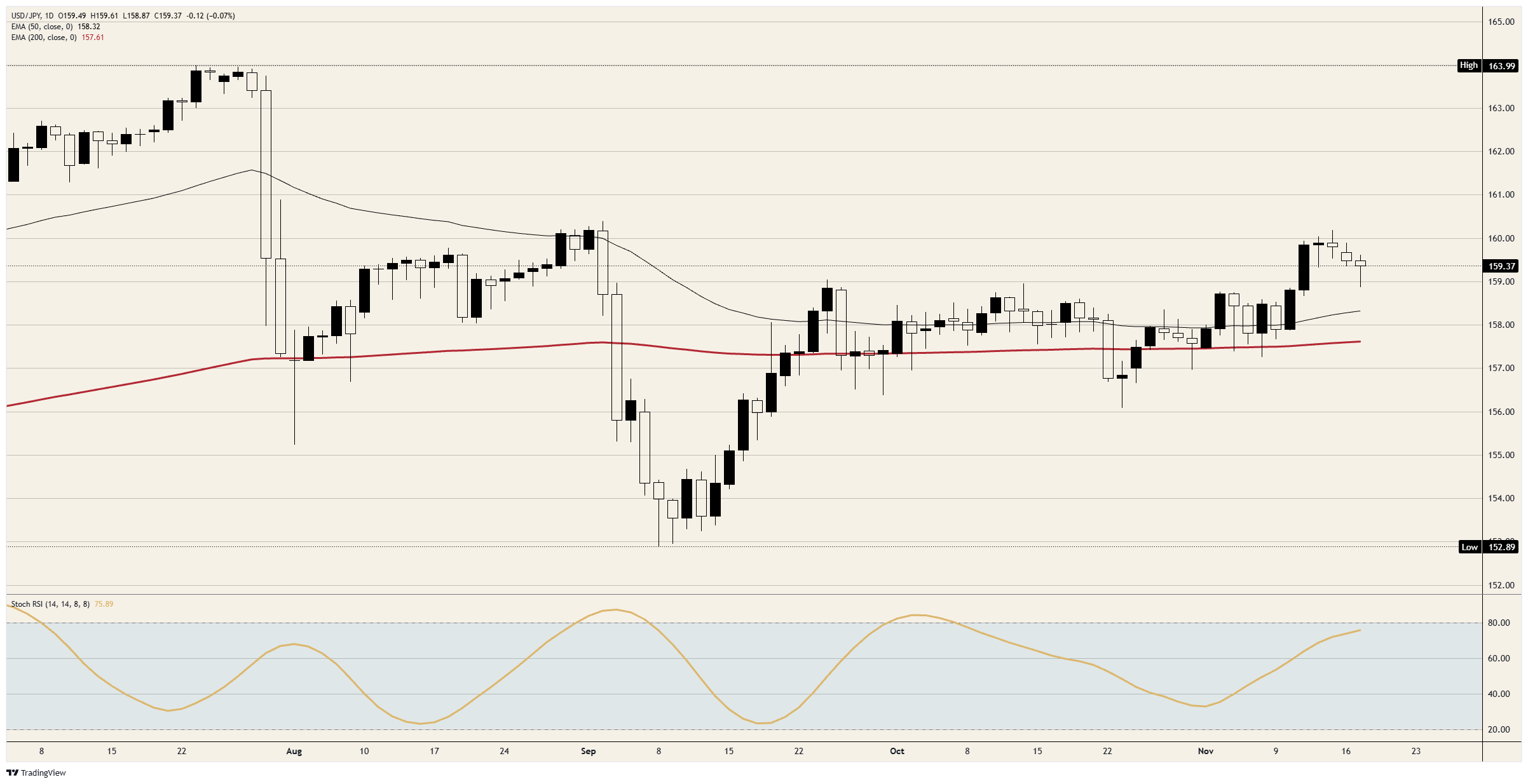
USD/JPY rose from just under 158.00 on November 10 to its November 13 high, then gave back about a third of that. Tuesday's low was the lowest since November 11, and the pair has recovered most of the session's drop. The 50-day Exponential Moving Average (EMA) has risen to just under 158.50, above the 200-day just above 157.50.
USD/JPY daily chart
Japanese Yen FAQs
The Japanese Yen (JPY) is one of the world’s most traded currencies. Its value is broadly determined by the performance of the Japanese economy, but more specifically by the Bank of Japan’s policy, the differential between Japanese and US bond yields, or risk sentiment among traders, among other factors.
One of the Bank of Japan’s mandates is currency control, so its moves are key for the Yen. The BoJ has directly intervened in currency markets sometimes, generally to lower the value of the Yen, although it refrains from doing it often due to political concerns of its main trading partners. The BoJ ultra-loose monetary policy between 2013 and 2024 caused the Yen to depreciate against its main currency peers due to an increasing policy divergence between the Bank of Japan and other main central banks. More recently, the gradually unwinding of this ultra-loose policy has given some support to the Yen.
Over the last decade, the BoJ’s stance of sticking to ultra-loose monetary policy has led to a widening policy divergence with other central banks, particularly with the US Federal Reserve. This supported a widening of the differential between the 10-year US and Japanese bonds, which favored the US Dollar against the Japanese Yen. The BoJ decision in 2024 to gradually abandon the ultra-loose policy, coupled with interest-rate cuts in other major central banks, is narrowing this differential.
The Japanese Yen is often seen as a safe-haven investment. This means that in times of market stress, investors are more likely to put their money in the Japanese currency due to its supposed reliability and stability. Turbulent times are likely to strengthen the Yen’s value against other currencies seen as more risky to invest in.
BELIEBTE ARTIKEL
1Pfund beendet fünftägige Verlustserie dank britischer Arbeitsmarktdaten und schwächerem US-Dollar2Euro erholt sich von 19-Monats-Tief auf knapp 1,10, da der Dollar nachgibt3Bitcoin-Ausverkauf verschärft sich: 51 % des Angebots liegen in der Verlustzone4Dow Jones Industrial Average fällt wegen Ausfalls bei der NSA, danach übertrifft Nvidia die Erwartungen5Erdgas: Nachfragerückgang in den USA bringt Europa nur begrenzte Entlastung - Commerzbank6Chinesischer Yuan: Weitere Gewinne gegenüber dem US-Dollar wahrscheinlich – UOB7Kupfer: Allmählicher Aufwärtstrend bis 2028 – Commerzbank8Ethereum-Kursprognose: ETH fällt vor Nvidias Quartalszahlen unter 1.800 US-Dollar9Taiwan-Dollar: Abflüsse am Aktienmarkt halten TWD unter Druck – OCBC


Jetzt loslegen!
Registrieren Sie sich und erhalten Sie in weniger als 3 Minuten Zugang zu den globalen Märkten

Verbinden Sie sich mit uns









Kontakte
Telefon: +61 2 8036 8388
Fax: +61 2 8036 8388
E-Mail: support@tmgm.com



Die auf dieser Website bereitgestellten Informationen sind ausschließlich allgemeiner Natur und stellen keine persönliche Finanzberatung dar. Bevor Sie auf Grundlage von Informationen auf dieser Website handeln, sollten Sie die Eignung dieser Informationen im Hinblick auf Ihre Ziele, Ihre finanzielle Situation und Ihre Bedürfnisse prüfen. Investitionen in CFDs und FX-Margin-Kontrakte sind mit erheblichen Risiken verbunden und nicht für alle Anleger geeignet. Sie können mehr als Ihre ursprüngliche Einzahlung verlieren. Sie besitzen weder das zugrunde liegende Vermögenswert noch haben Sie ein Interesse daran. Wir empfehlen Ihnen, unabhängigen Rat einzuholen und sicherzustellen, dass Sie die damit verbundenen Risiken vor dem Handel vollständig verstehen. Es ist wichtig, dass Sie das Offenlegungsdokument lesen und berücksichtigen, bevor Sie ein auf der Website aufgeführtes Produkt erwerben. Die auf dieser Website angebotenen Informationen und Werbeanzeigen sind nicht für die Nutzung durch Personen in Ländern oder Rechtsordnungen bestimmt, in denen eine solche Nutzung gegen lokale Gesetze und Vorschriften verstoßen würde. Die auf dieser Website angebotenen Produkte und Dienstleistungen sind nicht für Einwohner der Vereinigten Staaten, Malaysias und Thailands bestimmt.
TMGM ist in verschiedenen Gerichtsbarkeiten autorisiert und reguliert.
Trademax Australia Limited, handelnd als TMGM, wird von der Australian Securities and Investments Commission (ASIC) reguliert, AFSL Nr. 436416 und befindet sich in Level 28, One International Tower, 100 Barangaroo Avenue, 2000 Sydney, NSW Australien.
E-Mail: support@tmgm.com.au
Trademax Global Limited, handelnd als TMGM, ist von der Vanuatu Financial Services Commission (VFSC) autorisiert und reguliert, Registrierungsnummer 40356 und registriert unter 1276, Kumul Highway, Port Vila, Vanuatu, Republik Vanuatu.
E-Mail: support@tmgm.com
Die Trademax Global Markets (SE) Limited, tätig unter dem Namen TMGM, ist durch die Financial Services Authority (FSA) der Seychellen autorisiert und reguliert, Lizenznummer SD224. Das Unternehmen ist registriert im Büro Nr. 13, Providence Estate ABIS Centre, Mahé, Seychellen.
E-Mail: support@tmgm.com
Trademax Global Markets (International) Pty Ltd, handelnd als TMGM, ist von der Financial Services Commission, Mauritius (FSC) autorisiert und reguliert mit der Lizenznummer GB22201012 und registriert unter 33, Edith Cavell Street C/o IQ EQ Fund Services (Mauritius) Ltd Port Louis, 11324 Mauritius.
E-Mail: support@tmgm.com
Copyright © TMGM. Alle Rechte vorbehalten