
News & AnalysisCareer

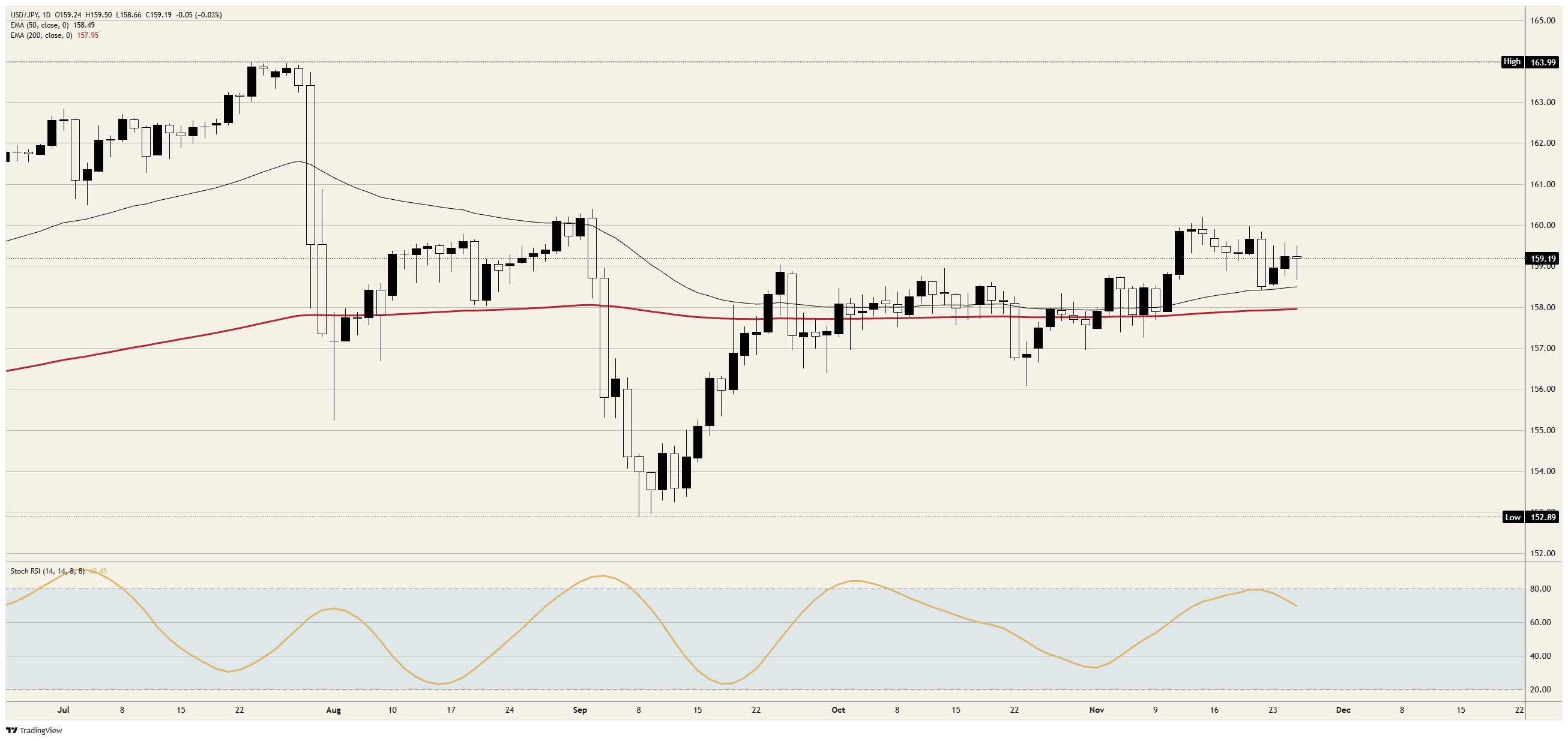
Japan's fastest services inflation since 1990 and stronger US economic figures exerted opposing pressures on USD/JPY on Wednesday, leaving the pair little changed. Trading just above its opening level of 159.00, USD/JPY has covered less than a Yen during the session. This marks an eighth session within the range established after the 13 November high.

An annual rise of 4.2% in Japan's services producer prices in October, the largest since 1990, strengthened the argument for a December rate increase by the Bank of Japan (BoJ). On 13 November, Finance Minister Katayama described the Yen's moves as rapid and one-sided. That was also the last day USD/JPY traded above 160.00; both developments help explain why it has not returned to that level.
With a December Fed rate increase already almost fully reflected in market pricing, stronger US releases offered little scope for further adjustment. Core inflation exceeded expectations, third-quarter economic growth reached a 4.3% pace versus a 3.4% forecast, and jobless claims fell to 189K. However, Treasury yields declined as investors sold technology shares, removing the usual support that robust US figures provide for USD/JPY.
Thursday's schedule begins with BoJ board member Tamura speaking at 01:00 GMT, followed by Tokyo's November Consumer Price Index (CPI) at 23:30 GMT. Inflation excluding fresh food is forecast at 3%, up from 2.6%, while the measure excluding food and energy is also expected at 3%, following 2.4%. Both readings will inform the BoJ's December decision, which shapes the Japanese side of USD/JPY's interest-rate differential.
US markets will be closed for Thanksgiving on Thursday, leaving New York on holiday when Tokyo's data are released. On Saturday, the Fed enters its pre-meeting quiet period ahead of its 8–9 December meeting, which precedes the BoJ's.
USD/JPY's highs on 12 and 13 November, a little above 160.00, marked its first trading at those levels since early September. The 50-day Exponential Moving Average (EMA), near 158.50, was reached at Friday's low, while Wednesday's low held just above it. The 200-day EMA sits near 158.00, and daily momentum has rolled over from the threshold of overbought territory.
Among the world's most actively traded currencies, the Japanese Yen (JPY) broadly reflects Japan's economic performance. More specific influences include Bank of Japan policy, the gap between Japanese and US bond yields, and traders' appetite for risk, alongside other factors.
Currency control forms part of the Bank of Japan's mandate, making its actions an important influence on the Yen. At times, the BoJ has intervened directly in currency markets, usually to weaken the currency. Such intervention is infrequent, however, because of political concerns among Japan's main trading partners. From 2013 to 2024, the BoJ's ultra-loose monetary stance weakened the Yen against its major peers as policy increasingly diverged from that of other leading central banks. More recently, a gradual withdrawal of this ultra-loose policy has provided the Yen with some support.
By maintaining ultra-loose monetary policy over the past decade, the BoJ increasingly diverged from other central banks, notably the US Federal Reserve. This helped widen the yield gap between 10-year US and Japanese bonds, supporting the US Dollar against the Japanese Yen. That differential is now narrowing as the BoJ follows its 2024 decision to move gradually away from ultra-loose policy and other major central banks cut interest rates.
The Japanese Yen's reputation as a safe-haven investment means it often attracts funds during periods of market stress. Investors are more inclined to hold the currency because of its perceived reliability and stability. As a result, market turbulence is likely to lift the Yen against currencies regarded as riskier investments.







Phone: +61 2 8036 8388
Fax: +61 2 8036 8388
Email: support@tmgm.com



The information provided on this website is of a general nature only and does not constitute personal financial advice. Before acting on any information on this website, you should consider the suitability of the information in relation to your objectives, financial situation and needs. Investing in CFDs and FX Margin Contracts carries significant risks and is not suitable for all investors. You may lose more than your initial deposit. You do not own, or have, any interest in the underlying asset. We recommend that you seek independent advice and ensure you fully understand the risks involved before trading. It is important that you read and consider the disclosure document before you acquire any product listed on the website. The information and advertisements offered on this website are not intended for use by any person in any country or jurisdiction where such use would be contrary to local laws and regulations. The Products and Services offered on this website are not intended for residents of the United States, Malaysia and Thailand.
TMGM is authorized and regulated in various jurisdictions.
Trademax Australia Limited, trading as TMGM, is regulated by the Australian Securities and Investments Commission (ASIC), AFSL no. 436416 and is located at Level 28, One International Tower, 100 Barangaroo Avenue, 2000 Sydney, NSW Australia.
Email: support@tmgm.com.au
Trademax Global Limited, trading as TMGM, is authorized and regulated by the Vanuatu Financial Services Commission (VFSC), registration number 40356 and registered at 1276, Kumul Highway, Port Vila, Vanuatu, Republic of Vanuatu.
Email: support@tmgm.com
Trademax Global Markets (SE) Limited, trading as TMGM, is authorized and regulated by the Financial Services Authority (FSA) of Seychelles, with license number SD224. The company is registered at Office No 13, Providence Estate ABIS Centre, Mahe, Seychelles.
Email: support@tmgm.com
Trademax Global Markets (International) Pty Ltd, trading as TMGM, is authorized and regulated by the Financial Services Commission, Mauritius (FSC) with license no. GB22201012, and registered at 33, Edith Cavell Street C/o IQ EQ Fund Services (Mauritius) Ltd Port Louis, 11324 Mauritius.
Email: support@tmgm.com
Copyright © TMGM. All rights reserved


