Swing Trading Meaning: What Is Swing Trading?
Swing trading is a trading approach that seeks to profit from price swings within a broader trend or range. Swing trading sits between day trading and long term investing. It usually requires less screen time than day trading, but it still needs active trade management.
A swing trade is a position opened to buy or sell a certain asset, in order to profit from price movements.
A swing trader may trade stocks, forex, gold, oil, CFDs and so on. The choice depends on market access, account size, liquidity, and risk tolerance.
Mechanism and Key Characteristics of Swing Trading
One important truth is that prices usually move in waves of ups and downs. When a market is trending upward, price often pauses, pulls back, re-balance, then breaks out again.
A swing trader tries to capture one part of that wave. The goal is to enter when a new swing may be starting, hold the trade while momentum continues, and exit when the swing reaches a target or starts to lose strength.
Swing traders use market structure analysis to understand what price is doing. Market structure helps show whether price is trending, ranging, breaking out, or reversing. They then use technical analysis to confirm whether the setup is strong enough to trade.
Important Swing Trading characteristics include:
Holding period: Swing trades are held overnight and can last from a few days to a few weeks.
Timeframe Analysis: Swing traders often use daily, 4 hour, and weekly charts to spot the bigger price move.
Trade setup: Entries often come from pullbacks, breakouts, reversals, or continuation patterns.
Risk control: Traders usually decide their stop loss and position sizing before entering the trade.
Trading costs: Spreads, commissions, slippage, and overnight financing can affect the final result, especially when a trade is held for several days.
What Is Swing Trading in Stock Market?
Swing trading in the stock market means buying or shorting stocks to capture price moves that last longer than one trading day. Traders may use individual shares, stock CFDs, ETFs, or index products, depending on their broker and account type.
Stock swing traders often focus on stocks with high liquidity (usually large caps) because it affects spread, order execution accuracy, and slippage.
When swing trading stocks, traders usually screen for trend strength, volume expansion, clean support and resistance levels, and upcoming events. Earnings dates matter because overnight gaps can jump past a planned stop loss.
Best Swing Trading Strategies
A good swing trading strategy uses price structure, momentum, defined invalidation levels and proper risk management.
The strategy must match the market environment. Trend strategies usually perform better in directional markets, while range strategies work better when price moves between support and resistance.
Pro Tip: A swing trade should have its entry, stop loss, target, and invalidation point defined before entry.
The Most Important Swing Trading Strategies include:
Trend Pullback Strategy
A trend pullback strategy means to enter a position during temporary pullback of an existing trend. You can wait for the price to pull back toward a major support level or a moving average line.
Breakout Strategy
Traders trading the breakout strategy enter a position when the price breaks above an important resistance, often the neckline of a chart pattern like Triple Top Pattern. The goal is to capture continuation after price breakout of a defined range.
A breakout is more reliable when volume expands as it breaks out of the resistance. Price action signals like a simple closing above the level, or a specific bullish candlestick like an Engulfing Candlestick near breakout level are confirmation signals that strengthens the reliability of the setup.
Range Trading Strategy
A range trading strategy is a strategy where traders find price behaviour that bounces within a set ‘support & resistance range’ or a price channel. The easily anticipated bounces means traders can confidently buy near support and sell near resistance while price remains range bound. This works best when the market has no clear trend and repeatedly reacts at the same levels.
However, this setup can become risky when volatility expands or price breaks out of the range due to any reason. Range traders need very clear stop loss rules because failed ranges can move quickly.
Support and Resistance Strategy
A support and resistance strategy uses support and resistance tools or indicators to identify the current trend direction and possible pullback zones.
For example, a trader may look for long trades when price reaches a major support level, this can be determined by raw support and resistance trend lines, fibonacci retracement or even moving averages.
Momentum Reversal Strategy
A momentum reversal strategy looks for a possible reversal in trend after a trend becomes overextended. Overextended price means that the price trend has gone on for so long that it can no longer be justified so traders expect take profits and sellers to enter the market. Traders may use MACD Divergence, RSI, or even reversal candles.
How to Learn Swing Trading: Approach, Tools, Technical Analysis, Entry and Exit Rules
To start swing trading, you need to understand the market trend, perform timeframe analysis using price charts, pick an approach or strategy, define the risk-reward ratio, and entry/exit levels before placing any trade.
If you are a complete beginner, you should focus on learning swing trading with one or two setups first instead of overwhelming yourself with many strategies.
Understand Your Swing Trading Approach
You should first find out what type of approach or strategy you want to use. Examples include trend continuation, breakout continuation, support/resistance reversal, or range trading.
The approach must also define when not to trade. Avoiding uncertain markets is essential to minimizing losses.
Use the Right Swing Trading Tools
A swing trader usually needs a broker account, charting platform with advanced tools, watchlist, economic or earnings calendar, trade journal, stock screener (if you are trading stocks), and trading calculator. These tools support decision making, so you can have enough information to make good quality trades.
Apply Technical Analysis
Technical analysis is the study of price action, volume, trend, support, resistance, and momentum. Swing traders use it to study market trends and identify entry/exit levels.
Common tools include trendlines, moving averages, RSI, MACD, Fibonacci retracements, volume, candlestick patterns, and chart patterns.
Set Entry and Exit Levels
Entry and exit levels depend on the swing trading strategy being used. For example, in a breakout strategy, a trader first looks for a setup that signals when price has broken above resistance or below support. Once the setup is confirmed, the trader can define the planned entry price, stop loss level, and profit target. These three prices form the trade’s entry and exit levels.
A real life example of a breakout swing trade will be detailed below.
Real Life Example of a Swing Trade
This BTCUSD Day Chart between March to June 2025 shows a bullish swing trade setup after a downtrend. Price forms an inverse head and shoulders pattern, then breaks above the horizontal neckline resistance. That breakout gives the trader a possible long entry.
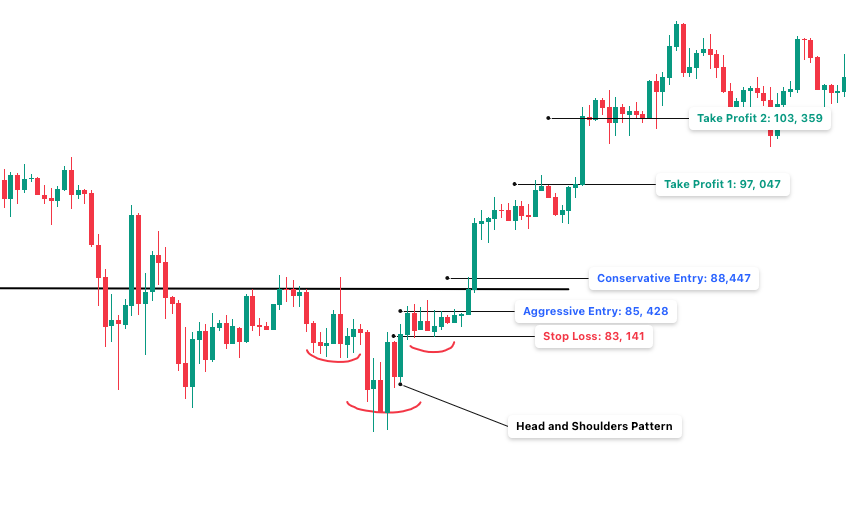
The chart shows two possible entry styles.
The aggressive entry is around ₹81,64,354 ($85,428), entered before full breakout confirmation.
The conservative entry is around ₹84,52,880 ($88,447), entered after price breaks above the neckline.
The stop loss is placed around ₹79,45,785 ($83,141). This is the invalidation level where the bullish setup starts to fail.
The first profit target is around ₹92,74,782 ($97,047). The second profit target is around ₹98,78,020 ($103,359). These targets are placed near higher resistance areas after the breakout.
Using the conservative entry, the trader risks about ₹5,07,094 ($5,306) per full unit of the asset. The potential reward is about ₹8,21,902 ($8,600) to Take Profit 1 and about ₹14,25,140 ($14,912) to Take Profit 2.
Using the aggressive entry, the trader risks less because the entry is closer to the stop loss. The trade also carries more false signal risk because it starts before the breakout is fully confirmed.
The key lesson is that a swing trade should define the setup first, then the entry, stop loss, and target levels. In this example, the pattern gives the setup, the neckline gives the confirmation area, and the stop loss controls the downside if the breakout fails.
Swing Trading vs Day Trading
Pros and Cons of Swing Trading
Swing trading can suit traders who want active market exposure without the stress of intense day trading. It still requires discipline for each trade because each trade carries market, execution, and psychological risk but you have more time window per trade.
Pros of swing trading:
Requires less screen time than day trading.
Works across stocks, forex, commodities, indices, and ETFs.
Allows more time for analysis than intraday trading.
Uses clear technical levels for entries and exits.
Can be easier to combine with a non-trading schedule.
Cons of swing trading:
Carries overnight and weekend gap risk.
Setups can take days to form.
Poor position sizing can turn normal losses into large drawdowns.
The main advantage is flexibility. The main limitation is that price can move sharply aftermarket due to news or simply while the trader is away from the screen.
Risk Management for Swing Traders
Risk management for swing traders basically means controlling the amount lost when a trade fails. It prevents you from getting wiped out from a small number of lost trades which is more common than people think.
Position Sizing Strategy
Position sizing decides how much money is risked per trade. A common method is risking only a fixed percentage of your total account.
For example, if a trader risks 1% of a ₹100,000 account, the maximum risk per trade is ₹1,000. More important to a beginner to remember is that the position size should be based on the risk reward ratio. If your risk to reward ratio (take profit amount vs stop loss amount) is about 1:2, which is standard, that means your expected profit to maximum loss on that trade should be ₹2,000 : ₹1,000.
Stop Loss Placement
A stop loss should be placed where the trade setup becomes invalid. For a long trade, that is usually right below your entry point, below a recent support level, or below a breakout retest level.
One thing that you should note is that stop losses that are too tight may be hit by normal price volatility, however stops that are too wide may create poor risk to reward and oversized losses.
Profit Target Techniques
A profit target should be set at a logical price area where the market may reach. Common target methods include next closest significant resistance level, measured moves from a chart pattern, Fibonacci extensions, fixed risk to reward ratios, or trailing stops.
Traders can also scale out of positions. This means closing part of the trade, say 50% of the trade, at the first profit target and leaving the rest to run if momentum continues. This way you get a strong risk cushion since you have already recovered your trade cost, the rest could be pure profit depending on the percentage.
Creating Your Swing Trading Plan
A swing trading plan is an extensive set of rules that defines what to trade, when to enter, where to exit, and how much to risk. It ensures consistency, troubleshooting ease and systematic improvement processes in the future.
A basic swing trading plan should include:
Market: Stocks, forex, commodities, indices, ETFs, or CFDs.
Timeframes: Main chart and confirmation chart. (Say you mainly use day charts to find setups, and use weekly charts to confirm)
Setup: Pullback, breakout, range trade, reversal, or moving average strategy.
Entry Level: Exact method to determine your entry level
Stop rule: Exact method to determine when you want to abandon the trade.
Target profit level: Price level or method used to take profit.
Risk rule: Maximum percentage risked per trade and per week.
Review process: Journal and backtesting routine.
Use a Trading Journal
All professional traders use a trading journal to record the trade plan, entry, exit, position size, reason for entry, result, and mistakes. It shows whether losses come from the strategy or from poor execution.
The best journal entries include screenshots before and after the trade. This helps the trader review whether the setup matched the plan.
Backtest Before Scaling
Backtesting means checking how a strategy would have performed on past market data. It helps traders estimate win rate, average loss, average gain, drawdown, and risk to reward.
Backtesting has some limits because historical results do not guarantee future performance. It is still useful because it shows whether the strategy has logical structure before real capital is used.
Review and Adjust the Plan
You should only change your trading plan after enough trade data exists. Changing rules after every loss makes the reliability of setup impossible to measure.
A practical review cycle is every 20 to 50 trades. That sample gives more useful information than judging a strategy after one winning or losing trade.
FAQs About Swing Trading
Is swing trading for beginners?
Swing trading can be suitable for beginners because it uses slower timeframes than day trading. Beginners should start with demo trading, simple setups, and small position sizes.
How long do swing traders usually hold trades? (swing trade kya hota hai)
Swing traders usually hold trades for several days to several weeks. The holding period depends on the setup, timeframe, target, and market volatility.
What is the best swing trading strategy?
The best swing trading strategy is the one that matches the market condition and has clear entry, exit, and risk rules. Common choices include trend pullbacks, breakouts, and support or resistance reversals.
What is the meaning of swing trading? (swing trading kya hoti hai)
Swing trading means holding a trade for several days to several weeks to capture a short to medium term price move. Traders usually use technical analysis, market structure, and risk management to decide when to enter and exit.
What is a swing trade?
A swing trade is a position opened to profit from one price swing in the market. The trade usually has a planned entry price, stop loss, and profit target before it is placed.
What is a swing trader?
A swing trader is a trader who looks for short to medium term price moves instead of very fast intraday trades or long term investments. Swing traders usually study charts, trends, support, resistance, and momentum before opening a position.