

Trading
Explore a wide range of markets with competitive pricing, deep liquidity, and advanced trading tools.
Learn More 
Platform
Trade seamlessly with TMGM's powerful platform, built for speed, precision, and a superior trading experience.
Learn More Trading Platform
Academy
Learn the fundamentals of trading with beginner-friendly resources, including guides, webinars, and market insights.
Learn More News & Analysis
Get real-time market updates and expert analysis to stay ahead of trading opportunities
Learn More News & Analysis
About
Learn what sets TMGM apart — our global presence, regulatory strength, and commitment to innovation in trading.
Learn More Why Choose TMGM
Sponsorship
0.5560: Key Support Level for NZD/USD
- 0.5600 in sight as New Zealand Dollar rebounds against US Dollar after retesting 18-month low of 0.5564
- Majorities in both the House and the Senate go to the Democrats.
- October US ADP Employment Change and ISM Services PMI releases are next on investors’ radar.
0.5600 is the New Zealand Dollar’s (NZD) trading level against the US Dollar (USD), holding its early recovery. During Wednesday’s European session, the Kiwi pair retains its rebound after retesting the 18-month low of 0.5564.
Uncertainty is expected to persist over the Kiwi pair’s outlook. Following the United States (US) midterm election results, which gave Democrats majorities in both the House and the Senate, the US Dollar has begun to recover.

At the time of writing, a 0.34% decline leaves the US Dollar Index (DXY) near 101.55. The index, which tracks the Greenback against six major currencies, has nonetheless rebounded substantially from its intraday low of 101.25.
With market participants already pricing in Democratic victories in both chambers of the federal legislature, the US Dollar had lagged over the past few weeks.
Due at 13:15 GMT, October’s US ADP Employment Change report will be a focus for investors. The US agency is expected to report 69K new private-sector hires, down from September’s 90K.
October’s US ISM Services PMI will draw financial markets’ attention later in the day. Expectations put the Services PMI at 54.8, slightly below the previous 54.9 reading.
0.5645 EMA Caps NZD/USD: Technical Analysis
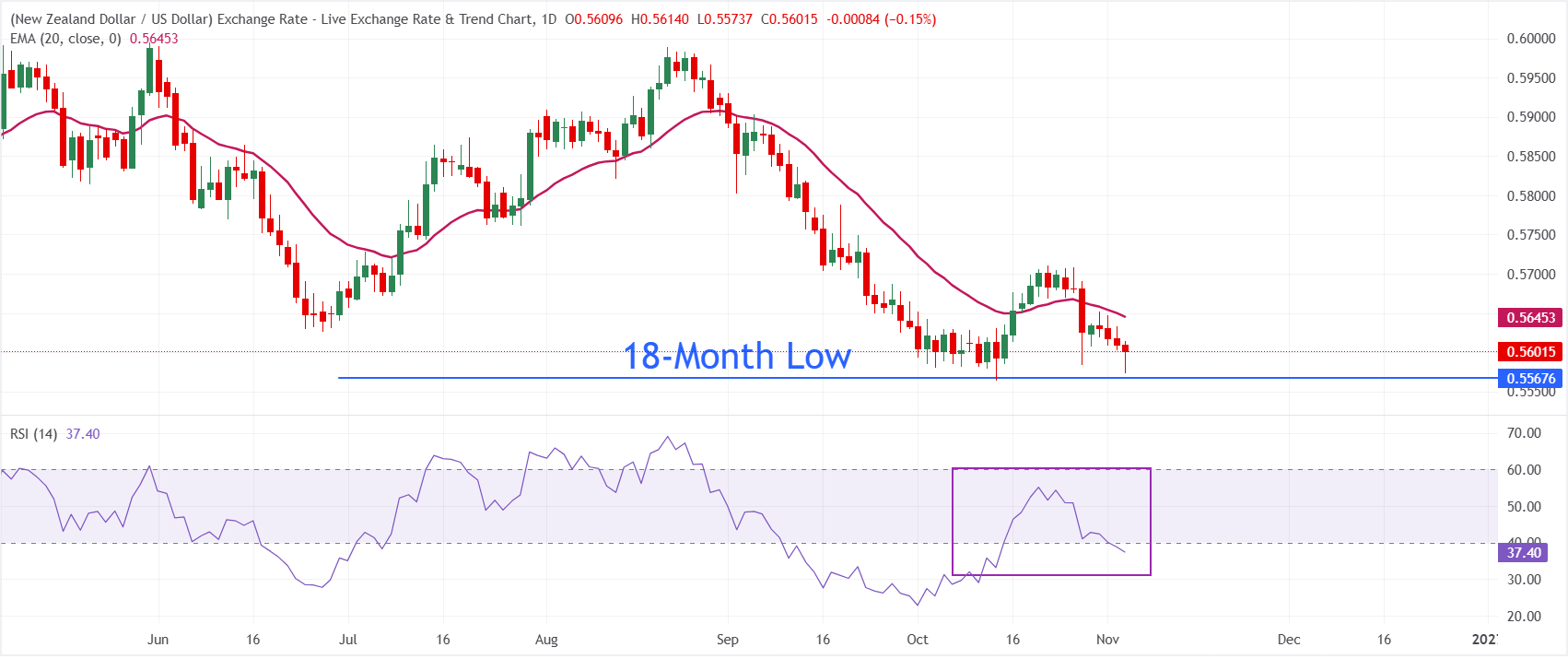
At 0.5601 on the daily chart, NZD/USD retains a bearish near-term bias. Spot remains beneath the 20-period exponential moving average (EMA) at 0.5645. This short-term EMA is limiting gains, suggesting that rebounds are likely to face difficulty while the pair stays below it. A Relative Strength Index (RSI) reading of 37 also points to sustained downward pressure, though not to an oversold extreme.
The 20-period EMA near 0.5645 provides the first upside resistance. Only a sustained move above it would ease the prevailing bearish bias and open the way for a more substantial recovery. On the downside, the 18-month low of 0.5564 provides key support. A decisive breach of 0.5564 would leave 0.5500 exposed.
(The technical analysis of this story was written with the help of an AI tool. Know more.)
Economic Data Indicator
ADP Employment Change Report
Released by Automatic Data Processing Inc., the largest US payroll processor, ADP Employment Change tracks changes in the number of people employed in the US private sector. An increase generally supports consumer spending and stimulates economic growth. A high reading is therefore traditionally regarded as bullish for the US Dollar (USD); a low reading is considered bearish.
Explore further.Next publication: Wed 04 Nov 2026 13:15
Release frequency: Every month
Consensus forecast: 69K
Prior reading: 90K
Data source: ADP Research Institute
ADP employment figures often signal what traders can expect from Nonfarm Payrolls. As America’s largest payroll provider, ADP publishes a report whose correlation with the Bureau of Labor Statistics release, usually issued two days later, makes it a widely watched precursor. Although the two series track each other closely overall, sizeable divergences can occur in individual months. FX traders also monitor ADP for the same reason they follow NFP: sustained, strong employment growth adds to inflationary pressure, increasing the likelihood of a Fed interest rate rise. A reading above consensus therefore tends to support the USD.
POPULAR ARTICLES
11.3480 in sight as British Pound rallies rapidly against US Dollar – UOB2Slower domestic growth keeps Indonesian Rupiah under pressure3Japan’s Kihara: Market moves will be monitored with a strong sense of urgency4US Dollar rebound from post-election reversal trims Japanese Yen gains5Forex Today: Democrats take control of Congress, putting US Dollar under pressure6Euro: EUR draws support from robust data and ECB vigilance – BNY7XAG/USD surges in near-vertical move: Silver Price Forecast as Democrats gain control of Houses8Equities: Democratic gains prompt a global market response – Deutsche Bank90.5560: Key Support Level for NZD/USD


Get Started!
Sign up and access the Global Markets in less than 3 minutes

Connect With Us









Contacts
Phone: +61 2 8036 8388
Fax: +61 2 8036 8388
Email: support@tmgm.com



The information provided on this website is of a general nature only and does not constitute personal financial advice. Before acting on any information on this website, you should consider the suitability of the information in relation to your objectives, financial situation and needs. Investing in CFDs and FX Margin Contracts carries significant risks and is not suitable for all investors. You may lose more than your initial deposit. You do not own, or have, any interest in the underlying asset. We recommend that you seek independent advice and ensure you fully understand the risks involved before trading. It is important that you read and consider the disclosure document before you acquire any product listed on the website. The information and advertisements offered on this website are not intended for use by any person in any country or jurisdiction where such use would be contrary to local laws and regulations. The Products and Services offered on this website are not intended for residents of the United States, Malaysia and Thailand.
TMGM is authorized and regulated in various jurisdictions.
Trademax Australia Limited, trading as TMGM, is regulated by the Australian Securities and Investments Commission (ASIC), AFSL no. 436416 and is located at Level 28, One International Tower, 100 Barangaroo Avenue, 2000 Sydney, NSW Australia.
Email: support@tmgm.com.au
Trademax Global Limited, trading as TMGM, is authorized and regulated by the Vanuatu Financial Services Commission (VFSC), registration number 40356 and registered at 1276, Kumul Highway, Port Vila, Vanuatu, Republic of Vanuatu.
Email: support@tmgm.com
Trademax Global Markets (SE) Limited, trading as TMGM, is authorized and regulated by the Financial Services Authority (FSA) of Seychelles, with license number SD224. The company is registered at Office No 13, Providence Estate ABIS Centre, Mahe, Seychelles.
Email: support@tmgm.com
Trademax Global Markets (International) Pty Ltd, trading as TMGM, is authorized and regulated by the Financial Services Commission, Mauritius (FSC) with license no. GB22201012, and registered at 33, Edith Cavell Street C/o IQ EQ Fund Services (Mauritius) Ltd Port Louis, 11324 Mauritius.
Email: support@tmgm.com
Copyright © TMGM. All rights reserved