

Trading
Explore a wide range of markets with competitive pricing, deep liquidity, and advanced trading tools.
Learn More 
Platform
Trade seamlessly with TMGM's powerful platform, built for speed, precision, and a superior trading experience.
Learn More Trading Platform
Academy
Learn the fundamentals of trading with beginner-friendly resources, including guides, webinars, and market insights.
Learn More News & Analysis
Get real-time market updates and expert analysis to stay ahead of trading opportunities
Learn More News & Analysis
About
Learn what sets TMGM apart — our global presence, regulatory strength, and commitment to innovation in trading.
Learn More Why Choose TMGM
Sponsorship
0.6610: AUD/USD Price Forecast as Bids Emerge Near Fresh YTD Low
- Near 0.6710, the Australian Dollar rebounds against a retreating US Dollar.
- After reaching a fresh 19-month peak near 104.00, the US Dollar Index pulls back.
- Another RBA interest rate increase faces a higher hurdle following weak Australian jobs figures.
AUD/USD is trading almost unchanged around 0.6710 in the European session. The Australian Dollar (AUD) has recovered nearly all its early losses against the US Dollar (USD), having touched a fresh year-to-date (YTD) low near 0.6610. A reversal lower in the US Dollar is driving the pair’s rebound.

Down 0.2% near 103.60 at the time of writing, the US Dollar Index (DXY) is correcting from a fresh 19-month high near 104.00. The index tracks the Greenback against six major currencies.
US Dollar Performance Today
Today’s percentage moves in the US Dollar (USD) against the major currencies listed appear in the table below. Its largest loss was against the New Zealand Dollar.
| USD | EUR | GBP | JPY | CAD | AUD | NZD | CHF | |
|---|---|---|---|---|---|---|---|---|
| USD | -0.28% | -0.15% | 0.37% | -0.15% | 0.02% | -0.66% | -0.14% | |
| EUR | 0.28% | 0.13% | 0.67% | 0.12% | 0.31% | -0.38% | 0.13% | |
| GBP | 0.15% | -0.13% | 0.55% | -0.01% | 0.18% | -0.51% | 0.00% | |
| JPY | -0.37% | -0.67% | -0.55% | -0.54% | -0.35% | -1.06% | -0.53% | |
| CAD | 0.15% | -0.12% | 0.00% | 0.54% | 0.18% | -0.51% | 0.02% | |
| AUD | -0.02% | -0.31% | -0.18% | 0.35% | -0.18% | -0.67% | -0.18% | |
| NZD | 0.66% | 0.38% | 0.51% | 1.06% | 0.51% | 0.67% | 0.54% | |
| CHF | 0.14% | -0.13% | -0.00% | 0.53% | -0.02% | 0.18% | -0.54% |
Percentage moves between major currencies are displayed in the heat map. Select the base currency in the left-hand column and the quote currency in the top row. Selecting the US Dollar on the left and following that row across to the Japanese Yen, for instance, gives the percentage change for USD (base)/JPY (quote) in the corresponding cell.
Confidence in financial markets that the Federal Reserve (Fed) will raise interest rates at consecutive meetings in the near term continues to underpin a firm US Dollar outlook.
According to analysts at MUFG/BTMU, “almost all Fed officials have judged that additional rate hikes would likely be appropriate in the months ahead to bring inflation back to the 2% target.” Their assessment is that “markets continue to fully price in a 25bps hike in December, three 25bps hikes by June next year, leaving elevated US rates and a resilient Dollar”.
For the Australian Dollar, October’s soft employment figures have made another interest rate increase by the Reserve Bank of Australia (RBA) harder to justify.
Australian labour market weakness dims prospects for another RBA hike
Rabobank analysts describe the Australian economy now facing the RBA as one where “unemployment is spiking (from 4.7% to 4.9%) and jobs growth was -43.5K vs. an expected +25K,” which they see as “making further rate hikes less likely.” However, they warn that the October CPI release due next week “could still show a sharp headline lift,” keeping the policy outlook finely balanced despite weaker labour figures curbing expectations of further tightening.
The case for a hawkish RBA had already weakened following publication of the October monetary policy meeting minutes. Those minutes suggested policymakers were reluctant to support further rate increases amid mounting economic concerns.
0.6861 EMA Caps AUD/USD: Technical Analysis
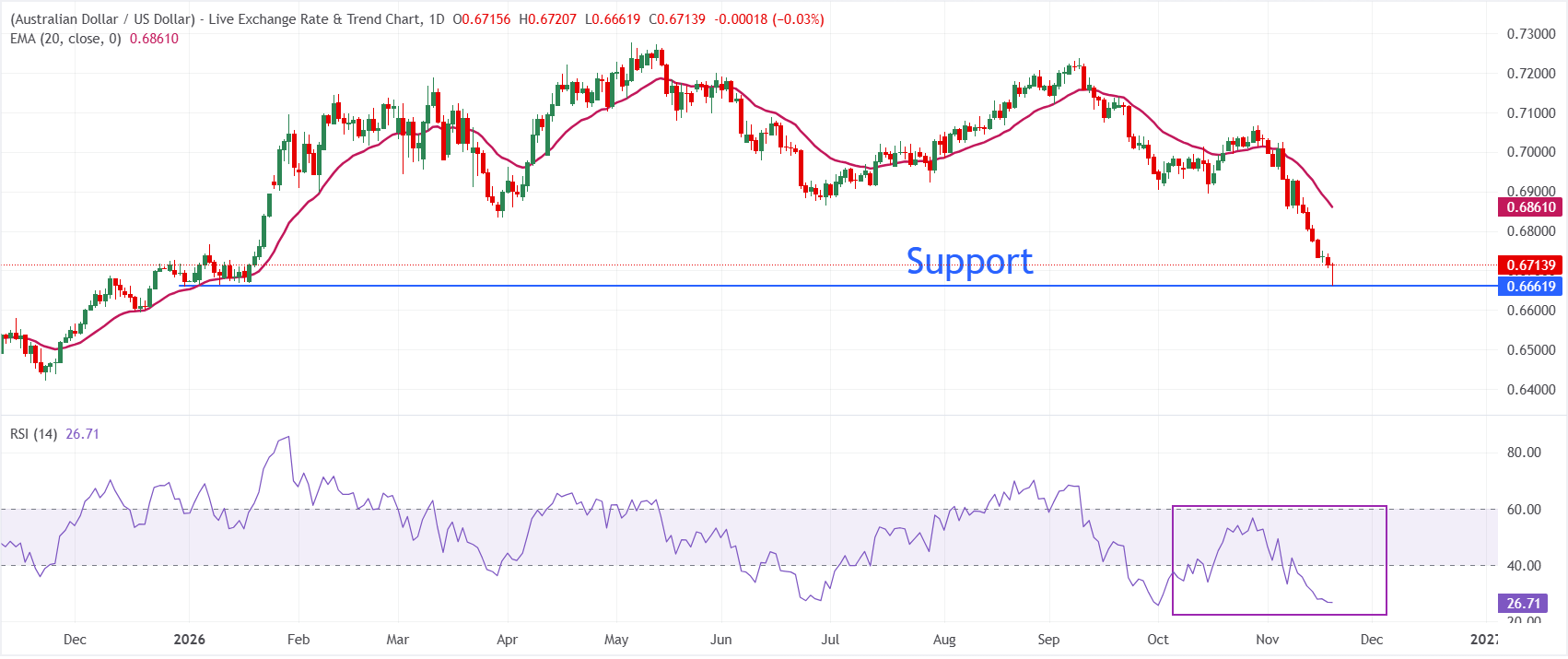
At 0.6714 on the daily chart, AUD/USD continues to fall below its 20-day exponential moving average (EMA) of 0.6861. That average now limits the upside, reinforcing the near-term bearish bias. Meanwhile, the Relative Strength Index (14) has dropped to around 27, hovering near oversold territory. Selling pressure still dominates, but the indicator suggests the decline could begin to slow if sellers’ conviction weakens at these lower levels.
A daily close above the 20-day EMA at 0.6861, the first resistance level, would be required to relieve immediate bearish pressure and point to scope for a corrective rebound. On the downside, initial support lies at the intraday low of 0.6662. A breach would clear the way for further losses towards 0.6600.
(The technical analysis of this story was written with the help of an AI tool. Know more.)
Economic Data Indicator
Seasonally Adjusted Unemployment Rate
Published by the Australian Bureau of Statistics, the Unemployment Rate expresses unemployed workers as a percentage of the total civilian labour force. A rise signals a lack of growth in Australia’s labour market and weakness in its economy. A lower reading is regarded as bullish for the Australian Dollar (AUD); a higher reading is regarded as bearish.
Continue reading.Latest release: Thu 19 November 2026 00:30
Release frequency: Monthly
Reported figure: 4.9%
Consensus forecast: 4.7%
Prior reading: 4.7%
Data source: Australian Bureau of Statistics
About 15 days after month-end, the Australian Bureau of Statistics (ABS) releases its labour market overview. Among the trends covered, the unemployment rate attracts close attention. Its strong correlation with consumer spending and inflation offers insight into broader economic conditions. Although it is a lagging indicator, it influences interest rate decisions by the Reserve Bank of Australia (RBA), which in turn move the Australian dollar. A favourable reading typically supports the AUD.
POPULAR ARTICLES
10.6610: AUD/USD Price Forecast as Bids Emerge Near Fresh YTD Low2Crypto Market Pulse: Anthropic IPO optimism at risk from ETF outflows and macro headwinds3Euro losses narrow as risk appetite picks up and Oil prices stay low4Below 3800: Gold remains under pressure – OCBC5Silver price today: FXStreet data point to gains in silver6Five-day losing streak as equities sell-off continues – Deutsche Bank7Around $45.00: Silver Price Forecast as XAG/USD Remains Subdued on Fed Rate-Hike Bets8US Dollar resilience underpinned by hawkish regime – TD Securities9Euro strengthens against Canadian Dollar as ECB Lagarde’s speech approaches


Get Started!
Sign up and access the Global Markets in less than 3 minutes

Connect With Us









Contacts
Phone: +61 2 8036 8388
Fax: +61 2 8036 8388
Email: support@tmgm.com



The information provided on this website is of a general nature only and does not constitute personal financial advice. Before acting on any information on this website, you should consider the suitability of the information in relation to your objectives, financial situation and needs. Investing in CFDs and FX Margin Contracts carries significant risks and is not suitable for all investors. You may lose more than your initial deposit. You do not own, or have, any interest in the underlying asset. We recommend that you seek independent advice and ensure you fully understand the risks involved before trading. It is important that you read and consider the disclosure document before you acquire any product listed on the website. The information and advertisements offered on this website are not intended for use by any person in any country or jurisdiction where such use would be contrary to local laws and regulations. The Products and Services offered on this website are not intended for residents of the United States, Malaysia and Thailand.
TMGM is authorized and regulated in various jurisdictions.
Trademax Australia Limited, trading as TMGM, is regulated by the Australian Securities and Investments Commission (ASIC), AFSL no. 436416 and is located at Level 28, One International Tower, 100 Barangaroo Avenue, 2000 Sydney, NSW Australia.
Email: support@tmgm.com.au
Trademax Global Limited, trading as TMGM, is authorized and regulated by the Vanuatu Financial Services Commission (VFSC), registration number 40356 and registered at 1276, Kumul Highway, Port Vila, Vanuatu, Republic of Vanuatu.
Email: support@tmgm.com
Trademax Global Markets (SE) Limited, trading as TMGM, is authorized and regulated by the Financial Services Authority (FSA) of Seychelles, with license number SD224. The company is registered at Office No 13, Providence Estate ABIS Centre, Mahe, Seychelles.
Email: support@tmgm.com
Trademax Global Markets (International) Pty Ltd, trading as TMGM, is authorized and regulated by the Financial Services Commission, Mauritius (FSC) with license no. GB22201012, and registered at 33, Edith Cavell Street C/o IQ EQ Fund Services (Mauritius) Ltd Port Louis, 11324 Mauritius.
Email: support@tmgm.com
Copyright © TMGM. All rights reserved