

Trading
Explore a wide range of markets with competitive pricing, deep liquidity, and advanced trading tools.
Learn More 
Platform
Trade seamlessly with TMGM's powerful platform, built for speed, precision, and a superior trading experience.
Learn More Trading Platform
Academy
Learn the fundamentals of trading with beginner-friendly resources, including guides, webinars, and market insights.
Learn More News & Analysis
Get real-time market updates and expert analysis to stay ahead of trading opportunities
Learn More News & Analysis
About
Learn what sets TMGM apart — our global presence, regulatory strength, and commitment to innovation in trading.
Learn More Why Choose TMGM
Sponsorship
Five straight weekly losses: Bitcoin may face more turbulence ahead
Support remains elusive for Bitcoin (BTC), which has fallen below $70,000 as several headwinds threaten further losses for the Crypto King. The widely expected “Uptober” rally never arrived. Instead, sustained selling and extensive liquidations have strengthened the “Rektober” narrative, describing an October dominated by steep losses rather than the gains traditionally associated with the month.
The decline has continued into November. Muted institutional demand, defensive derivatives positioning and worsening on-chain indicators point to weakening market confidence.
Persistent inflation worries, US Dollar (USD) strength, the Binance hack and MSCI’s decision to exclude major Bitcoin treasury holding companies from its global indices add to the bearish outlook. These pressures on risk-sensitive assets raise the risk of a major storm approaching the Crypto King.

Persistent inflation brings rate rises back into focus
Liquidity conditions have a strong influence on the largest cryptocurrency by market capitalisation, leaving it exposed to monetary tightening. As interest rates rise and liquidity shrinks, the opportunity cost of holding non-yielding assets such as BTC increases. Investors consequently favour safe-haven alternatives, including the Greenback and US Treasury bonds.
November’s macroeconomic conditions have broadly supported the Federal Reserve (Fed) in its efforts to keep monetary policy relatively restrictive. That backdrop has underpinned USD while weighing on risk assets.
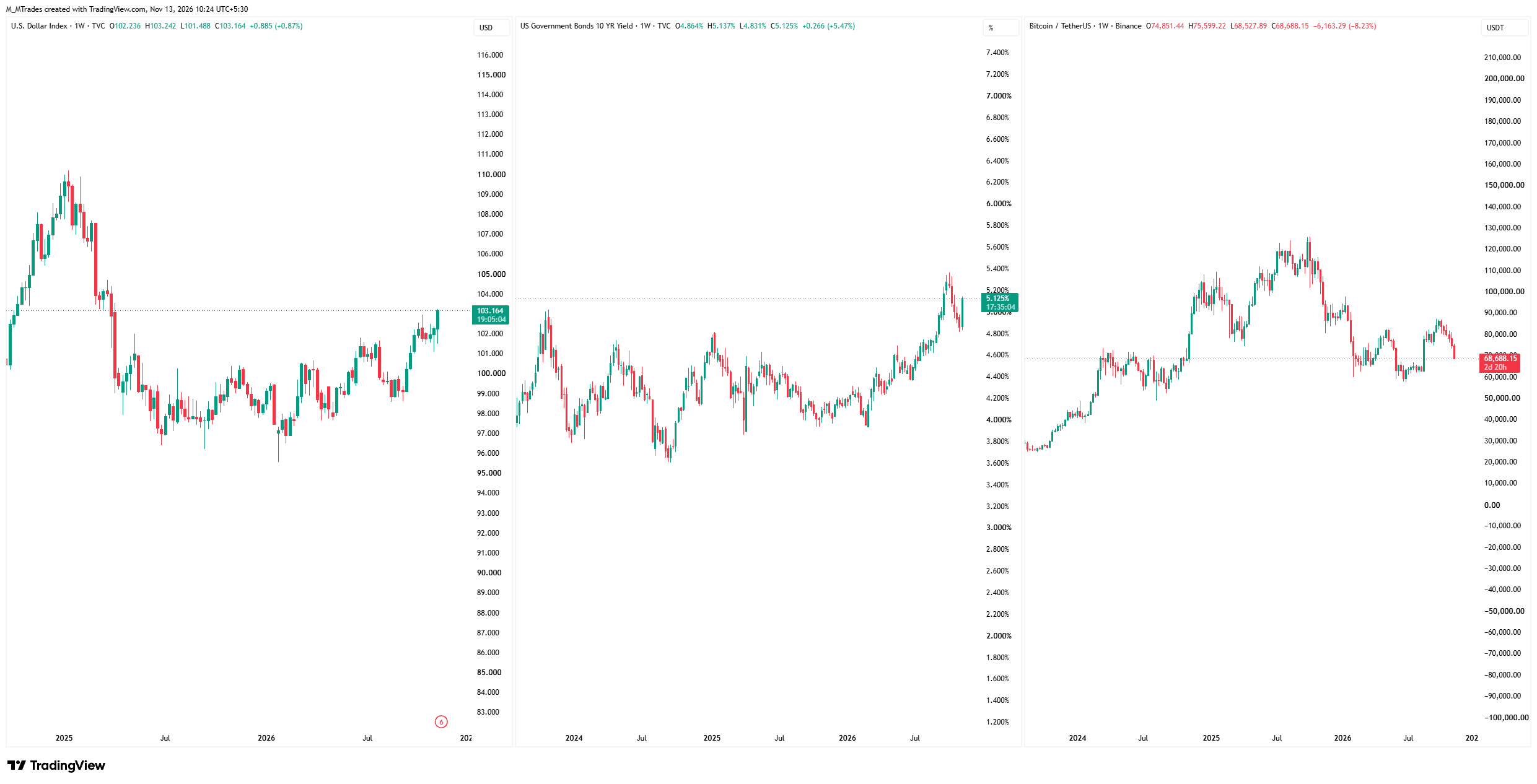
Released in November’s first week, October’s stronger-than-forecast US employment figures showed that the US labour market continues to demonstrate resilience. This reduced the central bank’s incentive to loosen policy. Subsequently, October US Consumer Price Index (CPI) figures exceeded expectations, reinforcing expectations of tighter monetary conditions.
The CPI release in particular increased the likelihood of a Fed interest rate rise in December. According to Fed Governor Christopher Waller, an upside surprise in core CPI could lead him to consider a larger 50-basis-point (bps) increase at the December 8–9 policy meeting. Restricting the rise to 25 bps could jeopardise the Fed’s credibility, he added.
Against mounting inflation concerns, this hawkish position has lifted 10-year US Treasury yields and the DXY Index, putting pressure on the Crypto King’s price.
Institutional buying demand fades
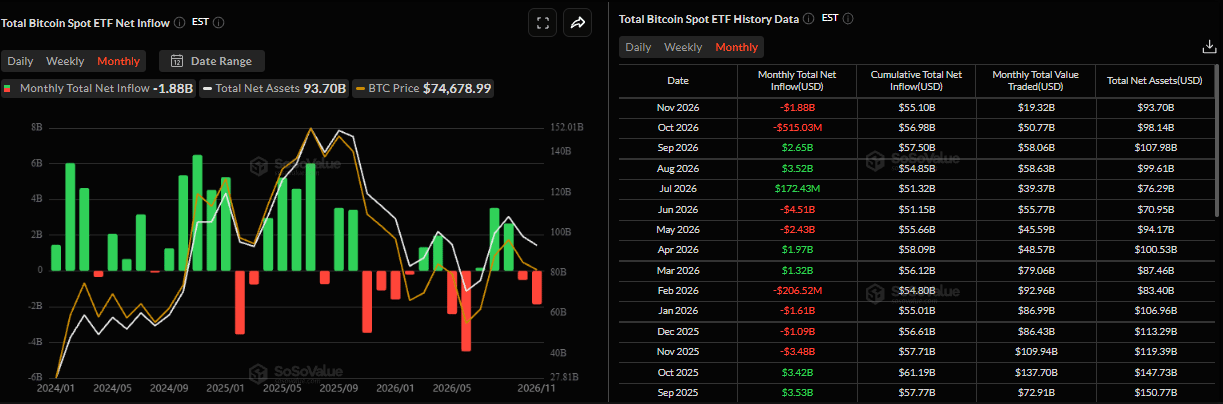
Among institutional investors, spot buying demand is losing strength too. Net withdrawals from US-listed spot Bitcoin Exchange Traded Funds (ETFs) exceeded $500 million in October. Outflows have accelerated to $1.88 billion so far in November, the largest monthly total since June.
Strong inflows in August and September contrast with the current deterioration in investor sentiment and demand. The reversal has eliminated an important source of steady buying that previously absorbed selling and softened its impact.
MSCI exclusions pressure major corporate Bitcoin holders
Another setback this week confronts corporate demand, historically a buffer for Bitcoin during steep corrections. Global index provider MSCI confirmed on Wednesday that Strategy would be excluded from its global indices, the MSCI USA Index and the MSCI World Index. With 850,364 BTC currently on its balance sheet, Strategy is Bitcoin’s largest corporate holder.
To align their portfolios with the changes, index funds following the affected benchmarks may have to sell Strategy shares by November 30. The exclusion directly concerns Strategy’s shares, not its Bitcoin holdings. Nevertheless, its status as the largest Bitcoin treasury means the repercussions could reach the cryptocurrency itself.
Tokyo-listed Metaplanet, another company that accumulates and holds BTC, also appeared on the exclusion list. Its removal from the MSCI Japan Small Cap Index takes effect on December 1.
Such potentially forced share disposals could pressure these BTC-holding companies’ share prices and indirectly dent sentiment towards BTC. The companies provide institutions with a route to Bitcoin exposure. Prolonged selling of their shares could therefore weaken confidence in corporate Bitcoin treasury strategies, creating a further obstacle to BTC’s recovery.
High leverage increases exposure to sharp swings
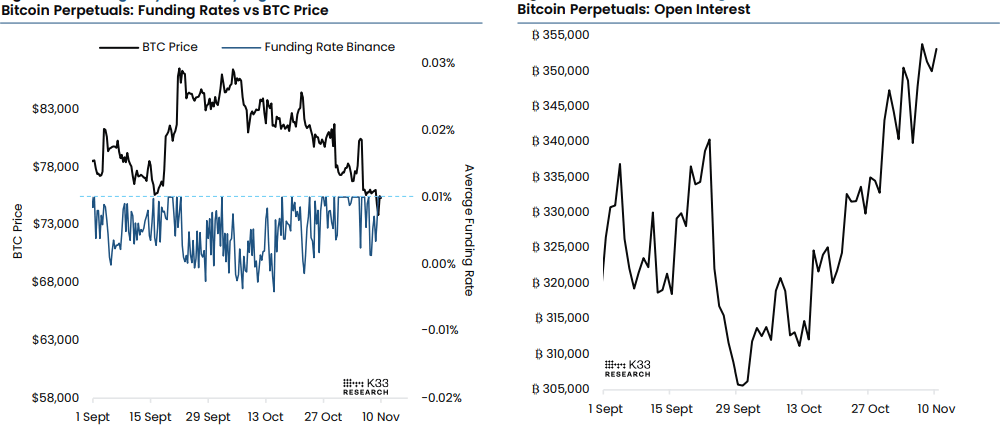
Continued leverage accumulation in derivatives leaves the likelihood of abrupt price swings elevated for the Crypto King.
At 353,000 BTC this week, Open Interest (OI) in BTC perpetual futures sits in the 99th percentile of readings from the past two years. Annualised funding rates, meanwhile, averaged 8.4% over the past week. This signals continued demand for long exposure while BTC tests important support levels.
Comparable levels of open interest have historically accompanied price extremes and substantial volatility, frequently ahead of sharp reversals. High leverage supported rallies in June and August, but positioning now looks less directional. That leaves significant room for swings either way. A break lower could force substantial long liquidations; a rebound could prompt short covering. In either case, the unwinding of leveraged positions could magnify price movements.
Regulatory catalysts absent as prices decline
Fresh concerns for the cryptocurrency industry follow the US political shift, with Democrats in control of both the House and Senate. The switch in congressional control could hold up or delay key legislation affecting the sector, including the CLARITY Act, which seeks to create a clearer regulatory framework for digital assets.
Uncertainty has also increased as investors weigh how a Democrat-controlled Congress could influence crypto and AI regulation when the new Congress convenes on January 3, 2027.
With no immediate bullish catalyst and the possibility of a longer wait for regulatory clarity, market sentiment remains under pressure.
Stolen BTC and ETH remain a market threat
Sentiment remains weighed down by the late October security breach at Binance, the largest centralised cryptocurrency exchange. The exchange has nevertheless covered the entire financial impact and had restored affected users’ balances by Thursday. It used its corporate treasury, Secure Asset Fund for Users (SAFUs) fund and other internal resources.
Attackers reportedly still control roughly $3 billion in stolen assets, however. Most are BTC and ETH, which are difficult to freeze. Renewed movement of those funds could trigger another wave of FUD (fear, uncertainty, and doubt) across the market.
On-chain liquidity: Available buying capital shrinks
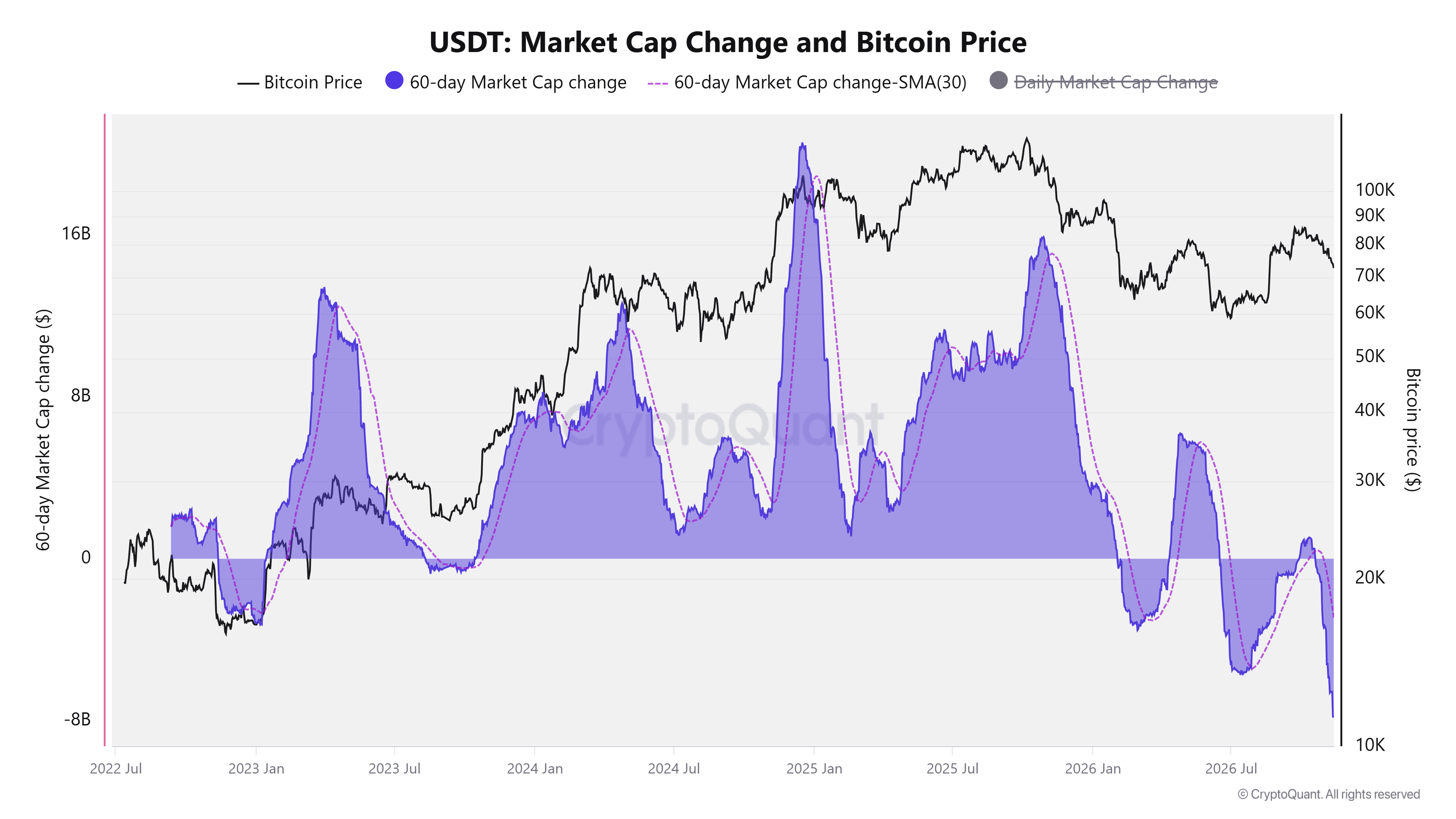
The fastest 60-day contraction in USDT stablecoin liquidity since 2022 is under way, according to CryptoQuant on-chain data.
As of Thursday, Tether’s market capitalisation had fallen $7.81 billion over the past 60 days, as the chart below illustrates. This is its biggest contraction since mid-2022, surpassing the $3.15 billion post-FTX exchange redemption level recorded on December 31, 2022.
Stablecoin supply measures the liquidity, or dry powder, readily available to the cryptocurrency market. A reduction leaves less capital able to enter BTC, constraining new buying demand.
In the current market cycle, Bitcoin rallies have accompanied expansion in stablecoin supply. The latest contraction therefore adds another barrier to recovery.
Technical analysis: Key support zone gives way
More than 13% has been lost across five consecutive weeks of declines as the Crypto King corrects from early October. Last week’s close was below the key 50-week Simple Moving Average (SMA) at $75,099. This week, BTC has shed more than 8.2% and is trading below $69,000 on Friday.
A continuation of the correction could take BTC towards the 200-week SMA at $67,998. Closing the week below that level would point to a further decline towards the key psychological threshold of $60,000.
At 41, the weekly Relative Strength Index (RSI) is below its neutral 50 mark, signalling weakening bullish momentum. This week’s red bar on the Moving Average Convergence Divergence (MACD) histogram adds weight to the bearish outlook.
Alternatively, a BTC rebound could reach the 50-week SMA at $75,099. A close above that level followed by sustained trading above it could open the way towards the 61.8% Fibonacci retracement at $78,661. That retracement is drawn from the August 2024 low of $49,000 to the October 2025 record high of $126,199.
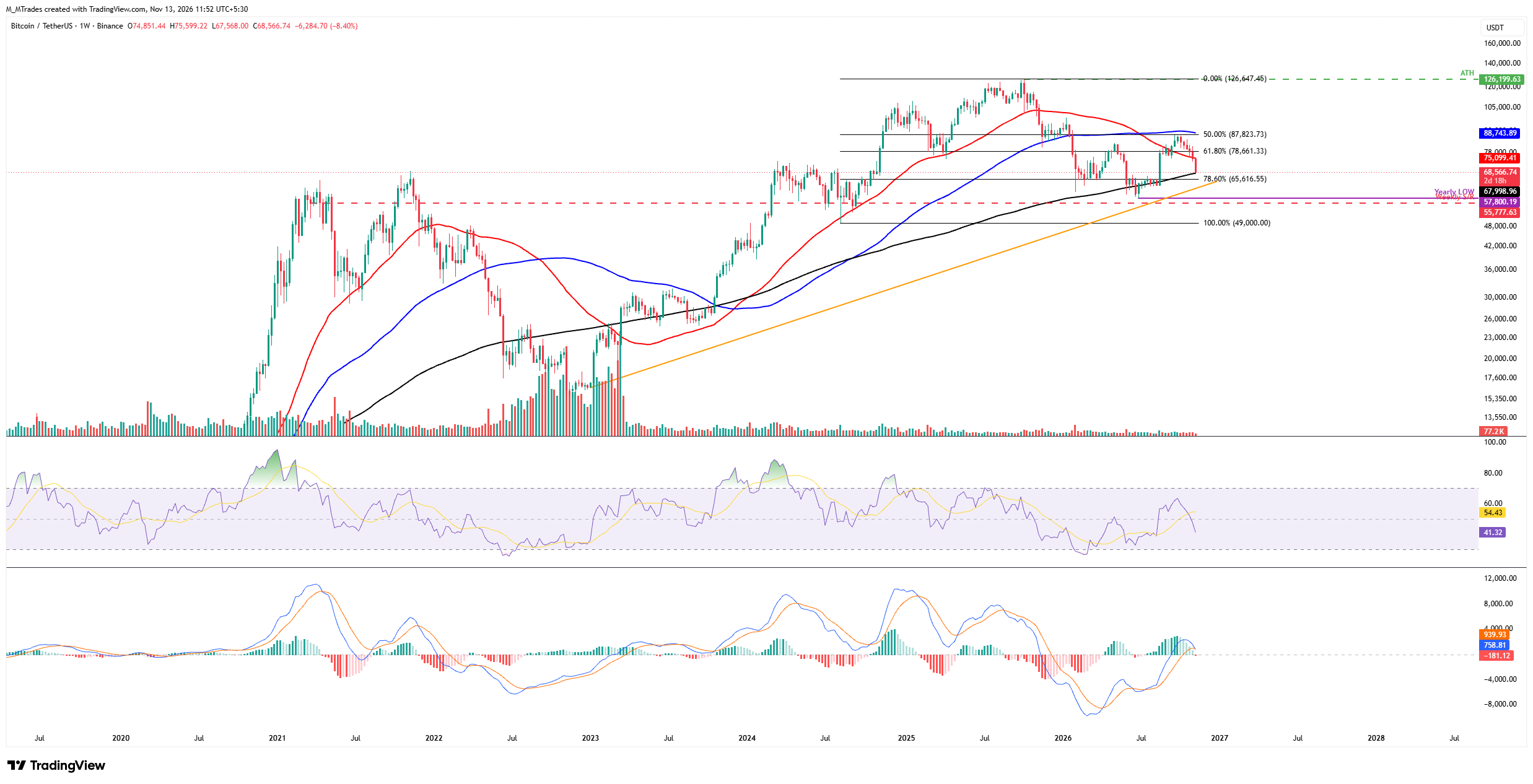
Together, current conditions suggest a growing risk of a major storm for the Crypto King. Downside risks for Bitcoin are likely to stay elevated until institutional demand steadies, liquidity improves and leveraged positions reset. A lasting recovery therefore remains difficult, with a deeper correction more likely.
FAQs on Bitcoin, altcoins and stablecoins
Designed to function as money, Bitcoin is a virtual currency and the largest cryptocurrency by market capitalisation. No single person, group or entity can control this payment method, removing the need for third parties to participate in financial transactions.
The term altcoin covers cryptocurrencies other than Bitcoin. Some also exclude Ethereum, however, because these two cryptocurrencies are the source of forks. Under that interpretation, Litecoin is the first altcoin: it was forked from the Bitcoin protocol and is therefore an “improved” version of it.
A stablecoin is a cryptocurrency intended to maintain a stable price, backed by reserves of the asset it represents. Its value is pegged to a commodity or financial instrument, such as the US Dollar (USD), while an algorithm or demand regulates supply. Stablecoins primarily provide an entry and exit route for investors seeking to trade and invest in cryptocurrencies. They also offer a way to store value, as cryptocurrencies are generally subject to volatility.
By comparing Bitcoin’s market capitalisation with the combined market capitalisation of all cryptocurrencies, Bitcoin dominance indicates investor interest in Bitcoin. BTC dominance is typically high before and during a bull run, when investors favour relatively stable cryptocurrencies with large market capitalisations, such as Bitcoin. A decline usually signals that investors are shifting capital and/or profits into altcoins in pursuit of higher returns. This often sparks a surge in altcoin rallies.
POPULAR ARTICLES
1GBP/USD: Pound fails to gain despite strong UK data – Societe Generale21.4250 area: Canadian Dollar holds near one-month low as USD bulls look to US PPI3December BoJ hike: Japan’s trade and inflation data lend support – DBS4Five straight weekly losses: Bitcoin may face more turbulence ahead5Australian Dollar: RBA constraints and vulnerability to AI – MUFG6EUR/USD: Fed hawks outpace their ECB counterparts – ING7Japanese Yen: Structural Support Meets Near-Term Upside Limits – Commerzbank8US Dollar: Hawkish Fed underpins resilience – TD Securities9Euro posts modest gains against British Pound, stays range-bound amid market caution


Get Started!
Sign up and access the Global Markets in less than 3 minutes

Connect With Us









Contacts
Phone: +61 2 8036 8388
Fax: +61 2 8036 8388
Email: support@tmgm.com



The information provided on this website is of a general nature only and does not constitute personal financial advice. Before acting on any information on this website, you should consider the suitability of the information in relation to your objectives, financial situation and needs. Investing in CFDs and FX Margin Contracts carries significant risks and is not suitable for all investors. You may lose more than your initial deposit. You do not own, or have, any interest in the underlying asset. We recommend that you seek independent advice and ensure you fully understand the risks involved before trading. It is important that you read and consider the disclosure document before you acquire any product listed on the website. The information and advertisements offered on this website are not intended for use by any person in any country or jurisdiction where such use would be contrary to local laws and regulations. The Products and Services offered on this website are not intended for residents of the United States, Malaysia and Thailand.
TMGM is authorized and regulated in various jurisdictions.
Trademax Australia Limited, trading as TMGM, is regulated by the Australian Securities and Investments Commission (ASIC), AFSL no. 436416 and is located at Level 28, One International Tower, 100 Barangaroo Avenue, 2000 Sydney, NSW Australia.
Email: support@tmgm.com.au
Trademax Global Limited, trading as TMGM, is authorized and regulated by the Vanuatu Financial Services Commission (VFSC), registration number 40356 and registered at 1276, Kumul Highway, Port Vila, Vanuatu, Republic of Vanuatu.
Email: support@tmgm.com
Trademax Global Markets (SE) Limited, trading as TMGM, is authorized and regulated by the Financial Services Authority (FSA) of Seychelles, with license number SD224. The company is registered at Office No 13, Providence Estate ABIS Centre, Mahe, Seychelles.
Email: support@tmgm.com
Trademax Global Markets (International) Pty Ltd, trading as TMGM, is authorized and regulated by the Financial Services Commission, Mauritius (FSC) with license no. GB22201012, and registered at 33, Edith Cavell Street C/o IQ EQ Fund Services (Mauritius) Ltd Port Louis, 11324 Mauritius.
Email: support@tmgm.com
Copyright © TMGM. All rights reserved