

Trading
Explore a wide range of markets with competitive pricing, deep liquidity, and advanced trading tools.
Learn More 
Platform
Trade seamlessly with TMGM's powerful platform, built for speed, precision, and a superior trading experience.
Learn More Trading Platform
Academy
Learn the fundamentals of trading with beginner-friendly resources, including guides, webinars, and market insights.
Learn More News & Analysis
Get real-time market updates and expert analysis to stay ahead of trading opportunities
Learn More News & Analysis
About
Learn what sets TMGM apart — our global presence, regulatory strength, and commitment to innovation in trading.
Learn More Why Choose TMGM
Sponsorship
$4,100 surpassed: Gold climbs as NASDAQ 100 plunges and December hike bets recede
- 1% gain takes Gold above $4,100 as NASDAQ 100 slumps 5.9%.
- 4.829% US 10-year Treasury yield follows a six-basis-point decline.
- 66% odds of a December Fed hike, down from 82%, as NFP approaches.
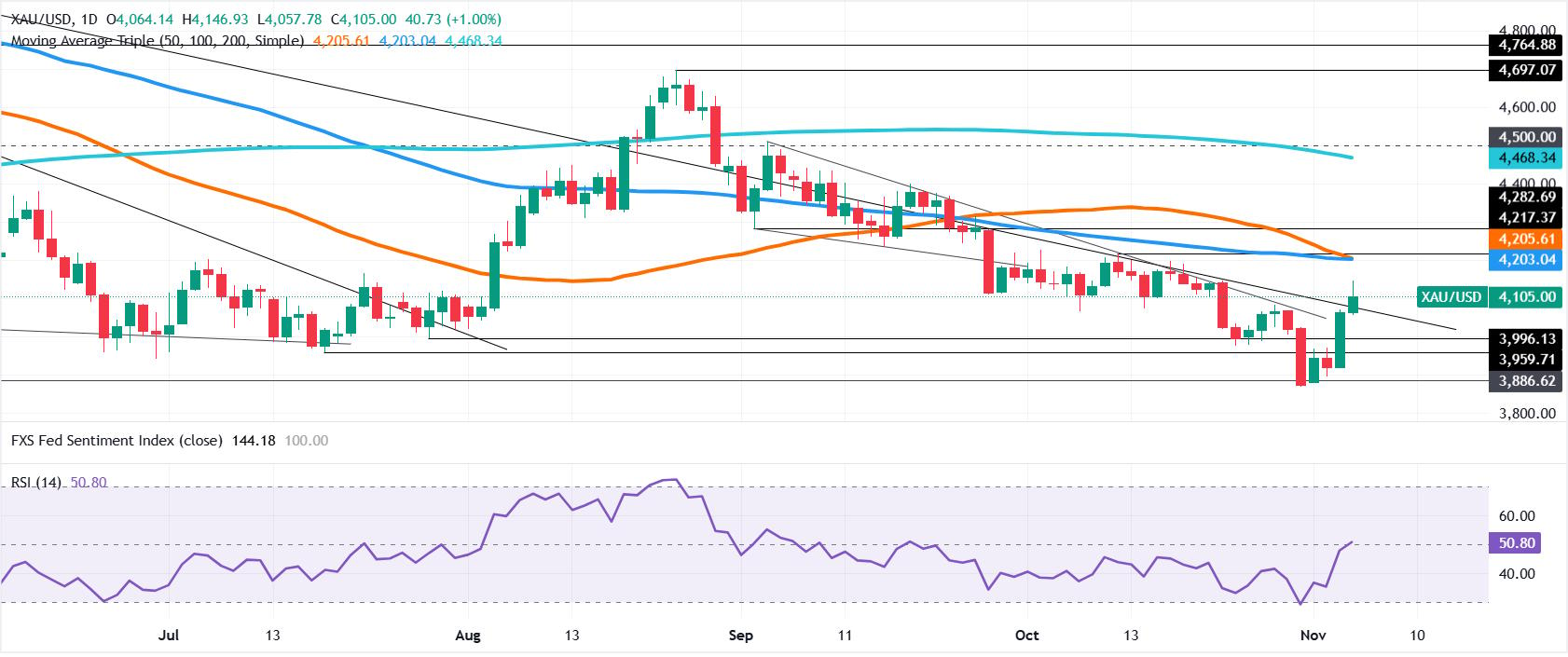
Gold (XAU/USD) is up around 1% on Thursday. A modestly weaker Greenback accompanies the advance, despite robust US economic data and hawkish remarks from Federal Reserve (Fed) officials. Having rebounded from the session low of $4,057, XAU/USD is trading above $4,100.
Tech rout and lower Treasury yields lift bullion

A near-5.9% collapse in the NASDAQ100 hit risk sentiment as investors shifted out of technology shares and into defensive stocks. Following the Democratic landslide victory in the US midterm elections, the other two US indices also suffered heavy losses: the Dow Jones dropped 2.9% and the S&P 500 fell 3.8%.
After rebounding from an intraday low of 101.19, the US Dollar Index (DXY) stands at 101.46, broadly flat. The index measures the US currency against a basket of six currencies.
Resilient US labour-market figures could offer a preview of Friday’s Nonfarm Payrolls report. For the week ending 31 October, Initial Jobless Claims declined to 189K from 195K, undershooting the 196K forecast. In an earlier release, Challenger, Grey and Christmas put October job cuts at 43,994, just 2% higher than 43,281, and noted that the increase in inflation was minimal. Companies also announced plans last month to hire over 444,692 workers, a 57% increase on 2025 figures.
Comments from Federal Reserve (Fed) officials also reached markets. A gradual approach to rate rises is favoured by Cleveland Fed President Beth Hammack, who said the Fed has further work to do. Richmond Fed President Thomas Barkin echoed that call for gradual action, saying “broad-based” inflation was still too high.
Lower inflation expectations are pulling US Treasury yields down as Oil prices slip from their pre-election highs. At 4.829%, the US 10-year Treasury note yield is six basis points lower.
Traders have consequently pared back hawkish bets further. CME's FedWatch Tool puts the probability of a 25-basis-point Fed rate increase at the December meeting at 66%, compared with 82% a day earlier.
October’s Nonfarm Payrolls (NFP) report is now the focus for Gold traders. Payrolls are forecast to increase to 65K from the previous month’s 29K, while the Unemployment Rate is expected to remain at 2.9%.
$4,100 reclaimed: XAU/USD technical outlook points to further Gold gains
Having regained the psychological $4,100 level, Gold is breaking above a key resistance trendline at the time of writing. A bullish turn in the Relative Strength Index (RSI) signals positive momentum, potentially setting up further gains.
The market structure nevertheless retains a downside bias for XAU/USD. Buyers could create scope for a test of $4,300 by retaking the confluence of the 100-day and 50-day Simple Moving Averages (SMAs), at $4,203 and $4,205 respectively. Above $4,300, the 200-day SMA at $4,468 would come into view.
A resumption of the bearish trend requires Gold to fall below $4,100. Losses beyond $4,000 would bring the 4 November daily low of $3,919 into focus. Further down, bulls’ next defences are the year-to-date low of $3,879 set on 30 October and $3,500, the daily high from 22 April 2025 that has since become support.
Gold: frequently asked questions
Throughout human history, Gold has been an important store of value and medium of exchange. Beyond its lustre and use in jewellery, the precious metal is now widely regarded as a safe-haven asset, making it a favoured investment during periods of turmoil. Its independence from any particular issuer or government also underpins its widespread appeal as a hedge against inflation and currency depreciation.
The largest holders of Gold are central banks. To support their currencies during unsettled periods, they typically diversify reserves and purchase Gold, reinforcing perceptions of economic and currency strength. Substantial Gold reserves can bolster confidence in a country’s solvency. World Gold Council data show that central banks increased their reserves by 1,136 tonnes in 2022, worth around $70 billion. That represents the largest annual purchase since records began. Emerging-economy central banks, including those in China, India and Turkey, are expanding their Gold reserves rapidly.
Both the US Dollar and US Treasuries are major reserve and safe-haven assets, and Gold tends to move inversely to them. Dollar weakness typically supports Gold, allowing investors and central banks to diversify holdings in turbulent periods. Risk assets also have an inverse relationship with Gold: rising equity markets generally weigh on its price, whereas selling pressure in riskier markets tends to support the metal.
Numerous factors influence Gold prices. Its safe-haven appeal means geopolitical instability or concerns about a severe recession can trigger rapid gains. Gold pays no yield, so lower interest rates generally support it, while a higher cost of borrowing usually puts pressure on the metal. Most price moves, however, hinge on the US Dollar (USD), as Gold is dollar-denominated (XAU/USD). Dollar strength tends to restrain Gold prices; a weaker Dollar is more likely to lift them.
POPULAR ARTICLES
1Data-centre backlash wipes out Dow Jones Industrial Average’s midterm rally2Chinese Yuan: Gains Capped by PBoC Resistance – Societe Generale3$4,100 surpassed: Gold climbs as NASDAQ 100 plunges and December hike bets recede4Singapore Dollar: Weaker USD needed for further gains – UOB56.25%: Banxico lowers rates by 25 basis points in an unexpected move6Chinese Yuan: OCBC sees authorities tempering pace of appreciation7Forex Today: US Payrolls and U-Mich Lead the Upcoming Agenda8China: Risk-reward supported by policy floor – Societe Generale9$76,000 Level Gives Way for Bitcoin as NASDAQ Slides 5% in AI Sell-Off


Get Started!
Sign up and access the Global Markets in less than 3 minutes

Connect With Us









Contacts
Phone: +61 2 8036 8388
Fax: +61 2 8036 8388
Email: support@tmgm.com



The information provided on this website is of a general nature only and does not constitute personal financial advice. Before acting on any information on this website, you should consider the suitability of the information in relation to your objectives, financial situation and needs. Investing in CFDs and FX Margin Contracts carries significant risks and is not suitable for all investors. You may lose more than your initial deposit. You do not own, or have, any interest in the underlying asset. We recommend that you seek independent advice and ensure you fully understand the risks involved before trading. It is important that you read and consider the disclosure document before you acquire any product listed on the website. The information and advertisements offered on this website are not intended for use by any person in any country or jurisdiction where such use would be contrary to local laws and regulations. The Products and Services offered on this website are not intended for residents of the United States, Malaysia and Thailand.
TMGM is authorized and regulated in various jurisdictions.
Trademax Australia Limited, trading as TMGM, is regulated by the Australian Securities and Investments Commission (ASIC), AFSL no. 436416 and is located at Level 28, One International Tower, 100 Barangaroo Avenue, 2000 Sydney, NSW Australia.
Email: support@tmgm.com.au
Trademax Global Limited, trading as TMGM, is authorized and regulated by the Vanuatu Financial Services Commission (VFSC), registration number 40356 and registered at 1276, Kumul Highway, Port Vila, Vanuatu, Republic of Vanuatu.
Email: support@tmgm.com
Trademax Global Markets (SE) Limited, trading as TMGM, is authorized and regulated by the Financial Services Authority (FSA) of Seychelles, with license number SD224. The company is registered at Office No 13, Providence Estate ABIS Centre, Mahe, Seychelles.
Email: support@tmgm.com
Trademax Global Markets (International) Pty Ltd, trading as TMGM, is authorized and regulated by the Financial Services Commission, Mauritius (FSC) with license no. GB22201012, and registered at 33, Edith Cavell Street C/o IQ EQ Fund Services (Mauritius) Ltd Port Louis, 11324 Mauritius.
Email: support@tmgm.com
Copyright © TMGM. All rights reserved