

Trading
Explore a wide range of markets with competitive pricing, deep liquidity, and advanced trading tools.
Learn More 
Platform
Trade seamlessly with TMGM's powerful platform, built for speed, precision, and a superior trading experience.
Learn More Trading Platform
Academy
Learn the fundamentals of trading with beginner-friendly resources, including guides, webinars, and market insights.
Learn More News & Analysis
Get real-time market updates and expert analysis to stay ahead of trading opportunities
Learn More News & Analysis
About
Learn what sets TMGM apart — our global presence, regulatory strength, and commitment to innovation in trading.
Learn More Why Choose TMGM
Sponsorship
Below $3,900: gold struggles ahead of US PPI release
- Bets on aggressive Fed rate increases dampen sentiment, putting Gold on course for a steep weekly loss.
- US PPI figures are in focus as traders seek further signals on inflation and the Fed’s rate path.
- An RSI reading below 50 and a negative MACD keep the technical outlook bearish.
$3,900 was briefly surpassed by Gold (XAU/USD) on Friday. The metal has since pared its gains, following Thursday’s slide to $3,852, the lowest since October 2025. Hawkish comments by Federal Reserve (Fed) officials have strengthened expectations of prolonged monetary tightening. The resulting rise in the US Dollar (USD) and US Treasury yields has left Gold more than 4% lower so far this week.

A 0.40% daily gain puts XAU/USD at around $3,889 at the time of writing. Attention is shifting to the US Producer Price Index (PPI) release at 13:30 GMT.
Short-end yields climb on Fed hike bets, powering Dollar rally
Rapid repricing of the Fed’s near-term policy trajectory has produced what ING analysts call “a powerful, macro-driven rally in the dollar” this week. As they explain, “short-dated US yields are close to 40bp higher since Tuesday morning, when the Fed's Christopher Waller mused over the need for a 50bp hike in December.” Following those remarks, ING observes that “the market has since adopted the view that back-to-back December and January hikes look likely, while extending the full Fed adjustment from here to a full 85bp of tightening.”
At around 103.23, the US Dollar Index (DXY) is close to a 19-month high and heading for its third consecutive weekly advance. The index measures the Greenback against six major currencies. Dollar strength increases the cost of Gold for holders of other currencies; rising US Treasury yields also increase the opportunity cost of owning the non-yielding metal.
Inflation still too high, Fed officials caution
A 0.4% MoM rise in October headline inflation exceeded the 0.3% forecast, US Consumer Price Index (CPI) figures released earlier this week showed. Excluding food and energy, core CPI increased 0.3% MoM against expectations of 0.2%.
Bringing inflation down requires “at least two more 25-basis-point rate increases”, Dallas Fed President Lorie Logan said on Tuesday.
Inflationary pressures were “moving in the wrong direction”, Cleveland Fed President Beth Hammack warned on Thursday. She said the Fed needed to “move to a restrictive stance of policy” to return inflation to 2%. San Francisco Fed President Mary Daly likewise said her “bias is that further tightening will be needed.”
With little prospect of an agreement to end the US-Iran war, higher energy prices could sustain elevated inflation. On Thursday, West Texas Intermediate (WTI) crude surged more than 3% after US President Donald Trump said Washington did not require a deal with Iran to end the conflict.
Technical Analysis: 21-day, 50-day and 100-day SMAs keep Gold under pressure
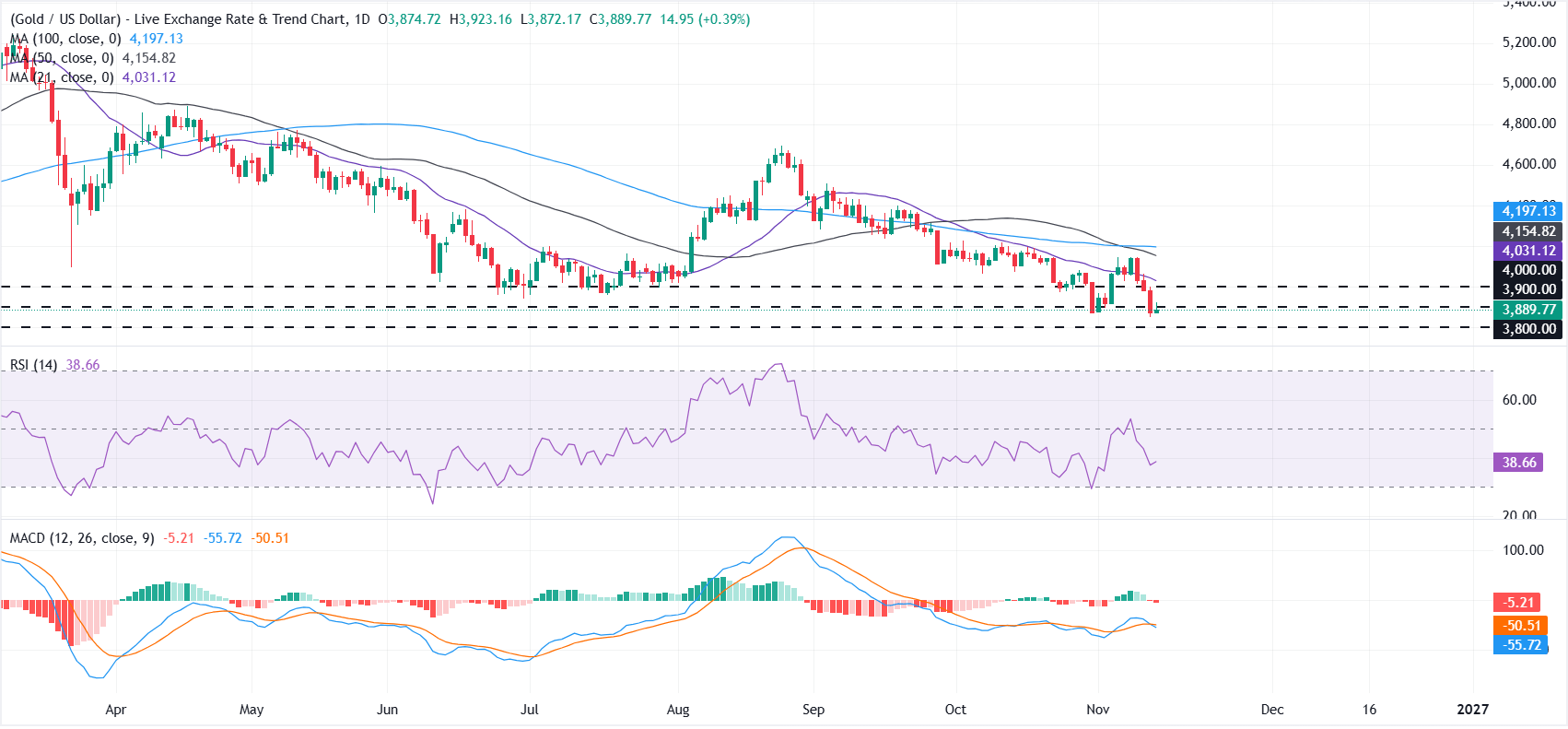
Below its 21-day, 50-day and 100-day Simple Moving Averages (SMAs), XAU/USD retains a bearish short-term bias on the daily chart. A Relative Strength Index (RSI) reading of 38 remains under the midline, alongside a negative Moving Average Convergence Divergence (MACD) indicator. Both point to continued mild downside pressure, although oversold conditions have yet to become extreme.
The nearby horizontal level at $3,900 provides the first resistance, with the psychological $4,000 mark next. Beyond that, the 21-day SMA at $4,031 limits a more substantial rebound. A wider supply zone sits higher, between the 50-day SMA at $4,154 and the 100-day SMA at $4,197.
Immediate downside support lies at Thursday’s $3,852 low, ahead of the psychological $3,800 mark. Losing $3,800 could pave the way for a more pronounced fall.
(The technical analysis of this story was written with the help of an AI tool. Know more.)
Gold: frequently asked questions
As both a store of value and a medium of exchange, Gold has held an important place throughout human history. Beyond its lustre and use in jewellery, the precious metal is now widely regarded as a safe-haven asset, making it a favoured investment in periods of turbulence. Its independence from any particular issuer or government also underpins its widespread appeal as a hedge against inflation and currency depreciation.
The largest holders of Gold are central banks. To support their currencies during periods of instability, they typically diversify reserves and purchase Gold, reinforcing perceptions of economic and currency strength. Substantial Gold reserves can bolster confidence in a country’s solvency. According to World Gold Council data, central banks increased their reserves by 1,136 tonnes of Gold in 2022, valued at around $70 billion. That was the largest annual purchase on record. Emerging-market central banks, including those in China, India and Turkey, are rapidly expanding their Gold holdings.
The US Dollar and US Treasuries, both leading reserve and safe-haven assets, have an inverse relationship with Gold. Dollar weakness generally supports Gold, allowing investors and central banks to diversify their holdings during unsettled periods. Risk assets also tend to move in the opposite direction to Gold: equity market gains typically weigh on its price, whereas selling in riskier markets usually supports the precious metal.
Many factors can influence Gold prices. Its safe-haven appeal means geopolitical turmoil or concerns over a severe recession can trigger rapid gains. Because Gold pays no yield, lower interest rates generally support it, while a higher cost of borrowing usually creates pressure. Most price movements nevertheless hinge on the US Dollar (USD), since Gold is quoted in dollars (XAU/USD). Dollar strength tends to restrain Gold prices, while a softer Dollar is likely to lift them.
POPULAR ARTICLES
1Asia FX: Shift out of AI trades – Societe Generale2Below $3,900: gold struggles ahead of US PPI release3EUR/USD stays under pressure as uneven Eurozone data and hawkish Fed weigh4US Dollar extends gains on Fed support – ING5EUR/USD: Euro Faces Political Headwinds – Commerzbank6US inflation: Oil and producer prices in focus – UBS7USD/JPY: Resistance under test as breakout advances – Societe Generale8US Dollar: Yields Provide Support Amid AI Risks – MUFG90.6% Eurozone Q3 GDP growth exceeds flash estimate of 0.4%

Get Started!
Sign up and access the Global Markets in less than 3 minutes

Connect With Us









Contacts
Phone: +61 2 8036 8388
Fax: +61 2 8036 8388
Email: support@tmgm.com



The information provided on this website is of a general nature only and does not constitute personal financial advice. Before acting on any information on this website, you should consider the suitability of the information in relation to your objectives, financial situation and needs. Investing in CFDs and FX Margin Contracts carries significant risks and is not suitable for all investors. You may lose more than your initial deposit. You do not own, or have, any interest in the underlying asset. We recommend that you seek independent advice and ensure you fully understand the risks involved before trading. It is important that you read and consider the disclosure document before you acquire any product listed on the website. The information and advertisements offered on this website are not intended for use by any person in any country or jurisdiction where such use would be contrary to local laws and regulations. The Products and Services offered on this website are not intended for residents of the United States, Malaysia and Thailand.
TMGM is authorized and regulated in various jurisdictions.
Trademax Australia Limited, trading as TMGM, is regulated by the Australian Securities and Investments Commission (ASIC), AFSL no. 436416 and is located at Level 28, One International Tower, 100 Barangaroo Avenue, 2000 Sydney, NSW Australia.
Email: support@tmgm.com.au
Trademax Global Limited, trading as TMGM, is authorized and regulated by the Vanuatu Financial Services Commission (VFSC), registration number 40356 and registered at 1276, Kumul Highway, Port Vila, Vanuatu, Republic of Vanuatu.
Email: support@tmgm.com
Trademax Global Markets (SE) Limited, trading as TMGM, is authorized and regulated by the Financial Services Authority (FSA) of Seychelles, with license number SD224. The company is registered at Office No 13, Providence Estate ABIS Centre, Mahe, Seychelles.
Email: support@tmgm.com
Trademax Global Markets (International) Pty Ltd, trading as TMGM, is authorized and regulated by the Financial Services Commission, Mauritius (FSC) with license no. GB22201012, and registered at 33, Edith Cavell Street C/o IQ EQ Fund Services (Mauritius) Ltd Port Louis, 11324 Mauritius.
Email: support@tmgm.com
Copyright © TMGM. All rights reserved