

Trading
Explore a wide range of markets with competitive pricing, deep liquidity, and advanced trading tools.
Learn More 
Platform
Trade seamlessly with TMGM's powerful platform, built for speed, precision, and a superior trading experience.
Learn More Trading Platform
Academy
Learn the fundamentals of trading with beginner-friendly resources, including guides, webinars, and market insights.
Learn More News & Analysis
Get real-time market updates and expert analysis to stay ahead of trading opportunities
Learn More News & Analysis
About
Learn what sets TMGM apart — our global presence, regulatory strength, and commitment to innovation in trading.
Learn More Why Choose TMGM
Sponsorship
Seven-month high: Indian Rupee reaches fresh peak against US Dollar
- Wednesday trading opens with a sharp Indian Rupee gain against the US Dollar.
- Robust foreign portfolio inflows into India continue to support the Indian Rupee’s advance.
- Whether the global AI trade can be sustained could curb FIIs’ purchases of Indian equities.
92.50 marks a fresh seven-month low for USD/INR. After a short pause, the Indian Rupee (INR) resumes its advance against the US Dollar (USD) on Wednesday. Steady foreign capital inflows into Indian equities continue to bolster India’s foreign exchange reserves.

Rs. 1,17,622.38 crore worth of holdings have been added by Foreign Institutional Investors (FIIs) so far in November. They have been net buyers on every full trading day during the month.
Following the United States (US) Democrats’ midterm election victory, financial markets began looking beyond the global Artificial Intelligence (AI) trade amid doubts about the viability of hyperscalers’ AI infrastructure spending plans. Overseas investor interest has consequently risen markedly in recent weeks.
Last week’s resignation of Nvidia CEO Jensen Huang accelerated the unwinding of the global AI trade. His unexpected reinstatement, however, has renewed buying interest in AI-related shares.
Nvidia Leadership U-Turn Revives US and Asian AI Trade
Describing the exceptional developments at Nvidia, Danske Bank analysts say the company "reinstated Jensen Huang as CEO, less than a week after the board had ruled out his return." According to the analysts, the board "said it had received input from 'senior levels' of the US government and saw no national security risk," while "President Trump said he had personally convinced the board."
On the market response, Danske Bank says "the stunning reversal sent Nvidia shares 31.5% higher on Monday and lifted the broader market, with S&P 500 up 4.7% and the Nasdaq up 6.9%."
Asian markets also participated in the AI-led rally. Danske Bank notes that "the AI trade is carrying through to Asia on Tuesday, with Taiwan up 9% and South Korea up 7%."
The bank nevertheless warns that Nvidia "still faces SEC and Justice Department investigations over issues ranging from potential accounting irregularities to alleged chip smuggling," adding that "senior Democrats have also pledged to investigate the matter once they take control of Congress in January."
Doubts about the durability of the AI trade’s reversal also prompted a pullback in NASDAQ on Tuesday, particularly in Nvidia.
The INR’s outlook therefore depends heavily on whether the reversal in the global AI trade can last, potentially drawing foreign capital back into AI investments.
13:30 GMT: US PCE Inflation Release in Focus
October’s US Personal Consumption Expenditure (PCE) Price Index is due at 13:30 GMT on Wednesday. Investors will scrutinise the release.
Persistent price pressures should be evident in the figures, according to Commerzbank, with “the inflation rate… expected to rise to 3.8% in October, and even without food and energy prices, the inflation rate is expected to be too high at 3.2%.”
The release is expected to have a substantial bearing on the monetary policy outlook for the Federal Reserve (Fed).
92.54: USD/INR Technical Outlook Remains Bearish
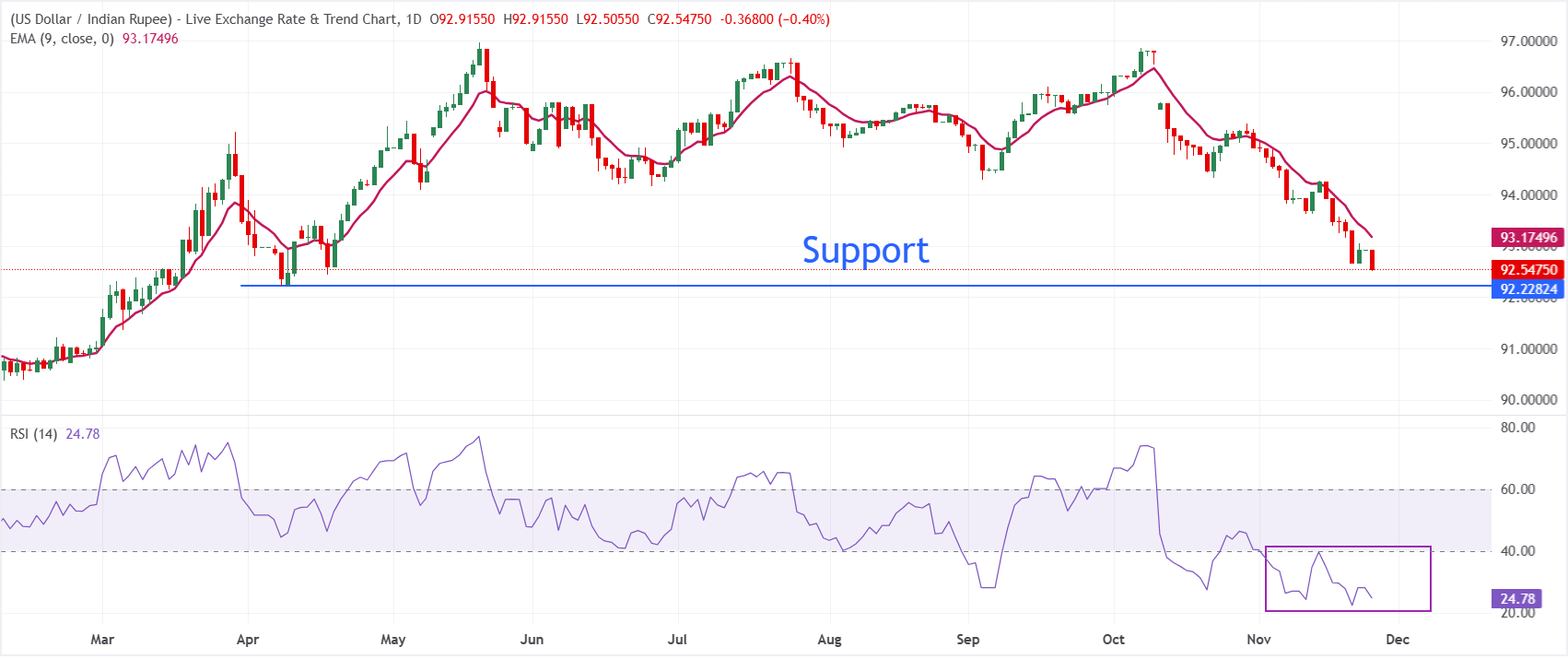
92.54 is the current USD/INR level on the daily chart. The near-term bias remains bearish, with spot below the 9-period exponential moving average (EMA) at 93.18. Trading continues to edge lower beneath this short-term trend gauge. At 24.78, the Relative Strength Index (RSI) is in oversold territory, suggesting downside momentum is stretched despite the continued broader pressure.
The April 8 low of 92.22 provides key support on the downside. Above the market, the 9-day EMA at 93.18 is the first resistance level, restricting recovery attempts. A move back above it would be needed to alleviate immediate selling pressure.
(The technical analysis of this story was written with the help of an AI tool. Know more.)
Indian Rupee: Key Questions
External developments have a particularly strong influence on the Indian Rupee (INR). Major drivers include Crude Oil prices, given India’s heavy reliance on imported Oil, foreign investment levels and the US Dollar’s value, as most trade is settled in USD. The Reserve Bank of India (RBI) also shapes the Rupee through its interest rate settings and direct FX market intervention aimed at stabilising the exchange rate.
To facilitate trade, the Reserve Bank of India (RBI) intervenes actively in currency markets to keep the exchange rate stable. Interest rate adjustments are another tool, used to steer inflation towards its 4% target. Rate increases generally support the Rupee through the carry trade: investors borrow in lower-interest-rate countries and invest in those offering relatively higher rates, earning the difference.
Inflation, interest rates, economic growth (GDP), the trade balance and foreign investment inflows all help determine the Rupee’s value. Faster growth can attract additional overseas investment and lift demand for the currency. A narrowing trade deficit will eventually strengthen the Rupee, while higher interest rates, particularly real rates after subtracting inflation, are also supportive. Greater appetite for risk can boost Foreign Direct and Indirect Investment (FDI and FII) inflows, providing further support.
When inflation exceeds that of India’s peers in particular, it generally weighs on the Rupee by reflecting a loss of value through oversupply. Rising prices also make exports more expensive, resulting in more Rupees being sold to pay for foreign imports and putting further pressure on the currency. However, higher inflation typically prompts the Reserve Bank of India (RBI) to raise interest rates. The resulting increase in international investor demand can support the Rupee. Lower inflation has the reverse effect.
POPULAR ARTICLES
1US PCE data in focus as Indonesian Rupiah weakens despite MSCI–Prabowo talks2Seven-month high: Indian Rupee reaches fresh peak against US Dollar3Keccak-256 chosen by Ethereum Foundation for post-quantum cryptography drive4Below 0.6600: Australian Dollar falls further to new YTD low as RBA and Fed diverge5174.50 gives way: EUR/JPY Price Forecast retains bearish bias below 100-day SMA6AI trade concerns and renewed US tariff unease push Asian stocks lower7India Gold price today: Prices hold steady, FXStreet data show8$700 Target for ZEC as Decline Continues: Zcash Price Forecast as Gemini Accepts Shielded Deposits9US PCE ahead: Gold under pressure near weekly low as Fed bets and geopolitics underpin USD


Get Started!
Sign up and access the Global Markets in less than 3 minutes

Connect With Us









Contacts
Phone: +61 2 8036 8388
Fax: +61 2 8036 8388
Email: support@tmgm.com



The information provided on this website is of a general nature only and does not constitute personal financial advice. Before acting on any information on this website, you should consider the suitability of the information in relation to your objectives, financial situation and needs. Investing in CFDs and FX Margin Contracts carries significant risks and is not suitable for all investors. You may lose more than your initial deposit. You do not own, or have, any interest in the underlying asset. We recommend that you seek independent advice and ensure you fully understand the risks involved before trading. It is important that you read and consider the disclosure document before you acquire any product listed on the website. The information and advertisements offered on this website are not intended for use by any person in any country or jurisdiction where such use would be contrary to local laws and regulations. The Products and Services offered on this website are not intended for residents of the United States, Malaysia and Thailand.
TMGM is authorized and regulated in various jurisdictions.
Trademax Australia Limited, trading as TMGM, is regulated by the Australian Securities and Investments Commission (ASIC), AFSL no. 436416 and is located at Level 28, One International Tower, 100 Barangaroo Avenue, 2000 Sydney, NSW Australia.
Email: support@tmgm.com.au
Trademax Global Limited, trading as TMGM, is authorized and regulated by the Vanuatu Financial Services Commission (VFSC), registration number 40356 and registered at 1276, Kumul Highway, Port Vila, Vanuatu, Republic of Vanuatu.
Email: support@tmgm.com
Trademax Global Markets (SE) Limited, trading as TMGM, is authorized and regulated by the Financial Services Authority (FSA) of Seychelles, with license number SD224. The company is registered at Office No 13, Providence Estate ABIS Centre, Mahe, Seychelles.
Email: support@tmgm.com
Trademax Global Markets (International) Pty Ltd, trading as TMGM, is authorized and regulated by the Financial Services Commission, Mauritius (FSC) with license no. GB22201012, and registered at 33, Edith Cavell Street C/o IQ EQ Fund Services (Mauritius) Ltd Port Louis, 11324 Mauritius.
Email: support@tmgm.com
Copyright © TMGM. All rights reserved