

Trading
Explore a wide range of markets with competitive pricing, deep liquidity, and advanced trading tools.
Learn More 
Platform
Trade seamlessly with TMGM's powerful platform, built for speed, precision, and a superior trading experience.
Learn More Trading Platform
Academy
Learn the fundamentals of trading with beginner-friendly resources, including guides, webinars, and market insights.
Learn More News & Analysis
Get real-time market updates and expert analysis to stay ahead of trading opportunities
Learn More News & Analysis
About
Learn what sets TMGM apart — our global presence, regulatory strength, and commitment to innovation in trading.
Learn More Why Choose TMGM
Sponsorship
5.7% jobless rate: Kiwi slips as New Zealand unemployment rises
- 0.1% decline in New Zealand third-quarter jobs contrasts with 0.4% growth forecast.
- At its weakest since mid-October, NZD/USD trades at the session low.
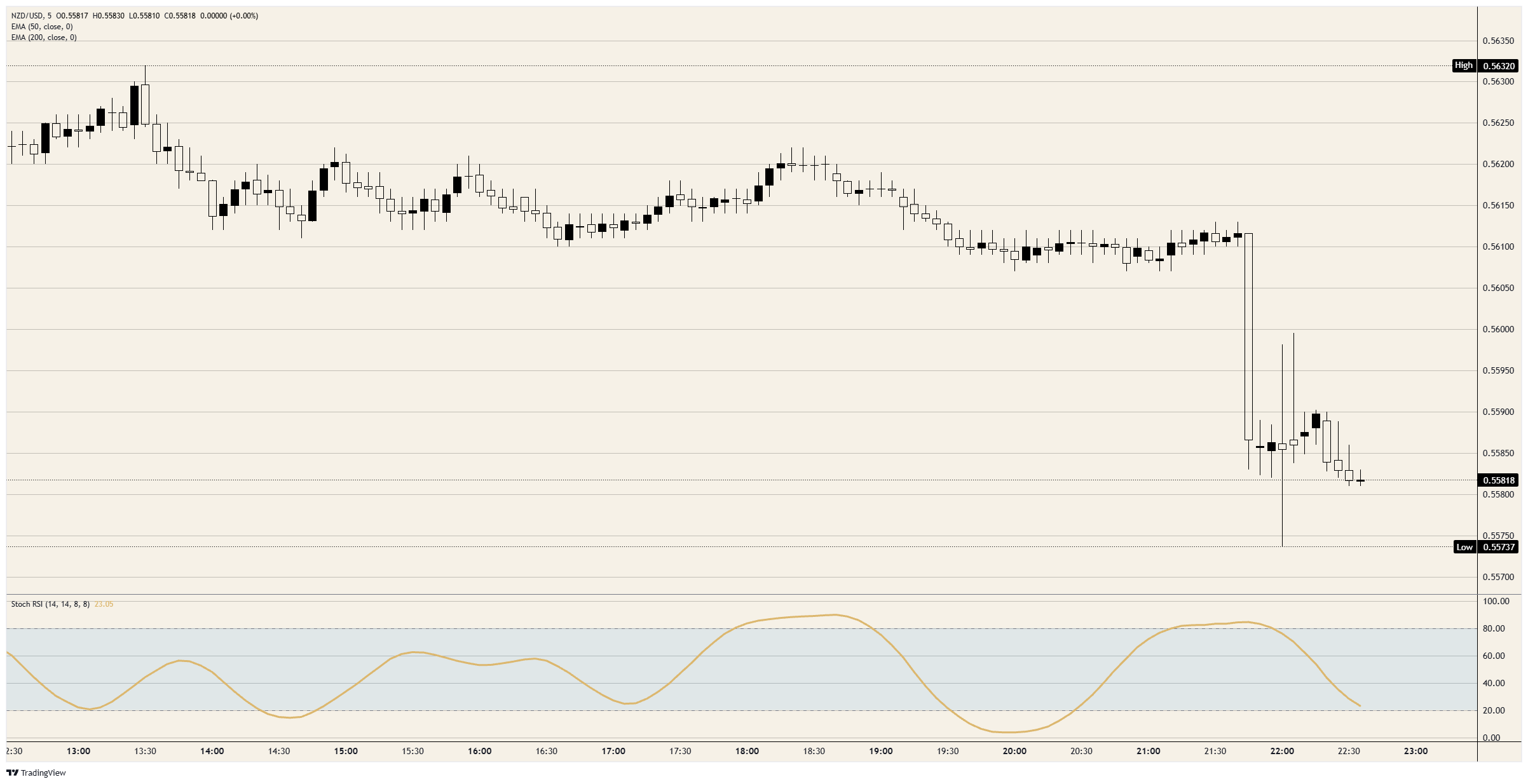
New Zealand employment contracted 0.1% in the third quarter. That compares with an expected 0.4% increase and follows 0.5% growth in the second quarter. Unemployment climbed to 5.7%, above the 5.5% forecast. Trading just below 0.5600 at its session low, NZD/USD has surrendered almost the entire advance from its 14 October low just above 0.5550.
Quarterly growth in the Labour Cost Index eased to 0.4% from 0.7%, falling short of the 0.5% forecast. Participation dropped from 70.7% to 70.4%, meaning unemployment increased even as fewer people sought work. Having been expected to raise rates, the Reserve Bank of New Zealand (RBNZ) instead left its rate unchanged on 28 October. The employment decline and softer wage growth weaken the case for a hike.

5-minute chart: NZD/USD
New Zealand Dollar: Frequently Asked Questions
Economic conditions in New Zealand and domestic central bank policy largely determine the value of the New Zealand Dollar (NZD), commonly called the Kiwi, a familiar currency among investors. Several country-specific factors also influence its exchange rate. As China is New Zealand’s largest trading partner, Chinese economic performance tends to affect the Kiwi. Negative developments in China are likely to reduce demand for New Zealand exports, weighing on the domestic economy and, in turn, its currency. Dairy prices are another important driver, with the dairy industry accounting for New Zealand’s main export. Higher prices lift export earnings, supporting both the economy and NZD.
A medium-term inflation range of 1% to 3%, with an emphasis on the 2% midpoint, is the Reserve Bank of New Zealand’s (RBNZ) target. The bank adjusts interest rates to achieve and maintain that objective. If inflation becomes too high, it raises rates to restrain economic activity. Higher rates also lift bond yields, making investment in New Zealand more attractive and supporting NZD. Rate reductions, by contrast, generally weaken the currency. Another key influence on NZD/USD is the interest rate differential: the gap between New Zealand rates and those set by the US Federal Reserve, including expectations for that gap.
New Zealand’s macroeconomic releases provide essential evidence of economic health and can affect the valuation of the New Zealand Dollar (NZD). Robust growth, low unemployment and strong confidence signal an economy that supports NZD. Rapid economic expansion draws foreign investment. If accompanied by elevated inflation, it may also prompt the Reserve Bank of New Zealand to raise interest rates. Weak economic figures, on the other hand, are likely to put downward pressure on NZD.
When investors see limited risks across markets and take an optimistic view of growth, the New Zealand Dollar (NZD) generally appreciates. These risk-on conditions tend to improve the outlook for commodities and so-called ‘commodity currencies’, including the Kiwi. During market disruption or economic uncertainty, the reverse typically occurs: investors sell riskier assets in favour of more stable safe havens, leaving NZD weaker.
POPULAR ARTICLES
1$2,309 realised price: ETH stays below as US-led selling continues | Ethereum Price Forecast25.7% Unemployment Rate in New Zealand: Q3 Rise Exceeds 5.5% Forecast30.7000 gives way: Aussie drops as US election worries outweigh RBA hike45.7% jobless rate: Kiwi slips as New Zealand unemployment rises5British Pound approaches Bank of England hike with markets already pricing in tightening well beyond this increase6Chinese Yuan: UOB expects modest weakening against US Dollar76.50% rates through 2027, Peso near 18.40: Banxico survey outlook8Softer inflation, persistent currency risks: Indonesian Rupiah – MUFG9Factory slowdown and US midterm anxiety send Mexican Peso tumbling


Get Started!
Sign up and access the Global Markets in less than 3 minutes

Connect With Us









Contacts
Phone: +61 2 8036 8388
Fax: +61 2 8036 8388
Email: support@tmgm.com



The information provided on this website is of a general nature only and does not constitute personal financial advice. Before acting on any information on this website, you should consider the suitability of the information in relation to your objectives, financial situation and needs. Investing in CFDs and FX Margin Contracts carries significant risks and is not suitable for all investors. You may lose more than your initial deposit. You do not own, or have, any interest in the underlying asset. We recommend that you seek independent advice and ensure you fully understand the risks involved before trading. It is important that you read and consider the disclosure document before you acquire any product listed on the website. The information and advertisements offered on this website are not intended for use by any person in any country or jurisdiction where such use would be contrary to local laws and regulations. The Products and Services offered on this website are not intended for residents of the United States, Malaysia and Thailand.
TMGM is authorized and regulated in various jurisdictions.
Trademax Australia Limited, trading as TMGM, is regulated by the Australian Securities and Investments Commission (ASIC), AFSL no. 436416 and is located at Level 28, One International Tower, 100 Barangaroo Avenue, 2000 Sydney, NSW Australia.
Email: support@tmgm.com.au
Trademax Global Limited, trading as TMGM, is authorized and regulated by the Vanuatu Financial Services Commission (VFSC), registration number 40356 and registered at 1276, Kumul Highway, Port Vila, Vanuatu, Republic of Vanuatu.
Email: support@tmgm.com
Trademax Global Markets (SE) Limited, trading as TMGM, is authorized and regulated by the Financial Services Authority (FSA) of Seychelles, with license number SD224. The company is registered at Office No 13, Providence Estate ABIS Centre, Mahe, Seychelles.
Email: support@tmgm.com
Trademax Global Markets (International) Pty Ltd, trading as TMGM, is authorized and regulated by the Financial Services Commission, Mauritius (FSC) with license no. GB22201012, and registered at 33, Edith Cavell Street C/o IQ EQ Fund Services (Mauritius) Ltd Port Louis, 11324 Mauritius.
Email: support@tmgm.com
Copyright © TMGM. All rights reserved