

Trading
Explore a wide range of markets with competitive pricing, deep liquidity, and advanced trading tools.
Learn More 
Platform
Trade seamlessly with TMGM's powerful platform, built for speed, precision, and a superior trading experience.
Learn More Trading Platform
Academy
Learn the fundamentals of trading with beginner-friendly resources, including guides, webinars, and market insights.
Learn More News & Analysis
Get real-time market updates and expert analysis to stay ahead of trading opportunities
Learn More News & Analysis
About
Learn what sets TMGM apart — our global presence, regulatory strength, and commitment to innovation in trading.
Learn More Why Choose TMGM
Sponsorship
Softer core inflation and Fed hike threat send Mexican Peso tumbling
- Nearly 1.40% higher, USD/MXN defies broad US Dollar weakness.
- 3.98% headline inflation contrasts with easing annual core inflation in Mexico.
- Ahead of Core PCE, expectations of Fed tightening put carry trade appeal at risk.
USD/MXN gains nearly 1.40% on Tuesday. The Mexican Peso extends its decline against the US Dollar as Mexico’s inflation data softens. A US inflation report, meanwhile, could lead the Fed to raise rates, reducing the interest rate gap between the US and Mexico. The pair is trading around 19.40.

3.98% headline inflation: Peso slides as mixed data and Fed outlook weigh
Risk aversion and a soft inflation reading both pressured the Mexican currency. Figures from INEGI, the National Statistics Agency, showed November’s mid-month core inflation falling to -0.1% from 0.25%. Headline inflation, however, climbed to 0.54% from 0.41%, above the 0.51% forecast.
Annual core inflation eased to 3.68% from 3.78%. By contrast, headline consumer price growth accelerated to 3.98% YoY from 3.62%.
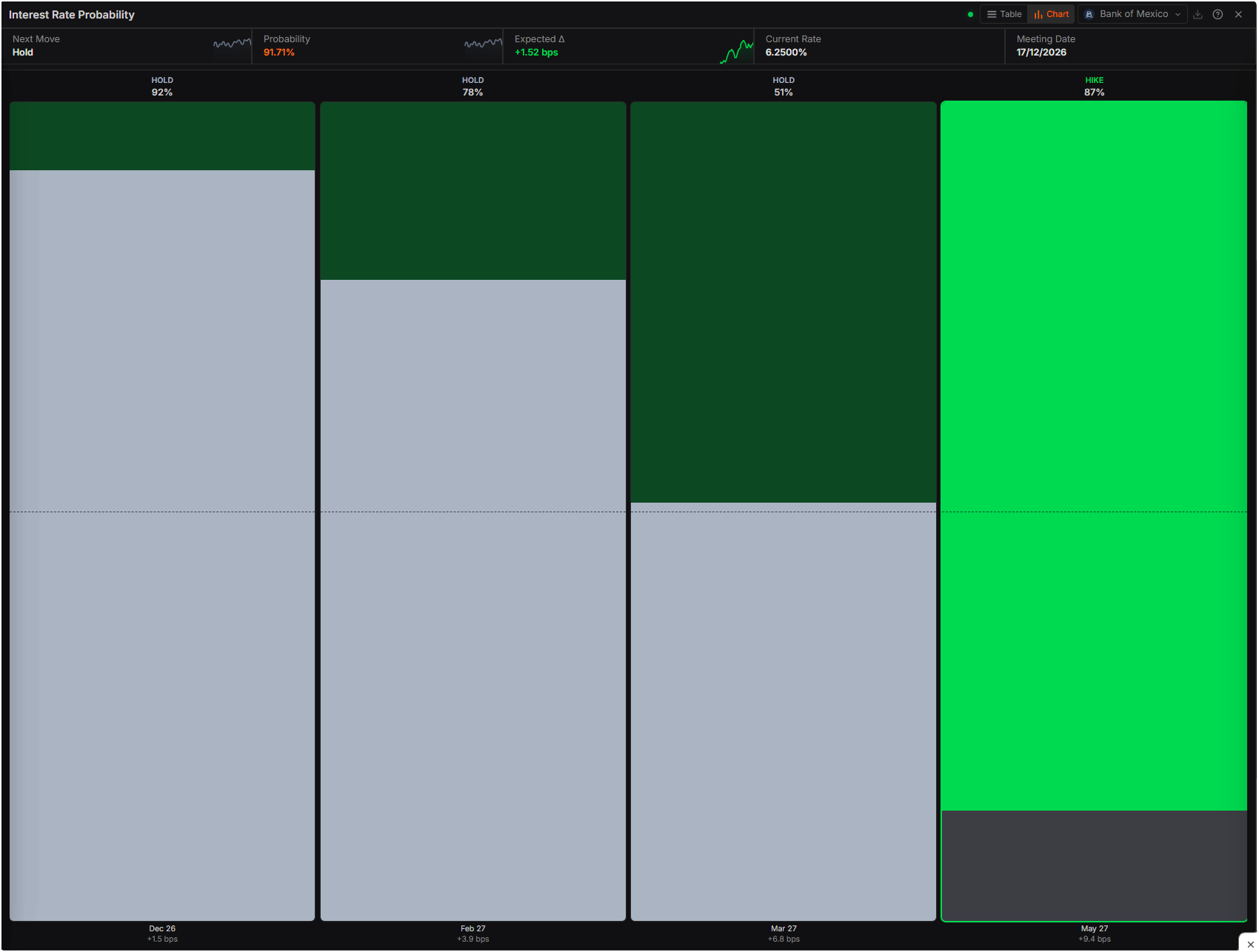
Despite the mixed figures, headline readings remain above the Bank of Mexico (Banxico) target of 3% plus or minus 1%. Banxico nevertheless lowered rates by 25 basis points this month. According to Prime Terminal data, money markets had priced in an unchanged rate of 6.25% at each of Banxico’s next three meetings, beginning in December.
November Consumer Confidence in the US rose to 103.3 from 91.9, beating the 92.5 estimate, the Conference Board reported. Americans felt less uncertain after the midterm elections, according to Fergus McCormick, Senior Economist, Global Indicators, of the Conference Board. He added that “the gain in confidence was led by stronger perceptions of present and future labor market conditions.”
At 103.82, the US Dollar Index (DXY) is 0.47% lower. The index tracks the US currency against six peers.
USD/MXN nonetheless advanced sharply on expectations of a narrower interest rate gap. The Fed is expected to end the year with rates in the 4%-4.25% range, compared with Mexico’s main reference rate of 6.25%.
Traders now await the US Core PCE inflation release, Gross Domestic Product (GDP) data and speeches from Fed officials.
19.4290 USD/MXN: Price Forecast and technical levels
At 19.4290 on the daily chart, USD/MXN continues to advance above a cluster of three simple moving averages aligned near 18.3561. This strengthens the near-term bullish bias, with the pair well above that medium-term trend reference. The Relative Strength Index (14) stands at 71.9, within overbought territory. Momentum remains strong, although the recent rally could give way to corrective pauses.
Around 21.08, a descending resistance trend line marks the next significant upside barrier and the broader ceiling for the current bullish phase. Initial downside support lies near 18.36 at the simple moving average cluster. Below that, horizontal support at 16.89 forms a deeper structural floor, where buyers would be expected to return in the event of a sharper pullback.
(The technical analysis of this story was written with the help of an AI tool. Know more.)
Mexican Peso: Frequently asked questions
Among Latin American currencies, the Mexican Peso (MXN) is the most actively traded. Its value largely reflects Mexico’s economic performance, central bank policy, foreign investment flows and remittances from Mexicans living overseas, particularly in the United States. Geopolitical developments can also affect MXN. Nearshoring, for instance, involves companies moving manufacturing capacity and supply chains nearer to their home countries. It is viewed as a catalyst for the Peso because Mexico is regarded as a major manufacturing hub in the Americas. Oil prices provide another driver, given Mexico’s position as a major exporter of the commodity.
Keeping inflation low and stable is the primary objective of Mexico’s central bank, Banxico. It aims for inflation at or near 3%, the midpoint of its 2% to 4% tolerance band, and sets interest rates accordingly. If inflation becomes too high, Banxico seeks to contain it through rate increases. These raise borrowing costs for households and businesses, restraining demand and slowing the wider economy. By lifting yields and making Mexico more attractive to investors, higher rates generally support the Mexican Peso (MXN). Lower rates, in contrast, typically put pressure on MXN.
The Mexican Peso (MXN) can respond to macroeconomic releases because these provide crucial evidence of the economy’s health. Strong growth, low unemployment and robust confidence underpin a healthy Mexican economy and support MXN. Such conditions draw more foreign investment and may also prompt the Bank of Mexico (Banxico) to raise interest rates, especially when economic strength coincides with high inflation. Weak economic figures, by contrast, are likely to lead to MXN depreciation.
Risk-on conditions generally favour the Mexican Peso (MXN), an emerging-market currency. When investors regard overall market risks as low, they are more willing to take on higher-risk investments. Market turmoil or economic uncertainty usually has the opposite effect: investors tend to sell riskier assets and move into more stable safe havens, weakening MXN.
POPULAR ARTICLES
1Gold falls to near $3,550 ahead of US PCE inflation data2New Zealand Dollar meets US inflation data near its 2026 low3160.00: Yen stays below as Tokyo CPI falls due on a US holiday4Softer core inflation and Fed hike threat send Mexican Peso tumbling519-month low: euro recovers ahead of ECB minutes and US inflation6Above 1.31 again: Pound awaits US inflation data7$53,200 downside risk for BTC as Bitcoin realised losses reach FTX-era levels850,000: Dow Jones Industrial Average revisits level as Nvidia leads tech lower9Below $1,700: Ethereum price forecast as ETH drops amid tariff concerns weighing on crypto


Get Started!
Sign up and access the Global Markets in less than 3 minutes

Connect With Us









Contacts
Phone: +61 2 8036 8388
Fax: +61 2 8036 8388
Email: support@tmgm.com



The information provided on this website is of a general nature only and does not constitute personal financial advice. Before acting on any information on this website, you should consider the suitability of the information in relation to your objectives, financial situation and needs. Investing in CFDs and FX Margin Contracts carries significant risks and is not suitable for all investors. You may lose more than your initial deposit. You do not own, or have, any interest in the underlying asset. We recommend that you seek independent advice and ensure you fully understand the risks involved before trading. It is important that you read and consider the disclosure document before you acquire any product listed on the website. The information and advertisements offered on this website are not intended for use by any person in any country or jurisdiction where such use would be contrary to local laws and regulations. The Products and Services offered on this website are not intended for residents of the United States, Malaysia and Thailand.
TMGM is authorized and regulated in various jurisdictions.
Trademax Australia Limited, trading as TMGM, is regulated by the Australian Securities and Investments Commission (ASIC), AFSL no. 436416 and is located at Level 28, One International Tower, 100 Barangaroo Avenue, 2000 Sydney, NSW Australia.
Email: support@tmgm.com.au
Trademax Global Limited, trading as TMGM, is authorized and regulated by the Vanuatu Financial Services Commission (VFSC), registration number 40356 and registered at 1276, Kumul Highway, Port Vila, Vanuatu, Republic of Vanuatu.
Email: support@tmgm.com
Trademax Global Markets (SE) Limited, trading as TMGM, is authorized and regulated by the Financial Services Authority (FSA) of Seychelles, with license number SD224. The company is registered at Office No 13, Providence Estate ABIS Centre, Mahe, Seychelles.
Email: support@tmgm.com
Trademax Global Markets (International) Pty Ltd, trading as TMGM, is authorized and regulated by the Financial Services Commission, Mauritius (FSC) with license no. GB22201012, and registered at 33, Edith Cavell Street C/o IQ EQ Fund Services (Mauritius) Ltd Port Louis, 11324 Mauritius.
Email: support@tmgm.com
Copyright © TMGM. All rights reserved