

Trading
Explore a wide range of markets with competitive pricing, deep liquidity, and advanced trading tools.
Learn More 
Platform
Trade seamlessly with TMGM's powerful platform, built for speed, precision, and a superior trading experience.
Learn More Trading Platform
Academy
Learn the fundamentals of trading with beginner-friendly resources, including guides, webinars, and market insights.
Learn More News & Analysis
Get real-time market updates and expert analysis to stay ahead of trading opportunities
Learn More News & Analysis
About
Learn what sets TMGM apart — our global presence, regulatory strength, and commitment to innovation in trading.
Learn More Why Choose TMGM
Sponsorship
XRP Retreats Under ETF Pressure: Ripple Price Forecast
- $0.94 remains a hurdle for XRP. With bears holding their ground, the risk of a correction towards $0.90 is increasing.
- Two consecutive days of ETF outflows add to the pressure on XRP.
- A modest recovery in the MACD has yet to reverse XRP's structural weakness.
$0.92 is coming into view for Ripple (XRP) on Tuesday. Renewed selling is weighing on the remittance token, which has spent most of the past week consolidating between $0.90 support and $1.00 resistance. The exception was last Friday's flash decline to $0.86.

Downward-sloping moving averages and the dynamic SuperTrend barrier continue to constrain the upside structurally, leaving the path of least resistance predominantly lower.
Two days of ETF outflows accompany risk aversion
At 11 on Tuesday, the Fear & Greed Index signals markedly weak appetite across the crypto market. The reading has shown no improvement over the past couple of weeks, consistent with market participants keeping macroeconomic factors at the centre of their attention.
A 25 basis point interest rate increase in December is widely expected from the Federal Reserve (Fed), which would take rates to the 4.00-4.25% range. The central bank remains committed to tackling elevated inflation in the United States (US) and reaching its long-term 2% target.
Continuing geopolitical tensions in the Middle East, however, are complicating the Fed's efforts to fulfil its dual mandate of supporting maximum employment and stabilising prices.
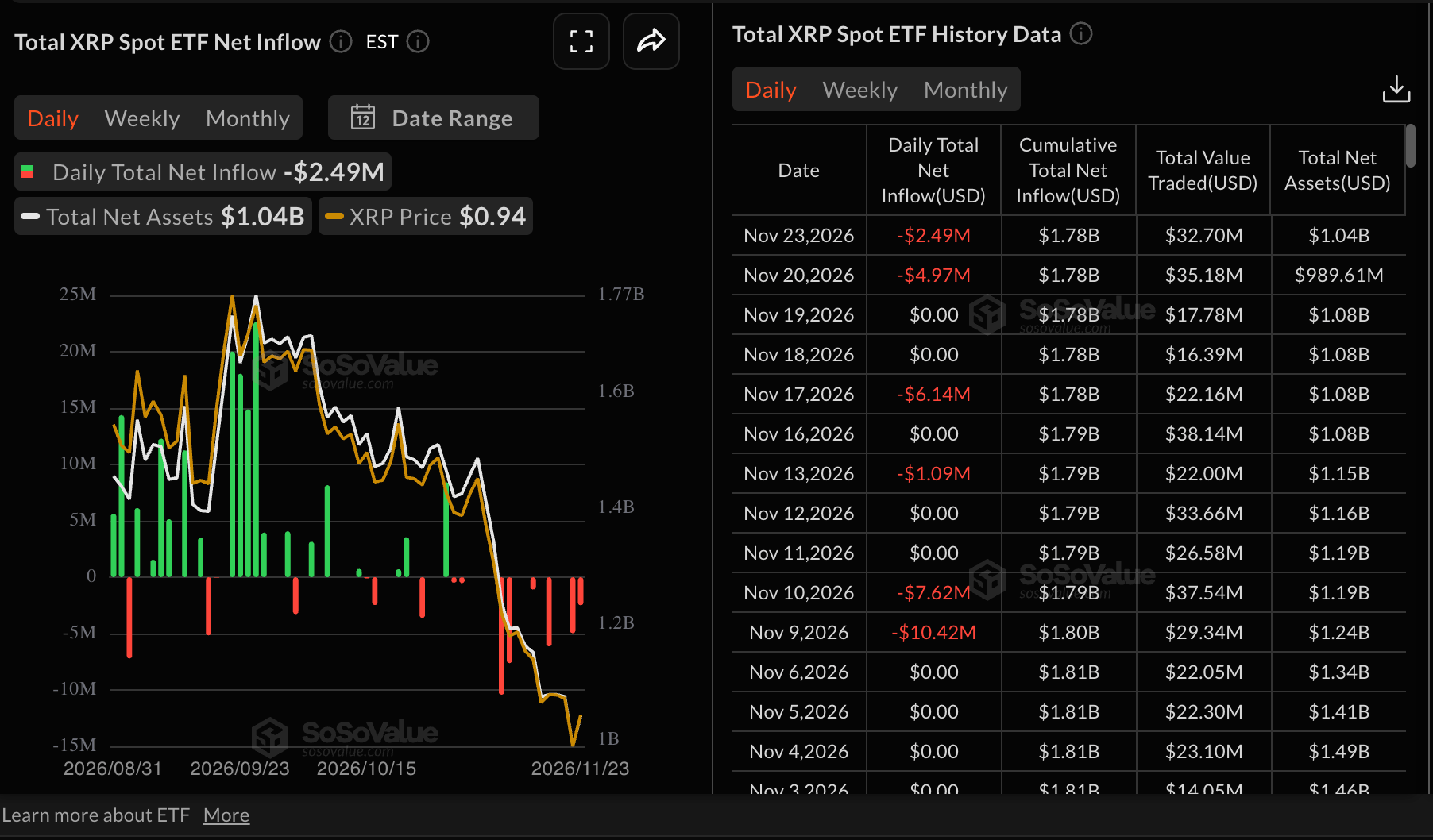
Monday brought $2.5 million of outflows from XRP spot Exchange-Traded Funds (ETFs), marking a second consecutive day of withdrawals after $5 million left last Friday. Cumulative inflows remain subdued at $1.8 billion, while net assets stand at $1 billion.
$0.93 XRP retains bearish bias: Technical analysis
At $0.93, XRP remains well beneath its key EMAs, keeping the bias bearish. Resistance is stacked at the 50-day EMA of $1.15, the 100-day EMA of $1.22 and the 200-day EMA of $1.30. The SuperTrend at $1.09 adds another constraint on the upside.
The momentum picture remains divided. A slight move into positive territory by the Moving Average Convergence Divergence (MACD) indicator points to tentative recovery efforts. Yet the Relative Strength Index (RSI), near 30, indicates that the pair is still close to oversold territory rather than displaying a clear trend reversal.
The SuperTrend around $1.09 provides the first resistance hurdle. Beyond it lie the 50-day EMA at $1.15 and the previous break area of the descending resistance trendline near $1.19. Further barriers follow at the 100-day EMA of $1.22 and the 200-day EMA of $1.30, ahead of the broader bearish trendline originating at $1.74. The daily chart offers no clearly defined structural support, so a further decline would likely reflect renewed deterioration in sentiment. To reduce the prevailing bearish pressure, any recovery would need to regain the SuperTrend and the cluster of short-term EMAs.
(The technical analysis of this story was written with the help of an AI tool. Know more.)
Ripple: Key questions answered
Specialising in cross-border remittances, payments company Ripple uses blockchain technology to carry out transfers. Ripple Labs Inc. created RippleNet, a payment transfer network available to financial institutions worldwide. XRP is also used by the company.
The decentralised XRPLedger blockchain has XRP as its native token. Ripple Labs uses it to facilitate transactions on XRPLedger, allowing financial institutions to transfer value across borders. By enabling instant, trustless payments on the XRPLedger chain, XRP helps financial firms reduce the cost of transactions worldwide.
Built on distributed ledger technology and blockchain, XRPLedger uses XRP to power transactions. A built-in inflammatory protocol distinguishes the ledger from other blockchains and helps counter spam and distributed denial-of-service (DDOS) attacks. Maintenance of XRPL is handled by a peer-to-peer network called the global XRP Ledger community.
The interledger standard used by XRP is a blockchain protocol designed to facilitate payments between different networks. XRP's blockchain can, for example, link the ledgers of two or more banks, effectively eliminating intermediaries and the system's need for centralisation. Within the XRPLedger blockchain engineered by Jed McCaleb, Arthur Britto and David Schwartz, XRP serves as the native token.
POPULAR ARTICLES
1Brazilian Real: Rebound potential constrained by debt concerns – BBH2Silver Price Forecast: Downside risk persists amid weak momentum3XRP Retreats Under ETF Pressure: Ripple Price Forecast4Canadian Dollar recovery gains momentum as US Dollar buyers step back5Euro downside against US Dollar could be constrained by fiscal rule – MUFG6Stronger German business confidence lifts Euro against British Pound7US Dollar: Further upside may not last, ING says8Canadian Dollar: December hike outlook hinges on Macklem speech – BBH9Australian Dollar consolidates following overextended slide against US Dollar – UOB


Get Started!
Sign up and access the Global Markets in less than 3 minutes

Connect With Us









Contacts
Phone: +61 2 8036 8388
Fax: +61 2 8036 8388
Email: support@tmgm.com



The information provided on this website is of a general nature only and does not constitute personal financial advice. Before acting on any information on this website, you should consider the suitability of the information in relation to your objectives, financial situation and needs. Investing in CFDs and FX Margin Contracts carries significant risks and is not suitable for all investors. You may lose more than your initial deposit. You do not own, or have, any interest in the underlying asset. We recommend that you seek independent advice and ensure you fully understand the risks involved before trading. It is important that you read and consider the disclosure document before you acquire any product listed on the website. The information and advertisements offered on this website are not intended for use by any person in any country or jurisdiction where such use would be contrary to local laws and regulations. The Products and Services offered on this website are not intended for residents of the United States, Malaysia and Thailand.
TMGM is authorized and regulated in various jurisdictions.
Trademax Australia Limited, trading as TMGM, is regulated by the Australian Securities and Investments Commission (ASIC), AFSL no. 436416 and is located at Level 28, One International Tower, 100 Barangaroo Avenue, 2000 Sydney, NSW Australia.
Email: support@tmgm.com.au
Trademax Global Limited, trading as TMGM, is authorized and regulated by the Vanuatu Financial Services Commission (VFSC), registration number 40356 and registered at 1276, Kumul Highway, Port Vila, Vanuatu, Republic of Vanuatu.
Email: support@tmgm.com
Trademax Global Markets (SE) Limited, trading as TMGM, is authorized and regulated by the Financial Services Authority (FSA) of Seychelles, with license number SD224. The company is registered at Office No 13, Providence Estate ABIS Centre, Mahe, Seychelles.
Email: support@tmgm.com
Trademax Global Markets (International) Pty Ltd, trading as TMGM, is authorized and regulated by the Financial Services Commission, Mauritius (FSC) with license no. GB22201012, and registered at 33, Edith Cavell Street C/o IQ EQ Fund Services (Mauritius) Ltd Port Louis, 11324 Mauritius.
Email: support@tmgm.com
Copyright © TMGM. All rights reserved