

Trading
Explore a wide range of markets with competitive pricing, deep liquidity, and advanced trading tools.
Learn More 
Platform
Trade seamlessly with TMGM's powerful platform, built for speed, precision, and a superior trading experience.
Learn More Trading Platform
Academy
Learn the fundamentals of trading with beginner-friendly resources, including guides, webinars, and market insights.
Learn More News & Analysis
Get real-time market updates and expert analysis to stay ahead of trading opportunities
Learn More News & Analysis
About
Learn what sets TMGM apart — our global presence, regulatory strength, and commitment to innovation in trading.
Learn More Why Choose TMGM
Sponsorship
United States Dollar Index pulls back amid doubts over sustainability of AI trade reversal
- Ahead of October’s US PCE inflation release, the US Dollar edges higher.
- Doubts about the sustainability of the AI trade cap gains in the US Dollar.
- An investigation into the Nvidia matter is pledged by US Democrats once they gain control of Congress.
103.92 is the level approached by the US Dollar Index (DXY) as it edges higher in Wednesday’s Asian session. The index measures the Greenback against six major currencies. Despite the modest gain, DXY retains the previous day’s corrective move after failing to retest Monday’s 20-month high of 104.53.

Doubts among market experts over the durability of the renewed global Artificial Intelligence (AI) trade recovery are pulling the US Dollar (USD) back from recent highs. That recovery followed Jensen Huang’s reinstatement as CEO of Nvidia.
Describing the rebound in a report, Danske Bank said "the stunning reversal sent Nvidia shares 31.5% higher and lifted the broader market, with S&P 500 up 4.7% and the Nasdaq up 6.9%." The bank nevertheless warned that Nvidia "still faces SEC and Justice Department investigations over issues ranging from potential accounting irregularities to alleged chip smuggling," adding that "senior Democrats have also pledged to investigate the matter once they take control of Congress in January."
The future performance of United States (US) technology shares remains central to the US Dollar outlook. Substantial capital inflows into US AI infrastructure-related stocks previously underpinned the currency’s strength.
October’s US Personal Consumption Expenditure (PCE) Price Index is the key economic release investors are awaiting. Publication is scheduled for 13:30 GMT.
Expectations put October’s US PCE Price Index at 3.8% year-on-year (YoY), up from September’s 3.6%. Core PCE inflation, the Fed’s preferred inflation measure, is also forecast to rise, reaching 3.2% YoY against 3.1% in the previous release.
The Federal Reserve’s (Fed) monetary policy outlook is expected to be significantly influenced by the inflation figures.
103.98: US Dollar Index Technical Outlook
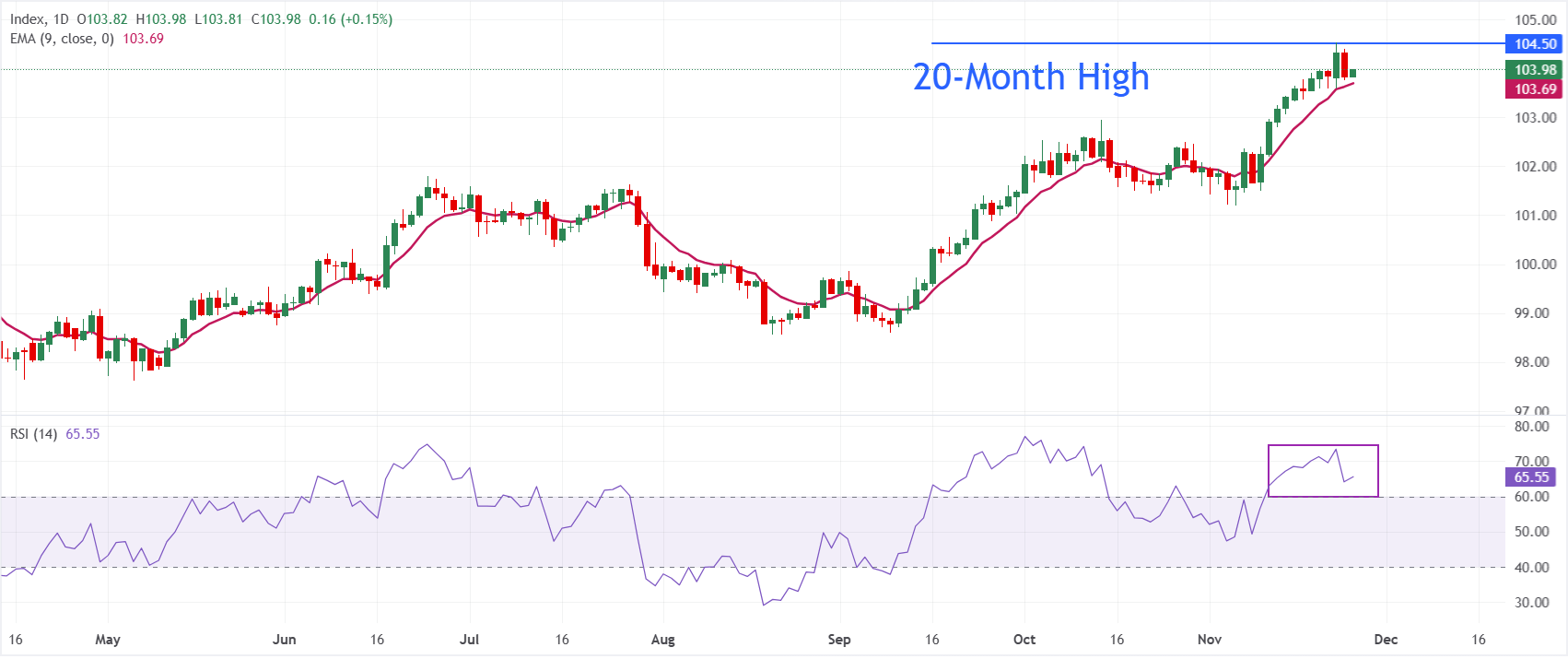
At 103.98 on the daily chart, Dollar Index Spot retains a bullish near-term bias above its 9-period exponential moving average (EMA) of 103.69. A close back above this short-term EMA supports the constructive trend. Meanwhile, the Relative Strength Index (RSI) stands at 65.55, in positive territory but below overbought levels. This suggests firm upward momentum without signs of overstretching.
Should the index consolidate or pull back, the 9-period EMA at 103.69 provides immediate support and the first area of demand. Buyers are likely to remain in control while Dollar Index Spot holds above this moving average on a closing basis, preserving the broader upward bias.
(The technical analysis of this story was written with the help of an AI tool. Know more.)
US Dollar: Key Questions
As the official currency of the United States of America, the US Dollar (USD) also serves as the ‘de facto’ currency in a significant number of other countries, circulating alongside their local banknotes. No other currency is traded more heavily. According to 2022 data, it accounts for over 88% of global foreign exchange turnover, equivalent to an average of $6.6 trillion in daily transactions. The USD replaced the British Pound as the world’s reserve currency after the Second World War. Gold backed the US Dollar for most of its history, until the Gold Standard ended with the Bretton Woods Agreement in 1971.
Monetary policy set by the Federal Reserve (Fed) is the single most influential factor in the US Dollar’s value. The Fed’s dual mandate combines price stability, or inflation control, with full employment. Interest rate adjustments are its main tool for meeting these objectives. Inflation above the Fed’s 2% target, with prices climbing too rapidly, prompts rate rises that support the USD. Conversely, the Fed may cut interest rates if inflation drops below 2% or the unemployment rate becomes too high, putting pressure on the Greenback.
Printing additional Dollars and implementing quantitative easing (QE) are options available to the Federal Reserve in extreme circumstances. Through QE, the Fed substantially expands credit flows within a financial system that has stalled. This unconventional policy addresses credit shortages caused by banks refusing to lend to one another for fear of counterparty default. It is a last resort when interest rate cuts alone are unlikely to deliver the required outcome. During the Great Financial Crisis in 2008, the Fed chose QE to tackle the credit crunch. The process entails printing more Dollars to purchase US government bonds, mainly from financial institutions. The US Dollar usually weakens as a result.
Under quantitative tightening (QT), the reverse process, the Federal Reserve ceases bond purchases from financial institutions. It also refrains from reinvesting the principal repaid on maturing bond holdings in new purchases. This generally supports the US Dollar.
POPULAR ARTICLES
1EUR/JPY Price Forecast: Weakens below 174.50, bearish vibe prevails below 100-day SMA2AI trade concerns and renewed US tariff unease push Asian stocks lower3India Gold price today: Prices hold steady, FXStreet data show4$700 Target for ZEC as Decline Continues: Zcash Price Forecast as Gemini Accepts Shielded Deposits5US PCE ahead: Gold under pressure near weekly low as Fed bets and geopolitics underpin USD6Below 0.5500: New Zealand Dollar retreats ahead of US PCE and GDP releases7United States Dollar Index pulls back amid doubts over sustainability of AI trade reversal83 Top Crypto Price Predictions: Bitcoin, Ethereum, Ripple – BTC, ETH and XRP deepen losses as oversold market looks towards yearly lows914-month low near $40.50: Silver Price Forecast as XAG/USD falls to fresh lows, US PCE data in focus


Get Started!
Sign up and access the Global Markets in less than 3 minutes

Connect With Us









Contacts
Phone: +61 2 8036 8388
Fax: +61 2 8036 8388
Email: support@tmgm.com



The information provided on this website is of a general nature only and does not constitute personal financial advice. Before acting on any information on this website, you should consider the suitability of the information in relation to your objectives, financial situation and needs. Investing in CFDs and FX Margin Contracts carries significant risks and is not suitable for all investors. You may lose more than your initial deposit. You do not own, or have, any interest in the underlying asset. We recommend that you seek independent advice and ensure you fully understand the risks involved before trading. It is important that you read and consider the disclosure document before you acquire any product listed on the website. The information and advertisements offered on this website are not intended for use by any person in any country or jurisdiction where such use would be contrary to local laws and regulations. The Products and Services offered on this website are not intended for residents of the United States, Malaysia and Thailand.
TMGM is authorized and regulated in various jurisdictions.
Trademax Australia Limited, trading as TMGM, is regulated by the Australian Securities and Investments Commission (ASIC), AFSL no. 436416 and is located at Level 28, One International Tower, 100 Barangaroo Avenue, 2000 Sydney, NSW Australia.
Email: support@tmgm.com.au
Trademax Global Limited, trading as TMGM, is authorized and regulated by the Vanuatu Financial Services Commission (VFSC), registration number 40356 and registered at 1276, Kumul Highway, Port Vila, Vanuatu, Republic of Vanuatu.
Email: support@tmgm.com
Trademax Global Markets (SE) Limited, trading as TMGM, is authorized and regulated by the Financial Services Authority (FSA) of Seychelles, with license number SD224. The company is registered at Office No 13, Providence Estate ABIS Centre, Mahe, Seychelles.
Email: support@tmgm.com
Trademax Global Markets (International) Pty Ltd, trading as TMGM, is authorized and regulated by the Financial Services Commission, Mauritius (FSC) with license no. GB22201012, and registered at 33, Edith Cavell Street C/o IQ EQ Fund Services (Mauritius) Ltd Port Louis, 11324 Mauritius.
Email: support@tmgm.com
Copyright © TMGM. All rights reserved