

Trading
Explore a wide range of markets with competitive pricing, deep liquidity, and advanced trading tools.
Learn More 
Platform
Trade seamlessly with TMGM's powerful platform, built for speed, precision, and a superior trading experience.
Learn More Trading Platform
Academy
Learn the fundamentals of trading with beginner-friendly resources, including guides, webinars, and market insights.
Learn More News & Analysis
Get real-time market updates and expert analysis to stay ahead of trading opportunities
Learn More News & Analysis
About
Learn what sets TMGM apart — our global presence, regulatory strength, and commitment to innovation in trading.
Learn More Why Choose TMGM
Sponsorship
November US S&P Global PMI expected to soften
- November's preliminary US Global PMI is forecast to ease modestly but stay well within expansion territory.
- Following strong October readings, growth in manufacturing and services activity is projected to soften.
- An upside data surprise could strengthen expectations for additional Fed interest rate increases, putting pressure on EUR/USD.
November's preliminary United States (US) S&P Global Purchasing Managers Indices (PMIs) are due on Monday at 14:45 GMT. The release will provide a fresh assessment of the world's largest economy as investors weigh the Federal Reserve's (Fed) monetary policy outlook before its December meeting.

Private-sector business activity is tracked through the report's Manufacturing PMI, Services PMI and Composite PMI. The dividing line is 50: readings above it denote expansion, while those below it indicate contraction.
The backdrop to November's surveys is one in which US economic growth continues to show strength despite ongoing inflation pressures and tighter monetary conditions. The figures will be scrutinised for evidence that October's slowdown has extended into November, and for signs that economic resilience warrants further interest rate increases.
November S&P Global PMI: Modest Slowdown Expected
After October's elevated readings, markets expect US private-sector activity to lose a little momentum in November. Forecasts put the S&P Global Services PMI on course to slip to 55.8 this month, compared with 56.1 in October. The Manufacturing PMI is projected to fall to 54.6 from 54.9. October's Composite PMI, at 55.9, pointed to solid expansion across the US private sector.
Even with this projected moderation, manufacturing and services activity are both expected to stay well above the 50 mark. That would suggest continued expansion at a relatively healthy pace for the US economy.
Although momentum eased slightly from September, October's surveys placed global economic growth among the strongest seen since 2022, according to S&P Global. November's results will help establish whether the easing is temporary or signals the start of a more persistent slowdown caused by high interest rates and lingering inflation.
Compared with other major developed economies, the US continues to deliver stronger growth. In recent months, output and employment have risen significantly faster in the United States than among its major peers, S&P Global notes. Nevertheless, a number of factors could progressively erode that momentum. Business investment and spending could be discouraged by tighter monetary policy, recent financial market volatility and economic uncertainty.
Persistent inflation pressures have kept expectations of further monetary tightening alive, with financial markets anticipating another Fed interest rate increase in December. The policy outlook is nonetheless uncertain. A recent warning from US Treasury Secretary Scott Bessent that excessive tightening could endanger economic growth has led traders to pare back expectations for more aggressive rate increases.
In this environment, the PMI release could be important in weighing economic resilience against the risks of an excessively restrictive policy stance.
14:45 GMT Monday: November US S&P Global Flash PMIs and EUR/USD Outlook
Monday at 14:45 GMT brings the November S&P Global Manufacturing, Services and Composite PMIs. As investors recalibrate expectations for the Fed's December monetary policy decision, the release could generate volatility in the US Dollar (USD) and EUR/USD.
An upside surprise, especially in services, could underscore US economic resilience and increase the likelihood of further interest rate rises. US Treasury yields and the Greenback would likely benefit in that scenario, potentially leaving EUR/USD under pressure.
A steeper slowdown than forecast, by contrast, could heighten concerns over the US economic outlook. If weak PMI results coincide with softer employment conditions or easing price pressures, investors could reduce expectations for additional monetary tightening. That could weigh on the US Dollar while supporting EUR/USD.
A release broadly in line with consensus could produce a relatively muted Forex response. Forecasts already allow for modest easing in manufacturing and services activity, with both remaining firmly in expansion territory.
Before the Fed's December meeting, a central question for investors will be whether US economic momentum remains strong enough to absorb further rate increases. Business activity above expectations could bolster the likelihood of a hawkish Fed. A more marked slowdown, however, could challenge the case for further monetary tightening and put pressure on the US Dollar.
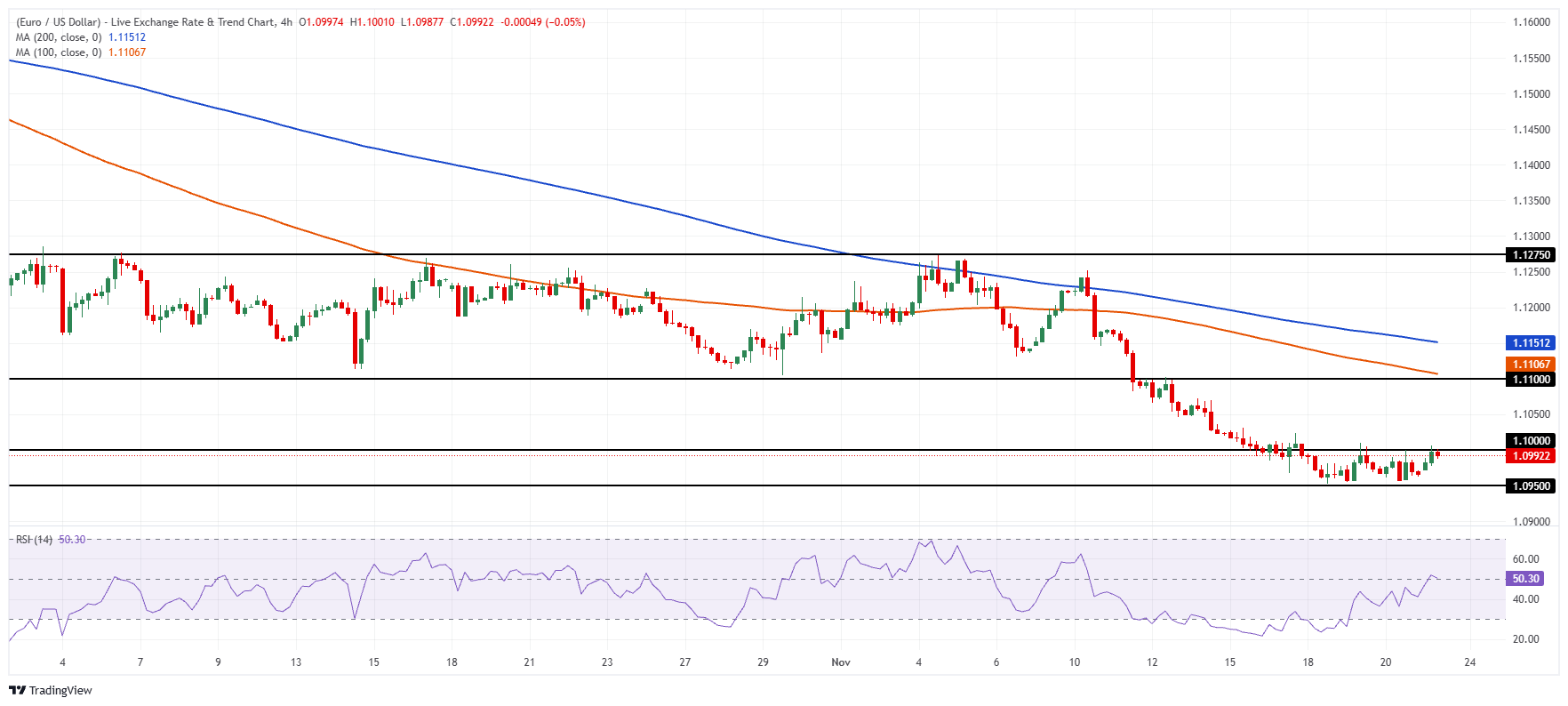
On the 4-hour chart, EUR/USD continues to face selling pressure just beneath psychological resistance at 1.1000. Although the pair is seeking to stabilise following its recent fall, the wider bearish picture is unchanged. Price remains below the 100-period Simple Moving Average (SMA) at 1.1107 and the 200-period SMA at 1.1151.
At 1.1000, immediate resistance marks a former support level lost in the recent bearish breakdown. Holding a recovery above that level could open the way towards 1.1100 and then the 100-period SMA at 1.1107. Beyond those levels, the 200-period SMA near 1.1151 would present further resistance.
Recent selling has been contained at 1.0950, the first downside support. Losing that level could renew bearish momentum and bring the psychological 1.0900 mark into view.
A recovery in the Relative Strength Index (RSI) to around 50 points to easing bearish momentum. A more convincing rebound would still require a sustained break above 1.1000. Below the key moving averages, the broader outlook continues to favour sellers.
Economic Data Indicator
S&P Global Manufacturing PMI: US Activity Gauge
Published monthly, the S&P Global Manufacturing Purchasing Managers Index (PMI) provides a leading gauge of US manufacturing business activity. It draws on surveys of senior executives at private-sector manufacturing companies. Respondents report any changes in the current month relative to the previous month. Their responses can foreshadow shifts in official data series, including Gross Domestic Product (GDP), industrial production, employment and inflation. Above 50, the index signals that the manufacturing economy is generally expanding, which is bullish for the US Dollar (USD). Below 50, it points to a general decline in manufacturing activity, a bearish signal for USD.
Continue reading.Next publication: Mon 23 Nov 2026 14:45 (Prel)
Release schedule: Every month
Market consensus: 54.6
Prior reading: 54.9
Data source: S&P Global
POPULAR ARTICLES
1Soft UK Flash PMIs: British Pound retreats from session highs2Federal Reserve: Sticky inflation and back-to-back rate hikes – TD Securities3November US S&P Global PMI expected to soften4US Dollar: Hawkish Fed stance sustains Greenback demand – ING552 in November: United Kingdom flash S&P Global Services PMI records an unexpected decline6FXStreet data: Silver price moves higher today7Japanese Yen: Growing Risk of Gains Against US Dollar – UOB8Preliminary Eurozone Activity Data Underwhelm as Euro Pares Daily Gains9New Zealand Dollar holds near lows despite robust consumption figures


Get Started!
Sign up and access the Global Markets in less than 3 minutes

Connect With Us









Contacts
Phone: +61 2 8036 8388
Fax: +61 2 8036 8388
Email: support@tmgm.com



The information provided on this website is of a general nature only and does not constitute personal financial advice. Before acting on any information on this website, you should consider the suitability of the information in relation to your objectives, financial situation and needs. Investing in CFDs and FX Margin Contracts carries significant risks and is not suitable for all investors. You may lose more than your initial deposit. You do not own, or have, any interest in the underlying asset. We recommend that you seek independent advice and ensure you fully understand the risks involved before trading. It is important that you read and consider the disclosure document before you acquire any product listed on the website. The information and advertisements offered on this website are not intended for use by any person in any country or jurisdiction where such use would be contrary to local laws and regulations. The Products and Services offered on this website are not intended for residents of the United States, Malaysia and Thailand.
TMGM is authorized and regulated in various jurisdictions.
Trademax Australia Limited, trading as TMGM, is regulated by the Australian Securities and Investments Commission (ASIC), AFSL no. 436416 and is located at Level 28, One International Tower, 100 Barangaroo Avenue, 2000 Sydney, NSW Australia.
Email: support@tmgm.com.au
Trademax Global Limited, trading as TMGM, is authorized and regulated by the Vanuatu Financial Services Commission (VFSC), registration number 40356 and registered at 1276, Kumul Highway, Port Vila, Vanuatu, Republic of Vanuatu.
Email: support@tmgm.com
Trademax Global Markets (SE) Limited, trading as TMGM, is authorized and regulated by the Financial Services Authority (FSA) of Seychelles, with license number SD224. The company is registered at Office No 13, Providence Estate ABIS Centre, Mahe, Seychelles.
Email: support@tmgm.com
Trademax Global Markets (International) Pty Ltd, trading as TMGM, is authorized and regulated by the Financial Services Commission, Mauritius (FSC) with license no. GB22201012, and registered at 33, Edith Cavell Street C/o IQ EQ Fund Services (Mauritius) Ltd Port Louis, 11324 Mauritius.
Email: support@tmgm.com
Copyright © TMGM. All rights reserved