What Is Doji Candle?
A doji candle is a candlestick pattern used in technical analysis where the opening price and closing price are nearly equal. That creates a very small real body and signals that neither buyers nor sellers finished the session with clear control, which is why the doji candle pattern is also often referred to as an indecision candle.
Price may have moved sharply during the session, but the final close returned near the opening level.
That is why the doji matters in price action analysis. It shows a pause in directional conviction, but it does not confirm what happens next on its own.
This is because the price action behind Doji reflects that the market reached a temporary balance between buying and selling forces, reflecting market hesitation.
What Does Doji Candle Mean?
The term doji comes from Japanese, broadly translated as "the same thing" — a reference to the pattern's defining trait, where the open and close finish at virtually the same price. That equality is uncommon enough to be worth flagging on a chart, which is why the candle earned its own name.
The name captures the meaning of the pattern as much as its shape: a session that ends where it began, with neither side able to convert its move into a decisive close. Everything else about the doji — the wick lengths, the type, the context — builds on that single idea of a market that moved but resolved nothing.
What Are the Components of a Doji Candlestick?
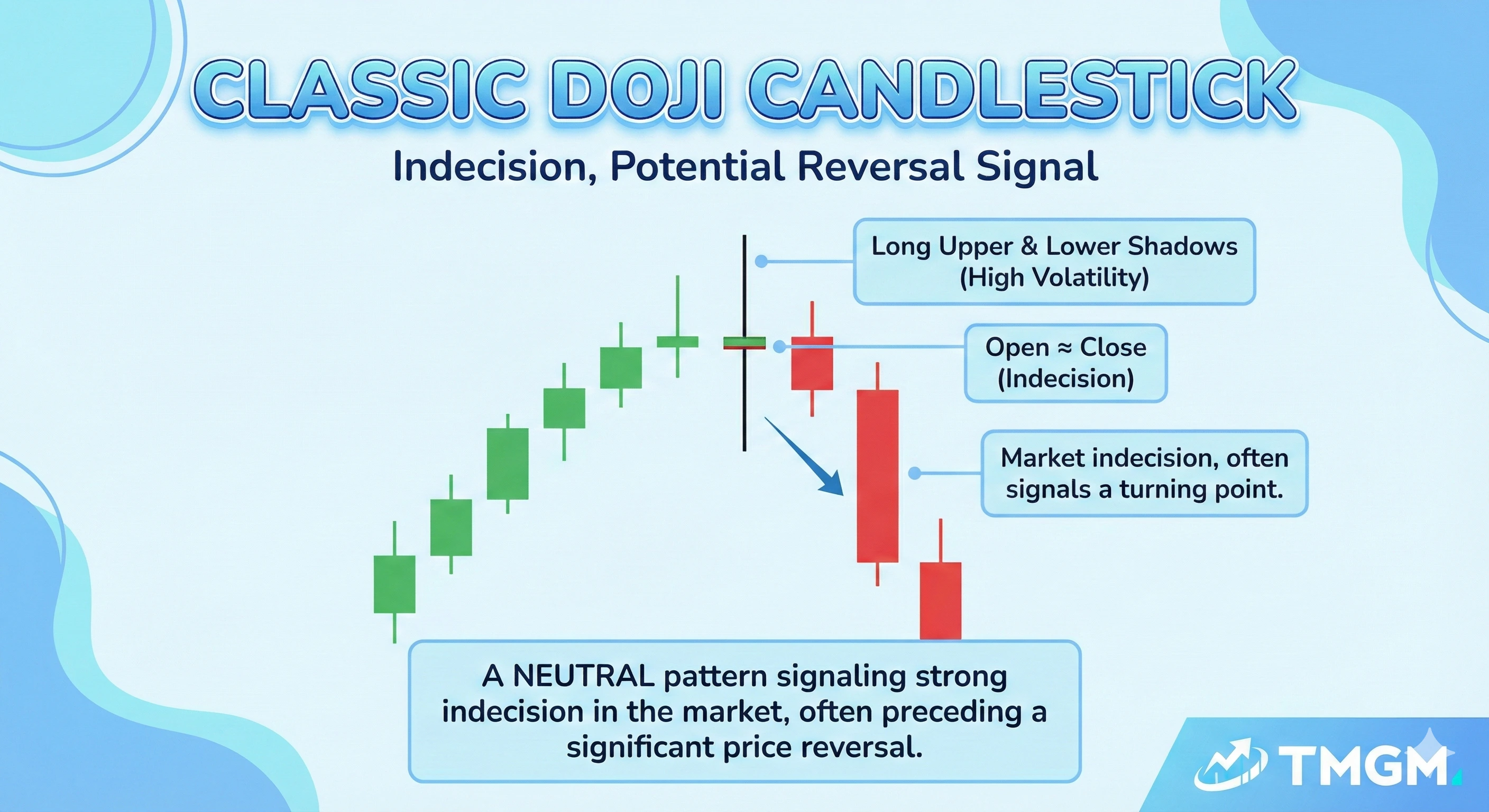
The main parts of a doji candlestick are the open, close, upper wick, and lower wick. The defining feature is that the open and close are extremely close together.
The real body is either flat or almost invisible. The wicks show how far price traveled above and below the opening level before the session closed.
A long upper wick shows that buyers pushed price higher but failed to hold it. A long lower wick shows that sellers pushed price lower but failed to keep control into the close.
How Do Traders Use a Doji Candlestick Pattern in Trading?
XAUUSD Example
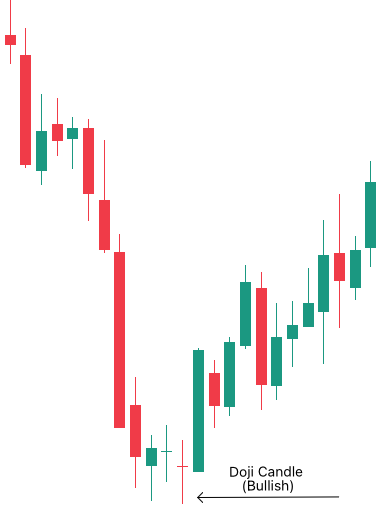
Here is a real life example of price chart data for XAUUSD where a doji candle printed on March 07, 2019. For a beginner, the key is to focus on sequence rather than reacting to the doji immediately.
First, notice that the doji appears after a strong selloff (downtrend) and near the bottom of the move, which makes it more meaningful from a price action perspective.
Second, wait for confirmation instead of entering by the doji itself. In this chart, the next strong bullish candle closes above the doji range, which is the signal that buyers may be starting to regain control.
Third, build the trade around that confirmation. Entry is often considered above the doji high or the confirmation candle, while the stop loss is usually placed below the doji low or the most recent swing low.
This helps beginners understand that the doji highlights a possible turning point, but the confirmation candle is what makes the setup tradable.
Pro Tip: The doji is the warning signal. The next candle is the decision signal.
Which Tools Can Confirm a Doji Pattern's Signal?
- Support and resistance are the most important confirmation tools because they give the candle a meaningful location. A doji at a key level is more useful than a doji in open space.
- Volume helps show participation. If a doji forms at a turning point and the next candle breaks with stronger volume, the signal carries more weight.
- RSI can help identify momentum exhaustion. A bearish doji near resistance with RSI divergence is often more relevant than the same candle without divergence.
- MACD helps traders judge momentum shift rather than candle shape alone. A doji followed by a momentum crossover or histogram weakening can strengthen the case for reversal or slowdown.
- Moving averages and Trendlines help define whether the doji forms in line with the broader trend or against it. This matters because countertrend doji setups usually need stronger confirmation.
What Are the Types of Doji Candlesticks?
Each doji type shares the same flat body but differs in wick placement, and that difference is what hints at where pressure was rejected.
What Is a Classic Doji Candle?
The classic doji has a very small body with upper and lower wicks that are often fairly balanced. It usually reflects general indecision with no strong directional rejection.
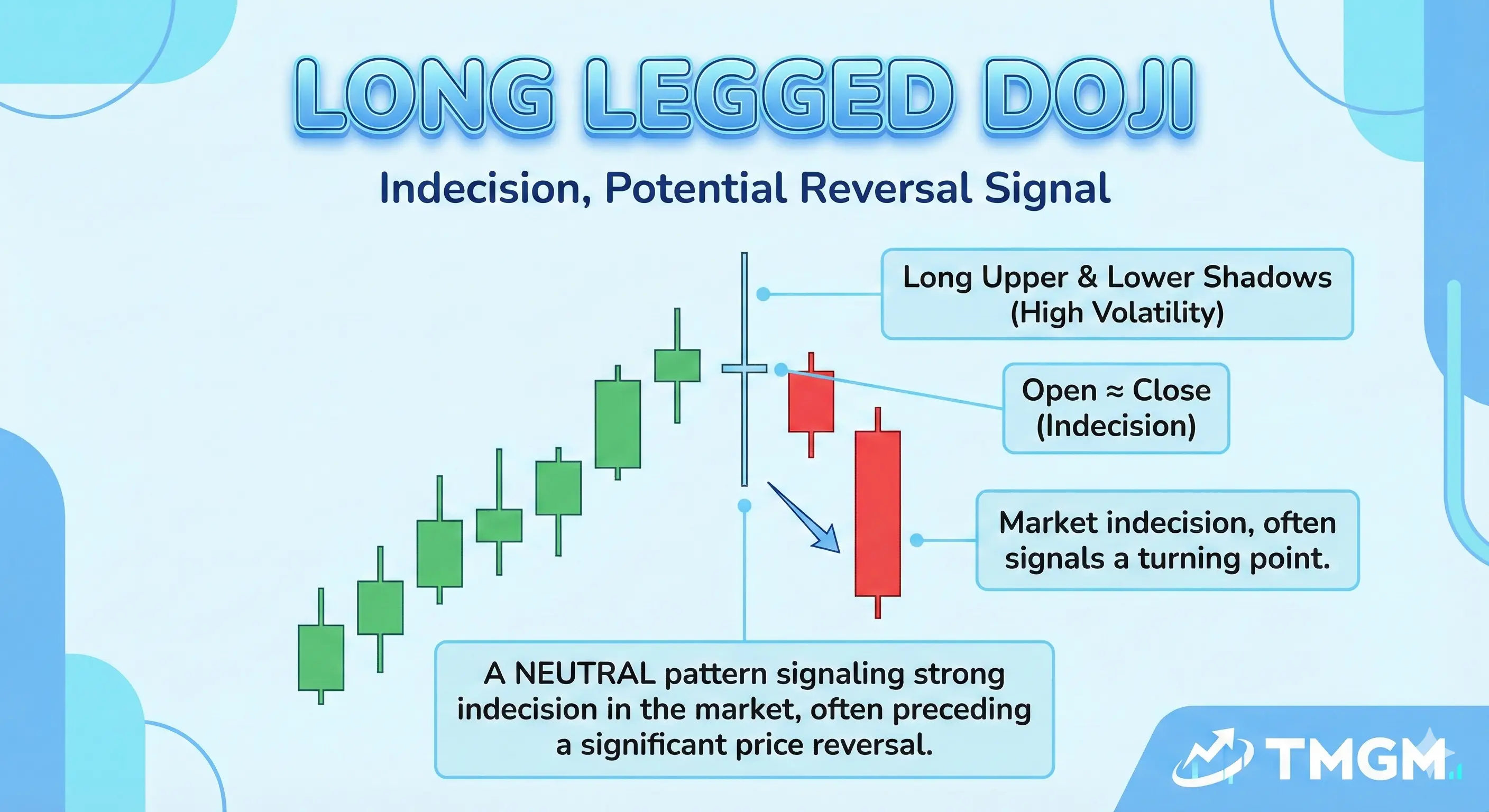
What Is a Long-Legged Doji Candle?
The long legged doji has long upper and lower wicks. This shows more aggressive two way price movement during the session, but still no clear winner by the close.
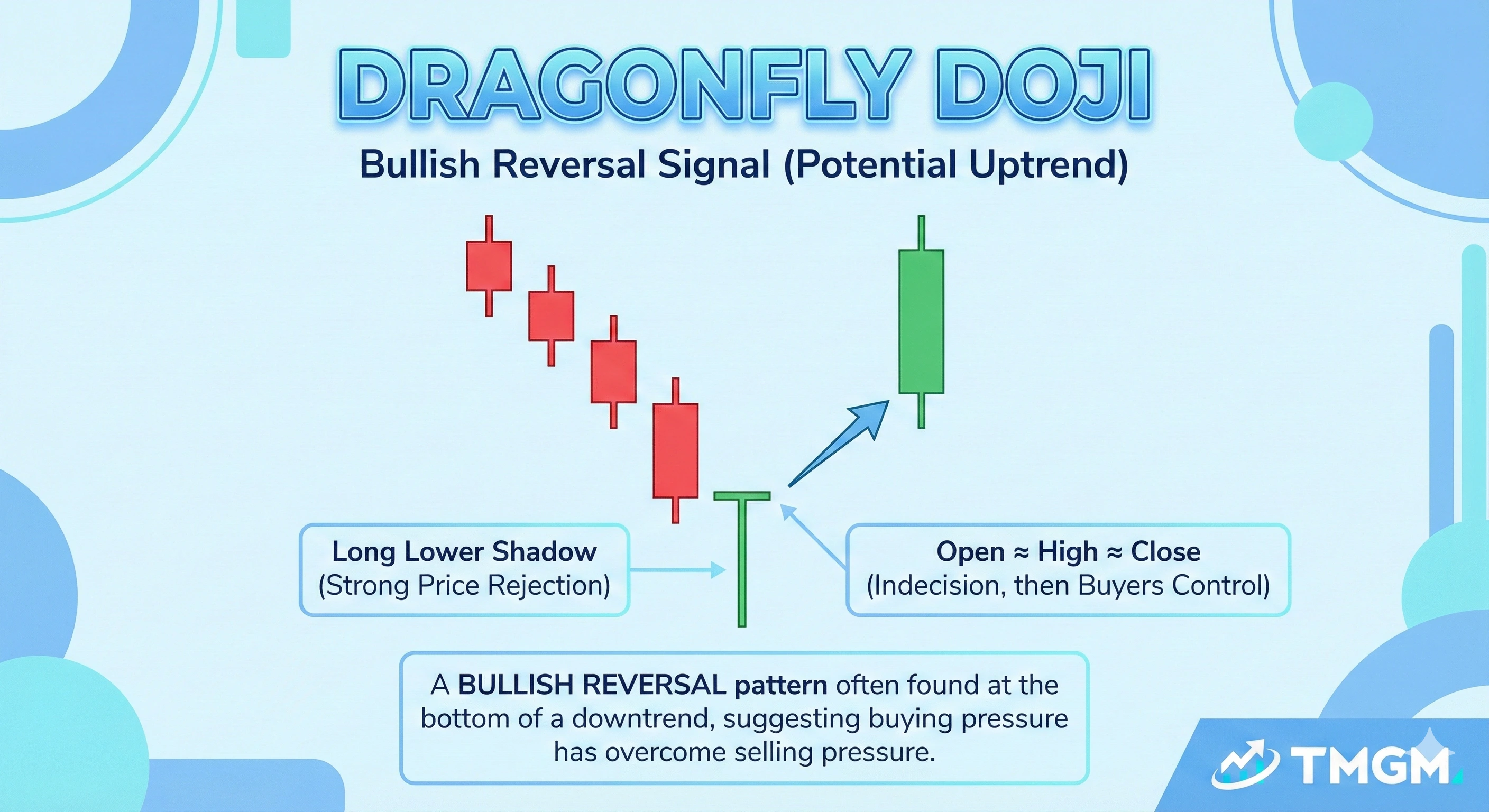
What Is a Dragonfly Doji Candle?
The dragonfly doji has little or no upper wick and a long lower wick. It shows that sellers drove price lower, but buyers recovered the move and pushed the close back near the open.
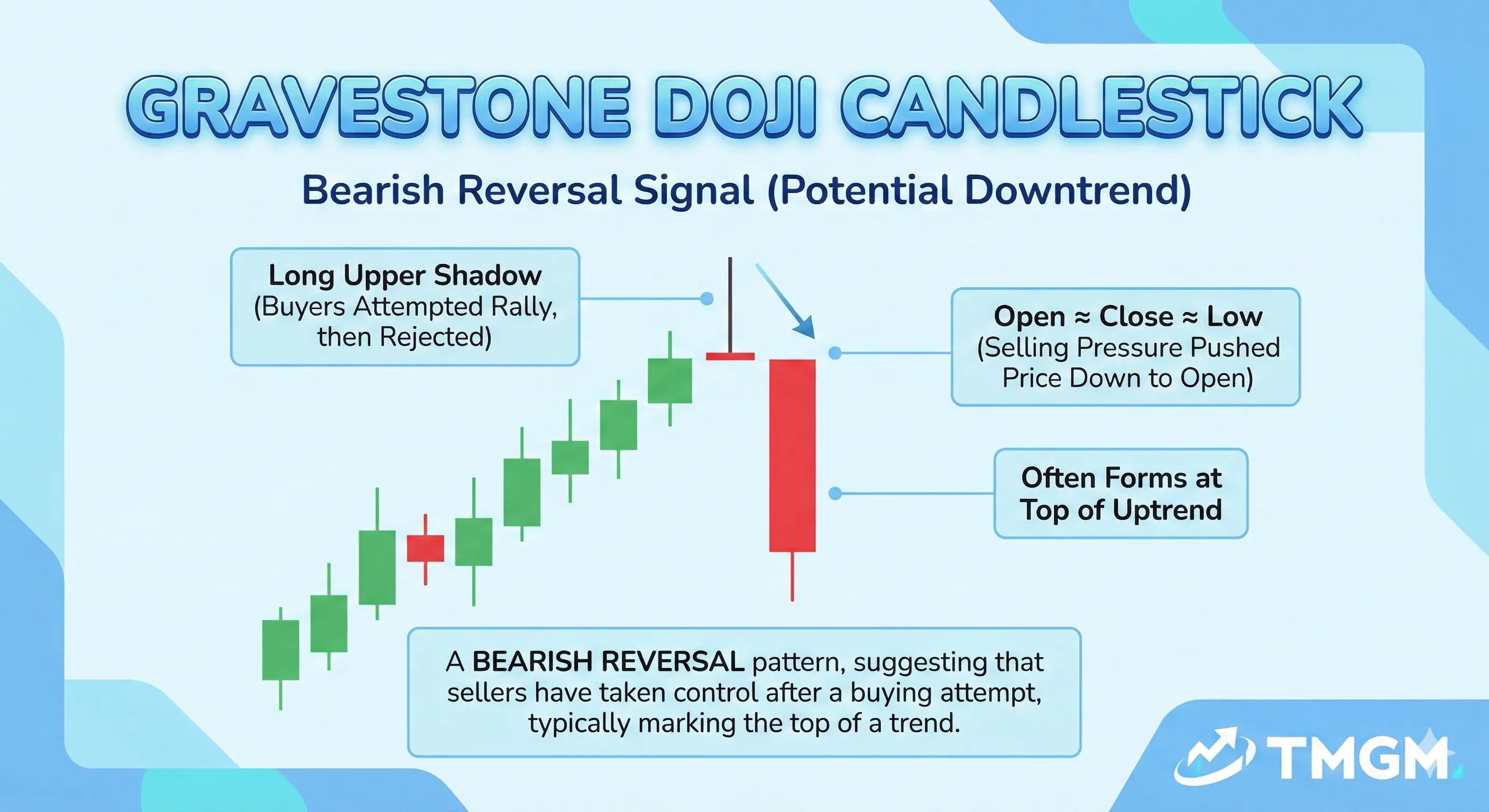
What Is a Gravestone Doji Candle?
The gravestone doji has little or no lower wick and a long upper wick. It shows that buyers pushed price higher, but sellers erased the move before the close.
What Is a Four Price Doji Candle?
The four price doji is the rarest and most extreme form, where the open, high, low, and close all print at virtually the same level, appearing as a single horizontal line with no meaningful wicks. Rather than signalling a reversal, it usually reflects extremely thin liquidity or a near-total absence of participation. That is why it carries little analytical weight outside of very illiquid instruments or dead, low-volume sessions.
Doji Candlestick vs Spinning Top
A doji candlestick and a spinning top both show hesitation, but they are not the same pattern. The key difference is the real body size.
In a doji, the open and close are almost identical. In a spinning top, the body is still small but clearly visible, which means one side retained slightly more control by the close.
This distinction matters because the doji shows a more balanced session. A spinning top still signals indecision, but it is usually less precise as a turning point clue.
When Is a Doji Bullish, Bearish, or Neutral?
A doji is bullish only in the right context. For example, a dragonfly doji after a clear downtrend near support can suggest sellers are losing control.
A doji is bearish when it forms after an extended rally near resistance and the next candle confirms downside pressure. A gravestone doji is a common example of this setup.
A doji is neutral when it appears in the middle of a range, during low conviction trading, or without any meaningful follow through. In those cases, it often reflects pause rather than directional edge.
A doji near a breakout level can be especially useful. It may show either breakout hesitation before continuation or a failed breakout that reverses back into the prior range.
What Are the Limitations of a Doji Candlestick?
The biggest limitation is that a doji is not predictive by itself. It only shows that the market paused or balanced during one candle period.
Some traders often overread it as a reversal signal when it may only reflect temporary hesitation. This mistake is commonly seen in choppy markets, low liquidity conditions, and lower time frames.
Important
A doji without confirmation is analysis. A doji with confirmation is a setup.
Pro tip:
A doji at a major level can matter a lot, while a doji in the middle of random consolidation may mean very little.
Does a Doji Candlestick Work in Forex, Stocks, and Crypto?
Yes, the doji candlestick pattern appears in Forex, Gold, Crypto, Oil, Shares and so on. The pattern is universal because it reflects the relationship between open, high, low, and close.
What changes across markets is the quality of the signal. In liquid markets with cleaner structure, the doji is usually easier to interpret than in thin or highly erratic markets.
Time frame also matters. A doji on a higher time frame usually carries more analytical weight than a doji on a very low time frame, where noise and spread distortion are more common.
Doji Candlestick FAQ
Is a doji candlestick a reversal signal?
A doji candle can appear before a reversal, but it is not a reversal signal on its own. Traders usually need confirmation from the next candle and the surrounding chart context.
Does the colour of a doji candle (red or green) matter?
For a true doji, colour carries very little weight because the real body is negligible by definition — a green doji simply closed a fraction above its open, and a red doji a fraction below. Unlike a full-bodied candle, that tiny difference says almost nothing about conviction, so read the wicks, the location, and the confirmation candle rather than the colour.
How often does a doji candlestick appear?
Doji candles appear frequently, especially on lower time frames where minor pauses are common — which is exactly why most of them carry little signal. A doji only becomes meaningful when it forms at a key level, after an extended move, or with confirmation; the majority reflect ordinary noise.
Doji Candlestick at a Glance
1 A doji has a near flat body, while the wicks show movement and rejection.
2 It shows indecision, but context determines the meaning.
3 Doji types include standard, long legged, dragonfly, gravestone, and four price.
4 A doji is flatter than a spinning top.
5 Confluence comes from the next candle, key levels, volume, RSI, MACD, and trend structure.
6 Context decides whether the signal is bullish, bearish, or neutral.
7 Many doji candles only reflect pause, low liquidity, or noise.