

Trading
Explore a wide range of markets with competitive pricing, deep liquidity, and advanced trading tools.
Learn More 
Platform
Trade seamlessly with TMGM's powerful platform, built for speed, precision, and a superior trading experience.
Learn More Trading Platform
Academy
Learn the fundamentals of trading with beginner-friendly resources, including guides, webinars, and market insights.
Learn More News & Analysis
Get real-time market updates and expert analysis to stay ahead of trading opportunities
Learn More News & Analysis
About
Learn what sets TMGM apart — our global presence, regulatory strength, and commitment to innovation in trading.
Learn More Why Choose TMGM
Sponsorship
Bitcoin Price Forecast: Could rising leverage in derivatives markets expose BTC to sharp moves?
- Bitcoin remains near $73,800 on Wednesday, having dropped to $72,727 after the previous day’s strong US inflation readings.
- Withdrawals from US-listed BTC spot ETFs extended to a fourth consecutive day on Tuesday, with outflows totalling $95 million.
- Heavy leverage in BTC derivatives is raising the risk of a sharp move in either direction, reports indicate.
Bitcoin (BTC) remains under pressure around $73,800 on Wednesday, after the previous day’s strong US inflation readings drove it to a low of $72,727. Further evidence of weakening institutional demand came from BTC spot Exchange Traded Funds (ETFs), which registered $95 million in outflows on Tuesday, their fourth consecutive day of withdrawals. With leverage accumulating in derivatives markets, a K33 Research report flags the risk of sharp BTC price swings, warranting caution among traders.

Why Are Strong US Inflation Readings Lifting Yields and the US Dollar but Hurting BTC?
October’s headline US Consumer Price Index (CPI) increased 0.4%, exceeding the market forecast of 0.3%, according to the closely watched data published on Tuesday. Excluding volatile food and energy prices, core CPI climbed 0.3%. That matched September’s rise but exceeded the estimated 0.2%.
Annual inflation readings were absent from this release because October 2025 monthly data is unavailable following the government shutdown from 1 October 2025 to 12 November 2025.
Risk appetite is weakening after the stronger-than-anticipated US CPI readings. At the same time, rising expectations of additional monetary tightening by the Federal Reserve (Fed) are lending support to the US Dollar (USD) and US Treasuries.
Concerns over a possible December interest rate increase by the Federal Reserve (Fed) have intensified since Tuesday’s inflation release. A stronger-than-expected core CPI reading of 0.3% could lead Fed Governor Christopher Waller to consider a larger 50-basis-point (bps) hike at the 8–9 December policy meeting, he warned. Waller also said that restricting the increase to 25 bps could jeopardise the Fed’s credibility.
The need to maintain restrictive policy to bring inflation back to 2% was also highlighted by Philadelphia Fed President Anna Paulson. Dallas Fed President Lorie Logan, meanwhile, indicated that interest rates may have to rise more quickly than previously envisaged.
With the 10-year Treasury yield climbing above 5%, this hawkish policy stance is lifting the USD and Treasury yields while putting pressure on risk assets, including Bitcoin.
What Is Driving the Wave of Crypto Liquidations?
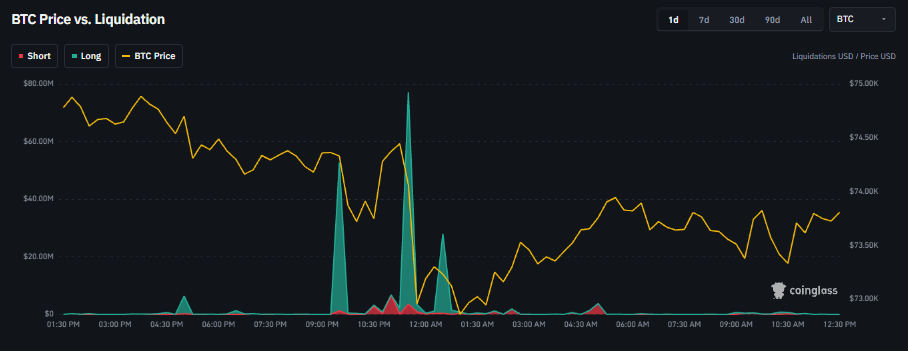
BTC’s steep correction following the stronger-than-expected US CPI release is illustrated in the CoinGlass liquidation chart below. Tuesday’s decline took the price to $72,727, its lowest level since 20 August.
Liquidations spread across the crypto market as prices fell sharply. Leveraged long positions accounted for most of the wipeout, underscoring the extent of bullish positioning.
For the leading cryptocurrency, the continued build-up of derivatives leverage also keeps the risk of abrupt price swings high.
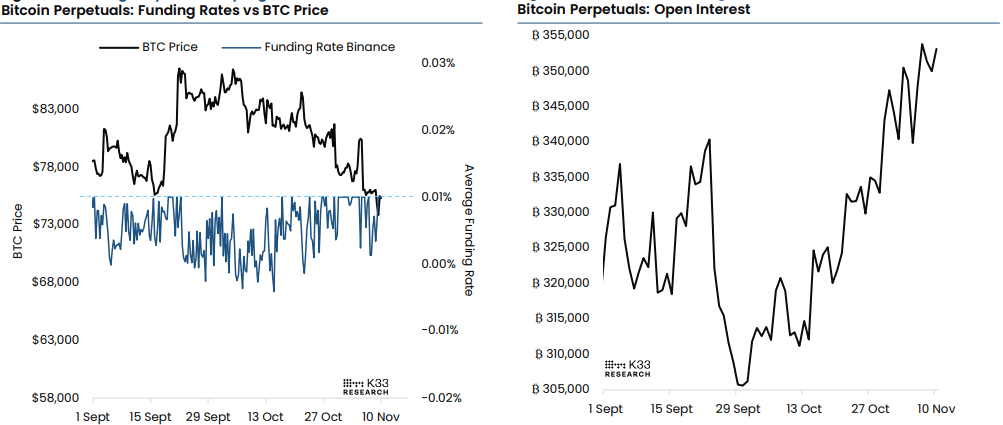
BTC perpetual futures Open Interest (OI) has reached 353,000 BTC, according to K33 Research, placing it in the 99th percentile of readings over the past two years. Over the past week, annualised funding rates have averaged 8.4%. This points to persistent demand for long exposure even as BTC tests important support levels.
The analyst concluded: “Historically, similarly elevated open interest has coincided with price extremes and periods of substantial volatility, often preceding sharp reversals. While elevated leverage provided fuel for upside moves in June and August, current positioning appears less directional, leaving considerable scope for volatility in either direction. A breakdown could trigger substantial long liquidations, while a recovery could fuel short covering, amplifying price moves as leveraged positions unwind,”
Could Continued ETF Outflows Deepen BTC’s Correction?
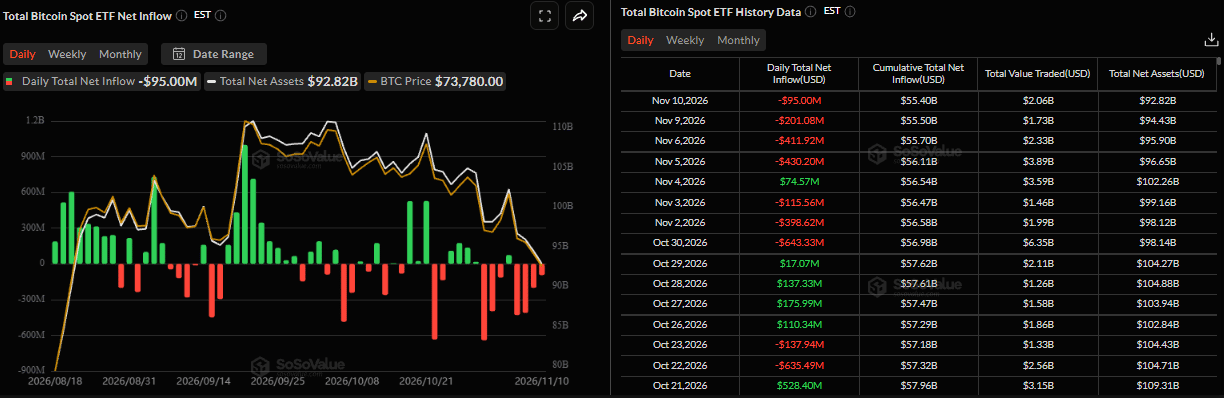
Bitcoin has seen further weakness in institutional demand this week. Tuesday brought net outflows of $95 million from BTC spot ETFs, SoSoValue data shows, extending the withdrawal streak that began last week to four consecutive days. Should these outflows persist and gather pace through the week, BTC could face additional selling pressure and a deeper price correction.
Can Diplomatic Optimism Offer Some Support?
BTC could find near-term support from some encouraging developments. Following Tuesday’s meeting of G7 foreign ministers in Paris, US Secretary of State Marco Rubio said the economic campaign against Iran had inflicted such damage that major combat operations were not necessary at present.
US President Donald Trump has also sought to ease concerns about escalation after the midterm elections. Speaking to reporters, he described fresh US attacks on Iran as "highly unlikely" and said negotiations to end the Middle East conflict had positive momentum. Iran, meanwhile, called on the US to satisfy its demands under a plan to reopen the Strait of Hormuz.
The developments are encouraging hopes of a diplomatic breakthrough that could end the US-Iran war. By easing concerns over geopolitical risks, this could provide Bitcoin with near-term support.
Bitcoin Technical Outlook: Are Rallies Likely to Face Selling Pressure?
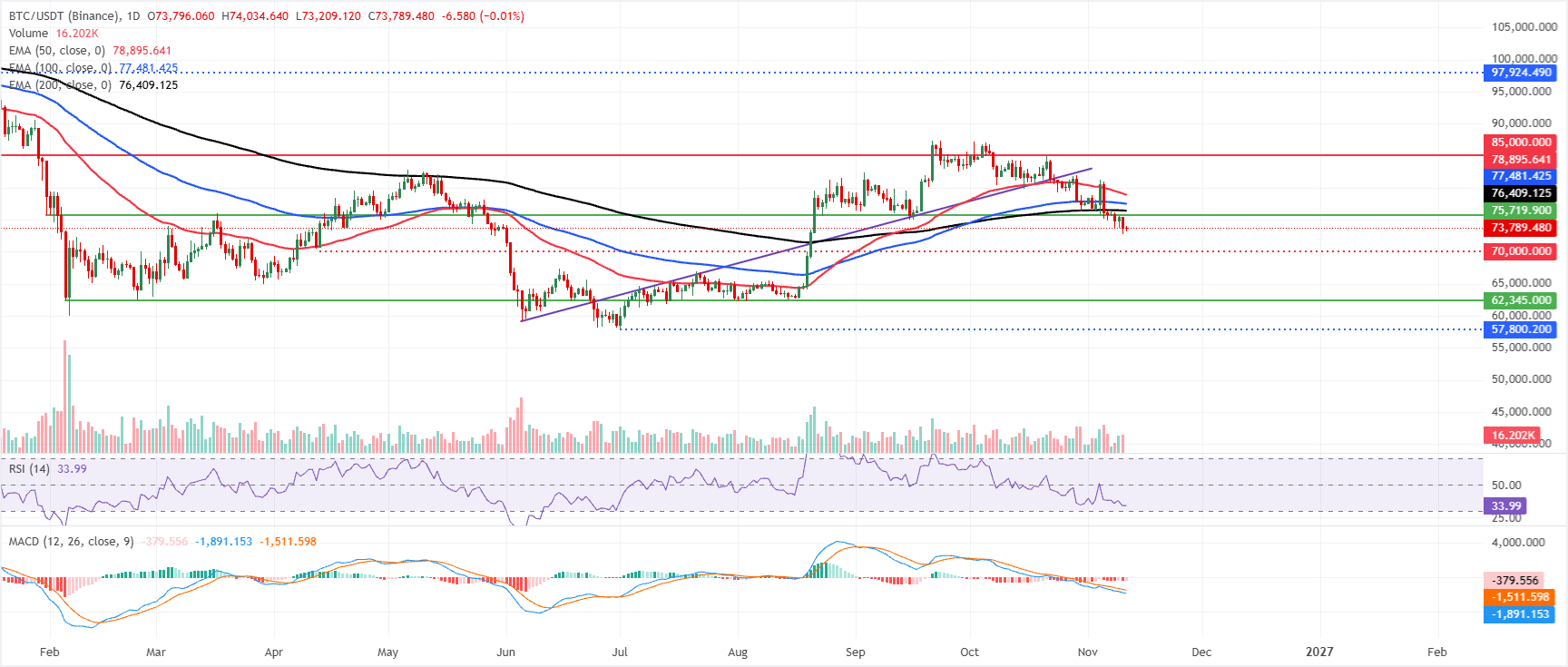
Trading at $73,789 at the time of writing on Wednesday, Bitcoin continues its bearish correction below the 50-day, 100-day and 200-day Exponential Moving Averages (EMAs). These averages are grouped within a range of roughly $76,400 to $78,900.
Rallies look likely to attract sellers in this configuration. On the daily chart, the Relative Strength Index (RSI) sits near 33, just above oversold territory, while the Moving Average Convergence Divergence (MACD) histogram stays negative. Together, these indicators underline continued downside pressure despite stretched short-term conditions.
Any recovery would first encounter the 200-day EMA around $76,409, ahead of the 100-day EMA near $77,481 and the 50-day EMA close to $78,895. Bulls would have to regain this tightly packed supply zone to reduce the bearish bias. Beyond it, horizontal resistance around $85,000 presents a more significant hurdle. A daily close above that level would be needed to indicate a more lasting return to a constructive medium-term trend.
With no nearby support mapped out, a break below current levels would point BTC towards the psychological support area around $70,000 before prices stabilise.
(The technical analysis of this story was written with the help of an AI tool. Know more.)
FAQs on Bitcoin, altcoins and stablecoins
Designed to function as money, Bitcoin is a virtual currency and the largest cryptocurrency by market capitalisation. No individual, group or entity can control this payment method, removing the need for third parties to participate in financial transactions.
The term altcoin covers cryptocurrencies other than Bitcoin. Some, however, exclude Ethereum as well, since forking originates from these two cryptocurrencies. Under that interpretation, Litecoin is the first altcoin: it was forked from the Bitcoin protocol and is therefore an “improved” version of it.
A stablecoin is a cryptocurrency intended to maintain a steady price, backed by a reserve of the asset it represents. Its value is linked to a commodity or financial instrument, such as the US Dollar (USD), while an algorithm or demand regulates its supply. Stablecoins primarily serve as an entry and exit route for investors looking to trade and invest in cryptocurrencies. They also enable investors to store value, given the volatility generally associated with cryptocurrencies.
Measured as Bitcoin’s market capitalisation relative to the combined market capitalisation of all cryptocurrencies, Bitcoin dominance offers a clear indication of investor interest in Bitcoin. BTC dominance is typically high ahead of and during a bull run, when investors favour a relatively stable cryptocurrency with a large market capitalisation, such as Bitcoin. Falling BTC dominance generally signals that investors are shifting capital and/or profits into altcoins in pursuit of better returns, often setting off a surge in altcoin rallies.
POPULAR ARTICLES
1Mixed Eurozone data leave Euro with smaller gains against British Pound2Why is the Japanese Yen still weakening with the Bank of Japan set for a December rate hike?3NZD/USD Price Forecast: Will growing bearish momentum drive a test of 19-month lows at 0.5527?4Oil: Brent rebound lifts prices above 200-day average – BBH5USD/JPY Price Forecast: Can bulls break 160.00 as intervention risks mount?6Ripple Price Forecast: Can XRP hold $1.00 support as 24-hour liquidations reach $20 million?7Amid bets on steeper Fed tightening, WTI Oil pares gains and slips below $878GBP/USD Price Forecast: Is a Retest of the Four-Month Low Near 1.3140 Likely?9CEE FX: Why Is Bearish Pressure Persisting? – ING


Get Started!
Sign up and access the Global Markets in less than 3 minutes

Connect With Us









Contacts
Phone: +61 2 8036 8388
Fax: +61 2 8036 8388
Email: support@tmgm.com



The information provided on this website is of a general nature only and does not constitute personal financial advice. Before acting on any information on this website, you should consider the suitability of the information in relation to your objectives, financial situation and needs. Investing in CFDs and FX Margin Contracts carries significant risks and is not suitable for all investors. You may lose more than your initial deposit. You do not own, or have, any interest in the underlying asset. We recommend that you seek independent advice and ensure you fully understand the risks involved before trading. It is important that you read and consider the disclosure document before you acquire any product listed on the website. The information and advertisements offered on this website are not intended for use by any person in any country or jurisdiction where such use would be contrary to local laws and regulations. The Products and Services offered on this website are not intended for residents of the United States, Malaysia and Thailand.
TMGM is authorized and regulated in various jurisdictions.
Trademax Australia Limited, trading as TMGM, is regulated by the Australian Securities and Investments Commission (ASIC), AFSL no. 436416 and is located at Level 28, One International Tower, 100 Barangaroo Avenue, 2000 Sydney, NSW Australia.
Email: support@tmgm.com.au
Trademax Global Limited, trading as TMGM, is authorized and regulated by the Vanuatu Financial Services Commission (VFSC), registration number 40356 and registered at 1276, Kumul Highway, Port Vila, Vanuatu, Republic of Vanuatu.
Email: support@tmgm.com
Trademax Global Markets (SE) Limited, trading as TMGM, is authorized and regulated by the Financial Services Authority (FSA) of Seychelles, with license number SD224. The company is registered at Office No 13, Providence Estate ABIS Centre, Mahe, Seychelles.
Email: support@tmgm.com
Trademax Global Markets (International) Pty Ltd, trading as TMGM, is authorized and regulated by the Financial Services Commission, Mauritius (FSC) with license no. GB22201012, and registered at 33, Edith Cavell Street C/o IQ EQ Fund Services (Mauritius) Ltd Port Louis, 11324 Mauritius.
Email: support@tmgm.com
Copyright © TMGM. All rights reserved