

Trading
Explore a wide range of markets with competitive pricing, deep liquidity, and advanced trading tools.
Learn More 
Platform
Trade seamlessly with TMGM's powerful platform, built for speed, precision, and a superior trading experience.
Learn More Trading Platform
Academy
Learn the fundamentals of trading with beginner-friendly resources, including guides, webinars, and market insights.
Learn More News & Analysis
Get real-time market updates and expert analysis to stay ahead of trading opportunities
Learn More News & Analysis
About
Learn what sets TMGM apart — our global presence, regulatory strength, and commitment to innovation in trading.
Learn More Why Choose TMGM
Sponsorship
EURUSD
-0.16%
1 D change
1.12389

GBPUSD
-0.09%
1 D change
1.33279
USDJPY
-0.03%
1 D change
157.99100
AUDUSD
-0.21%
1 D change
0.69445
US30
-0.2%
1 D change
52118.15000
NAS100
-1.42%
1 D change
29445.74000
BTCUSD
-1.12%
1 D change
81672.25000
XTIUSD
-27.85%
1 D change
70.71000
XAUUSD
-0.32%
1 D change
4164.35000
XAGUSD
-1.43%
1 D change
56.99000
EURUSD
-0.16%
1 D change
1.12389
GBPUSD
-0.09%
1 D change
1.33279
USDJPY
-0.03%
1 D change
157.99100
AUDUSD
-0.21%
1 D change
0.69445
US30
-0.2%
1 D change
52118.15000
NAS100
-1.42%
1 D change
29445.74000
BTCUSD
-1.12%
1 D change
81672.25000
XTIUSD
-27.85%
1 D change
70.71000
XAUUSD
-0.32%
1 D change
4164.35000
XAGUSD
-1.43%
1 D change
56.99000
GBPUSD
Trade Now
What is GBPUSD?
GBPUSD represents the live exchange rate between the British pound and the US dollar. GBP is the currency code for pound sterling, and USD is the US dollar. The pair shows how many US dollars one British pound is worth at any given time. Among traders, GBPUSD is commonly known as "Cable."
GBPUSD is the fourth most traded currency pair in the global forex market, with an average daily volume of $731 billion and a 7.6% share of total forex turnover, according to the 2025 BIS Triennial Survey.
What affects the GBPUSD price?
The GBPUSD price is driven by the interest rate differential between the Bank of England (BoE) and the Federal Reserve (Fed).
- When the gap between the Fed's rate and the BoE's rate widens, the dollar attracts more capital and GBPUSD falls.
- When the gap narrows, capital flows back toward the pound and GBPUSD rises.
The BoE bank rate currently stands at 3.75%, while the Fed maintains the federal funds rate at 3.50–3.75%. The differential between the two rates is close to zero, which reduces the carry trade incentive that dominates wider-spread pairs like USDJPY and shifts the primary pricing mechanism toward relative growth expectations and market risk sentiment.
Six additional factors influence the pair:
- Macroeconomic data releases
- Inflation expectations
- UK fiscal policy and gilt market dynamics
- Energy prices and the UK trade balance
- Geopolitical events and trade policy
- Market sentiment
GDP growth, employment reports (nonfarm payrolls in the US, ONS labour market data in the UK), and CPI releases on both sides of the Atlantic shift rate expectations and reprice GBPUSD in real time. UK fiscal events carry an outsized influence on the pair: budget statements, spending reviews, and changes to borrowing forecasts move gilt yields and reprice sterling directly, independent of BoE policy. Energy prices act as a persistent transmission channel because the UK is a net energy importer, so rising oil and gas costs widen the trade deficit and weigh on the pound. The Iran conflict, for example, has complicated both the BoE's and the Fed's rate paths in 2026 by pushing energy-led inflation higher.
How is the GBPUSD exchange rate calculated?
The GBPUSD exchange rate quotes the value of one British pound (GBP) in US dollars (USD). If the pair is trading at 1.3200, one pound costs 1.32 US dollars. The pair moves when either side of the equation changes: rising demand for the pound pushes the rate higher, while a strengthening US dollar pushes it lower. Both forces act at the same time, which is why GBPUSD reflects the relative strength between the pound and the dollar at any given moment.
How does GBPUSD trading work?
Trading GBPUSD gives you exposure to the pound-dollar exchange rate without holding either currency in a foreign bank account. You profit by correctly predicting whether the exchange rate will rise or fall.
- Opening a buy (long) position means buying GBP by selling USD, profiting if the pound strengthens against the dollar.
- Opening a sell (short) position means selling GBP by buying USD, profiting if the pound weakens.
You can open and close positions within the same trading day to capitalise on intraday exchange rate movements.
What is the key benefit specific to trading GBPUSD?
The key benefit of trading GBPUSD is the combination of deep liquidity and a wider daily trading range than other major pairs, creating more pip-capture opportunities per session without compromising execution quality.
GBPUSD's $731 billion in average daily volume compresses bid-ask spreads to among the tightest in the forex market, supporting fast execution and low slippage. That liquidity does not come at the expense of movement: the pair averages 100–120 pips of daily range in current conditions, compared with 80–90 pips on EURUSD. GBPUSD also shows clean price action, with well-defined support and resistance levels that give technical traders clear entry and exit signals. This combination of deep liquidity, elevated volatility, and structural price clarity sets GBPUSD apart from EURUSD, where the range is narrower, and from less liquid pairs, where wider spreads erode the advantage of larger moves.
What is the key risk specific to trading GBPUSD?
The key risk specific to GBPUSD is the pair's sensitivity to UK political and fiscal shocks, which can trigger sharp repricing disconnected from the underlying interest rate differential.
GBPUSD reacts sharply to domestic political developments, fiscal statements, and shifts in sovereign credit perception. Budget announcements, spending reviews, and changes to government borrowing forecasts move gilt yields and reprice sterling directly, independent of BoE policy. The September 2022 gilt crisis demonstrated this dynamic: a fiscal statement triggered a multi-hundred-pip GBPUSD sell-off within hours, without any change in either central bank's policy rate. The pair's elevated baseline volatility compounds the risk, because when a political or fiscal shock lands on top of an already wide daily range, the resulting move can exceed what traders positioned for a single catalyst would normally expect.
What is the best time to trade GBPUSD?
The best time to trade GBPUSD is during the London/New York overlap, from 12:00 to 16:00 UTC (08:00 to 12:00 EST). Both sides of the pair are represented by their home sessions during this window: London, the largest forex trading centre and the pound's home market, and New York, where most USD-denominated flow originates. More than 50% of the pair's daily trading volume is concentrated within this overlap, compressing spreads to their tightest levels. Major US data releases (nonfarm payrolls, CPI, PPI) at 12:30 UTC arrive at the start of the window, directly shifting Fed rate expectations and repricing GBPUSD.
GBPUSD stands apart from other major pairs in that the London open generates a second high-activity window. UK economic data releases from the ONS, including GDP, CPI, and labour market reports, cluster at 07:00 UTC, producing directional moves before US traders become active. This gives GBPUSD two distinct volatility peaks per day rather than a single overlap-driven concentration. The BoE's scheduled policy announcements at 12:00 UTC fall at the transition into the overlap window, adding a further layer of event-driven volume on decision days.
Higher liquidity produces tighter spreads, faster execution, and lower slippage risk on every GBPUSD trade.
What are the GBPUSD trading strategies?
GBPUSD trading strategies include trend following, breakout trading, pullback trading, event-driven trading, and scalping. Each strategy aligns with a specific market condition and time window on the GBPUSD pair.
Trend following uses moving averages or directional indicators (MACD, ADX) to capture sustained moves driven by BoE-Fed policy divergence or shifts in UK risk sentiment. GBPUSD's wide daily range supports multi-day trends that reward trend-following systems, and setups perform best during the London and New York sessions when institutional flow establishes clear directional momentum.
Breakout trading targets moves through prior session highs, lows, or consolidation zones. The London open (07:00 to 08:00 UTC) and the New York open (12:00 to 13:00 UTC) produce the most reliable breakout conditions as fresh liquidity enters the market. GBPUSD's tendency to form identifiable chart patterns, including head and shoulders, double tops, and descending triangles, gives breakout traders well-defined trigger levels and invalidation points.
Pullback trading waits for a retracement within an established trend before entering in the original direction, using key support or resistance zones, moving averages, or Fibonacci retracement levels to time entries and tighten stop-loss placement. The strategy suits GBPUSD's wide intraday swings, which produce deeper pullbacks than lower-volatility pairs and create re-entry opportunities within the same session.
Event-driven trading centres on scheduled UK macroeconomic releases and BoE policy decisions. The BoE's "Super Thursday" releases its rate decision, monetary policy report, and press conference simultaneously, concentrating repricing into a single event window and producing sharper intraday moves than the staggered release calendars of the Fed and ECB. ONS data releases at 07:00 UTC and UK fiscal statements create additional high-conviction setups with clear directional signals.
Scalping operates on the 1-minute or 5-minute chart during the London/New York overlap (12:00 to 16:00 UTC), where GBPUSD's tight spreads and high volume support rapid entries and exits using momentum oscillators (RSI, Stochastic) and Bollinger Bands for mean-reversion signals.
How do I start trading GBPUSD?
You can start trading GBPUSD directly from this page. The live chart above shows the current pound-dollar exchange rate, and the Trade Now button prompts you to open a trading account.
To place your first GBPUSD trade on TMGM, follow these five steps:
- Open and verify your TMGM trading account.
- Deposit funds and confirm your available margin.
- Analyse the GBPUSD chart to identify your entry point and trade direction.
- Set your position size, stop-loss, and take-profit levels.
- Click buy if you expect the pound to strengthen, or sell if you expect it to weaken.
TMGM quotes a bid and ask price for GBPUSD. The difference between them is the spread, which is deducted from your position at entry. Monitor your open trade against the live chart and adjust your stop-loss as the price moves.
How much money do I need to trade GBPUSD?
The minimum deposit to start trading GBPUSD on TMGM is $100. The amount you need beyond that depends on your position size, leverage ratio, and margin requirement.
GBPUSD margin is calculated as the position value divided by the leverage ratio. For example, if GBPUSD is trading at 1.3200 and you open a 0.1 lot position (10,000 GBP) with 1:500 leverage, the position value is $13,200 and the required margin is $26.40. A larger position or a lower leverage ratio increases the margin needed to open and maintain the trade.
Your trading capital should also account for the spread cost at entry and enough free margin to absorb price fluctuations without triggering a margin call. Risking no more than 1% of your account balance per trade gives you room to manage multiple positions and withstand short-term moves against your trade direction.
Go long or short on GBPUSD with TMGM.
Open a forex trading accountOr try our free demo account (no deposit required).
TMGM is licensed by ASIC, VFSC, FSA, and FSC, and uses segregated client deposit accounts to protect client funds.
Related to News & Market Insights

British Pound: Weekly outside reversal eyes 1.3650 against US Dollar – Scotiabank
Scotiabank analysts highlight that Bank of England Governor Bailey sees little evidence of second-round inflation effects and a more resilient UK economy, with markets still pricing a 25bp hike next month.
Read more
16 Oct 2026
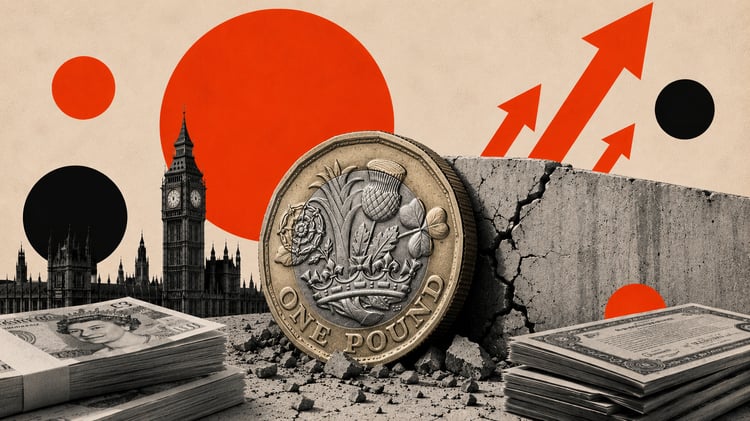
British Pound breaks 1.3350 as Warsh stays vague, BoE hike bets build
The Pound Sterling advanced against the US Dollar on Friday after Fed Chair Kevin Warsh didn’t provide forward guidance on interest rates, while expectations that the Bank of England would hike rates in November supported GBP/USD, pushing it above 1.3350 and registering gains of over 0.61%.
Read more
16 Oct 2026

British Pound: Budget risks threaten gains against US Dollar - Nordea
Nordea strategists note EUR/GBP has traded between 0.84 and 0.87 since late February, with recent British Pound (GBP) gains helped by external factors. They highlights diminished carry appeal as the Bank of England (BoE) holds rates at 3.75%, resilient UK growth, and a crucial Autumn Budget Bill. A November hike may support GBP, but fiscal missteps could push yields higher and weaken the Pound.
Read more
16 Oct 2026
Related to News & Market Insights
British Pound: Weekly outside reversal eyes 1.3650 against US Dollar – Scotiabank
Scotiabank analysts highlight that Bank of England Governor Bailey sees little evidence of second-round inflation effects and a more resilient UK economy, with markets still pricing a 25bp hike next month.
Read more
16 Oct 2026
British Pound breaks 1.3350 as Warsh stays vague, BoE hike bets build
The Pound Sterling advanced against the US Dollar on Friday after Fed Chair Kevin Warsh didn’t provide forward guidance on interest rates, while expectations that the Bank of England would hike rates in November supported GBP/USD, pushing it above 1.3350 and registering gains of over 0.61%.
Read more
16 Oct 2026
British Pound: Budget risks threaten gains against US Dollar - Nordea
Nordea strategists note EUR/GBP has traded between 0.84 and 0.87 since late February, with recent British Pound (GBP) gains helped by external factors. They highlights diminished carry appeal as the Bank of England (BoE) holds rates at 3.75%, resilient UK growth, and a crucial Autumn Budget Bill. A November hike may support GBP, but fiscal missteps could push yields higher and weaken the Pound.
Read more
16 Oct 2026
More
Learn to Trade

What Is Forex (FX) Trading?
Read more
22 Jul 2026

Forex Trading Strategies: Types, Tools, and How to Pick the Right One
Read more
22 Jul 2026
More

Open Account
GBP/USD FAQs
Why is GBPUSD called Cable?
+
How did Brexit affect GBPUSD?
+
What type of Forex pair is GBPUSD?
+
Is GBPUSD good for beginners?
+
What is 1 pip in GBPUSD?
+
Awards & Recognition
Most Trusted
Forex Broker
2024
Forex Broker
2024

Awarded by Wiki Finance Expo, Bangkok
Best Forex
Trading Platform
2024
Trading Platform
2024
Awarded by IFINEXPO, Hong Kong
SkyLine
Guide 2024
Award
Guide 2024
Award
Awarded by WikiFX SkyLine Guide
Most Innovative
Sports
Sponsorship
Sports
Sponsorship
Awarded by Forex Sports Awards
Get Started!
Sign up and access the Global Markets in less than 3 minutes

Connect With Us









Contacts
Phone: +61 2 8036 8388
Fax: +61 2 8036 8388
Email: support@tmgm.com



The information provided on this website is of a general nature only and does not constitute personal financial advice. Before acting on any information on this website, you should consider the suitability of the information in relation to your objectives, financial situation and needs. Investing in CFDs and FX Margin Contracts carries significant risks and is not suitable for all investors. You may lose more than your initial deposit. You do not own, or have, any interest in the underlying asset. We recommend that you seek independent advice and ensure you fully understand the risks involved before trading. It is important that you read and consider the disclosure document before you acquire any product listed on the website. The information and advertisements offered on this website are not intended for use by any person in any country or jurisdiction where such use would be contrary to local laws and regulations. The Products and Services offered on this website are not intended for residents of the United States, Malaysia and Thailand.
TMGM is authorized and regulated in various jurisdictions.
Trademax Australia Limited, trading as TMGM, is regulated by the Australian Securities and Investments Commission (ASIC), AFSL no. 436416 and is located at Level 28, One International Tower, 100 Barangaroo Avenue, 2000 Sydney, NSW Australia.
Email: support@tmgm.com.au
Trademax Global Limited, trading as TMGM, is authorized and regulated by the Vanuatu Financial Services Commission (VFSC), registration number 40356 and registered at 1276, Kumul Highway, Port Vila, Vanuatu, Republic of Vanuatu.
Email: support@tmgm.com
Trademax Global Markets (SE) Limited, trading as TMGM, is authorized and regulated by the Financial Services Authority (FSA) of Seychelles, with license number SD224. The company is registered at Office No 13, Providence Estate ABIS Centre, Mahe, Seychelles.
Email: support@tmgm.com
Trademax Global Markets (International) Pty Ltd, trading as TMGM, is authorized and regulated by the Financial Services Commission, Mauritius (FSC) with license no. GB22201012, and registered at 33, Edith Cavell Street C/o IQ EQ Fund Services (Mauritius) Ltd Port Louis, 11324 Mauritius.
Email: support@tmgm.com
Copyright © TMGM. All rights reserved