

Trading
Explore a wide range of markets with competitive pricing, deep liquidity, and advanced trading tools.
Learn More 
Platform
Trade seamlessly with TMGM's powerful platform, built for speed, precision, and a superior trading experience.
Learn More Trading Platform
Academy
Learn the fundamentals of trading with beginner-friendly resources, including guides, webinars, and market insights.
Learn More News & Analysis
Get real-time market updates and expert analysis to stay ahead of trading opportunities
Learn More News & Analysis
About
Learn what sets TMGM apart — our global presence, regulatory strength, and commitment to innovation in trading.
Learn More Why Choose TMGM
Sponsorship
Bitcoin Price Forecast: BTC reaches $80,500 amid rising short liquidations
- Bitcoin’s recovery gathers pace above $80,500 on Thursday, following a close above key EMAs a day earlier.
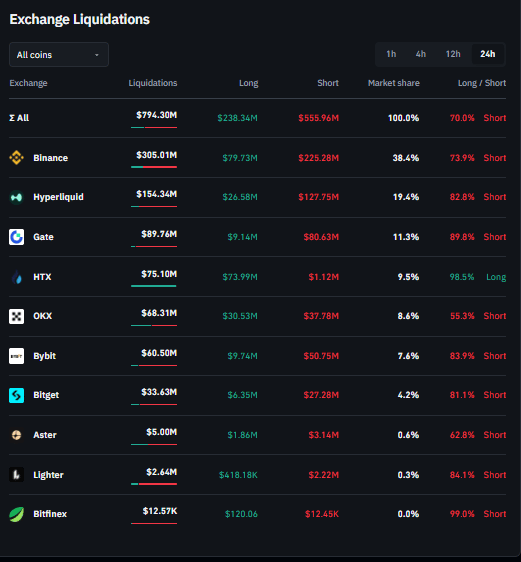
- Short positions accounted for 70% of the more than $700 million in positions liquidated over the past 24 hours.
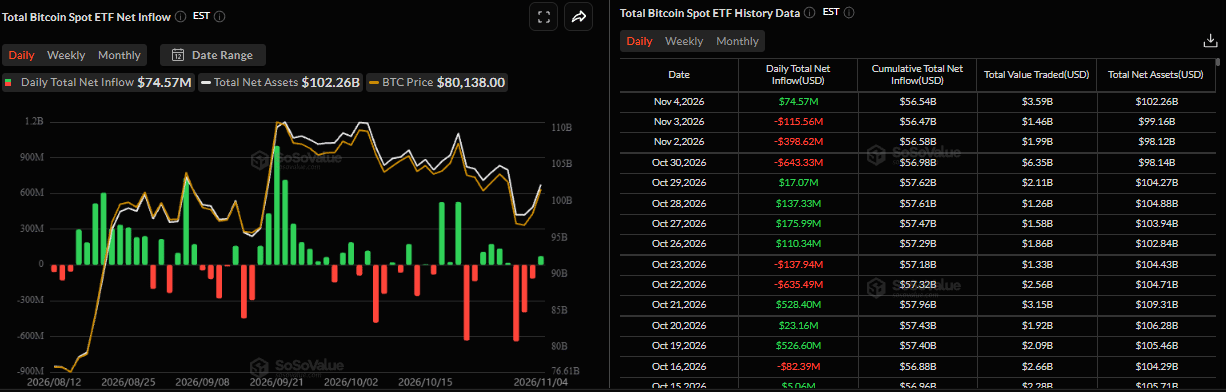
- A modest $74.57 million inflow into US-listed spot ETFs on Wednesday ended a run of three consecutive days of outflows.
Improving sentiment and renewed buying interest are supporting Bitcoin’s (BTC) rebound above $80,500 on Thursday, after it closed above key Exponential Moving Averages (EMAs) a day earlier. A short squeeze has accompanied the recovery, triggering nearly $800 million in liquidations over the past 24 hours. Institutional demand has also shown tentative improvement: spot Exchange Traded Funds (ETFs) attracted $74.57 million on Wednesday, ending three consecutive days of outflows. Together, these developments could help sustain the Crypto King’s recovery.
How is US political gridlock supporting risk assets?
Uncertainty eased after the closely watched US midterm elections delivered Democratic victories in both the House and the Senate. The result also reduced expectations of US President Donald Trump resuming military strikes against Iran.
On Wednesday, Senate Democratic Leader Chuck Schumer pledged to seek an end to the Iran war, saying his party could leverage its control over government funding to pursue that objective.
Crude oil prices have fallen on this optimism, helping ease inflation concerns. West Texas Intermediate (WTI) is trading around $87 on Thursday, at levels last seen in early September.
Risk assets are also benefiting from expectations that fiscal gridlock in Washington could further constrain government spending. Those expectations have weighed on US bond yields and kept the US Dollar (USD) under pressure, helping BTC regain the $80,500 level.
What drove liquidations above $700 million?
The Coinglass chart below puts liquidations over the past 24 hours at $794.30 million, as BTC saw the elevated volatility discussed in the previous report.
Shorts made up 70% of the liquidated positions, indicating that leveraged bearish traders bore the brunt of BTC’s rise above $80,000. Forced closures of these short positions may have added to buying pressure and quickened the Crypto King’s recovery.
Can modest ETF inflows support the recovery?
Tentative optimism is emerging in institutional demand for BTC, with SoSoValue reporting modest inflows of $74.57 million into BTC spot ETFs on Wednesday. This ended three consecutive days of outflows. A continuation and strengthening of inflows through the rest of this week could support a further recovery in BTC.
Bitcoin technical outlook: Can gains above key EMAs hold?
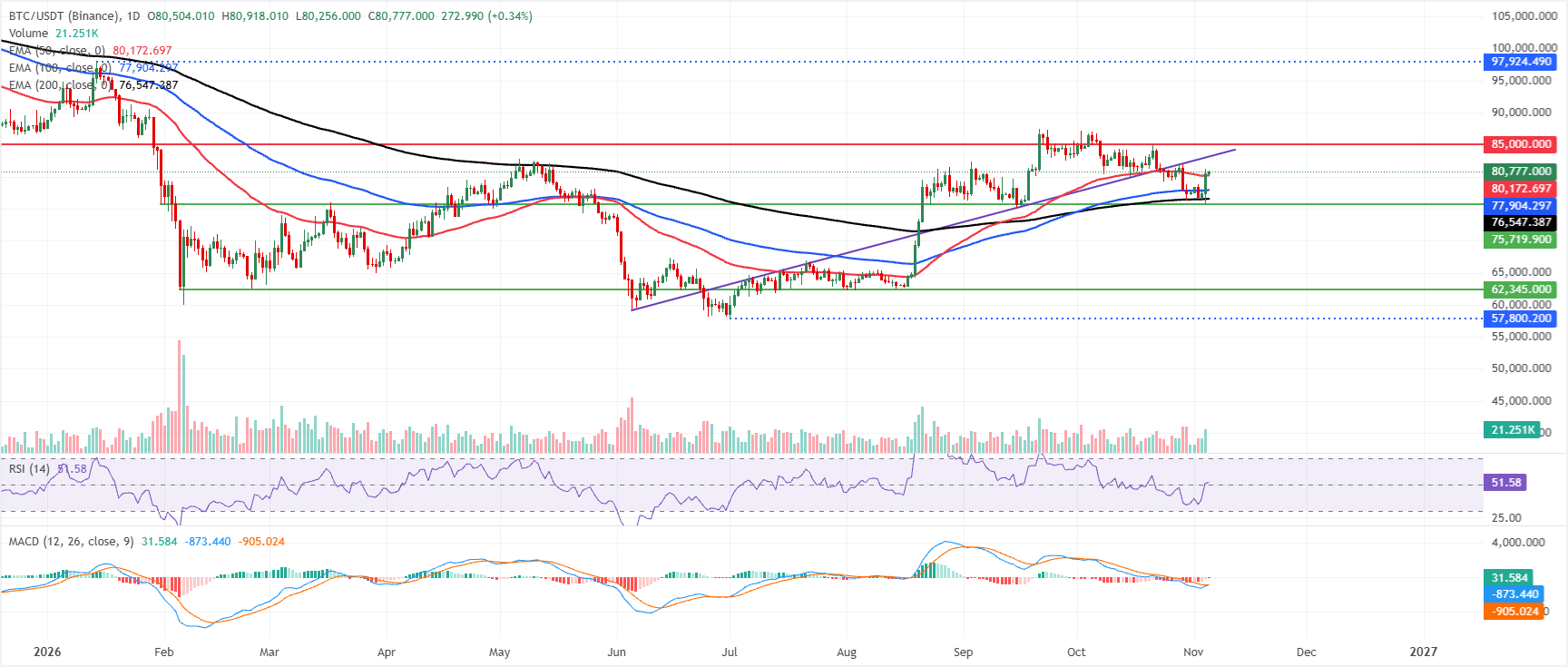
Holding above its 50-day, 100-day and 200-day Exponential Moving Averages (EMAs), Bitcoin retains a positive bullish bias at $80,777 on Thursday. These averages stand at $80,172, $77,904 and $76,547, respectively, a configuration that indicates the broader uptrend remains intact. Meanwhile, a Relative Strength Index (RSI) reading of 51 and a newly positive Moving Average Convergence Divergence (MACD) histogram point to a recovery in bullish momentum, rather than overbought conditions.
Should the advance continue, horizontal resistance at $85,000 represents the next major obstacle and a potential area for profit-booking.
The first downside support lies around the 50-day EMA at $80,172. Below that, the 100-day EMA near $77,904 and the 200-day EMA at $76,547 provide further support. BTC’s bullish outlook is likely to hold while the price stays above this layered EMA support zone.
(The technical analysis of this story was written with the help of an AI tool. Know more.)
FAQs on Bitcoin, altcoins and stablecoins
Designed to function as money, Bitcoin is a virtual currency and the largest cryptocurrency by market capitalisation. No single individual, group or entity can control this payment method, removing the need for a third party to participate in financial transactions.
Any cryptocurrency other than Bitcoin is generally classed as an altcoin. Some, however, exclude Ethereum as well, on the grounds that forks originate from these two cryptocurrencies. Under that interpretation, Litecoin was the first altcoin: it was forked from the Bitcoin protocol and is therefore an “improved” version of it.
To maintain a stable price, stablecoins are backed by reserves of the assets they represent. Each stablecoin’s value is pegged to a commodity or financial instrument, such as the US Dollar (USD), while an algorithm or demand regulates its supply. Their primary purpose is to offer investors a route into and out of cryptocurrency trading and investment. They also enable investors to store value, given the volatility generally associated with cryptocurrencies.
By comparing Bitcoin’s market capitalisation with the combined market capitalisation of all cryptocurrencies, Bitcoin dominance offers a clear indication of investor interest in Bitcoin. BTC dominance is typically high ahead of and during a bull run, as investors turn to a relatively stable cryptocurrency with a large market capitalisation, such as Bitcoin. When BTC dominance declines, it usually signals that investors are shifting capital and/or profits into altcoins in pursuit of higher returns, often sparking a surge in altcoin rallies.
POPULAR ARTICLES
1Bitcoin Price Forecast: BTC reaches $80,500 amid rising short liquidations2British Pound: Recovery Advances Towards Upper End of Range – Societe Generale3Crypto Today: Why is the Bitcoin, Ethereum and XRP recovery slowing as capital inflows return?4France 10-y Bond Auction came in at 4.74%, above expectations (0%)5Eurozone Producer Price Index (MoM) meets expectations (2.5%) in September6Eurozone Producer Price Index (YoY) above forecasts (10.9%) in September: Actual (11.1%)7Spain 5-y Bond Auction came in at 3.338%, above expectations (0%)8Spain 10-y Obligaciones Auction above expectations (0%): Actual (3.802%)9US Dollar: Falls alongside Brent as US-Iran hopes build – MUFG


Get Started!
Sign up and access the Global Markets in less than 3 minutes

Connect With Us









Contacts
Phone: +61 2 8036 8388
Fax: +61 2 8036 8388
Email: support@tmgm.com



The information provided on this website is of a general nature only and does not constitute personal financial advice. Before acting on any information on this website, you should consider the suitability of the information in relation to your objectives, financial situation and needs. Investing in CFDs and FX Margin Contracts carries significant risks and is not suitable for all investors. You may lose more than your initial deposit. You do not own, or have, any interest in the underlying asset. We recommend that you seek independent advice and ensure you fully understand the risks involved before trading. It is important that you read and consider the disclosure document before you acquire any product listed on the website. The information and advertisements offered on this website are not intended for use by any person in any country or jurisdiction where such use would be contrary to local laws and regulations. The Products and Services offered on this website are not intended for residents of the United States, Malaysia and Thailand.
TMGM is authorized and regulated in various jurisdictions.
Trademax Australia Limited, trading as TMGM, is regulated by the Australian Securities and Investments Commission (ASIC), AFSL no. 436416 and is located at Level 28, One International Tower, 100 Barangaroo Avenue, 2000 Sydney, NSW Australia.
Email: support@tmgm.com.au
Trademax Global Limited, trading as TMGM, is authorized and regulated by the Vanuatu Financial Services Commission (VFSC), registration number 40356 and registered at 1276, Kumul Highway, Port Vila, Vanuatu, Republic of Vanuatu.
Email: support@tmgm.com
Trademax Global Markets (SE) Limited, trading as TMGM, is authorized and regulated by the Financial Services Authority (FSA) of Seychelles, with license number SD224. The company is registered at Office No 13, Providence Estate ABIS Centre, Mahe, Seychelles.
Email: support@tmgm.com
Trademax Global Markets (International) Pty Ltd, trading as TMGM, is authorized and regulated by the Financial Services Commission, Mauritius (FSC) with license no. GB22201012, and registered at 33, Edith Cavell Street C/o IQ EQ Fund Services (Mauritius) Ltd Port Louis, 11324 Mauritius.
Email: support@tmgm.com
Copyright © TMGM. All rights reserved