

Bitcoin Price Forecast: BTC pressured amid ETF outflows, fresh US-Iran risks
- Bitcoin remains under pressure, trading below $78,200 on Thursday after correcting around 3% so far this week.
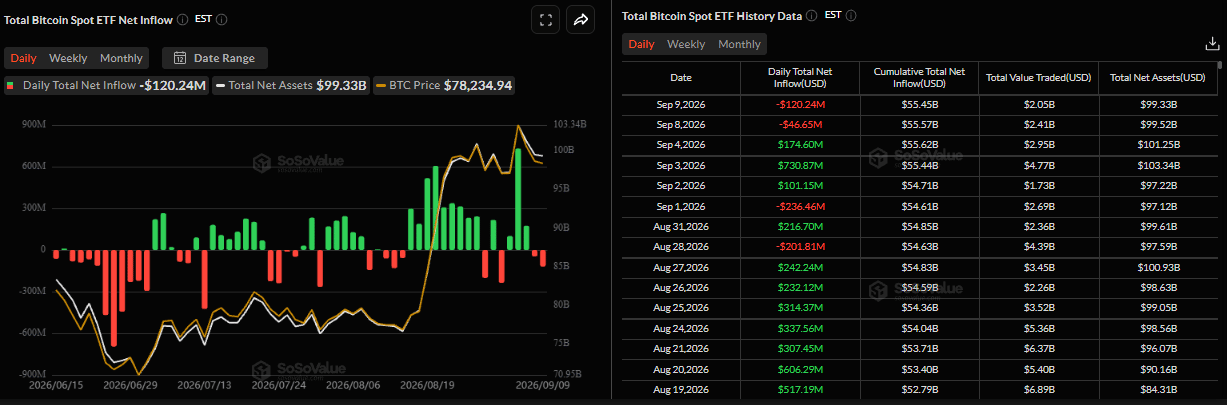
- US-listed spot ETF recorded an outflow of $120.24 million on Wednesday, marking the second consecutive day of withdrawals.
- Escalating tensions between the US and Iran near the Strait of Hormuz continue to dampen risk appetite and weigh on BTC.
Bitcoin (BTC) remains under pressure, trading below $78,200 at the time of writing on Thursday after declining nearly 3% so far this week. Weakening institutional demand, along with escalating geopolitical tensions between the US and Iran near the Strait of Hormuz, continues to dampen risk appetite and weigh on the Crypto King.

Institutional demand shows caution signs
Institutional demand for Bitcoin shows early signs of caution. SoSoValue data show that spot Exchange Traded Funds (ETFs) recorded a $120.24 million outflow on Wednesday, following a $46.65 million outflow the previous day. If these withdrawals continue and intensify through the week, BTC could see further correction.
Geopolitical tensions near the Strait of Hormuz pressure BTC
Iran said that it has attacked 10 ships around the Strait of Hormuz after the US announced it had sunk five Iranian oil tankers.
This adds to concerns about a prolonged disruption to Oil supplies from the Middle East and continues to support the black liquid price, with West Texas Intermediate (WTI) having gained over 5% so far this week, reaching a high above $95.00 on Thursday, the highest level since the end of May.
This fresh wave of conflict keeps the geopolitical risk premium elevated, which could weigh on risk appetite and increase pressure on the Crypto King.
In an interview with FXStreet, Simon-Peter Massabni, Head of Business Development at XS.com, said that the cryptocurrency recovery continues to face a challenging macroeconomic environment.
Massabni noted that strong US labor market data has increased expectations of another Federal Reserve rate hike, while rising US Treasury yields continue to pressure higher-risk assets.
He added that escalating tensions in the Middle East and the resulting surge in Oil prices have further complicated the outlook. Persistently high Oil prices could fuel renewed inflationary pressures and force major central banks to maintain restrictive monetary policies for longer, potentially limiting the recovery in cryptocurrencies.
Bitcoin technical outlook: BTC remains under pressure
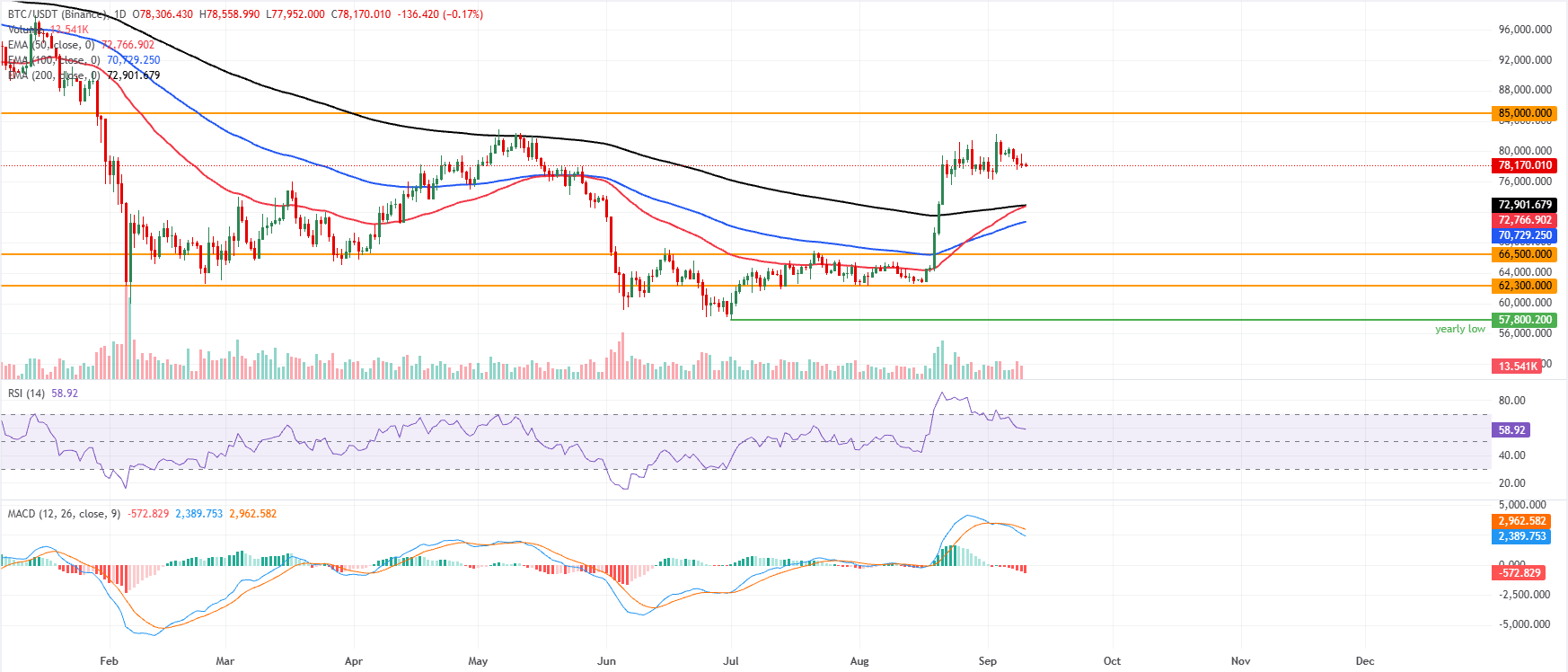
At the time of writing, Bitcoin price trades at $78,170 after falling nearly 3% so far this week. BTC maintains a constructive bullish bias as it holds comfortably above the 50-day, 100-day, and 200-day Exponential Moving Averages (EMAs), clustered between roughly $70,700 and $72,900. This positioning suggests the broader uptrend remains intact even as price consolidates below recent highs.
The Relative Strength Index (RSI) eases to around 58 on the daily chart, indicating still-positive but cooling momentum. At the same time, the Moving Average Convergence Divergence (MACD) histogram stays in negative territory, all hinting that upside traction is moderating despite the strong underlying technical structure.
On the topside, initial resistance is seen at the horizontal barrier near $85,000, where a break would reopen the path toward fresh highs.
On the downside, immediate support is provided by the 200-day EMA at about $72,901 and the nearby 50-day EMA around $72,766, with the 100-day EMA lower near $70,729 reinforcing the broader bullish floor. Below these, horizontal supports at $66,500 and $62,300 mark deeper demand zones that would need to give way to threaten the prevailing uptrend.
(The technical analysis of this story was written with the help of an AI tool. Know more.)
Bitcoin, altcoins, stablecoins FAQs
Bitcoin is the largest cryptocurrency by market capitalization, a virtual currency designed to serve as money. This form of payment cannot be controlled by any one person, group, or entity, which eliminates the need for third-party participation during financial transactions.
Altcoins are any cryptocurrency apart from Bitcoin, but some also regard Ethereum as a non-altcoin because it is from these two cryptocurrencies that forking happens. If this is true, then Litecoin is the first altcoin, forked from the Bitcoin protocol and, therefore, an “improved” version of it.
Stablecoins are cryptocurrencies designed to have a stable price, with their value backed by a reserve of the asset it represents. To achieve this, the value of any one stablecoin is pegged to a commodity or financial instrument, such as the US Dollar (USD), with its supply regulated by an algorithm or demand. The main goal of stablecoins is to provide an on/off-ramp for investors willing to trade and invest in cryptocurrencies. Stablecoins also allow investors to store value since cryptocurrencies, in general, are subject to volatility.
Bitcoin dominance is the ratio of Bitcoin's market capitalization to the total market capitalization of all cryptocurrencies combined. It provides a clear picture of Bitcoin’s interest among investors. A high BTC dominance typically happens before and during a bull run, in which investors resort to investing in relatively stable and high market capitalization cryptocurrency like Bitcoin. A drop in BTC dominance usually means that investors are moving their capital and/or profits to altcoins in a quest for higher returns, which usually triggers an explosion of altcoin rallies.














