

Trading
Explore a wide range of markets with competitive pricing, deep liquidity, and advanced trading tools.
Learn More 
Platform
Trade seamlessly with TMGM's powerful platform, built for speed, precision, and a superior trading experience.
Learn More Trading Platform
Academy
Learn the fundamentals of trading with beginner-friendly resources, including guides, webinars, and market insights.
Learn More News & Analysis
Get real-time market updates and expert analysis to stay ahead of trading opportunities
Learn More News & Analysis
About
Learn what sets TMGM apart — our global presence, regulatory strength, and commitment to innovation in trading.
Learn More Why Choose TMGM
Sponsorship
Bitcoin Price Forecast: Ahead of US CPI data, BTC drops below $75,000
- Bitcoin remains below $75,000 on Tuesday, following last week’s close beneath the key 200-day EMA near $76,444.
- Fresh BTC volatility could follow Tuesday’s US CPI report as market participants assess its implications for Fed rate-hike expectations.
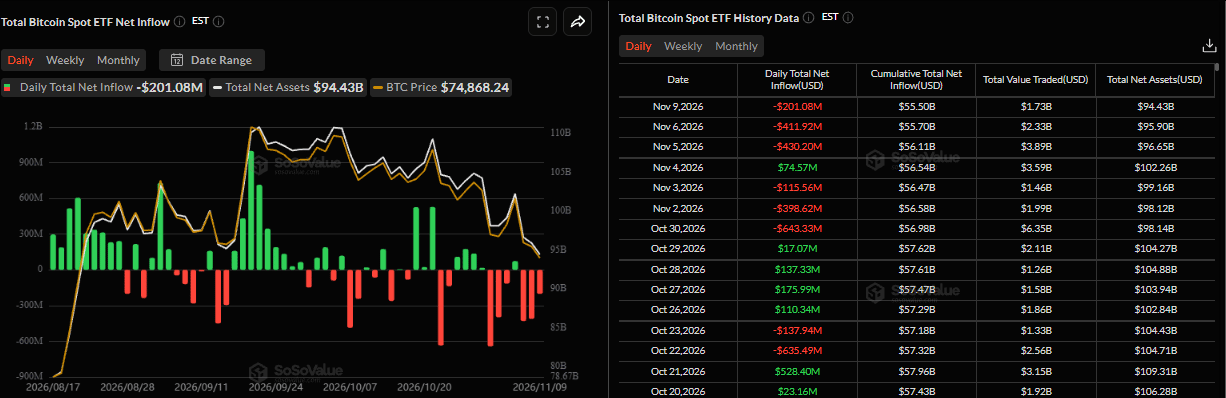
- While Strategy increased its treasury holdings by 1,036 BTC, US-listed spot ETFs saw net outflows of $201.08 million on Monday.
Selling pressure persists in Bitcoin (BTC), which is trading below $75,000 on Tuesday after ending last week beneath a key technical support zone. Institutional demand presents a mixed picture: Exchange Traded Funds (ETFs) continue to register outflows, even as Strategy (MSTR) added 1,036 BTC to its treasury.

For traders, attention has shifted to Tuesday’s release of the US October Consumer Price Index (CPI). The figures could reshape expectations for Federal Reserve (Fed) rate hikes and spark another bout of volatility in the Crypto King.
Could US CPI determine Bitcoin’s next move?
Whether BTC and other risk assets rebound or suffer a sharp extension of their losses could hinge on the closely watched US CPI release.
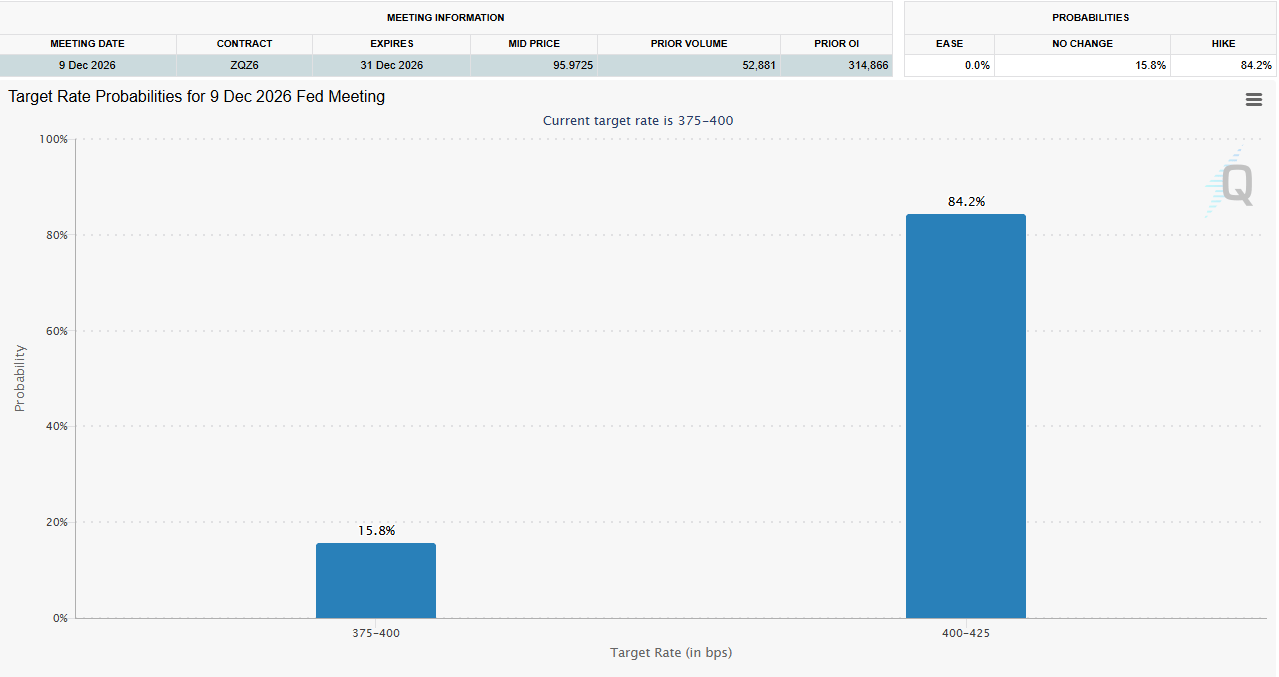
Expectations that the Fed could leave interest rates higher for longer strengthened after last week’s US payrolls exceeded forecasts. Traders now assign a probability of over 80% to another increase in borrowing costs by the US central bank in December, according to the CME Group’s FedWatch Tool. While this macroeconomic backdrop continues to underpin the US Dollar (USD) and pressure risk assets such as BTC, USD bulls are holding off on fresh positions until the US CPI report.
Investors will scrutinise Tuesday’s inflation figures for further indications of the Fed’s policy trajectory. Should the reading exceed expectations, rate-hike bets could strengthen and place risk assets under additional pressure.
Risk appetite is also being restrained by conflicting signals around US-Iran peace talks, which sustain the geopolitical risk premium. According to US President Donald Trump, efforts to end the war on Iran are gaining positive momentum and renewed strikes are quite unlikely; he described the conflict as effectively over.
In contrast, Mohsen Rezaei, Secretary of Iran’s Supreme National Security Council, rejected reports of ongoing negotiations as fake news. He reiterated that ending the conflict requires Washington to accept Tehran’s seven conditions. The resulting geopolitical risk premium continues to favour the safe-haven USD and constrain the prospects for a BTC recovery.
Could weakening institutional demand add to BTC’s pressure?
The week opened with further weakness in institutional appetite for Bitcoin. According to SoSoValue, BTC spot ETFs registered $201.08 million in net outflows on Monday, following withdrawals of $1.28 billion last week, the largest weekly outflow since the end of June. A continuation and intensification of withdrawals through this week could add to the pressure on BTC and deepen its price correction.
Corporate buying, however, remains active. Michael Saylor said on Monday that Strategy, his firm, had purchased 1,036 BTC, taking its current holdings to 850,364 BTC alongside $4.9 billion in USD assets. The latest acquisitions indicate continued corporate accumulation of Bitcoin, which could offer some support should BTC prices decline further.
Bitcoin technical outlook: Can BTC regain the 200-day EMA?
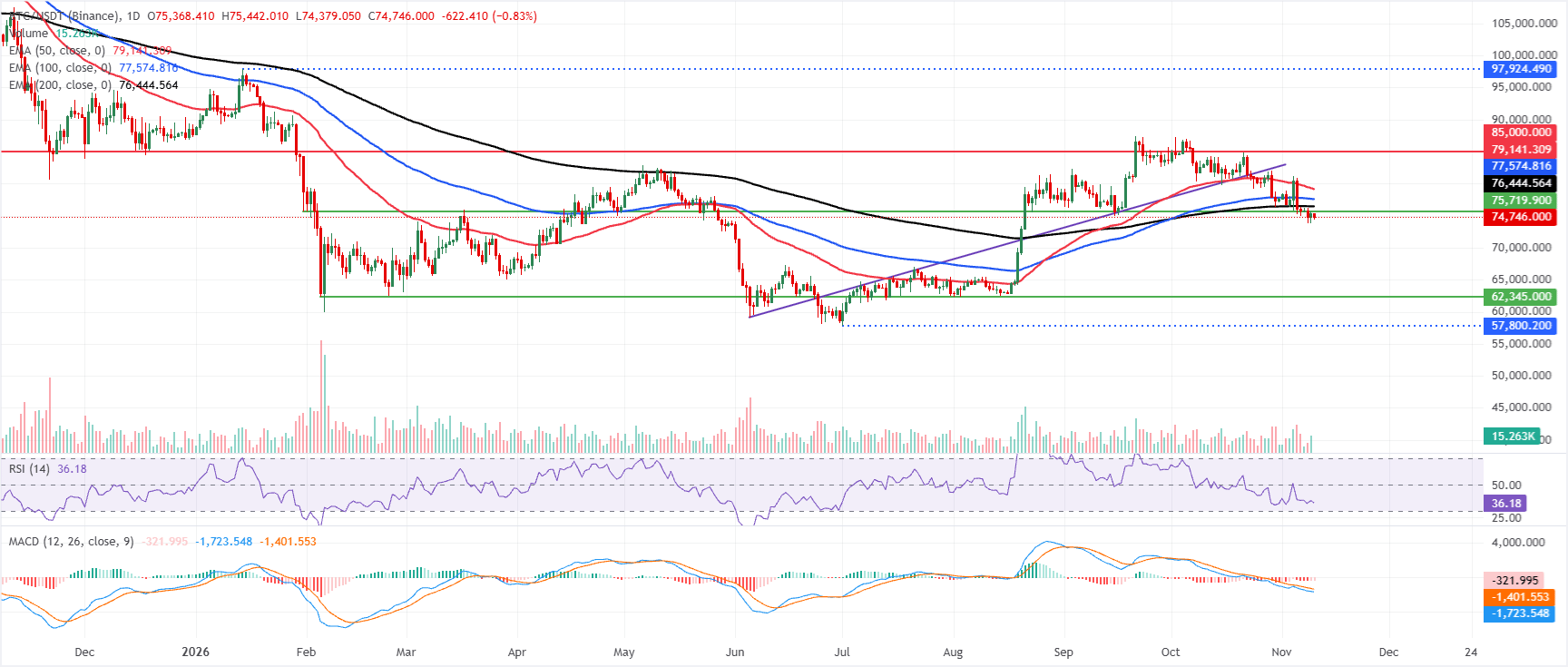
With Bitcoin trading at $74,746 on Tuesday, its position below the major Exponential Moving Averages (EMAs) keeps the near-term outlook bearish. Immediately above the spot price, the 200-day EMA near $76,444 provides the first ceiling. The 100-day EMA around $77,574 and the 50-day EMA near $79,141 add to this layered zone of overhead supply.
Downside momentum persists, with the Relative Strength Index (RSI) close to 36 and the Moving Average Convergence Divergence (MACD) still below zero. Together, these indicators suggest that advances towards the clustered EMAs are likely to encounter selling pressure.
Any recovery would first face resistance around $76,444 at the 200-day EMA, followed by the 100-day EMA near $77,574 and the 50-day EMA around $79,141. Further up, a horizontal barrier lies at approximately $85,000.
With no nearby support identified on the chart, a break beneath current levels would point BTC towards the psychological support area around $70,000 before the price stabilises.
(The technical analysis of this story was written with the help of an AI tool. Know more.)
FAQs on Bitcoin, altcoins and stablecoins
Designed to function as money, Bitcoin is a virtual currency and the largest cryptocurrency by market capitalisation. No single person, group or entity can control this payment method, removing the need for third-party involvement in financial transactions.
The term altcoin covers any cryptocurrency other than Bitcoin. Some, however, also exclude Ethereum, arguing that forks originate from these two cryptocurrencies. On that basis, Litecoin is the first altcoin: it was forked from the Bitcoin protocol and is therefore an “improved” version of it.
A stablecoin is a cryptocurrency intended to maintain a steady price, backed by reserves of the asset it represents. Its value is tied to a commodity or financial instrument, such as the US Dollar (USD), while an algorithm or demand regulates its supply. Stablecoins primarily offer a route into and out of the cryptocurrency market for investors looking to trade and invest in it. They also enable investors to preserve value, given the volatility generally associated with cryptocurrencies.
Measured as Bitcoin’s market capitalisation relative to the combined market capitalisation of all cryptocurrencies, Bitcoin dominance offers a clear indication of investor interest in Bitcoin. BTC dominance is typically high ahead of and during a bull run, when investors turn to relatively stable cryptocurrencies with large market capitalisations, such as Bitcoin. Conversely, declining BTC dominance usually signals that investors are shifting capital and/or profits into altcoins in pursuit of higher returns. This shift commonly sparks a surge in altcoin rallies.
POPULAR ARTICLES
1Fed’s Daly expects further rate hikes, warning that AI is fuelling inflation2Forex Today: US Inflation Returns3Why has silver fallen over 3% as Fed rate hike bets drive a US Dollar rally?4Overheating economy: Fed’s Goolsbee warns high inflation is no one-off5British Pound slides towards 1.32 as hawkish Fed sentiment overshadows solid UK growth6Mounting Fed tightening bets drive Australian Dollar to 10-month low7Dogecoin Price Forecast: Can DOGE defend its three-year low as selling pressure intensifies?8Can Euro Escape Pressure Near May 2025 Lows as Fed Hawks Bolster Dollar?9Fed’s Hammack favours gradual rate hikes as she says inflation is getting worse

Get Started!
Sign up and access the Global Markets in less than 3 minutes

Connect With Us









Contacts
Phone: +61 2 8036 8388
Fax: +61 2 8036 8388
Email: support@tmgm.com



The information provided on this website is of a general nature only and does not constitute personal financial advice. Before acting on any information on this website, you should consider the suitability of the information in relation to your objectives, financial situation and needs. Investing in CFDs and FX Margin Contracts carries significant risks and is not suitable for all investors. You may lose more than your initial deposit. You do not own, or have, any interest in the underlying asset. We recommend that you seek independent advice and ensure you fully understand the risks involved before trading. It is important that you read and consider the disclosure document before you acquire any product listed on the website. The information and advertisements offered on this website are not intended for use by any person in any country or jurisdiction where such use would be contrary to local laws and regulations. The Products and Services offered on this website are not intended for residents of the United States, Malaysia and Thailand.
TMGM is authorized and regulated in various jurisdictions.
Trademax Australia Limited, trading as TMGM, is regulated by the Australian Securities and Investments Commission (ASIC), AFSL no. 436416 and is located at Level 28, One International Tower, 100 Barangaroo Avenue, 2000 Sydney, NSW Australia.
Email: support@tmgm.com.au
Trademax Global Limited, trading as TMGM, is authorized and regulated by the Vanuatu Financial Services Commission (VFSC), registration number 40356 and registered at 1276, Kumul Highway, Port Vila, Vanuatu, Republic of Vanuatu.
Email: support@tmgm.com
Trademax Global Markets (SE) Limited, trading as TMGM, is authorized and regulated by the Financial Services Authority (FSA) of Seychelles, with license number SD224. The company is registered at Office No 13, Providence Estate ABIS Centre, Mahe, Seychelles.
Email: support@tmgm.com
Trademax Global Markets (International) Pty Ltd, trading as TMGM, is authorized and regulated by the Financial Services Commission, Mauritius (FSC) with license no. GB22201012, and registered at 33, Edith Cavell Street C/o IQ EQ Fund Services (Mauritius) Ltd Port Louis, 11324 Mauritius.
Email: support@tmgm.com
Copyright © TMGM. All rights reserved