

Trading
Explore a wide range of markets with competitive pricing, deep liquidity, and advanced trading tools.
Learn More 
Platform
Trade seamlessly with TMGM's powerful platform, built for speed, precision, and a superior trading experience.
Learn More Trading Platform
Academy
Learn the fundamentals of trading with beginner-friendly resources, including guides, webinars, and market insights.
Learn More News & Analysis
Get real-time market updates and expert analysis to stay ahead of trading opportunities
Learn More News & Analysis
About
Learn what sets TMGM apart — our global presence, regulatory strength, and commitment to innovation in trading.
Learn More Why Choose TMGM
Sponsorship
Bitcoin losses deepen with 51% of supply now underwater
- More than half of Bitcoin’s circulating supply is held at a loss after a seven-day fall of 14% left the cryptocurrency trading 8.5% below its 200-week average.
- Leveraged Bitcoin ETF exposure sank to its lowest since March 2024 as outflows from Bitcoin ETFs totalled 44,900 BTC over 14 days.
- Market attention is on Nvidia’s earnings, the Fed minutes due on Wednesday, October PCE data and Anthropic’s public-market debut.
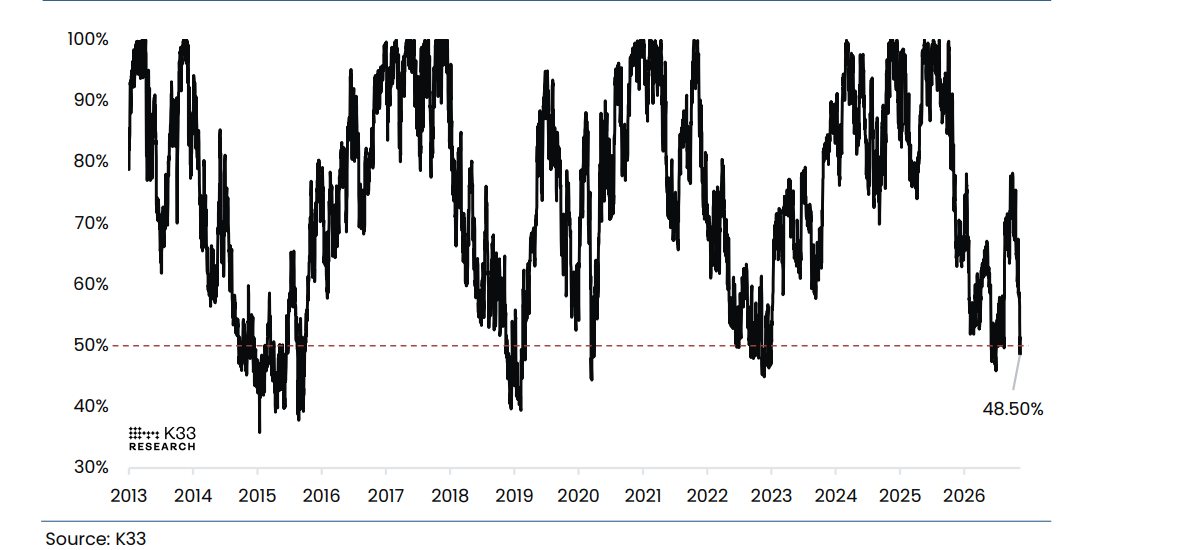
Selling pressure on Bitcoin (BTC) is being compounded by ETF withdrawals and high derivatives leverage. Following a 14% decline over seven days, BTC is trading below its 200-week moving average, with K33 reporting that 51.5% of circulating supply is held at a loss.

Why Has Bitcoin’s Sell-off Left More Than Half Its Supply Underwater?
Holders of 51.5% of Bitcoin’s circulating supply are now facing losses following a 14% weekly slide. The cryptocurrency revisited levels last recorded in early August and, on November 15, traded as much as 8.5% below its 200-week moving average. In a report published on Tuesday, K33 said last week’s fall extended the losing streak to six consecutive seven-day periods, something seen only twice before in Bitcoin’s history.
K33 wrote: “This puts BTC's price in territory where holders on average could have sold for more within the past 4 years,”
Net ETF withdrawals totalled 44,900 BTC over the 14 trading days since October 29, K33 further noted. That remains below June’s record of 71,000 BTC, but the latest outflows are “comparable to the extremes” seen around earlier local lows.
At 21,900 BTC, leveraged ETF exposure also declined to its lowest since March 2024.
According to the report, Bitcoin ETF flows over 30 days continue to show a strong relationship with BTC’s price returns.
The firm described the link as follows: "This relationship has persisted for several years, with an R² of 0.71 between 30-day flows and returns in 2026,"
Why Is Bitcoin Derivatives Leverage Still High After Forced Selling?
Strong demand for downside protection pushed the one-month 25-delta options skew above 20, a level not seen since July.
Pressure spread to Bitcoin perpetual futures when the leading cryptocurrency slipped below $70,000. Repeatedly negative funding rates, together with a steep drop in open interest, pointed to forced selling, K33 observed.
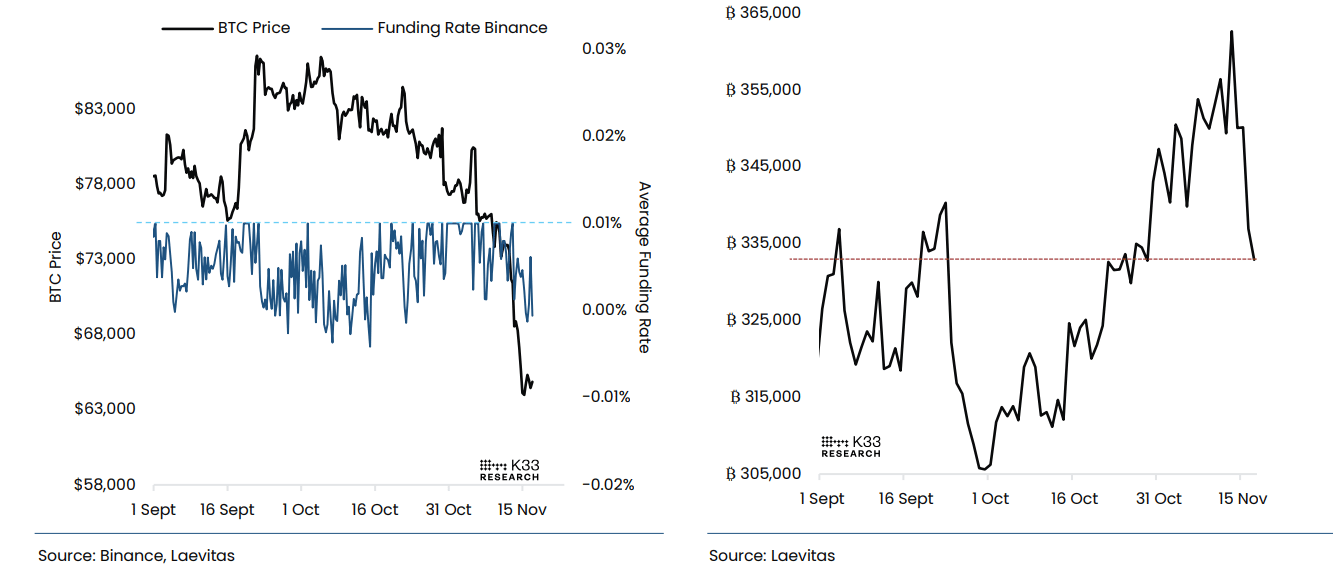
Liquidations of Bitcoin long positions reached roughly $1.3 billion between November 13 and 14. This was the largest two-day total since October 2025 and the second-largest liquidation event of 2026. Although the wave of liquidations cut perpetual futures open interest by 30,000 BTC, it stayed above 330,000 BTC, near September’s levels.
The report offered this assessment: “Despite partial deleveraging amid the sharp drawdown, leverage remains elevated relative to historical norms,”
A more defensive view came from digital asset trading firm Wintermute, which characterised the rally since July as a “fake-out,” in a Tuesday report.
Wintermute set out its position: “This is a rates tape in which Bitcoin is the non-yielding funding leg, the ETF bid is gone and the technicals have broken, so we stay defensive and the path of least resistance still feels lower and we’ll likely chop here,”
A daily close back above the 200-week moving average near $68,000, alongside net ETF inflows, would prompt Wintermute to reassess its defensive position, the firm said.
With holiday liquidity thin, Wintermute identified several potential triggers for volatility: Wednesday’s Fed minutes, October PCE data and forthcoming market events such as Nvidia’s results and Anthropic’s public-market debut.
At the time of writing, a 2% decline over the past 24 hours has left Bitcoin trading at $63,800.
POPULAR ARTICLES
1Softer Dollar helps Euro inch back to 1.10 from a 19-month low2Bitcoin losses deepen with 51% of supply now underwater3NSA outage sends Dow Jones Industrial Average lower before Nvidia beats4Natural gas: Why does falling US demand offer Europe only limited relief? - Commerzbank5Chinese Yuan: Is further strength against the US Dollar likely? – UOB6Copper: Commerzbank sees a gradual climb into 20287Ethereum Price Forecast: Why has ETH slipped below $1,800 ahead of Nvidia's earnings?8Taiwan Dollar: How are equity outflows weighing on TWD? – OCBC9Crude Oil rises on Gulf attacks, yet most of Monday's losses remain


Get Started!
Sign up and access the Global Markets in less than 3 minutes

Connect With Us









Contacts
Phone: +61 2 8036 8388
Fax: +61 2 8036 8388
Email: support@tmgm.com



The information provided on this website is of a general nature only and does not constitute personal financial advice. Before acting on any information on this website, you should consider the suitability of the information in relation to your objectives, financial situation and needs. Investing in CFDs and FX Margin Contracts carries significant risks and is not suitable for all investors. You may lose more than your initial deposit. You do not own, or have, any interest in the underlying asset. We recommend that you seek independent advice and ensure you fully understand the risks involved before trading. It is important that you read and consider the disclosure document before you acquire any product listed on the website. The information and advertisements offered on this website are not intended for use by any person in any country or jurisdiction where such use would be contrary to local laws and regulations. The Products and Services offered on this website are not intended for residents of the United States, Malaysia and Thailand.
TMGM is authorized and regulated in various jurisdictions.
Trademax Australia Limited, trading as TMGM, is regulated by the Australian Securities and Investments Commission (ASIC), AFSL no. 436416 and is located at Level 28, One International Tower, 100 Barangaroo Avenue, 2000 Sydney, NSW Australia.
Email: support@tmgm.com.au
Trademax Global Limited, trading as TMGM, is authorized and regulated by the Vanuatu Financial Services Commission (VFSC), registration number 40356 and registered at 1276, Kumul Highway, Port Vila, Vanuatu, Republic of Vanuatu.
Email: support@tmgm.com
Trademax Global Markets (SE) Limited, trading as TMGM, is authorized and regulated by the Financial Services Authority (FSA) of Seychelles, with license number SD224. The company is registered at Office No 13, Providence Estate ABIS Centre, Mahe, Seychelles.
Email: support@tmgm.com
Trademax Global Markets (International) Pty Ltd, trading as TMGM, is authorized and regulated by the Financial Services Commission, Mauritius (FSC) with license no. GB22201012, and registered at 33, Edith Cavell Street C/o IQ EQ Fund Services (Mauritius) Ltd Port Louis, 11324 Mauritius.
Email: support@tmgm.com
Copyright © TMGM. All rights reserved