

Trading
Explore a wide range of markets with competitive pricing, deep liquidity, and advanced trading tools.
Learn More 
Platform
Trade seamlessly with TMGM's powerful platform, built for speed, precision, and a superior trading experience.
Learn More Trading Platform
Academy
Learn the fundamentals of trading with beginner-friendly resources, including guides, webinars, and market insights.
Learn More News & Analysis
Get real-time market updates and expert analysis to stay ahead of trading opportunities
Learn More News & Analysis
About
Learn what sets TMGM apart — our global presence, regulatory strength, and commitment to innovation in trading.
Learn More Why Choose TMGM
Sponsorship
Fed’s Waller warning of a larger rate hike sends British Pound into reversal against USD
- British Pound reverses its initial advance, slipping towards 1.3430 against the US Dollar.
- A larger December interest rate hike may be needed if US core CPI holds steady or climbs further, Fed’s Waller warns.
- A December interest rate hike remains an option, says BoE’s Lombardelli.
An early advance in the British Pound (GBP) gives way to losses against the US Dollar (USD), leaving GBP/USD near 1.3430 in Tuesday’s European trading session. The reversal follows a swift recovery in the US Dollar after hawkish comments from Federal Reserve (Fed) Governor Christopher Waller.

Having recovered its initial losses, the US Dollar Index (DXY) is almost unchanged near 101.65 at the time of writing. The index measures the Greenback against a basket of six major currencies.
With inflation pressures elevated and the labour market remaining solid, further interest rate increases are necessary, Waller said during the European session. Ahead of the United States (US) Consumer Price Index (CPI) release for October, due at 13:30 GMT, he also cautioned that a “half-point Fed rate hike may be needed in December, if October core CPI inflation comes in around 0.3% or higher.”
Could inflation concerns prompt a larger December hike, as Waller warns?
Heightened concern over stubborn inflation was evident in Fed’s Waller’s markedly hawkish remarks: his FXS Speechtracker score reached 8.6/10, against a historical average of 7.2/10. His explicit willingness to consider a half-point Fed rate increase in December if core CPI comes in around 0.3% or higher, together with support for at least a quarter-point increase even if the data improve, indicates a firm preference for further tightening and little tolerance for upside inflation surprises. Although the labour market and GDP growth remain solid, his focus on widespread price increases, emerging producer price pressures and potentially longer-lasting energy shocks suggests that inflation risks are dominating the policy response.
A 1.58-point increase took the FXS Fed Sentiment Index to 143.91, leaving it firmly in hawkish territory. This confirms a substantial hawkish shift in the speech compared with the established baseline. Read alongside the above-average FXS Speechtracker score, the higher index level suggests that markets should assign a greater probability to further Fed tightening. Repricing of interest rate expectations could consequently create upside risk for the Dollar.
According to MUFG/BTMU, "October headline and core CPI are expected to slow to 0.3%mom and 0.2%mom, respectively." However, the institutions warn that "a downside inflation surprise would challenge rate hike expectations and could weigh on the dollar," which could moderate the recent increase in bets on Fed tightening.
Over the past few weeks, pressure on the US Dollar has generally persisted. Growing optimism over a US-Iran deal has pushed oil prices lower, helping to anchor global inflation expectations.
For the British Pound, the prospect of additional rate increases remains alive after comments from Bank of England (BoE) Deputy Governor Clare Lombardelli. Speaking to the Guardian in an interview, she said: “Wouldn’t rule out rate hike possibility in December,”
GBP/USD Technical Analysis: Can Buyers Maintain Control?
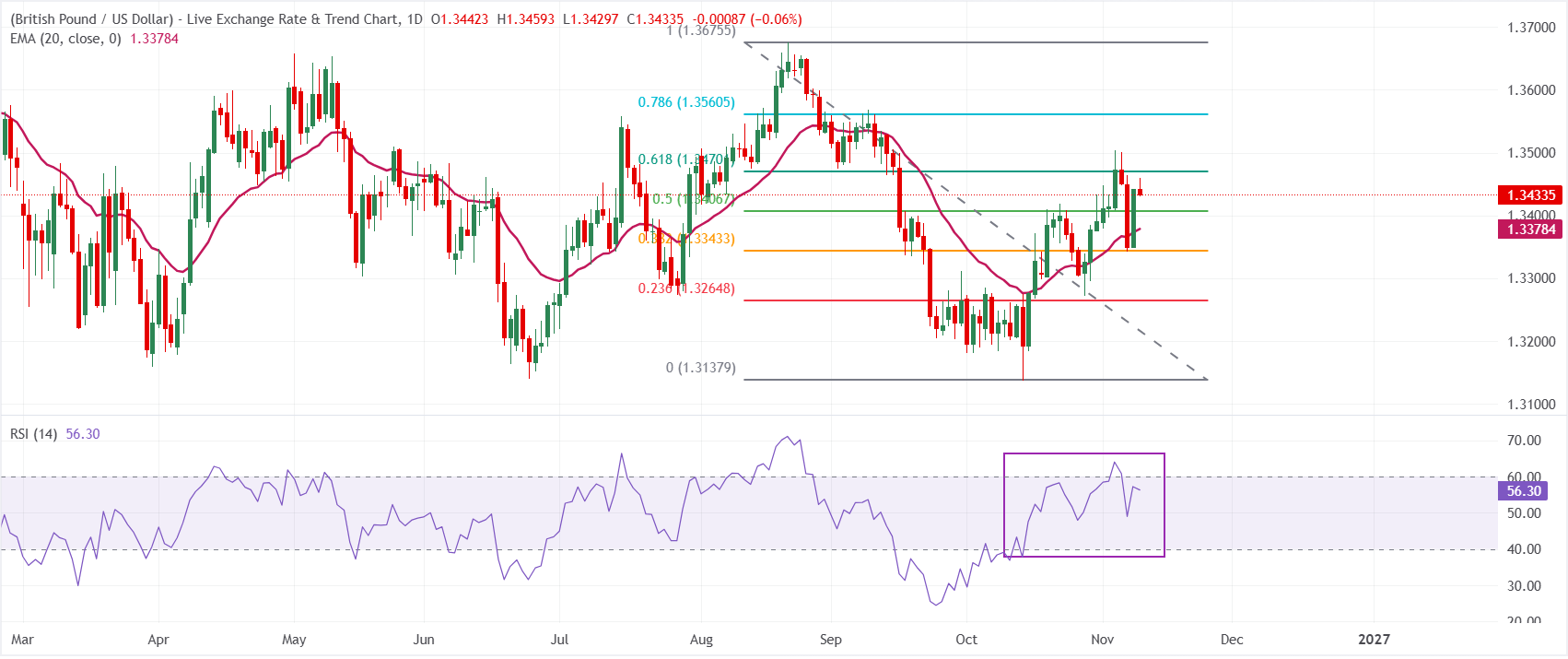
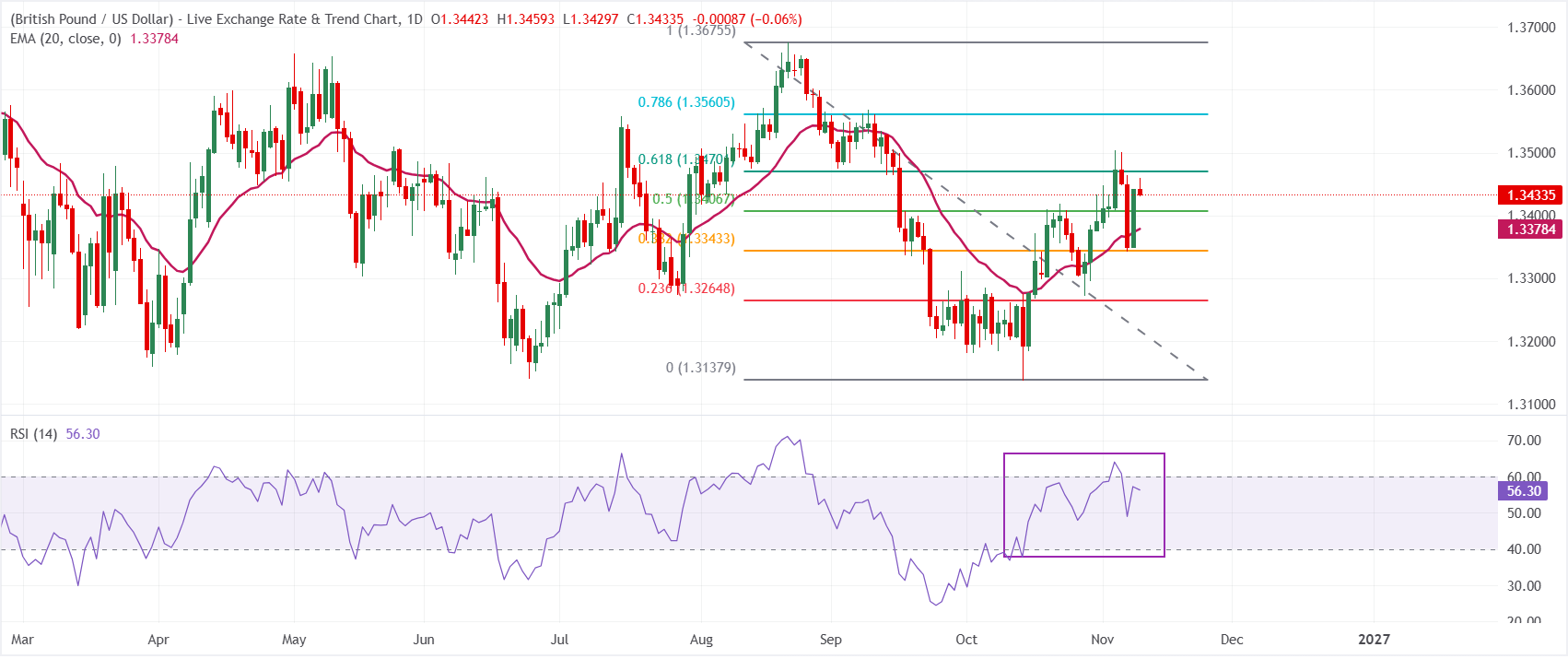
A modest bullish bias remains intact on the daily chart, where GBP/USD trades at 1.3433. The pair is holding above the 20-day Exponential Moving Average (EMA), roughly at 1.3378, and has moved back above the latest downswing’s 50.0% Fibonacci retracement near 1.3407. At around 56, the Relative Strength Index (14) points to firm upward momentum without signs of overextension. This suggests buyers remain in control as long as the price stays above these support levels.
The first upside hurdle is the 61.8% Fibonacci retracement near 1.3470. Should buyers extend the advance, the 78.6% retracement around 1.3560 would present the next higher barrier. Support initially lies at the 50.0% retracement of 1.3407, with the 20-day EMA near 1.3378 below it. A sharper retreat would bring the 38.2% level around 1.3343 into view, followed by the 23.6% retracement at 1.3265 and, subsequently, the structural floor near 1.3138.
(The technical analysis of this story was written with the help of an AI tool. Know more.)
Can a December hike remain on the table as Lombardelli highlights a slowing economy?
With attention turning towards a “low-gear economy” and a cooling labour market, Lombardelli struck a slightly less confident tone. Her FXS Speechtracker score of 6/10 is notably below the historical average of 7.2/10. Her reference to a “real fall-off in hiring”, alongside limited redundancies, points to weakening demand rather than acute stress, reducing the immediate urgency for aggressive tightening.
Nevertheless, by explicitly “not ruling out” a December rate increase, she retained a mildly hawkish bias and clearly preserved policy flexibility despite uncertainty over the data. The implications for GBP are mixed: weaker growth signals could limit near-term gains, while the continued possibility of another rate hike provides a cushion against declines.
POPULAR ARTICLES
1Is the pound heading for a fifth consecutive loss as Fed rate hike bets build?2Euro hits new 19-month low as hawkish Fed outlook drives selling3Can Mixed CPI Data Stem the Canadian Dollar’s Continuing Decline?4Australian Dollar: Why are RBA Minutes in focus ahead of wages data? – BBH5Singapore Dollar: Downside Bias Against US Dollar Remains Limited – UOB6South Korean Won: How is tech sentiment driving KRW volatility against US Dollar? – OCBC7Chinese Yuan: Large Surplus Supports Gradual Appreciation – Commerzbank8Silver Price Forecast: Fresh lower lows leave XAG/USD under bearish control9Can the British Pound Stem Losses Below 1.3200 as Fed Rate Hike Expectations Lift the US Dollar?


Get Started!
Sign up and access the Global Markets in less than 3 minutes

Connect With Us









Contacts
Phone: +61 2 8036 8388
Fax: +61 2 8036 8388
Email: support@tmgm.com



The information provided on this website is of a general nature only and does not constitute personal financial advice. Before acting on any information on this website, you should consider the suitability of the information in relation to your objectives, financial situation and needs. Investing in CFDs and FX Margin Contracts carries significant risks and is not suitable for all investors. You may lose more than your initial deposit. You do not own, or have, any interest in the underlying asset. We recommend that you seek independent advice and ensure you fully understand the risks involved before trading. It is important that you read and consider the disclosure document before you acquire any product listed on the website. The information and advertisements offered on this website are not intended for use by any person in any country or jurisdiction where such use would be contrary to local laws and regulations. The Products and Services offered on this website are not intended for residents of the United States, Malaysia and Thailand.
TMGM is authorized and regulated in various jurisdictions.
Trademax Australia Limited, trading as TMGM, is regulated by the Australian Securities and Investments Commission (ASIC), AFSL no. 436416 and is located at Level 28, One International Tower, 100 Barangaroo Avenue, 2000 Sydney, NSW Australia.
Email: support@tmgm.com.au
Trademax Global Limited, trading as TMGM, is authorized and regulated by the Vanuatu Financial Services Commission (VFSC), registration number 40356 and registered at 1276, Kumul Highway, Port Vila, Vanuatu, Republic of Vanuatu.
Email: support@tmgm.com
Trademax Global Markets (SE) Limited, trading as TMGM, is authorized and regulated by the Financial Services Authority (FSA) of Seychelles, with license number SD224. The company is registered at Office No 13, Providence Estate ABIS Centre, Mahe, Seychelles.
Email: support@tmgm.com
Trademax Global Markets (International) Pty Ltd, trading as TMGM, is authorized and regulated by the Financial Services Commission, Mauritius (FSC) with license no. GB22201012, and registered at 33, Edith Cavell Street C/o IQ EQ Fund Services (Mauritius) Ltd Port Louis, 11324 Mauritius.
Email: support@tmgm.com
Copyright © TMGM. All rights reserved