

Trading
Explore a wide range of markets with competitive pricing, deep liquidity, and advanced trading tools.
Learn More 
Platform
Trade seamlessly with TMGM's powerful platform, built for speed, precision, and a superior trading experience.
Learn More Trading Platform
Academy
Learn the fundamentals of trading with beginner-friendly resources, including guides, webinars, and market insights.
Learn More News & Analysis
Get real-time market updates and expert analysis to stay ahead of trading opportunities
Learn More News & Analysis
About
Learn what sets TMGM apart — our global presence, regulatory strength, and commitment to innovation in trading.
Learn More Why Choose TMGM
Sponsorship
Crypto Today: Can Bitcoin maintain its hold on the 50-day EMA as Ethereum and XRP encounter structural resistance?
- Bitcoin advances past $81,000 on Friday, having held support at the 50-day EMA.
- Ethereum remains broadly rangebound near $2,400, supported by a cluster of medium- and long-term moving averages.
- XRP rebounds above $1.32 after a steep fall on Thursday tested demand around $1.30.
A bullish outlook continues to underpin Bitcoin (BTC), which is edging above $81,000 on Friday after recently holding structural support near $80,000. The Crypto King’s defence of that level strengthens the prevailing positive bias. Ethereum (ETH) is also making modest gains above $2,400, while Ripple (XRP) is trading above $1.32 following a test of support near $1.30.

What will the Fed decision mean for markets?
Markets assign roughly a 92% probability to the Federal Open Market Committee (FOMC) leaving rates on hold after September’s 25-basis-point increase. The broad expectation is that the Federal Reserve (Fed) will maintain the 3.75-4.00% interest rate range on Wednesday.
An October rate increase carries an 8% probability, according to the FedWatch Tool, while the likelihood of a hike in December is higher.
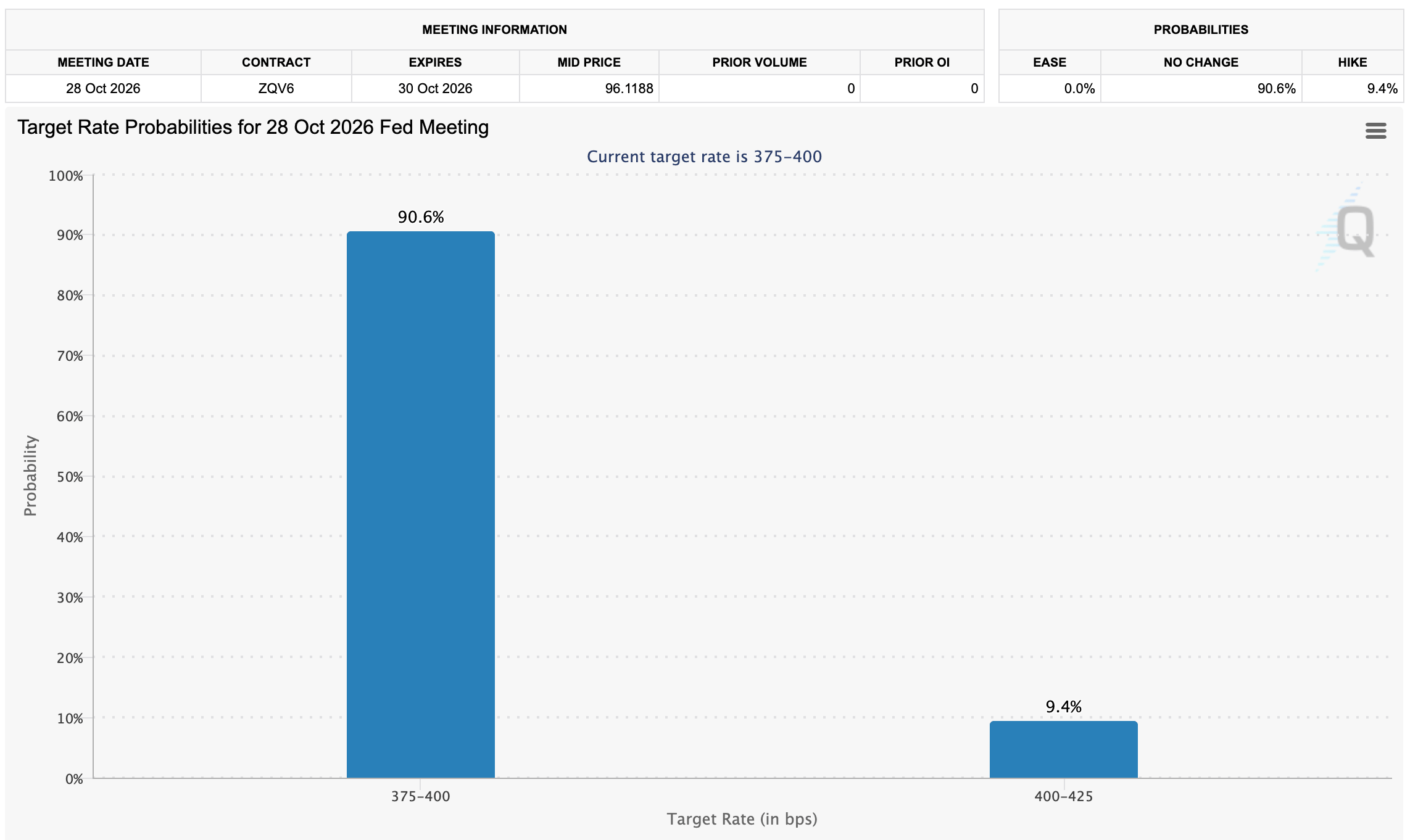
In an analysis report sent by email, Crypto Finance said: "The FOMC meets 27-28 October, with the decision on Wednesday, 28 October. With inflation risk still elevated and risk assets already tightening financial conditions, the market will watch closely for any shift in the Fed's reaction function,"
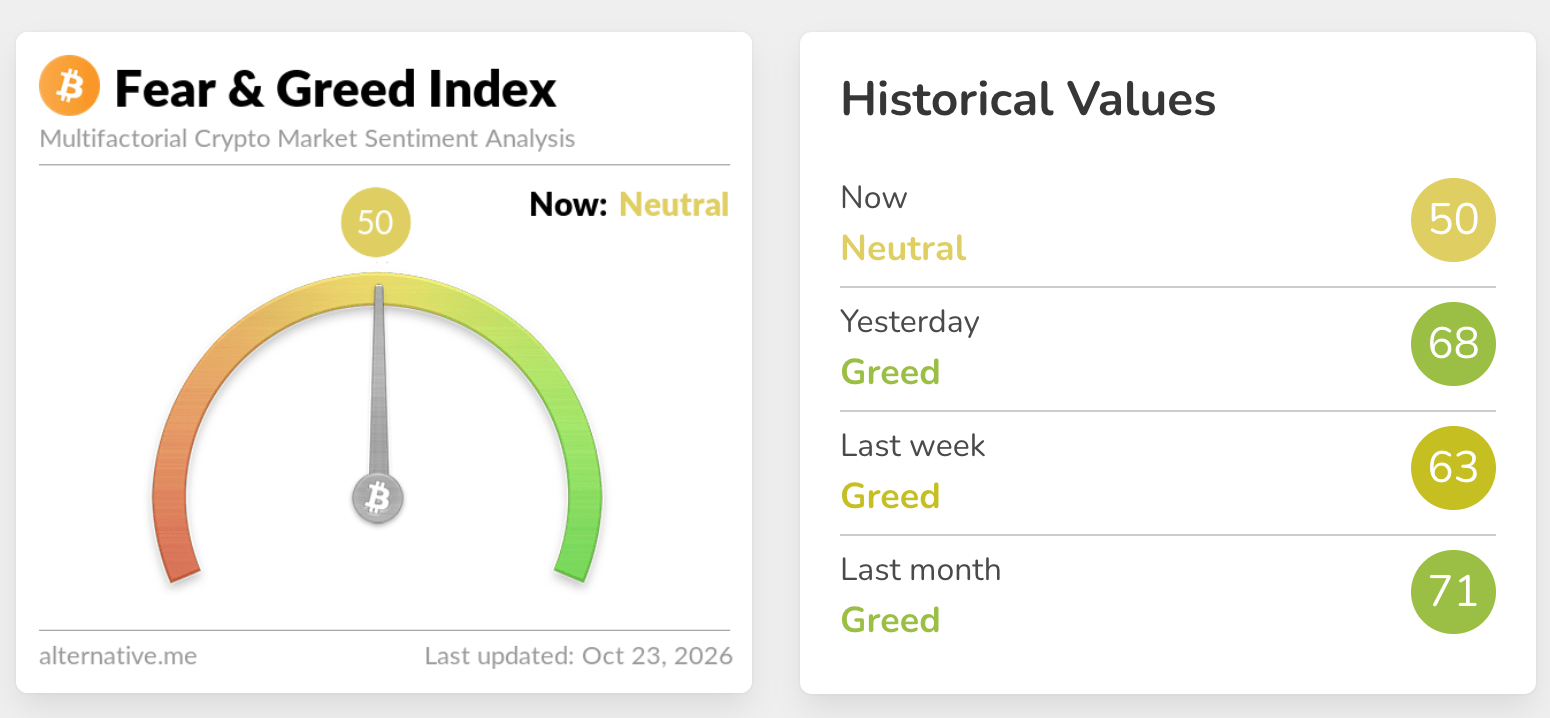
Caution ahead of the Fed’s decision has dampened demand for digital asset investment products this week. Reflecting that weaker appetite, the crypto Fear & Greed Index slipped to 50, in Neutral territory, on Friday from 68, in the Greed range, a day earlier. The pullback coincides with increased volatility before the policy announcement, with investors staying on the sidelines until the central bank’s policy direction becomes clear.
Technical analysis: Can Bitcoin maintain its bullish bias?
A positive near-term outlook remains intact for Bitcoin at $81,862, with the price above its key Exponential Moving Averages (EMAs). Dynamic support is layered below the spot price, with the 50-day EMA near $80,879 and the SuperTrend line around $79,664. Further down, the 100-day EMA at $77,529 and the 200-day EMA at $76,209 lend additional support to the broader uptrend.
Momentum indicators paint a more restrained picture. With the Relative Strength Index (RSI) sitting just below 50 and the Moving Average Convergence Divergence (MACD) indicator remaining negative, further gains may be gradual and corrective rather than impulsive.
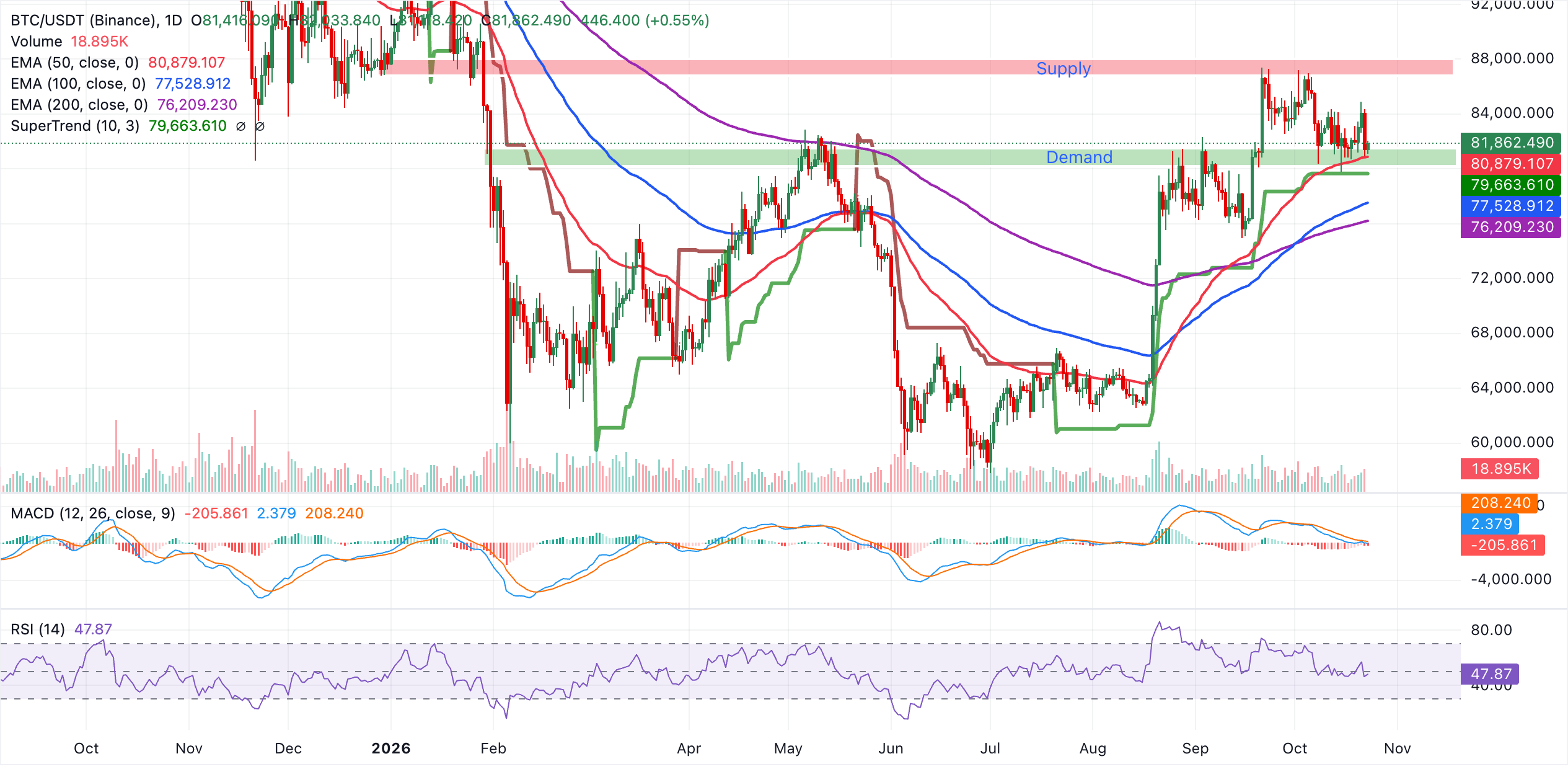
Buyers may seek to protect the existing bullish structure at the first support, the 50-day EMA at $80,879, and then at the SuperTrend baseline of $79,664. A steeper retreat would bring the 100-day EMA at $77,529 into focus, followed by another support layer at the 200-day EMA of $76,209.
Whether Bitcoin can remain above this EMA cluster is the central question, as the daily chart offers no clearly defined indicator resistance. Staying above the 50-day EMA would leave scope for the broader uptrend to resume gradually; a daily close below it would instead undermine the positive bias.
Crypto Finance also noted: "The $80,000-$81,000 area remains the line bulls have repeatedly defended, while $83,000 is the first level that would suggest buyers are beginning to regain control. Beyond that, the $85-$87,000 area remains the larger resistance zone that capped the September and early-October rally,"
Altcoins technical analysis: Can Ethereum and XRP recover in the short term?
A mildly positive near-term outlook holds for Ethereum at $2,410, above the 100-day EMA of $2,365 and the 200-day EMA of $2,317. The price has moved back above the break area of the rising support trendline near $2,368. However, gains remain constrained while Ethereum trades below the 50-period EMA at $2,475 and SuperTrend resistance at $2,675.
Rather than a strong bullish impulse, momentum appears to be stabilising: the MACD remains below zero despite a slight improvement, while the RSI stands around 41.
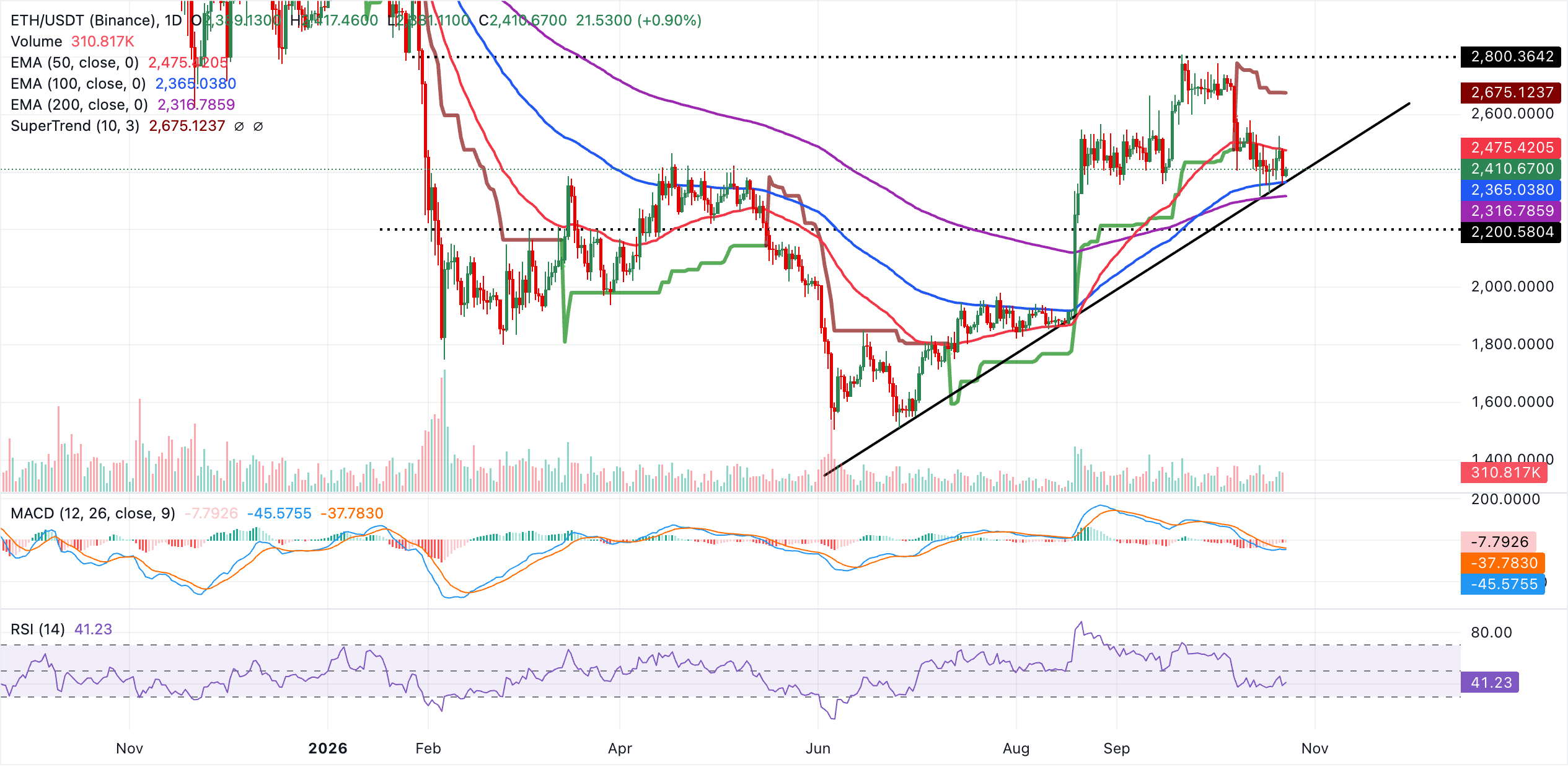
The recovered trendline area near $2,368 offers the nearest support, with the 100-EMA at $2,365 just below it. The next level is the 200-EMA around $2,317, where buyers may attempt to protect the broader uptrend structure.
On the upside, the 50-EMA near $2,475 provides the first resistance, followed by a firmer obstacle at the SuperTrend level around $2,675. Clearing these barriers on a daily closing basis would create room for a more decisive bullish extension. Conversely, losing the $2,368-$2,365 cluster would bring the $2,317 area back into focus.
Despite its recent rebound from lower levels, XRP retains a bearish broader outlook at $1.32. Selling pressure persists as the price remains below the 100-day EMA of $1.34, the 50-day EMA of $1.37 and the 200-day EMA of $1.38.
The prevailing downtrend is reinforced by the SuperTrend indicator at $1.47, well above the spot price. Although the RSI has recovered from oversold territory to around 43, it points to only limited bullish momentum within a predominantly bearish structure.
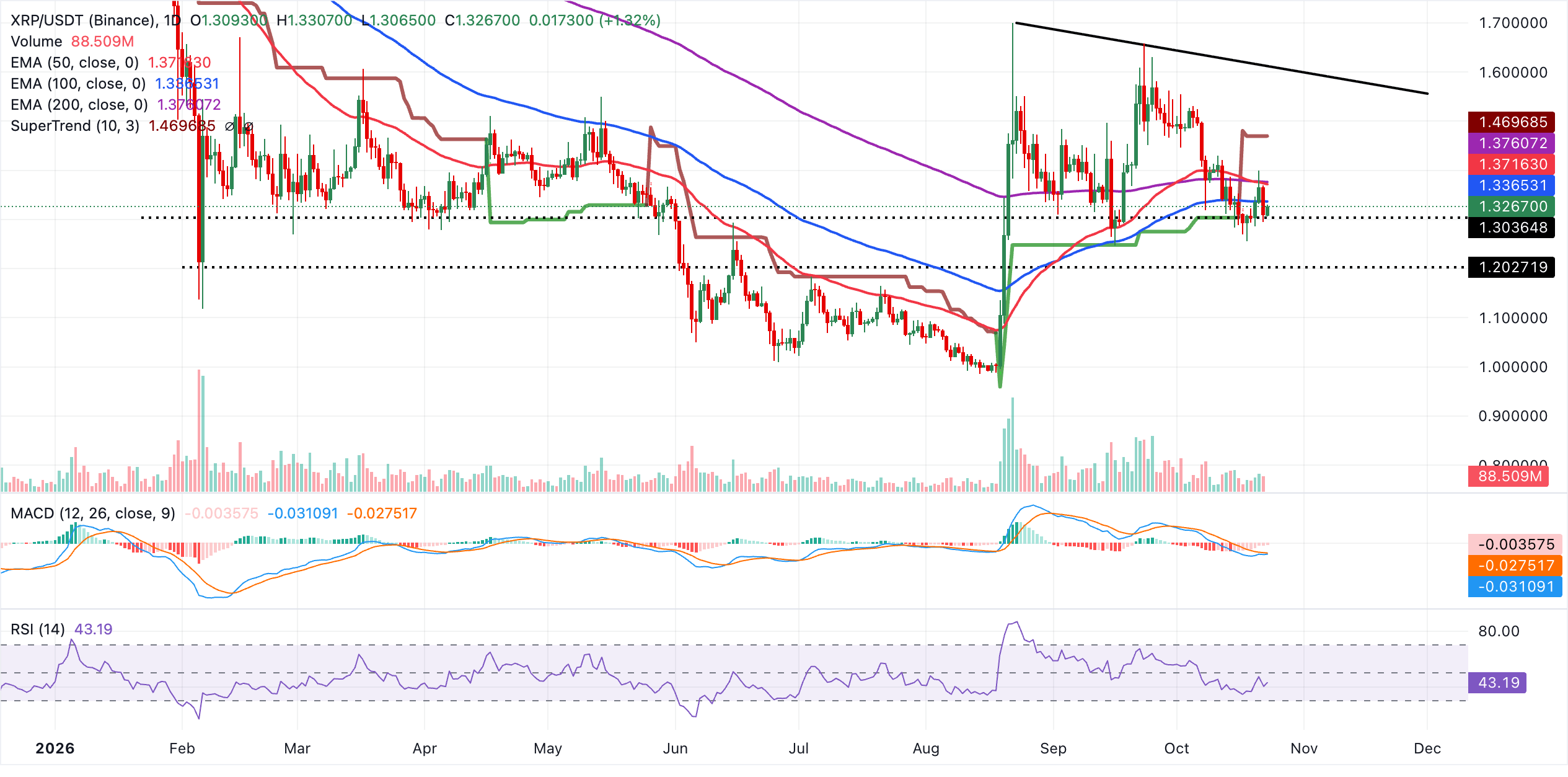
To relieve immediate selling pressure, XRP would need to sustain a close above its first resistance, the 100-day EMA at $1.34. Beyond that, a concentrated supply zone comprises the 50-day EMA at $1.37 and the 200-day EMA at $1.38. A decisive break through this band would be required to indicate a more lasting recovery, while the SuperTrend level of $1.47 remains an important medium-term barrier.
Should momentum weaken, the pair would be vulnerable to another round of selling, as the daily chart shows no nearby moving-average or trendline support.
(The technical analysis of this story was written with the help of an AI tool. Know more.)
Crypto ETFs: Common Questions
Investors use an Exchange-Traded Fund (ETF) to obtain exposure to a particular asset. This investment vehicle or index follows the price of an underlying asset, though it can also track a basket of assets and sectors rather than a single asset. A Bitcoin ETF, for instance, follows the price of Bitcoin.
Yes. Approval for the first US Bitcoin futures ETF came from the US Securities & Exchange Commission in October 2021. Seven Bitcoin futures ETFs have received clearance in total, while more than 20 await the regulator’s approval. Citing the cryptocurrency industry’s newness and susceptibility to manipulation, the SEC has delayed crypto-related futures ETFs over the past few years.
Yes. Institutional capital and mainstream investors gained an avenue to trade the leading cryptocurrency when the SEC authorised the listing and trading of several Bitcoin spot Exchange-Traded Funds in January 2024. The industry welcomed the decision as a game changer.
Exposure to a cryptocurrency without having to own it is the key benefit of crypto ETFs, lowering the risks and costs of holding the asset directly. Investors also face a gentler learning curve and benefit from greater security, since the ETF is responsible for safeguarding the underlying holdings. The principal drawback is the lack of direct ownership of the asset, summed up in the crypto expression “not your keys, not your coins.” Fees charged by ETFs for active management also raise the cost of holding crypto. Lastly, although ETFs reduce the risks associated with holding an asset, fluctuations in the underlying cryptocurrency’s price are still likely to feed through to the investment vehicle.
POPULAR ARTICLES
1Crypto Today: Can Bitcoin maintain its hold on the 50-day EMA as Ethereum and XRP encounter structural resistance?2Why is the British Pound lagging despite an upbeat UK flash PMI report?3Gold Price Forecast: Can XAU/USD extend its rebound from the $4,000 area while bears remain in control?4Japanese Yen: USD Expected to Remain Rangebound as Strong CPI Supports BoJ Hikes - BBH5Will US S&P Global PMI show the expected moderation in October business activity?6Canadian Dollar: Under pressure against US Dollar near 1.40 – TD Securities7Silver price today: FXStreet data show a decline in silver prices8$127 target in focus as Brent resumes uptrend – Societe Generale9Euro falls to new 17-month lows against British Pound following Eurozone and UK PMI releases
LIVE QUOTES


ALL ABOUT TECHNICAL
What Does Smart Money Concept (SMC) Mean, and How Can You Trade It?
What Is an Order Block in Trading and How Can You Trade It?
Average True Range (ATR) Indicator: What Is the Formula, and How Do You Read and Use It?
What Is a Judas Swing? ICT Trading Strategy Explained With Examples
The Real Interest Rate: Are Your Savings Actually Earning Anything?
Butterfly Pattern Trading: How to Identify and Trade the Butterfly Harmonic Pattern
What Is a Rising Wedge Pattern and How Do You Trade It?
What Is a Descending Triangle Pattern and How Do You Trade It?
Accumulation, Manipulation and Distribution (AMD): ICT Power of 3 Trading Guide
Get Started!
Sign up and access the Global Markets in less than 3 minutes

Connect With Us









Contacts
Phone: +61 2 8036 8388
Fax: +61 2 8036 8388
Email: support@tmgm.com



The information provided on this website is of a general nature only and does not constitute personal financial advice. Before acting on any information on this website, you should consider the suitability of the information in relation to your objectives, financial situation and needs. Investing in CFDs and FX Margin Contracts carries significant risks and is not suitable for all investors. You may lose more than your initial deposit. You do not own, or have, any interest in the underlying asset. We recommend that you seek independent advice and ensure you fully understand the risks involved before trading. It is important that you read and consider the disclosure document before you acquire any product listed on the website. The information and advertisements offered on this website are not intended for use by any person in any country or jurisdiction where such use would be contrary to local laws and regulations. The Products and Services offered on this website are not intended for residents of the United States, Malaysia and Thailand.
TMGM is authorized and regulated in various jurisdictions.
Trademax Australia Limited, trading as TMGM, is regulated by the Australian Securities and Investments Commission (ASIC), AFSL no. 436416 and is located at Level 28, One International Tower, 100 Barangaroo Avenue, 2000 Sydney, NSW Australia.
Email: support@tmgm.com.au
Trademax Global Limited, trading as TMGM, is authorized and regulated by the Vanuatu Financial Services Commission (VFSC), registration number 40356 and registered at 1276, Kumul Highway, Port Vila, Vanuatu, Republic of Vanuatu.
Email: support@tmgm.com
Trademax Global Markets (SE) Limited, trading as TMGM, is authorized and regulated by the Financial Services Authority (FSA) of Seychelles, with license number SD224. The company is registered at Office No 13, Providence Estate ABIS Centre, Mahe, Seychelles.
Email: support@tmgm.com
Trademax Global Markets (International) Pty Ltd, trading as TMGM, is authorized and regulated by the Financial Services Commission, Mauritius (FSC) with license no. GB22201012, and registered at 33, Edith Cavell Street C/o IQ EQ Fund Services (Mauritius) Ltd Port Louis, 11324 Mauritius.
Email: support@tmgm.com
Copyright © TMGM. All rights reserved