

Trading
Explore a wide range of markets with competitive pricing, deep liquidity, and advanced trading tools.
Learn More 
Platform
Trade seamlessly with TMGM's powerful platform, built for speed, precision, and a superior trading experience.
Learn More Trading Platform
Academy
Learn the fundamentals of trading with beginner-friendly resources, including guides, webinars, and market insights.
Learn More News & Analysis
Get real-time market updates and expert analysis to stay ahead of trading opportunities
Learn More News & Analysis
About
Learn what sets TMGM apart — our global presence, regulatory strength, and commitment to innovation in trading.
Learn More Why Choose TMGM
Sponsorship
Ripple Price Forecast: XRP retreats under ETF pressure
- Bearish pressure leaves XRP struggling for traction above $0.94, increasing the likelihood of a correction towards $0.90.
- Pressure on XRP intensifies as ETF outflows continue for a second consecutive day.
- A modest recovery in the MACD has yet to offset XRP's structural weakness.
Renewed selling pressure is weighing on Ripple (XRP) on Tuesday, pushing the token down towards $0.92. Over the past week, the remittance token has mostly traded within a range bounded by $0.90 support and $1.00 resistance, with last Friday's flash decline to $0.86 the exception.

Further declines remain the more likely direction, as falling moving averages and the dynamic SuperTrend barrier continue to restrict the scope for a structural recovery.
Can risk appetite recover as ETF outflows continue?
Risk appetite across the broader crypto market remains markedly weak. Tuesday's Fear & Greed Index reading of 11 reflects this subdued mood, with no improvement over the past couple of weeks as market participants remain focused primarily on macroeconomic developments.
Against this backdrop, expectations are widespread that the Federal Reserve (Fed) will raise interest rates by 25 basis points in December, taking the range to 4.00-4.25%. Tackling elevated inflation in the United States (US) and bringing it back to the long-term 2% target remain firm priorities for the central bank.
Persistent geopolitical tensions in the Middle East, however, are complicating the Fed's efforts to fulfil its dual mandate of maximum employment and price stability.
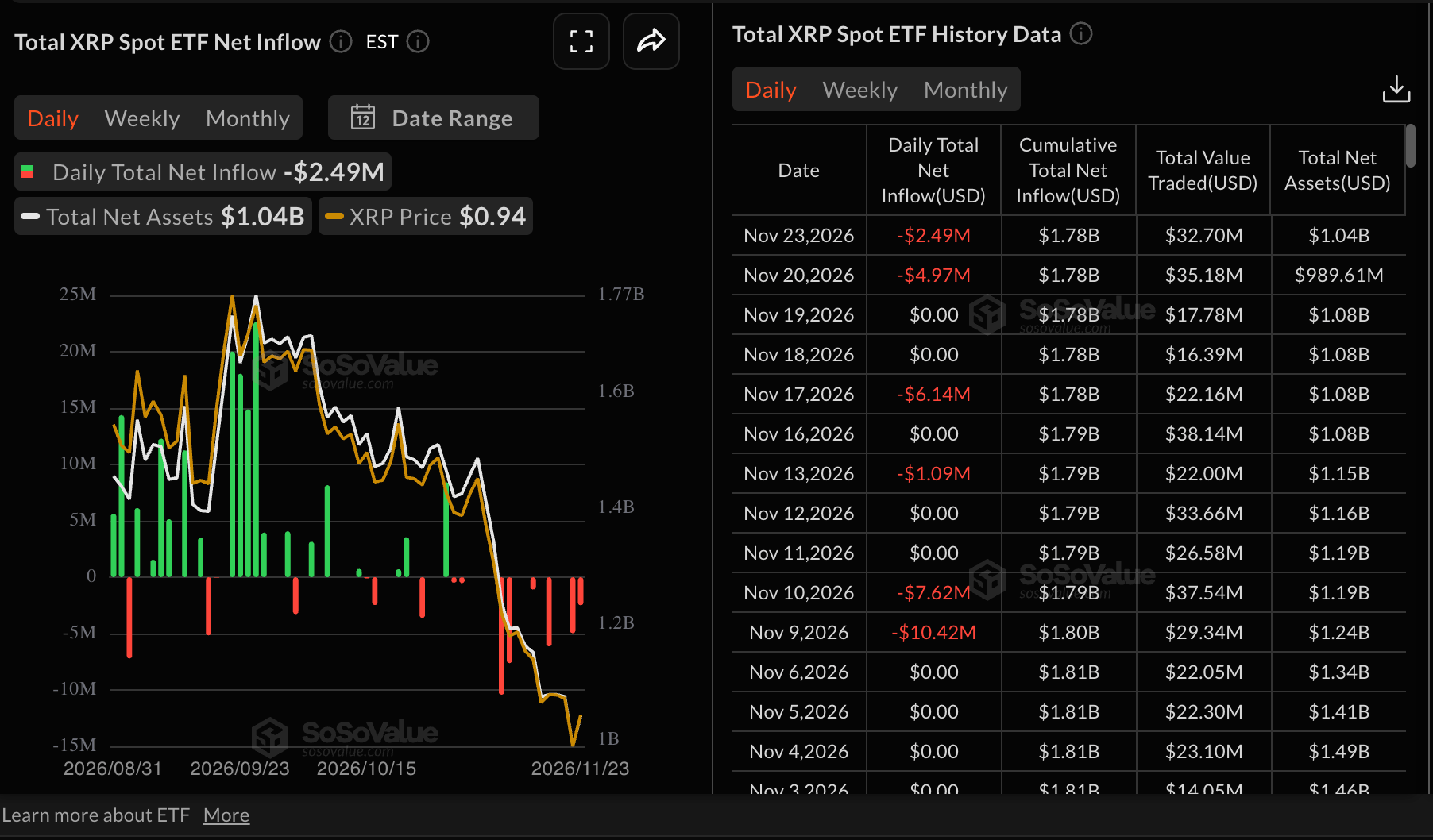
Monday brought $2.5 million in outflows from XRP spot Exchange-Traded Funds (ETFs), marking a second consecutive day of withdrawals after $5 million left the funds last Friday. Cumulative inflows remain subdued at $1.8 billion, while net assets stand at $1 billion.
Technical analysis: Can XRP withstand renewed selling pressure?
Trading at $0.93, XRP retains a bearish bias, with its price still well below the key EMAs. Overhead resistance is layered at the 50-day EMA of $1.15, the 100-day EMA of $1.22 and the 200-day EMA of $1.30. The SuperTrend at $1.09 adds another constraint on the upside.
Momentum signals remain mixed. A slightly positive Moving Average Convergence Divergence (MACD) indicator points to tentative recovery efforts. Yet, with the Relative Strength Index (RSI) near 30, the pair appears to be lingering around oversold territory rather than establishing a decisive trend reversal.
The first upside hurdle is the SuperTrend around $1.09. Beyond it lie the 50-day EMA at $1.15 and the earlier breakout area along the descending resistance trendline near $1.19. Further barriers are positioned at the 100-day EMA of $1.22 and the 200-day EMA of $1.30, ahead of the broader bearish trendline originating from $1.74. The daily chart offers no clearly defined structural support, leaving renewed deterioration in sentiment as the likely driver of any additional losses. To relieve the prevailing bearish pressure, recovery attempts would need to take the price back above the SuperTrend and the cluster of short-term EMAs.
(The technical analysis of this story was written with the help of an AI tool. Know more.)
Ripple: Frequently asked questions
Specialising in cross-border remittances, payments company Ripple uses blockchain technology to facilitate transfers. Ripple Labs Inc. created RippleNet, a payments transfer network available to financial institutions across the world. The company also uses the XRP token.
The decentralised XRPLedger blockchain has XRP as its native token. Ripple Labs uses it to enable transactions on XRPLedger, allowing financial institutions to transfer value across borders. By facilitating instant, trustless payments on the XRPLedger chain, XRP helps financial firms reduce the cost of transactions worldwide.
Built on distributed ledger technology, XRPLedger is a blockchain that uses XRP to power transactions. Unlike other blockchains, the ledger incorporates an inflammatory protocol designed to combat spam and distributed denial-of-service (DDOS) attacks. Maintenance of XRPL is handled by a peer-to-peer network called the global XRP Ledger community.
The interledger standard used by XRP is a blockchain protocol that facilitates payments between different networks. XRP's blockchain, for example, can link the ledgers of two or more banks, effectively eliminating intermediaries and the need for centralisation within the system. Developed by Jed McCaleb, Arthur Britto and David Schwartz, the XRPLedger blockchain uses XRP as its native token.
POPULAR ARTICLES
1Ripple Price Forecast: XRP retreats under ETF pressure2Why is the Canadian Dollar’s recovery gaining momentum as US Dollar bulls pause?3Could the fiscal rule cushion the Euro’s downside against the US Dollar? – MUFG4Stronger German business confidence lifts Euro against British Pound5US Dollar: Could further gains prove short-lived? - ING6Canadian Dollar: Will Macklem’s Speech Clarify December Hike Prospects? – BBH7Australian Dollar: Overstretched slide against US Dollar gives way to consolidation – UOB8What is keeping the US Dollar resilient despite Bessent's warning against Fed overtightening?9BRL: Currency Weakens Against US Dollar as Fiscal Concerns Mount – Societe Generale


Get Started!
Sign up and access the Global Markets in less than 3 minutes

Connect With Us









Contacts
Phone: +61 2 8036 8388
Fax: +61 2 8036 8388
Email: support@tmgm.com



The information provided on this website is of a general nature only and does not constitute personal financial advice. Before acting on any information on this website, you should consider the suitability of the information in relation to your objectives, financial situation and needs. Investing in CFDs and FX Margin Contracts carries significant risks and is not suitable for all investors. You may lose more than your initial deposit. You do not own, or have, any interest in the underlying asset. We recommend that you seek independent advice and ensure you fully understand the risks involved before trading. It is important that you read and consider the disclosure document before you acquire any product listed on the website. The information and advertisements offered on this website are not intended for use by any person in any country or jurisdiction where such use would be contrary to local laws and regulations. The Products and Services offered on this website are not intended for residents of the United States, Malaysia and Thailand.
TMGM is authorized and regulated in various jurisdictions.
Trademax Australia Limited, trading as TMGM, is regulated by the Australian Securities and Investments Commission (ASIC), AFSL no. 436416 and is located at Level 28, One International Tower, 100 Barangaroo Avenue, 2000 Sydney, NSW Australia.
Email: support@tmgm.com.au
Trademax Global Limited, trading as TMGM, is authorized and regulated by the Vanuatu Financial Services Commission (VFSC), registration number 40356 and registered at 1276, Kumul Highway, Port Vila, Vanuatu, Republic of Vanuatu.
Email: support@tmgm.com
Trademax Global Markets (SE) Limited, trading as TMGM, is authorized and regulated by the Financial Services Authority (FSA) of Seychelles, with license number SD224. The company is registered at Office No 13, Providence Estate ABIS Centre, Mahe, Seychelles.
Email: support@tmgm.com
Trademax Global Markets (International) Pty Ltd, trading as TMGM, is authorized and regulated by the Financial Services Commission, Mauritius (FSC) with license no. GB22201012, and registered at 33, Edith Cavell Street C/o IQ EQ Fund Services (Mauritius) Ltd Port Louis, 11324 Mauritius.
Email: support@tmgm.com
Copyright © TMGM. All rights reserved