

Trading
Explore a wide range of markets with competitive pricing, deep liquidity, and advanced trading tools.
Learn More 
Platform
Trade seamlessly with TMGM's powerful platform, built for speed, precision, and a superior trading experience.
Learn More Trading Platform
Academy
Learn the fundamentals of trading with beginner-friendly resources, including guides, webinars, and market insights.
Learn More News & Analysis
Get real-time market updates and expert analysis to stay ahead of trading opportunities
Learn More News & Analysis
About
Learn what sets TMGM apart — our global presence, regulatory strength, and commitment to innovation in trading.
Learn More Why Choose TMGM
Sponsorship
Ripple Price Forecast: Could XRP drop below $0.90 as whales cut exposure?
- Technical weakness keeps XRP under pressure, with the token correcting near $0.91 on Wednesday.
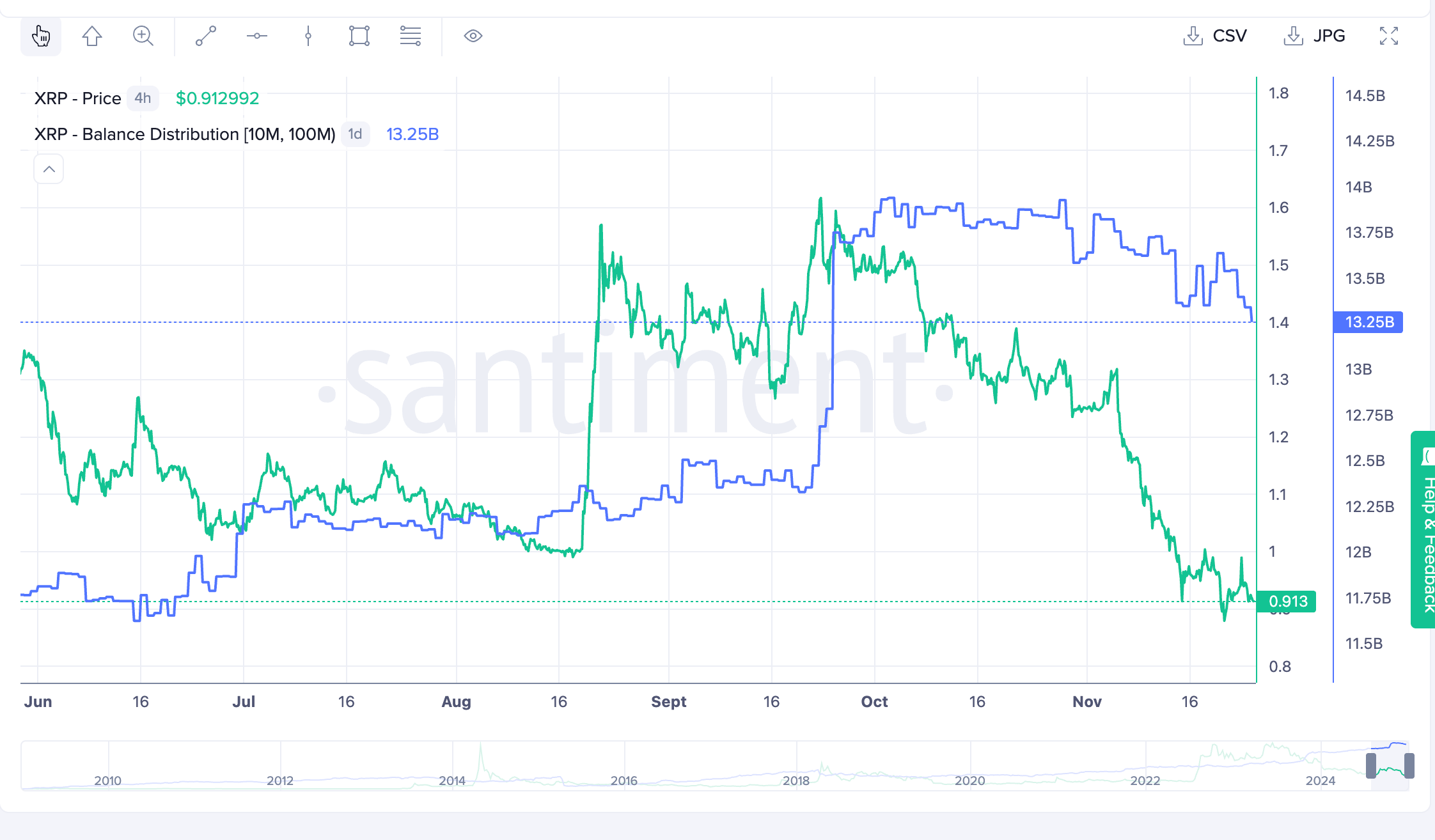
- Combined holdings of whales owning between 10M and 100M XRP fall 2.9% to 13.25B XRP.
- Subdued ETF activity and a slightly oversold RSI accompany the continued risk-off mood.
Persistent pressure across the broader cryptocurrency market keeps Ripple (XRP) trading around $0.91 on Wednesday. Strong resistance to recovery attempts towards $1.00 is fuelling the ongoing correction, leaving the token’s technical outlook predominantly bearish.
Why are XRP whales selling as risk aversion persists?

Selling pressure and weak technical signals are prompting large XRP holders to adjust their positions. According to Santiment, whales owning between 10 million and 100 million XRP have steadily offloaded the token, cutting their holdings by roughly 2.9% in November from 13.65 billion XRP to 13.25 billion XRP. Viewed more broadly, the Balance Distribution metric reached a peak of 13.85 billion XRP in October, undermining appetite for risk. Should this pattern persist, declining demand will erode support and raise the likelihood of a correction below $0.90.
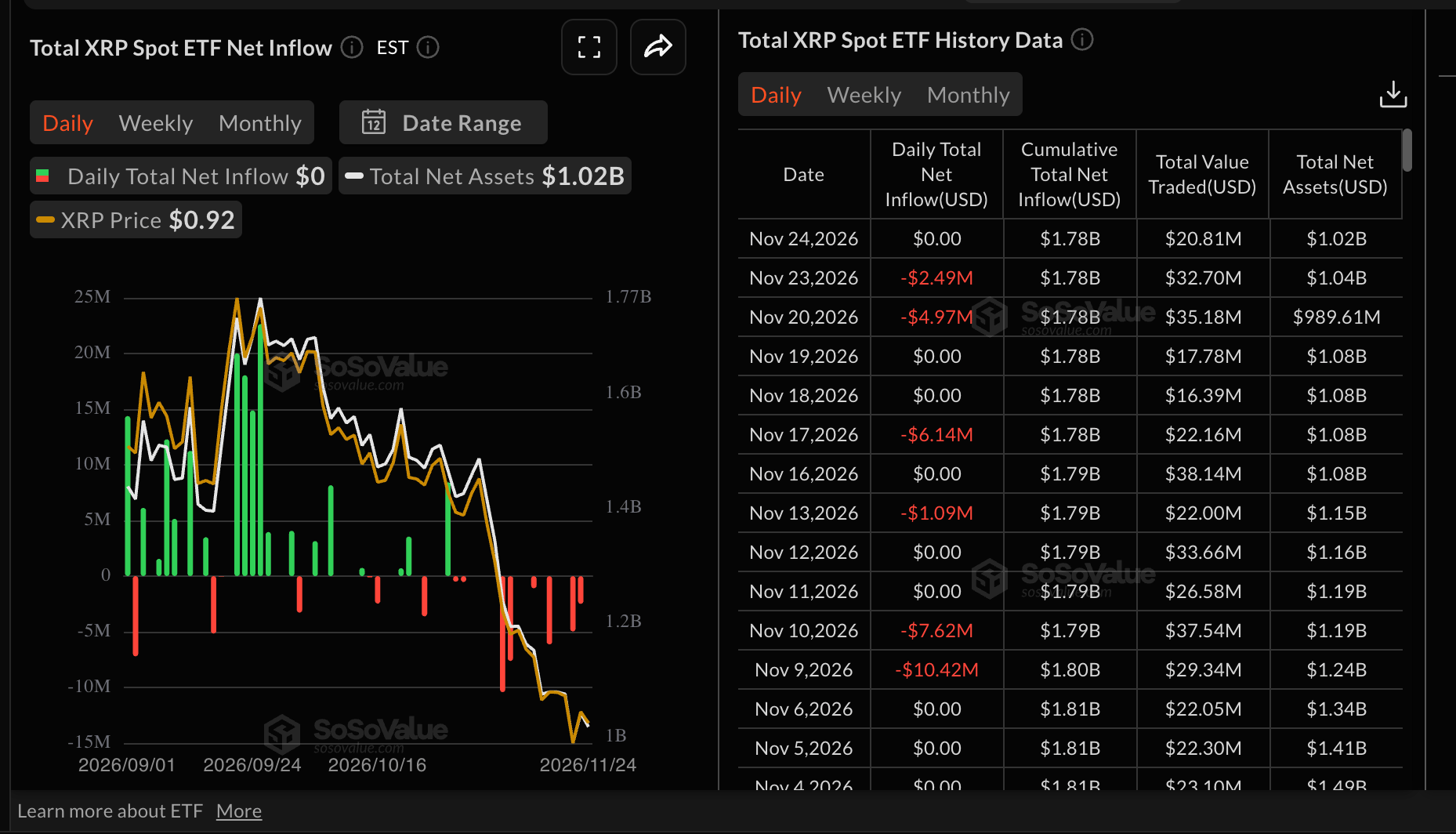
Following outflows of $2.5 million on Monday and $5 million last Friday, activity in XRP spot Exchange-Traded Funds (ETFs) remained subdued on Tuesday. November’s cumulative outflows averaged $33 million, marking the first bearish month since March. A lack of institutional demand leaves XRP with little buffer against adverse market conditions, heightening the possibility of a prolonged downtrend.
Technical analysis: Can XRP sellers push towards $0.90?
Trading at $0.91, XRP retains a bearish short-term bias, with its price significantly below the 50-day, 100-day and 200-day Exponential Moving Averages (EMAs), positioned at $1.14, $1.2135 and 1.30, respectively. Although the Parabolic SAR provides tactical support at $0.87, momentum indicators currently suggest scope for a corrective rebound rather than a lasting trend reversal. These include an oversold Relative Strength Index (RSI) around 29 and a slightly positive Moving Average Convergence Divergence (MACD) reading.
The latest Parabolic SAR reading places immediate downside support at $0.87, a level where buyers may try to arrest the recent decline. Any recovery would first encounter resistance around the 50-day EMA at $1.14, ahead of the 100-day EMA at $1.21 and the 200-day EMA near $1.30. Together, these averages form a wide overhead supply zone; reclaiming it would be necessary to weaken the current bearish structure.
(The technical analysis of this story was written with the help of an AI tool. Know more.)
Crypto ETFs: Key questions answered
By tracking the price of an underlying asset, an Exchange-Traded Fund (ETF) serves as an investment vehicle or index. Its scope can extend beyond a single asset to a basket of assets and sectors. A Bitcoin ETF, for instance, follows the price of Bitcoin. Investors use ETFs to obtain exposure to a particular asset.
Yes. In October 2021, approval for the first US Bitcoin futures ETF came from the US Securities & Exchange Commission. Seven Bitcoin futures ETFs have received approval in total, while more than 20 remain awaiting regulatory permission. Citing the cryptocurrency industry’s newness and vulnerability to manipulation, the SEC has delayed crypto-related futures ETFs over the last few years.
Yes. Several Bitcoin spot Exchange-Traded Funds received SEC approval for listing and trading in January 2024. This opened access for institutional capital and mainstream investors to trade the leading cryptocurrency, a decision the industry welcomed as a game changer.
Exposure to a cryptocurrency without owning it is the principal benefit of crypto ETFs, lowering the risks and costs involved in holding the asset. Investors also face a gentler learning curve and gain greater security, as the ETFs assume responsibility for safeguarding the underlying holdings. However, the absence of direct ownership is also the key drawback, captured by the crypto saying, “not your keys, not your coins.” Fees charged by ETFs for active management are another disadvantage, adding to the cost of holding crypto. Moreover, while ETF investment reduces the risks associated with holding an asset, fluctuations in the underlying cryptocurrency’s price are likely to carry through to the investment vehicle.
POPULAR ARTICLES
1Ripple Price Forecast: Could XRP drop below $0.90 as whales cut exposure?2US Dollar: Why are tariff risks and inflation data in the spotlight? – Danske Bank3NZD/USD Price Forecast: Why is the Kiwi still vulnerable as rallies stall below 0.5500?4ECB's Kocher: Market pricing appears not entirely unreasonable - Bloomberg5Euro: Can It Weather the Dollar Storm? – ING6Euro slips: Will US PCE inflation validate bets on Fed tightening?7Brazilian Real: Is fiscal progress underpinning a cautious rebound? – Societe Generale8104.38: Australian Dollar hits new YTD low versus Japanese Yen9Gold trades near 14-month low as US PCE inflation data keeps traders on edge


Get Started!
Sign up and access the Global Markets in less than 3 minutes

Connect With Us









Contacts
Phone: +61 2 8036 8388
Fax: +61 2 8036 8388
Email: support@tmgm.com



The information provided on this website is of a general nature only and does not constitute personal financial advice. Before acting on any information on this website, you should consider the suitability of the information in relation to your objectives, financial situation and needs. Investing in CFDs and FX Margin Contracts carries significant risks and is not suitable for all investors. You may lose more than your initial deposit. You do not own, or have, any interest in the underlying asset. We recommend that you seek independent advice and ensure you fully understand the risks involved before trading. It is important that you read and consider the disclosure document before you acquire any product listed on the website. The information and advertisements offered on this website are not intended for use by any person in any country or jurisdiction where such use would be contrary to local laws and regulations. The Products and Services offered on this website are not intended for residents of the United States, Malaysia and Thailand.
TMGM is authorized and regulated in various jurisdictions.
Trademax Australia Limited, trading as TMGM, is regulated by the Australian Securities and Investments Commission (ASIC), AFSL no. 436416 and is located at Level 28, One International Tower, 100 Barangaroo Avenue, 2000 Sydney, NSW Australia.
Email: support@tmgm.com.au
Trademax Global Limited, trading as TMGM, is authorized and regulated by the Vanuatu Financial Services Commission (VFSC), registration number 40356 and registered at 1276, Kumul Highway, Port Vila, Vanuatu, Republic of Vanuatu.
Email: support@tmgm.com
Trademax Global Markets (SE) Limited, trading as TMGM, is authorized and regulated by the Financial Services Authority (FSA) of Seychelles, with license number SD224. The company is registered at Office No 13, Providence Estate ABIS Centre, Mahe, Seychelles.
Email: support@tmgm.com
Trademax Global Markets (International) Pty Ltd, trading as TMGM, is authorized and regulated by the Financial Services Commission, Mauritius (FSC) with license no. GB22201012, and registered at 33, Edith Cavell Street C/o IQ EQ Fund Services (Mauritius) Ltd Port Louis, 11324 Mauritius.
Email: support@tmgm.com
Copyright © TMGM. All rights reserved