

Trading
Explore a wide range of markets with competitive pricing, deep liquidity, and advanced trading tools.
Learn More 
Platform
Trade seamlessly with TMGM's powerful platform, built for speed, precision, and a superior trading experience.
Learn More Trading Platform
Academy
Learn the fundamentals of trading with beginner-friendly resources, including guides, webinars, and market insights.
Learn More News & Analysis
Get real-time market updates and expert analysis to stay ahead of trading opportunities
Learn More News & Analysis
About
Learn what sets TMGM apart — our global presence, regulatory strength, and commitment to innovation in trading.
Learn More Why Choose TMGM
Sponsorship
Will US JOLTS job openings show the expected strength in labour demand and bolster Fed rate hike bets?
- US job openings are expected to stay above the 2025 average, despite a projected fall to 7.28 million in May’s JOLTS report.
- Markets will look to the Job Openings figures for validation of expectations for Federal Reserve rate hikes.
- Pressure persists on EUR/USD, which is trading within relatively close reach of its 13-month lows.
Markets are closely watching the May Job Openings and Labor Turnover Survey (JOLTS), due from the US Bureau of Labor Statistics on Tuesday at 14:00 GMT. Drawing on employers’ estimates of job openings, hiring and separations across the US, the survey usually precedes a series of employment indicators through the week. That sequence concludes with the closely tracked Nonfarm Payrolls report.

With markets reassessing the likelihood of US Federal Reserve (Fed) interest rate hikes, Tuesday’s May JOLTS release comes at a critical juncture and is likely to attract close scrutiny. Inflation continues to climb at levels well above the central bank’s target.
Despite the recent retreat in Crude prices, inflationary pressures have not eased, while considerable uncertainty persists over the Middle East conflict. Investors’ hopes of at least one rate hike this year have strengthened following the Fed’s renewed commitment to tackling inflation. Against this backdrop, the labour market releases this week could be crucial in judging when the next monetary policy move might come, while also providing a fresh impetus to US Dollar (USD) volatility.
Will May’s JOLTS figures point to a stabilising labour market?
Market consensus puts May job openings at 7.28 million, implying a modest fall from April’s 7.61 million, the highest reading since July 2024. Even so, the projected figure would remain robust and comfortably above the 2025 average of 7.08 million openings. Confirmation of these estimates would likely support the view that the US labour market is stabilising and reinforce the narrative of US economic exceptionalism.
In April, JOLTS exceeded forecasts as openings rose 4.6% month on month, adding 731,000 vacancies to March’s 6.88 million. Quits, layoffs and discharges, by contrast, showed little change.
The US Nonfarm Payrolls report also recorded 172K additional jobs in May, rounding off a strong three-month performance through May. Confidence in the US economy’s resilience to the Middle East war strengthened on these numbers. They also enabled Fed policymakers to set aside labour market concerns and concentrate entirely on above-target inflation when shaping near-term policy. In response to this changed backdrop, investors have increased their bets on some monetary tightening over the coming months.
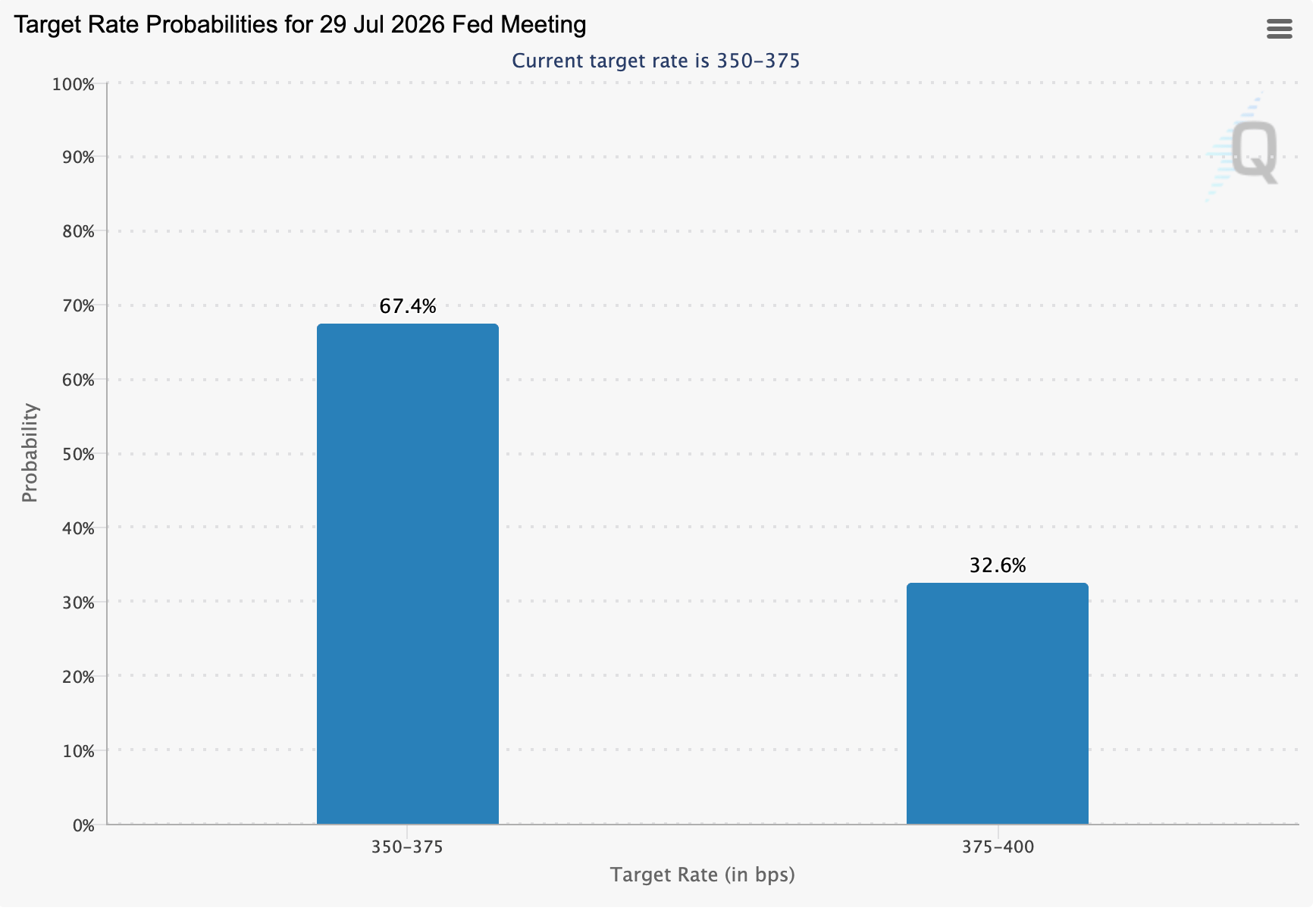
Futures markets now assign a 30% probability to a rate hike at next month’s Federal Open Market Committee (FOMC) meeting and a more than 60% probability to monetary tightening in September, according to the CME Group’s Fedwatch Tool. The corresponding probabilities stood at 6% and 20% respectively a month earlier. Investors will scrutinise this week’s employment data to test those expectations.
When is JOLTS due, and what could it mean for EUR/USD?
With EUR/USD still relatively close to its 13-month lows, the pair is heading for a 2.17% decline in June and a fall of nearly 3% across the past two months. The Job Openings figures are scheduled for Tuesday at 15:00 GMT.
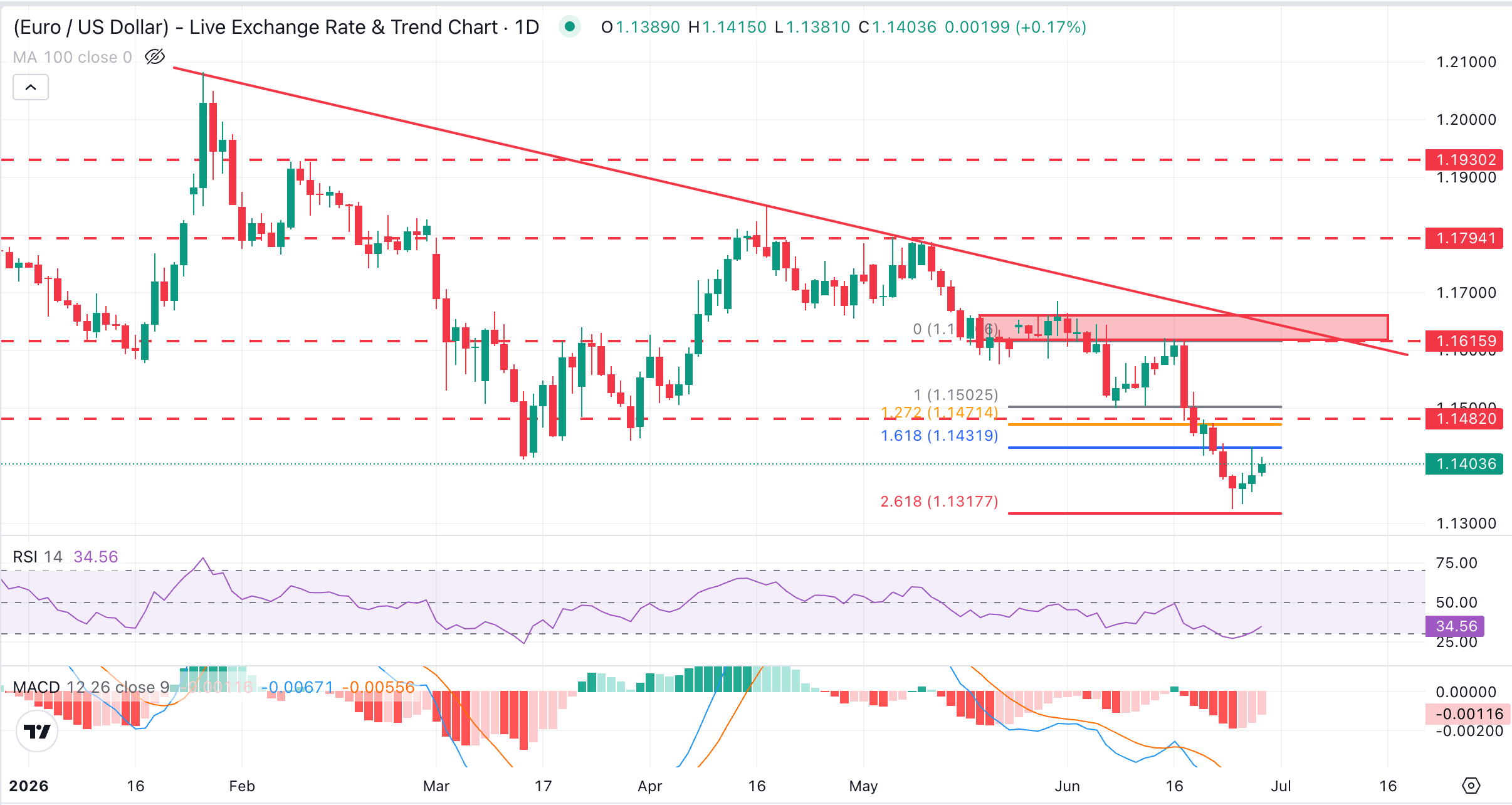
Continued US economic outperformance relative to the Eurozone and weaker risk appetite owing to Iran’s war leave EUR/USD tilted lower, according to FXStreet analyst Guillermo Alcalá: “The Euro has remained vulnerable over the last two months amid geopolitical woes and a sluggish economic growth in the Eurozone. Unless the scenario changes significantly, Euro rallies are likely to offer good entry opportunities for sellers. The 13-month low at 1.1325 remains the key support level. Further down, bears might be tempted to revisit the late May 2025 low at 1.1210.”
For any upside move, Alcala identifies the resistance zones at 1.1500 and 1.1620-1.1640 as the principal obstacles facing buyers: “The pair is struggling to consolidate above 1.1400 at the time of writing in a rebound from the mentioned 13-month lows, which, so far, seems corrective. Bulls should break the 1.1500 area (June 8,11 lows) and preferably also the area between 1.1620 and 1.1640, where late May and early June highs meet the descending trendline from the year-to-date (YTD) highs, to break the negative structure.”
Central banks: frequently asked questions
Maintaining price stability within a country or region is a central bank’s core responsibility. As the prices of goods and services fluctuate, economies face inflation or deflation. Sustained increases in the prices of the same goods constitute inflation, while sustained declines constitute deflation. By adjusting its policy rate, a central bank seeks to keep demand in balance. Major central banks, including the US Federal Reserve (Fed), the European Central Bank (ECB) and the Bank of England (BoE), have a mandate to keep inflation near 2%.
Adjusting the benchmark policy rate, commonly called the interest rate, is a key tool available to a central bank seeking to raise or lower inflation. At pre-announced times, it publishes a statement setting out the policy rate and explaining why it has kept the rate unchanged, reduced it or raised it. Domestic banks then revise their savings and lending rates accordingly. Those changes affect how easily savers can earn returns and businesses can borrow to invest in their operations. A substantial increase in central bank interest rates is termed monetary tightening; a reduction in the benchmark rate is known as monetary easing.
Political independence is common among central banks. Before taking a seat on a central bank’s policy board, prospective members go through a series of panels and hearings. Board members generally hold particular views on how inflation should be managed and what monetary policy should follow. Those who favour very accommodative policy, with low interest rates and inexpensive borrowing to give the economy a substantial boost, and are comfortable with inflation slightly above 2%, are known as ‘doves’. By contrast, members who prefer higher rates to reward saving and want inflation kept under control at all times are called ‘hawks’. They remain focused on bringing inflation to 2% or just below it.
A chairperson or president typically presides over each meeting and works to build agreement between hawks and doves. If votes are evenly divided on changing the current policy, the chairperson has the deciding say to prevent a 50-50 tie. Speeches by the chairperson, often available to follow live, set out the prevailing policy stance and outlook. Central banks aim to implement monetary policy without causing sharp swings in interest rates, equities or their currency. Ahead of a policy meeting, all members communicate their views to markets. Public comments are then prohibited from a few days before the meeting until the new policy has been announced. This interval is known as the blackout period.
Economic data indicator
JOLTS Job Openings survey
To measure vacancies, the US Bureau of Labor Statistics conducts the JOLTS Job Openings survey each month. Its data comes from employers across retailers, manufacturers and various offices.
Explore further.Upcoming release: Tue 30 Jun 2026 14:00
Release frequency: Every month
Consensus estimate: 7.28M
Previous reading: 7.618M
Data source: US Bureau of Labor Statistics
POPULAR ARTICLES
1Could Democrats’ takeover of Congress bring legislative scrutiny for crypto executives?2Top 7 weekly crypto losers: Deepening market sell-off leaves RAIN, ZEC and BTW leading losses3Ethereum Price Forecast: Are inflation and the AI decline keeping ETH below $2,000?4Can gold avoid a weekly rout as high US yields bolster Fed rate hike bets?5Silver Price Forecast: Why does XAG/USD remain confined to a descending channel?6Why is the Swiss Franc facing broad-based weakness as low interest rates weigh?7Further rate hikes likely as firms look to pass on costs, Fed’s Daly expects8Why does ECB’s Nagel see another hike as second-round risks build?9Rising US yields and Fed tightening outlook push Australian Dollar lower


Get Started!
Sign up and access the Global Markets in less than 3 minutes

Connect With Us









Contacts
Phone: +61 2 8036 8388
Fax: +61 2 8036 8388
Email: support@tmgm.com



The information provided on this website is of a general nature only and does not constitute personal financial advice. Before acting on any information on this website, you should consider the suitability of the information in relation to your objectives, financial situation and needs. Investing in CFDs and FX Margin Contracts carries significant risks and is not suitable for all investors. You may lose more than your initial deposit. You do not own, or have, any interest in the underlying asset. We recommend that you seek independent advice and ensure you fully understand the risks involved before trading. It is important that you read and consider the disclosure document before you acquire any product listed on the website. The information and advertisements offered on this website are not intended for use by any person in any country or jurisdiction where such use would be contrary to local laws and regulations. The Products and Services offered on this website are not intended for residents of the United States, Malaysia and Thailand.
TMGM is authorized and regulated in various jurisdictions.
Trademax Australia Limited, trading as TMGM, is regulated by the Australian Securities and Investments Commission (ASIC), AFSL no. 436416 and is located at Level 28, One International Tower, 100 Barangaroo Avenue, 2000 Sydney, NSW Australia.
Email: support@tmgm.com.au
Trademax Global Limited, trading as TMGM, is authorized and regulated by the Vanuatu Financial Services Commission (VFSC), registration number 40356 and registered at 1276, Kumul Highway, Port Vila, Vanuatu, Republic of Vanuatu.
Email: support@tmgm.com
Trademax Global Markets (SE) Limited, trading as TMGM, is authorized and regulated by the Financial Services Authority (FSA) of Seychelles, with license number SD224. The company is registered at Office No 13, Providence Estate ABIS Centre, Mahe, Seychelles.
Email: support@tmgm.com
Trademax Global Markets (International) Pty Ltd, trading as TMGM, is authorized and regulated by the Financial Services Commission, Mauritius (FSC) with license no. GB22201012, and registered at 33, Edith Cavell Street C/o IQ EQ Fund Services (Mauritius) Ltd Port Louis, 11324 Mauritius.
Email: support@tmgm.com
Copyright © TMGM. All rights reserved