

Trading
Explore a wide range of markets with competitive pricing, deep liquidity, and advanced trading tools.
Learn More 
Platform
Trade seamlessly with TMGM's powerful platform, built for speed, precision, and a superior trading experience.
Learn More Trading Platform
Academy
Learn the fundamentals of trading with beginner-friendly resources, including guides, webinars, and market insights.
Learn More News & Analysis
Get real-time market updates and expert analysis to stay ahead of trading opportunities
Learn More News & Analysis
About
Learn what sets TMGM apart — our global presence, regulatory strength, and commitment to innovation in trading.
Learn More Why Choose TMGM
Sponsorship
As inflation eases towards the Fed's 2% target in 2027, what will reverse the US Dollar's course?
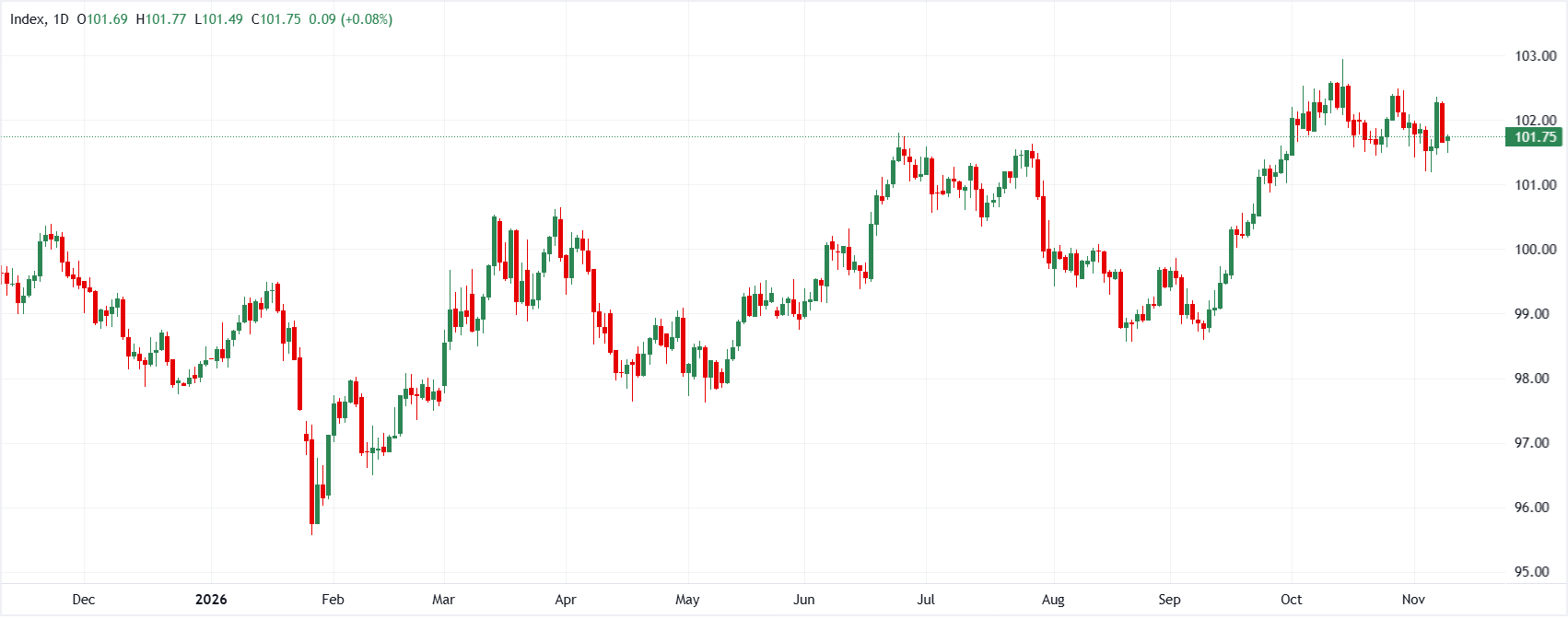
Sentiment towards the US Dollar (USD) is becoming more mixed as investors shift their attention between near-term Federal Reserve (Fed) policy expectations, energy prices and underperforming equities. Resilient domestic activity and attractive yield carry continue to underpin the Greenback. However, falling US Treasury yields and crude Oil prices retreating towards $90/bbl are testing its appeal as an effortless safe-haven currency. With a December Fed rate hike still largely priced in, investors are assessing incoming inflation readings. Against this backdrop, institutional strategists at ING, TD Securities, and MUFG are considering whether the US Dollar's current weakness is merely a modest year-end consolidation or signals a wider cyclical turning point in 2027.

Can a hawkish Fed underpin the US Dollar through Q1 2027 before inflation falls in Q2? ING's view
Strong US growth and inflation remaining stubbornly above 3% underpin the positive near-term US Dollar assessment from Chris Turner at ING. He expects these conditions to keep the Federal Reserve signalling the possibility of further tightening throughout the first quarter of 2027. The outlook changes in the second quarter, however: ING expects base effects to bring headline inflation back towards the Fed's 2% target and push short-dated US rates lower.
"The dollar should stay supported by strong US growth, high inflation and a Fed threatening to tighten before weakening next spring as inflation falls... Our base call assumes that the Federal Reserve stays hawkish in the first quarter, as decent US growth and above-3% inflation keep money markets pricing in the threat of an extended tightening cycle... That turns in the second quarter, when energy-driven base effects drop out of headline inflation and a return to the Fed’s 2% inflation target sees short-dated US rates move meaningfully lower."
Is the US Dollar losing its haven appeal as equity factors turn bearish? TD Securities weighs in
Limited US Dollar gains during recent bouts of global equity risk aversion suggest that it no longer serves as an effortless safe haven, according to Jayati Bharadwaj and the macro strategy team at TD Securities. The team sees scope for modest Greenback weakness towards year-end, with relative US equity underperformance weighing on the currency and Fed hawkishness already reflected in prices. Resilient US growth and attractive carry nevertheless provide underlying support. Euro weakness stemming from French debt risks is also expected to contain overall USD losses.
"We continue to see US vs RoW relative equity performance as the main driver for the broad USD. Muted USD upside despite equity risk-off last week confirms our view that the USD is no longer the effortless haven currency it used to be... While we expect some modest USD downside into year-end, the magnitude will likely be muted as the EUR remains impaired by the French debt fragility... USD still benefits from a supportive external balance backdrop, a US economy that remains resilient, and its attractive carry profile. However, Equity factor has turned bearish USD."
Are lower yields and Oil prices weighing on the US Dollar as Fed pressure eases? MUFG's assessment
Declines in Brent crude prices and US Treasury yields have eased pressure on the Federal Reserve, while the US Dollar has surrendered its post-payrolls gains, notes Lee Hardman at MUFG. Ahead of crucial CPI inflation data, traders are reducing their expectations for further policy tightening in 2027. Financial markets nonetheless continue to price in a December rate hike.
"The US dollar has continued to trade at weaker levels overnight after giving back all of its gains yesterday following the release of the stronger NFP report on Friday... The move lower in energy prices is also helping to bring down government borrowing costs... If there is further progress towards a US-Iran deal to end the conflict it would help to sustain lower energy prices and ease pressure on major central banks including the Fed to keep hiking rates... The US rate market still expects the Fed to hike rates again as planned at the end of this year in December but has been scaling back expectations for further hikes in 2027."
What does this mean for the US Dollar outlook?
Competing forces are shaping the US Dollar's path: domestic economic resilience continues to offer support, but monetary policy momentum for 2027 is fading. In the assessment of ING, above-3% inflation and a hawkish Federal Reserve should keep the Greenback firmly underpinned through the first quarter. By contrast, the analysis from TD Securities and MUFG shows that subdued safe-haven demand, easing energy-related yield pressures and reduced expectations for 2027 rate hikes are limiting gains. Together, these forces leave the US Dollar positioned for a broader slowdown as inflation moves back towards target.
(This article was created with the help of an Artificial Intelligence tool and reviewed by an editor. Know more.)
POPULAR ARTICLES
1Could Democrats’ takeover of Congress bring legislative scrutiny for crypto executives?2Top 7 weekly crypto losers: Deepening market sell-off leaves RAIN, ZEC and BTW leading losses3Ethereum Price Forecast: Are inflation and the AI decline keeping ETH below $2,000?4Can gold avoid a weekly rout as high US yields bolster Fed rate hike bets?5Silver Price Forecast: Why does XAG/USD remain confined to a descending channel?6Why is the Swiss Franc facing broad-based weakness as low interest rates weigh?7Further rate hikes likely as firms look to pass on costs, Fed’s Daly expects8Why does ECB’s Nagel see another hike as second-round risks build?9Rising US yields and Fed tightening outlook push Australian Dollar lower


Get Started!
Sign up and access the Global Markets in less than 3 minutes

Connect With Us









Contacts
Phone: +61 2 8036 8388
Fax: +61 2 8036 8388
Email: support@tmgm.com



The information provided on this website is of a general nature only and does not constitute personal financial advice. Before acting on any information on this website, you should consider the suitability of the information in relation to your objectives, financial situation and needs. Investing in CFDs and FX Margin Contracts carries significant risks and is not suitable for all investors. You may lose more than your initial deposit. You do not own, or have, any interest in the underlying asset. We recommend that you seek independent advice and ensure you fully understand the risks involved before trading. It is important that you read and consider the disclosure document before you acquire any product listed on the website. The information and advertisements offered on this website are not intended for use by any person in any country or jurisdiction where such use would be contrary to local laws and regulations. The Products and Services offered on this website are not intended for residents of the United States, Malaysia and Thailand.
TMGM is authorized and regulated in various jurisdictions.
Trademax Australia Limited, trading as TMGM, is regulated by the Australian Securities and Investments Commission (ASIC), AFSL no. 436416 and is located at Level 28, One International Tower, 100 Barangaroo Avenue, 2000 Sydney, NSW Australia.
Email: support@tmgm.com.au
Trademax Global Limited, trading as TMGM, is authorized and regulated by the Vanuatu Financial Services Commission (VFSC), registration number 40356 and registered at 1276, Kumul Highway, Port Vila, Vanuatu, Republic of Vanuatu.
Email: support@tmgm.com
Trademax Global Markets (SE) Limited, trading as TMGM, is authorized and regulated by the Financial Services Authority (FSA) of Seychelles, with license number SD224. The company is registered at Office No 13, Providence Estate ABIS Centre, Mahe, Seychelles.
Email: support@tmgm.com
Trademax Global Markets (International) Pty Ltd, trading as TMGM, is authorized and regulated by the Financial Services Commission, Mauritius (FSC) with license no. GB22201012, and registered at 33, Edith Cavell Street C/o IQ EQ Fund Services (Mauritius) Ltd Port Louis, 11324 Mauritius.
Email: support@tmgm.com
Copyright © TMGM. All rights reserved