

Trading
Explore a wide range of markets with competitive pricing, deep liquidity, and advanced trading tools.
Learn More 
Platform
Trade seamlessly with TMGM's powerful platform, built for speed, precision, and a superior trading experience.
Learn More Trading Platform
Academy
Learn the fundamentals of trading with beginner-friendly resources, including guides, webinars, and market insights.
Learn More News & Analysis
Get real-time market updates and expert analysis to stay ahead of trading opportunities
Learn More News & Analysis
About
Learn what sets TMGM apart — our global presence, regulatory strength, and commitment to innovation in trading.
Learn More Why Choose TMGM
Sponsorship
Australian Dollar outperforms as hot CPI data lifts hawkish RBA expectations
- Australian Dollar gains as the likelihood of an RBA interest rate hike in November has increased.
- Hot Australian CPI data for Q3 and September has lifted RBA interest rate hike expectations.
- The Fed is seen leaving borrowing costs unchanged in the 3.75%-4.00% range.
The Australian Dollar (AUD) trades sharply higher against its major currency peers on Wednesday. Against the US Dollar (USD), the antipodean is up 0.15% to near 0.7035 even after giving back some of its early losses.

Australian Dollar Price Today
The table below shows the percentage change of Australian Dollar (AUD) against listed major currencies today. Australian Dollar was the strongest against the New Zealand Dollar.
| USD | EUR | GBP | JPY | CAD | AUD | NZD | CHF | |
|---|---|---|---|---|---|---|---|---|
| USD | -0.01% | 0.08% | -0.14% | 0.04% | -0.15% | 1.23% | 0.11% | |
| EUR | 0.01% | 0.09% | -0.14% | 0.06% | -0.13% | 1.24% | 0.13% | |
| GBP | -0.08% | -0.09% | -0.23% | -0.03% | -0.23% | 1.13% | 0.03% | |
| JPY | 0.14% | 0.14% | 0.23% | 0.19% | 0.00% | 1.37% | 0.26% | |
| CAD | -0.04% | -0.06% | 0.03% | -0.19% | -0.19% | 1.17% | 0.07% | |
| AUD | 0.15% | 0.13% | 0.23% | -0.01% | 0.19% | 1.38% | 0.27% | |
| NZD | -1.23% | -1.24% | -1.13% | -1.37% | -1.17% | -1.38% | -1.08% | |
| CHF | -0.11% | -0.13% | -0.03% | -0.26% | -0.07% | -0.27% | 1.08% |
The heat map shows percentage changes of major currencies against each other. The base currency is picked from the left column, while the quote currency is picked from the top row. For example, if you pick the Australian Dollar from the left column and move along the horizontal line to the US Dollar, the percentage change displayed in the box will represent AUD (base)/USD (quote).
The Australian currency gains as hot Consumer Price Index (CPI) data for September and the third quarter this year has fuelled expectations of more interest rate hikes by the Reserve Bank of Australia (RBA) in the near term.
Month-on-Month CPI grew by 0.8%, faster than 0.7% estimates and the previous reading of 0.4%. On an annualized basis, inflationary pressures rose by 1.3% QoQ in the third quarter, as expected, faster than 0.6% growth recorded in the April-June period.
RBA seen delivering one last hike as TD Securities flags firmer inflation
According to TD Securities, the Reserve Bank of Australia is now expected to deliver another rate increase at next week’s meeting, with the bank forecasting that the RBA will “lift the cash rate 25bps … to 4.85%.” Strategists argue that “the firmer Q3 CPI outcome validates the Bank's decision to hike last month,” and that “likely forecast upgrades to the Bank's inflation track in the November Statement on Monetary Policy likely justify a follow-up 25bps hike next week.” TD Securities adds that this “hike should mark the last in the cycle,” suggesting the tightening phase is nearing its end.
Meanwhile, the US Dollar trades firmly ahead of the Federal Reserve’s (Fed) monetary policy announcement due at 18:00 GMT.
Fed seen on hold as Deutsche Bank flags hawkish message ahead
Economists at Deutsche Bank expect the Fed to keep monetary policy unchanged at today’s meeting, noting that “futures are pricing less than a 10% chance of a hike.” However, they anticipate the communication will lean firmly to the hawkish side, with the “broader message” likely to stress that “recent inflation data support the case for further tightening over time.” In that context, Deutsche Bank’s team continues to “foresee 50bp of further hikes across December and March,” reinforcing expectations that the Fed will keep additional tightening on the table even while standing pat for now.
AUD/USD Technical Analysis
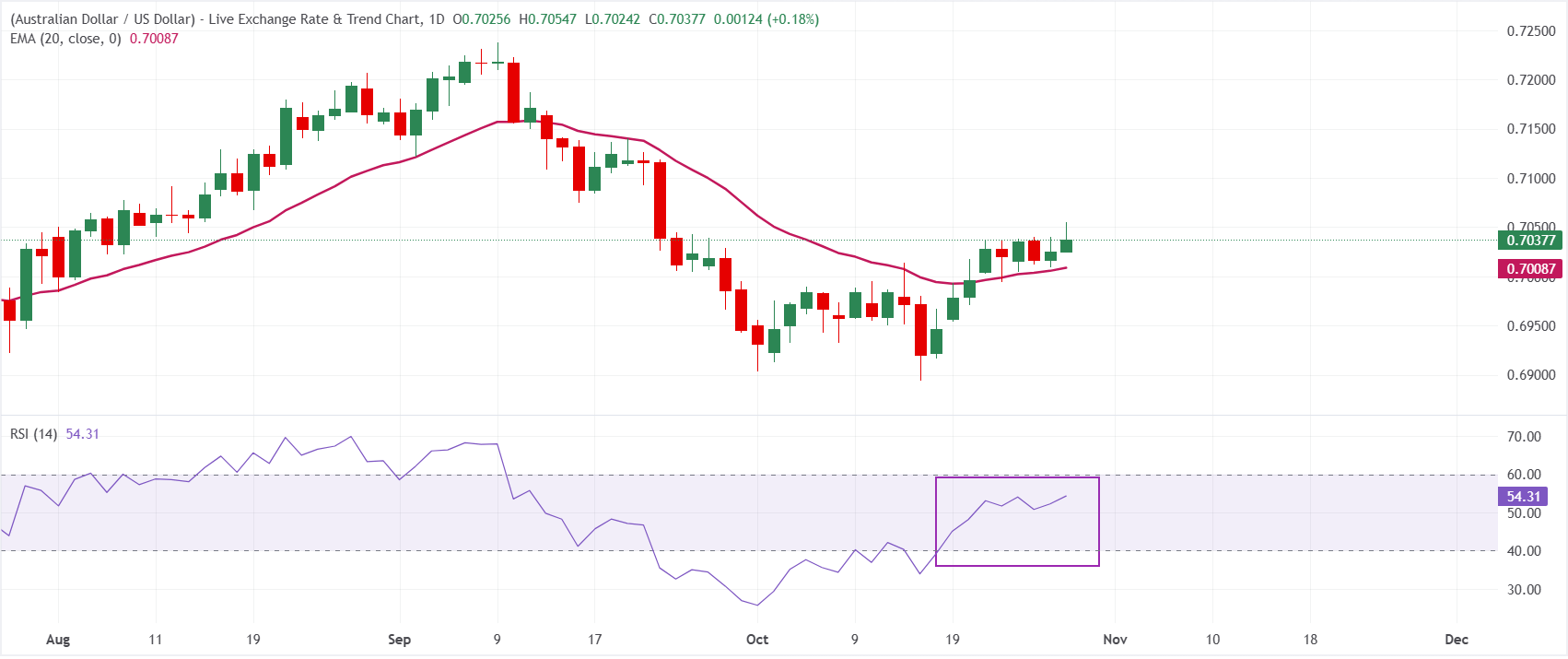
On the daily chart, AUD/USD trades at 0.7038, holding a mildly bullish near-term bias as spot remains above the 20-period Exponential Moving Average (EMA) at 0.7009. The pair is attempting to build on its recent recovery from last week’s lows, while the Relative Strength Index (RSI) at around 54 stays in neutral-positive territory, hinting that upside momentum is constructive but not extended.
On the downside, initial support is aligned at the psychological 0.7038 area, with a break exposing the dynamic floor provided by the 20-day EMA at 0.7009. As long as price holds above this moving average, pullbacks are likely to be viewed as corrective within a budding recovery phase, while a daily close below it would undermine the current positive tone and open the door to a deeper retracement.
(The technical analysis of this story was written with the help of an AI tool. Know more.)
Economic Indicator
Quarterly Consumer Price Index (QoQ)
The Consumer Price Index (CPI), released by the Australian Bureau of Statistics on a quarterly basis, measures the changes in the price of a fixed basket of goods and services acquired by household consumers. The quarterly CPI data series are calculated as the average of the three relevant monthly CPIs. The QoQ reading compares prices in the reference quarter to the previous quarter. A high reading is seen as bullish for the Australian Dollar (AUD), while a low reading is seen as bearish.
Read more.Last release: Wed Oct 28, 2026 00:30
Frequency: Quarterly
Actual: 1.3%
Consensus: 1.3%
Previous: 0.6%
Source: Australian Bureau of Statistics
The quarterly Consumer Price Index (CPI) published by the Australian Bureau of Statistics (ABS) has a significant impact on the market and the AUD valuation. The gauge is closely watched by the Reserve Bank of Australia (RBA), in order to achieve its inflation mandate, which has major monetary policy implications. Rising consumer prices tend to be AUD bullish, as the RBA could hike interest rates to maintain its inflation target. The data is released nearly 25 days after the quarter ends.
Top Articles
1Czech Koruna: Political tensions raise risk premium – Commerzbank2Pi Network Price Forecast: PI stalls as Core Team expands investment fund to Axis Robotics3New Zealand Dollar: Downside risks grow against US Dollar – Societe Generale4Euro: Lending slowdown threatens key support against US Dollar - ING5British Pound trims losses but remains below 1.3300 with all eyes on the UK budget6BoC expected to raise interest rates to 2.50%7Silver price today: Silver falls, according to FXStreet data8Swiss Franc: Further weakness seen against US Dollar - UOB9USD/CAD Price Forecast: Moves above 1.4050 to target moving averages
LIVE QUOTES


ALL ABOUT FOREX
Stop Loss: What It Is, How It Works and How to Set One
Margin Call Meaning: What It Is, What Triggers It and How to Avoid One
Top 15 Weakest Currencies in the World
Top 15 Strongest Currencies in the World
Is Forex Trading Halal?
Best Time to Trade Forex
Forex Trading vs Futures Trading
Forex Trading vs Stock Trading
Forex Trading vs Crypto Trading
Get Started!
Sign up and access the Global Markets in less than 3 minutes

Connect With Us









Contacts
Phone: +61 2 8036 8388
Fax: +61 2 8036 8388
Email: support@tmgm.com



The information provided on this website is of a general nature only and does not constitute personal financial advice. Before acting on any information on this website, you should consider the suitability of the information in relation to your objectives, financial situation and needs. Investing in CFDs and FX Margin Contracts carries significant risks and is not suitable for all investors. You may lose more than your initial deposit. You do not own, or have, any interest in the underlying asset. We recommend that you seek independent advice and ensure you fully understand the risks involved before trading. It is important that you read and consider the disclosure document before you acquire any product listed on the website. The information and advertisements offered on this website are not intended for use by any person in any country or jurisdiction where such use would be contrary to local laws and regulations. The Products and Services offered on this website are not intended for residents of the United States, Malaysia and Thailand.
TMGM is authorized and regulated in various jurisdictions.
Trademax Australia Limited, trading as TMGM, is regulated by the Australian Securities and Investments Commission (ASIC), AFSL no. 436416 and is located at Level 28, One International Tower, 100 Barangaroo Avenue, 2000 Sydney, NSW Australia.
Email: support@tmgm.com.au
Trademax Global Limited, trading as TMGM, is authorized and regulated by the Vanuatu Financial Services Commission (VFSC), registration number 40356 and registered at 1276, Kumul Highway, Port Vila, Vanuatu, Republic of Vanuatu.
Email: support@tmgm.com
Trademax Global Markets (SE) Limited, trading as TMGM, is authorized and regulated by the Financial Services Authority (FSA) of Seychelles, with license number SD224. The company is registered at Office No 13, Providence Estate ABIS Centre, Mahe, Seychelles.
Email: support@tmgm.com
Trademax Global Markets (International) Pty Ltd, trading as TMGM, is authorized and regulated by the Financial Services Commission, Mauritius (FSC) with license no. GB22201012, and registered at 33, Edith Cavell Street C/o IQ EQ Fund Services (Mauritius) Ltd Port Louis, 11324 Mauritius.
Email: support@tmgm.com
Copyright © TMGM. All rights reserved