

The New Zealand Dollar sells the hike it asked for
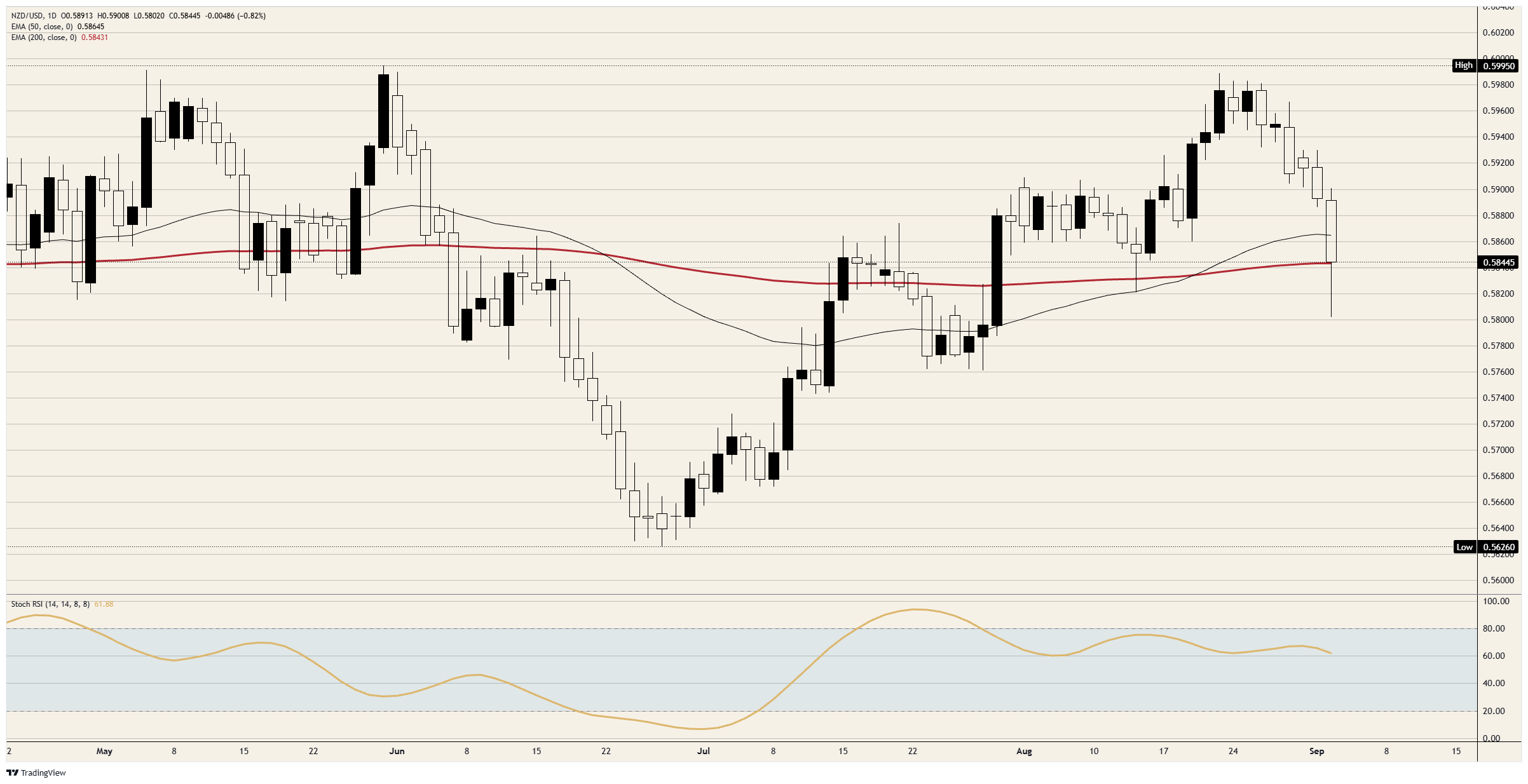
- NZD/USD trades near 0.5850 after a 1.7% peak-to-trough slide.
- The Official Cash Rate went to 2.75%, a unanimous second straight hike.
- Headline inflation is 4.1%, but 2.9% excluding vehicle fuels.
The Reserve Bank of New Zealand (RBNZ) raised its policy rate on Wednesday and the currency fell almost 1.7% from top to bottom on the day it happened. NZD/USD ran from near 0.5900 down into the 0.5800 area before a grudging recovery left it near 0.5850, sitting directly on its 200-day Exponential Moving Average (EMA). A central bank delivering exactly what the market asked for and getting sold for it is worth more than a paragraph.

A hike is not a path
The Official Cash Rate (OCR) went up a quarter point to 2.75%, unanimously, the second consecutive increase and precisely the consensus call. Nothing in the decision itself surprised anyone. The disappointment sat in the projections, where the track carried the prospect of one further quarter point before year end and no more, against a market that had been running a considerably longer ladder into 2027.
The press conference confirmed the read rather than repairing it. The Governor's framing was that the bank can now take time to assess the effect of two back-to-back moves, which is the language of a pause being placed on the table rather than removed from it. Currencies do not trade the level of the policy rate. They trade the slope, and the slope got flatter at two o'clock.
The scale of the gap explains the size of the move. Rate markets had been carrying something in the region of 95 basis points of further tightening out to the middle of 2027, a path several times longer than the one the bank published, and a repricing that large does not happen in twenty pips. It happened in the ninety minutes after the decision, and the Kiwi was the weakest major currency on the board from the Tokyo open onward.
The inflation being tightened into is not domestic
New Zealand's headline rate reached 4.1% in the second quarter, more than two points above the target midpoint, which reads like an emergency. Strip out vehicle fuels and the annual number is 2.9%, comfortably inside the band, and most core measures sit near it. The wedge between those two figures is an imported energy shock, delivered by a conflict that has kept Crude Oil above $90.00 through renewed American strikes on Iranian targets and Iranian retaliation across the Gulf.
That distinction is the whole trade. Tightening into an import-price shock is the least credible form of tightening available, because the central bank cannot influence the shock and the shock reverses on somebody else's timetable. The market has worked out that if fuel rolls over, the case for the remaining quarter point rolls over with it, and the currency is priced for exactly that outcome rather than for the hike that has already been banked.
The cross tape confirms this is a New Zealand problem rather than a Dollar one. AUD/NZD gained 1.07% on the session and pushed to a high short of 1.2300, the top of a range that has capped it since 2013, on a day when the Australian Dollar itself barely moved against the Greenback. A currency being sold against its nearest neighbour and against the reserve currency at the same time is not the victim of a Dollar bid.
What the rest of the week does to the Kiwi
Thursday's Chinese services survey at 01:45 GMT, seen at 50.6 against 50.4, matters more to this pair than its billing suggests, because the export channel through New Zealand's largest trading partner is the one domestic variable capable of moving the growth forecast the RBNZ just published. The American session then brings initial jobless claims at 12:30 GMT and the Institute for Supply Management (ISM) services Purchasing Managers Index (PMI) at 14:00 GMT, seen at 54.3 with prices paid last at 70.3.
Friday is where the pair gets resolved. Nonfarm payrolls at 12:30 GMT carry a 58K consensus against a prior reading of 23K jobs lost, with unemployment seen at 4.1% and average hourly earnings at 0.3% on the month. Wednesday's private payrolls miss at 38K against a 47K consensus failed to weaken the Dollar at all, which tells you how a firm Friday number gets treated with the Federal Reserve priced around two thirds for a hike on September 16.
Levels and bias
Resistance: The 0.5850 shelf is congested, with the 200-day EMA underneath the price and the 50-day sitting roughly twenty pips above it, so the whole area functions as one hurdle rather than two levels. Above that, 0.5900 is the level lost on the decision and the first genuine recovery marker, with 0.5950 guarding the range high near 0.6000.
Support: The 0.5800 area caught the low and is the line that decides whether Wednesday was a repricing or a rout. Beneath it, 0.5750 is the next reference, and the pair has no meaningful structure between there and 0.5700.
Bias: Bearish. Price is resting on a long-run average it spent the session slicing through, the Stochastic Relative Strength Index (Stoch RSI) near 62 has plenty of room to fall before anything looks stretched, and the central bank has just told the market its tightening cycle is nearer its end than the curve assumed. A daily close back above 0.5900 would be needed to argue otherwise.
NZD/USD daily chart
New Zealand Dollar FAQs
The New Zealand Dollar (NZD), also known as the Kiwi, is a well-known traded currency among investors. Its value is broadly determined by the health of the New Zealand economy and the country’s central bank policy. Still, there are some unique particularities that also can make NZD move. The performance of the Chinese economy tends to move the Kiwi because China is New Zealand’s biggest trading partner. Bad news for the Chinese economy likely means less New Zealand exports to the country, hitting the economy and thus its currency. Another factor moving NZD is dairy prices as the dairy industry is New Zealand’s main export. High dairy prices boost export income, contributing positively to the economy and thus to the NZD.
The Reserve Bank of New Zealand (RBNZ) aims to achieve and maintain an inflation rate between 1% and 3% over the medium term, with a focus to keep it near the 2% mid-point. To this end, the bank sets an appropriate level of interest rates. When inflation is too high, the RBNZ will increase interest rates to cool the economy, but the move will also make bond yields higher, increasing investors’ appeal to invest in the country and thus boosting NZD. On the contrary, lower interest rates tend to weaken NZD. The so-called rate differential, or how rates in New Zealand are or are expected to be compared to the ones set by the US Federal Reserve, can also play a key role in moving the NZD/USD pair.
Macroeconomic data releases in New Zealand are key to assess the state of the economy and can impact the New Zealand Dollar’s (NZD) valuation. A strong economy, based on high economic growth, low unemployment and high confidence is good for NZD. High economic growth attracts foreign investment and may encourage the Reserve Bank of New Zealand to increase interest rates, if this economic strength comes together with elevated inflation. Conversely, if economic data is weak, NZD is likely to depreciate.
The New Zealand Dollar (NZD) tends to strengthen during risk-on periods, or when investors perceive that broader market risks are low and are optimistic about growth. This tends to lead to a more favorable outlook for commodities and so-called ‘commodity currencies’ such as the Kiwi. Conversely, NZD tends to weaken at times of market turbulence or economic uncertainty as investors tend to sell higher-risk assets and flee to the more-stable safe havens.














