

Trading
Explore a wide range of markets with competitive pricing, deep liquidity, and advanced trading tools.
Learn More 
Platform
Trade seamlessly with TMGM's powerful platform, built for speed, precision, and a superior trading experience.
Learn More Trading Platform
Academy
Learn the fundamentals of trading with beginner-friendly resources, including guides, webinars, and market insights.
Learn More News & Analysis
Get real-time market updates and expert analysis to stay ahead of trading opportunities
Learn More News & Analysis
About
Learn what sets TMGM apart — our global presence, regulatory strength, and commitment to innovation in trading.
Learn More Why Choose TMGM
Sponsorship
Crypto Today: Losses deepen for Bitcoin, Ethereum, XRP as sellers strengthen control
- $68,000 remains above Bitcoin's spot price on Friday. Bears are strengthening their grip.
- Below $2,000, Ethereum probes lows as risk aversion grips the wider crypto market.
- A ninth straight day of selling leaves XRP holding precariously above $1.00.
$69,000 remains above Bitcoin's (BTC) spot price on Friday. Selling in the largest cryptocurrency by market capitalisation is intensifying, leading a sharp market decline. Ethereum (ETH) trades below $2,000, while Ripple (XRP) sits marginally above $1.00.
Despite oversold conditions, selling pressure shows little sign of abating. It has continued since the $6.3 billion Binance hack and the United States (US) midterm elections.

20 on Fear Index Signals Continued Risk Aversion
At 20 in Fear territory on Friday, the Fear & Greed Index reflects muted interest across cryptocurrencies, down from 20 in the Extreme Fear range a day earlier. The reading suggests that persistent US inflation is prompting investors to step aside and adjust their portfolios.
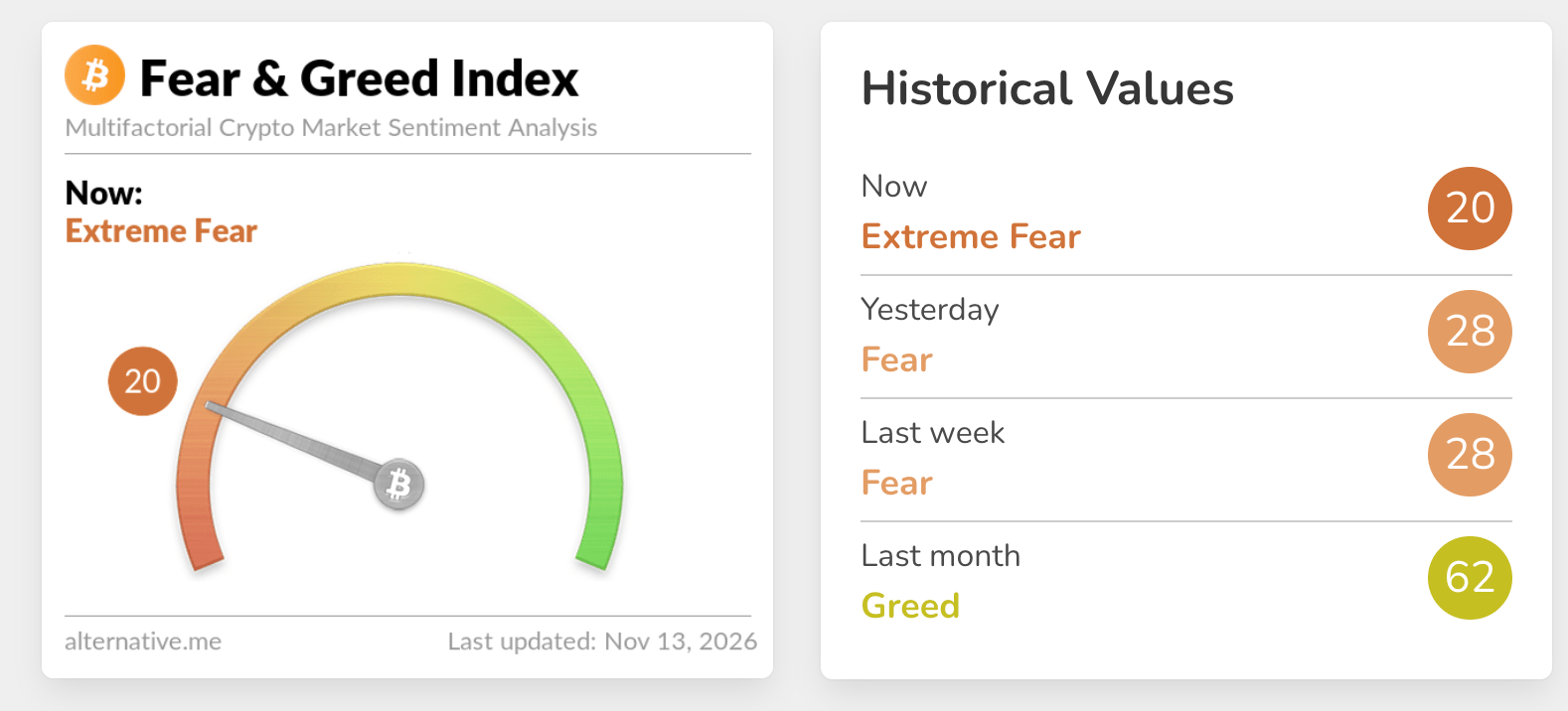
A 25 basis point interest rate increase by the Federal Reserve (Fed) in December is widely expected, taking the range to 3.75-4.00%. Bringing inflation in the world's largest economy back to its long-term 2% target remains the Fed's commitment. Risk assets seldom benefit from tighter monetary policy, which could undermine sentiment and make a sustained recovery less likely.
$68,603 Bitcoin: Technical Picture Points to Relentless Selling
At $68,603, Bitcoin remains well beneath its key Exponential Moving Averages (EMAs), maintaining a bearish short-term outlook. The first major upside hurdle is the 200-day EMA around $76,309. Above it, the SuperTrend at $77,026 and the 100-day EMA near $77,194 create a concentrated supply zone. Further resistance awaits at the 50-day EMA of $78,220, leaving any rebound facing several barriers.
Momentum indicators remain under strain. Deep below zero, the Moving Average Convergence Divergence (MACD) line also sits beneath its signal line. An oversold Relative Strength Index (RSI) reading of 25 suggests that, although sellers still dominate, the potential for a corrective rebound is increasing.
For an initial indication of stabilisation, Bitcoin would need a daily close above the 200-day EMA at $76,309. That would put the SuperTrend at $77,026 and the 100-day EMA at $77,194 in view as the next resistance levels. A lasting break above the 50-day EMA at $78,220 would be required before the bearish structure begins to weaken.
With indicators offering no nearby downside support, attention remains on previous lows and price action. Unless BTC establishes a base above the $68,000 area, further losses remain a risk before an oversold rebound can take hold.
$1,937 Ethereum: ETH Sellers Keep Technical Control
Trading at $1,937, Ethereum continues to retreat well beneath its main moving averages, preserving a bearish short-term outlook. Overhead resistance comes from the 50-day EMA at $2,319, the 100-day EMA at $2,312 and the 200-day EMA at $2,293. These levels reinforce the limits on the upside, with the SuperTrend line at $2,253 providing the first technical hurdle.
A MACD reading below zero underlines weak momentum. Meanwhile, the RSI stands at an oversold 25, suggesting that selling pressure is stretched without yet signalling a clear reversal.
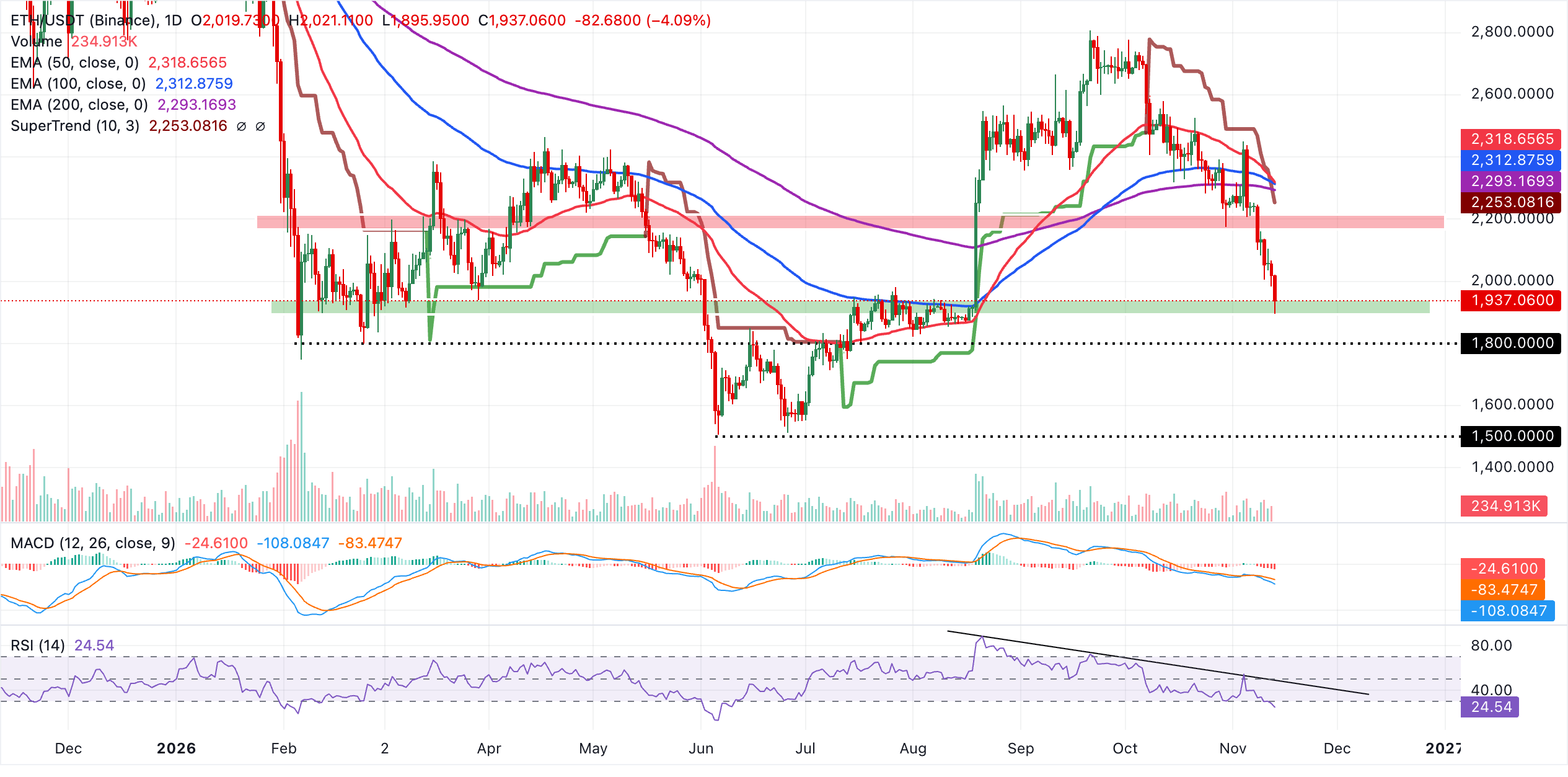
The SuperTrend around $2,253 offers the nearest resistance, ahead of the 200-day EMA at $2,293. A decisive recovery above the latter would be needed to reduce the current downside bias. Beyond that, a tight resistance band comprises the 100-day EMA at $2,313 and the 50-day EMA at $2,319. Unless buying gathers substantial momentum, this area would likely restrict rebound attempts.
Indicators provide no clearly established support, leaving the recent low close to the prevailing price as a tentative floor. With sellers retaining control, failure to stabilise above $1,937 could pave the way for additional losses.
$1.03 XRP: Technical Outlook Remains Under Heavy Selling Pressure
At $1.03, XRP continues its decline far below the principal moving averages and the breached descending trendline. The short-term outlook remains firmly bearish. The 50-day EMA at $1.26, the 100-day EMA at $1.29 and the 200-day EMA at $1.34 all remain above the price. The SuperTrend at $1.19 also tracks overhead, indicating that rebounds remain susceptible to selling.
An RSI near 22 remains entrenched in oversold territory, highlighting weak momentum. The MACD line is below zero and its negative histogram is narrowing slightly. Together, these readings suggest continuing downside pressure and only modest room for a corrective recovery.
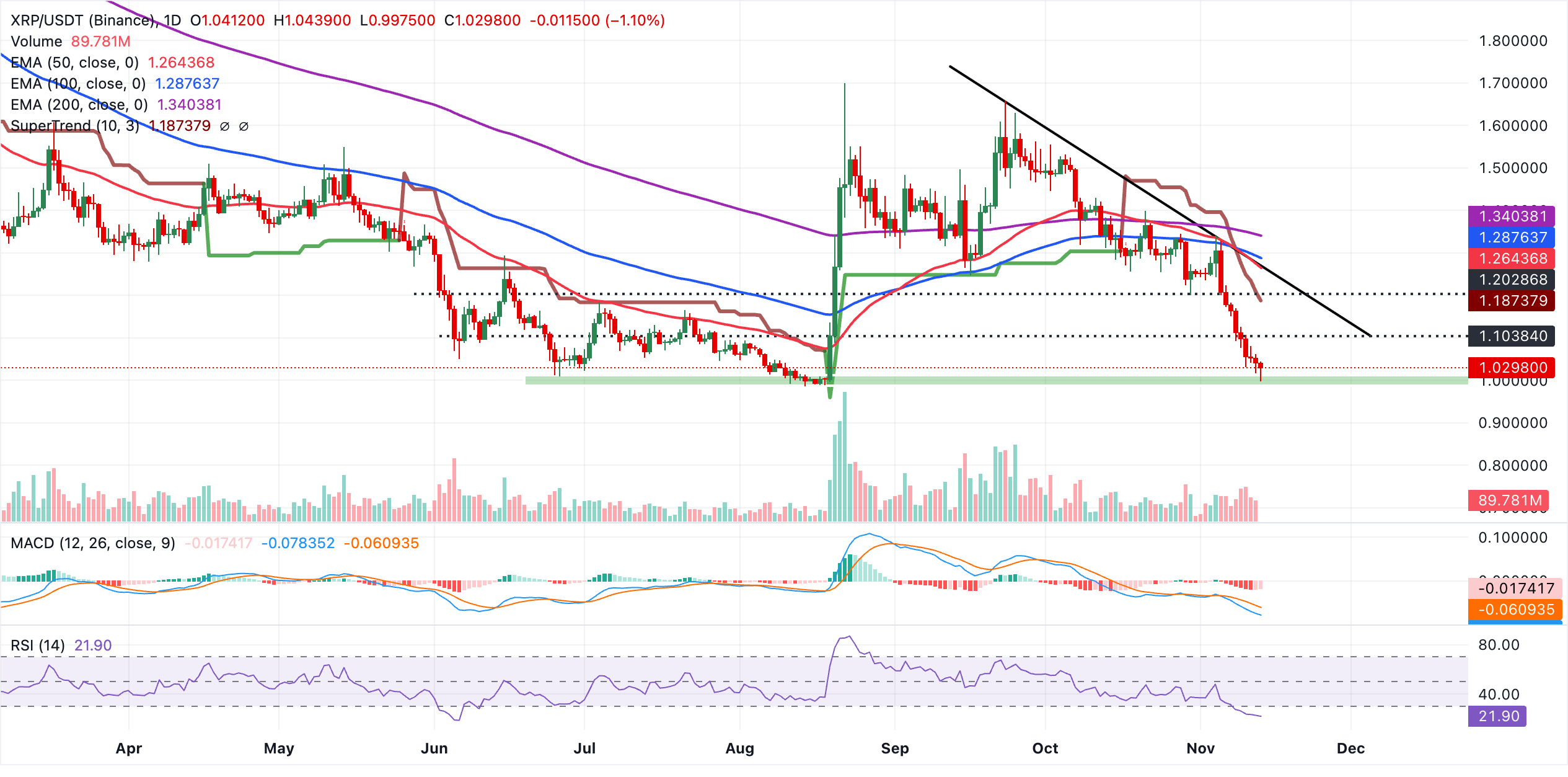
Around $1.19, the SuperTrend presents the first resistance hurdle. Next comes a concentrated resistance zone comprising the 50-day EMA at $1.26 and the previous trendline break at $1.27. Further up, the 100-day EMA at $1.29 and the longer-term 200-day EMA at $1.34 are likely to constrain recovery attempts for as long as the price remains below them.
The current daily-chart indicators identify no clear structural support beneath the spot price. Before anticipating a durable reversal of the prevailing downtrend, traders should watch developing price action for evidence that a base is forming.
(The technical analysis of this story was written with the help of an AI tool. Know more.)
Bitcoin, Altcoins and Stablecoins: Key Questions
Designed to function as money, Bitcoin is a virtual currency and the largest cryptocurrency by market capitalisation. No single individual, group or entity can control this payment method. That removes the need for third parties to participate in financial transactions.
Any cryptocurrency other than Bitcoin is classed as an altcoin. Some, however, exclude Ethereum as well, because forks originate from these two cryptocurrencies. On that basis, Litecoin would be the first altcoin: it was forked from the Bitcoin protocol and is therefore an “improved” version of it.
A stablecoin is a cryptocurrency intended to maintain a steady price, backed by reserves of the asset it represents. Its value is linked to a commodity or financial instrument, such as the US Dollar (USD), while an algorithm or demand regulates supply. Stablecoins primarily offer an entry and exit route for investors seeking to trade and invest in cryptocurrencies. They also provide a way to store value, as cryptocurrencies are generally subject to volatility.
Measured as Bitcoin's market capitalisation divided by the combined market capitalisation of all cryptocurrencies, Bitcoin dominance indicates investor interest in Bitcoin. BTC dominance is typically high ahead of and during a bull run, when investors turn to relatively stable cryptocurrencies with large market capitalisations, such as Bitcoin. Falling BTC dominance generally signals that investors are shifting capital and/or profits into altcoins in pursuit of greater returns. This usually sparks a surge in altcoin rallies.
POPULAR ARTICLES
1Silver price today: FXStreet data show silver holding broadly steady2Crypto Today: Losses deepen for Bitcoin, Ethereum, XRP as sellers strengthen control3Swiss Franc Slides to Fresh Monthly Lows as Hawkish Fed and Higher US Yields Weigh4Below 1.1050: Euro faces renewed pressure against US Dollar as focus turns to US PPI5GBP/USD: Pound fails to gain despite strong UK data – Societe Generale61.4250 area: Canadian Dollar holds near one-month low as USD bulls look to US PPI7December BoJ hike: Japan’s trade and inflation data lend support – DBS8Five straight weekly losses: Bitcoin may face more turbulence ahead9Australian Dollar: RBA constraints and vulnerability to AI – MUFG


Get Started!
Sign up and access the Global Markets in less than 3 minutes

Connect With Us









Contacts
Phone: +61 2 8036 8388
Fax: +61 2 8036 8388
Email: support@tmgm.com



The information provided on this website is of a general nature only and does not constitute personal financial advice. Before acting on any information on this website, you should consider the suitability of the information in relation to your objectives, financial situation and needs. Investing in CFDs and FX Margin Contracts carries significant risks and is not suitable for all investors. You may lose more than your initial deposit. You do not own, or have, any interest in the underlying asset. We recommend that you seek independent advice and ensure you fully understand the risks involved before trading. It is important that you read and consider the disclosure document before you acquire any product listed on the website. The information and advertisements offered on this website are not intended for use by any person in any country or jurisdiction where such use would be contrary to local laws and regulations. The Products and Services offered on this website are not intended for residents of the United States, Malaysia and Thailand.
TMGM is authorized and regulated in various jurisdictions.
Trademax Australia Limited, trading as TMGM, is regulated by the Australian Securities and Investments Commission (ASIC), AFSL no. 436416 and is located at Level 28, One International Tower, 100 Barangaroo Avenue, 2000 Sydney, NSW Australia.
Email: support@tmgm.com.au
Trademax Global Limited, trading as TMGM, is authorized and regulated by the Vanuatu Financial Services Commission (VFSC), registration number 40356 and registered at 1276, Kumul Highway, Port Vila, Vanuatu, Republic of Vanuatu.
Email: support@tmgm.com
Trademax Global Markets (SE) Limited, trading as TMGM, is authorized and regulated by the Financial Services Authority (FSA) of Seychelles, with license number SD224. The company is registered at Office No 13, Providence Estate ABIS Centre, Mahe, Seychelles.
Email: support@tmgm.com
Trademax Global Markets (International) Pty Ltd, trading as TMGM, is authorized and regulated by the Financial Services Commission, Mauritius (FSC) with license no. GB22201012, and registered at 33, Edith Cavell Street C/o IQ EQ Fund Services (Mauritius) Ltd Port Louis, 11324 Mauritius.
Email: support@tmgm.com
Copyright © TMGM. All rights reserved