

Trading
Explore a wide range of markets with competitive pricing, deep liquidity, and advanced trading tools.
Learn More 
Platform
Trade seamlessly with TMGM's powerful platform, built for speed, precision, and a superior trading experience.
Learn More Trading Platform
Academy
Learn the fundamentals of trading with beginner-friendly resources, including guides, webinars, and market insights.
Learn More News & Analysis
Get real-time market updates and expert analysis to stay ahead of trading opportunities
Learn More News & Analysis
About
Learn what sets TMGM apart — our global presence, regulatory strength, and commitment to innovation in trading.
Learn More Why Choose TMGM
Sponsorship
1.3140: Has support turned into resistance for GBP/USD?
- GBP/USD recovers towards 1.3110, reversing course after two days of steep losses.
- The US Dollar remains supported by the Fed’s hawkish tone.
- October UK Retail Sales increased 0.7% MoM, beating expectations of no growth.
Buying interest lifts the British Pound (GBP) towards 1.3110 against the US Dollar in Friday’s European trading session, ending a two-day losing streak. Earlier in the day, GBP/USD touched 1.3079, a fresh low in almost a year, before attracting bids.
A brief halt in the US Dollar’s rally allows Cable to recover some ground temporarily. At the time of writing, the US Dollar Index (DXY) is slightly lower near 103.85, having reached a fresh 19-month high close to 104.00 on the previous day. The index tracks the Greenback against six major currencies.

Concerns that the Federal Reserve (Fed) will raise interest rates at consecutive meetings in the near term keep the US Dollar’s outlook bullish.
Can renewed hawkish FOMC expectations sustain US Dollar strength?
A substantial repricing of the US interest-rate outlook has taken place, according to analysts at Rabobank. They point to an OIS curve implying that “investors are positioned for a full hike in December, followed by close to 70% of a 25bp hike priced in for the January meeting.” In their assessment, this configuration is “in line with Waller’s comments, after having moved from one of the most hawkish to one of the most dovish FOMC members and now back among the most hawkish.” Rabobank says his recent calls favour “either a 50bp hike at the December meeting or a 25bp hike accompanied by clear forward guidance from Warsh that an additional hike will follow in January.” The bank adds that, against this backdrop, “the USD has continued to dominate FX markets, with the DXY Index climbing back to levels not seen since 2025 on the back of elevated US hiking expectations and safe-haven demand.”
For the British Pound, October’s United Kingdom (UK) Retail Sales figures exceeded expectations. Data from the Office for National Statistics (ONS) showed a 0.7% Month-on-Month (MoM) increase, against forecasts for no growth.
GBP/USD Technical Analysis: Can the Pair Arrest Its Decline?
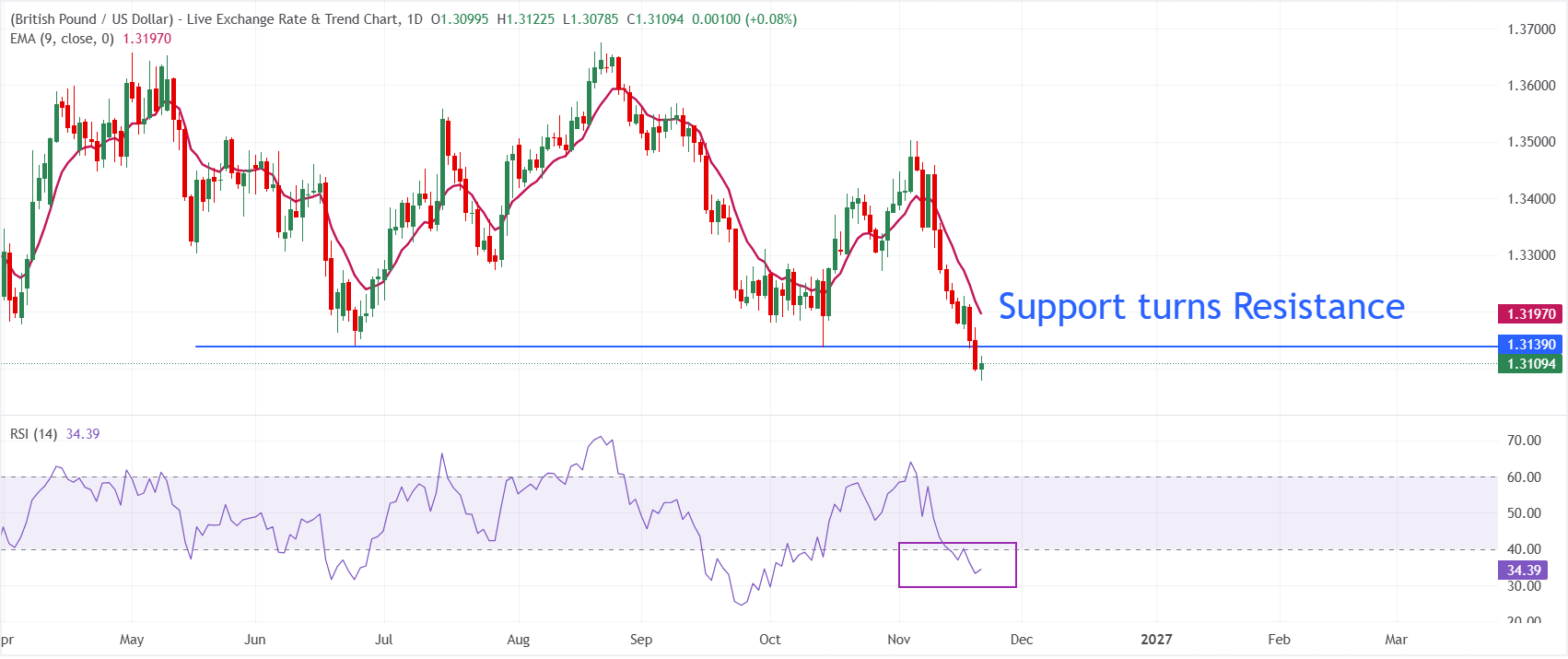
With GBP/USD at 1.3109 on the daily chart, the near-term bias remains bearish as the spot price stays below the 9-period Exponential Moving Average (EMA) of 1.3197. Rebounds continue to be capped by this short-term EMA, keeping the pair under pressure. However, a Relative Strength Index (RSI) reading around 34 indicates that downward momentum is easing somewhat, rather than gathering pace into oversold territory.
A break below the June 24 low of 1.3140 has heightened concerns over another leg lower, with that level now set to pose a key hurdle for the pair. Further declines could take GBP/USD towards 1.3000.
(The technical analysis of this story was written with the help of an AI tool. Know more.)
Economic Data Indicator
Retail Sales: Month-on-Month (MoM)
Published monthly by the Office for National Statistics, Retail Sales tracks the volume of goods sold directly to end customers by retailers in Great Britain. Market participants closely monitor changes in the data as a gauge of consumer spending. Percentage changes show the pace at which these sales volumes change; the MoM figure compares the reference month with the preceding month. A high reading is generally regarded as bullish for the Pound Sterling (GBP), whereas a low reading is considered bearish.
Learn more.Latest release: Fri 20 November 2026 07:00
Release frequency: Monthly
Reported figure: 0.7%
Market consensus: 0%
Prior reading: -0.4%
Data source: Office for National Statistics
POPULAR ARTICLES
11.3140: Has support turned into resistance for GBP/USD?2Could AI-led risk aversion favour the Japanese Yen against the US Dollar? – MUFG3Is gold heading for its steepest weekly fall since March as Fed rate-hike bets and forced selling weigh?4Swiss Franc: Could Further Weakness Against US Dollar Extend Towards 0.8485? - UOB5South African Rand: Why are politics and metals overshadowing a hawkish SARB? – Commerzbank6Ripple Price Forecast: Why Has XRP Failed to Reclaim $1.00 Despite a Supply Shortage on Binance?7Mexican Peso: How is Fed hawkishness driving weakness against US Dollar? – Societe Generale8Could energy inflation spread across the economy? ECB's Santos Pereira highlights the risk9AI sell-off weighs on US Dollar strength as Swiss Franc trims losses

Get Started!
Sign up and access the Global Markets in less than 3 minutes

Connect With Us









Contacts
Phone: +61 2 8036 8388
Fax: +61 2 8036 8388
Email: support@tmgm.com



The information provided on this website is of a general nature only and does not constitute personal financial advice. Before acting on any information on this website, you should consider the suitability of the information in relation to your objectives, financial situation and needs. Investing in CFDs and FX Margin Contracts carries significant risks and is not suitable for all investors. You may lose more than your initial deposit. You do not own, or have, any interest in the underlying asset. We recommend that you seek independent advice and ensure you fully understand the risks involved before trading. It is important that you read and consider the disclosure document before you acquire any product listed on the website. The information and advertisements offered on this website are not intended for use by any person in any country or jurisdiction where such use would be contrary to local laws and regulations. The Products and Services offered on this website are not intended for residents of the United States, Malaysia and Thailand.
TMGM is authorized and regulated in various jurisdictions.
Trademax Australia Limited, trading as TMGM, is regulated by the Australian Securities and Investments Commission (ASIC), AFSL no. 436416 and is located at Level 28, One International Tower, 100 Barangaroo Avenue, 2000 Sydney, NSW Australia.
Email: support@tmgm.com.au
Trademax Global Limited, trading as TMGM, is authorized and regulated by the Vanuatu Financial Services Commission (VFSC), registration number 40356 and registered at 1276, Kumul Highway, Port Vila, Vanuatu, Republic of Vanuatu.
Email: support@tmgm.com
Trademax Global Markets (SE) Limited, trading as TMGM, is authorized and regulated by the Financial Services Authority (FSA) of Seychelles, with license number SD224. The company is registered at Office No 13, Providence Estate ABIS Centre, Mahe, Seychelles.
Email: support@tmgm.com
Trademax Global Markets (International) Pty Ltd, trading as TMGM, is authorized and regulated by the Financial Services Commission, Mauritius (FSC) with license no. GB22201012, and registered at 33, Edith Cavell Street C/o IQ EQ Fund Services (Mauritius) Ltd Port Louis, 11324 Mauritius.
Email: support@tmgm.com
Copyright © TMGM. All rights reserved