

Trading
Explore a wide range of markets with competitive pricing, deep liquidity, and advanced trading tools.
Learn More 
Platform
Trade seamlessly with TMGM's powerful platform, built for speed, precision, and a superior trading experience.
Learn More Trading Platform
Academy
Learn the fundamentals of trading with beginner-friendly resources, including guides, webinars, and market insights.
Learn More News & Analysis
Get real-time market updates and expert analysis to stay ahead of trading opportunities
Learn More News & Analysis
About
Learn what sets TMGM apart — our global presence, regulatory strength, and commitment to innovation in trading.
Learn More Why Choose TMGM
Sponsorship
AUD/USD Price Forecast: Support from 20-day EMA remains intact
- AUD/USD eases towards 0.7025 as the US Dollar recovers.
- Caution grips investors as next week’s US mid-term elections approach.
- Australia’s Q3 and September CPI readings showed stronger price pressures.
Cautious sentiment ahead of next week’s United States (US) mid-term elections is weighing on AUD/USD as the US Dollar recoups its earlier losses. During Friday’s European session, the Australian Dollar (AUD) is trading slightly lower against the US Dollar (USD), around 0.7025.
At the time of writing, the US Dollar Index (DXY) is largely unchanged near 101.82. The index tracks the Greenback against a basket of six major currencies.

Could US midterms bring divided government and policy gridlock?
A split between the White House and Congress appears likely, according to analysts at Commerzbank, who describe the US as “heading towards what is known as a ‘divided government’,”. Much of President Trump’s agenda could nevertheless proceed despite slower legislative progress. In areas central to him, the analysts observe, “such as foreign and trade policy, he has in any case relied primarily on executive orders recently,”.
Meanwhile, preliminary Gross Domestic Product (GDP) figures for the US showed stronger-than-expected growth in Q3.
The advance Q3 GDP estimate stood at “3.4% qoq annualised (Bloomberg consensus: 3.2%) vs 2.2% in Q2.” Commerzbank economists describe the US economy as having “expanded strongly by 3.4% in the third quarter of 2026,”. Consumer spending led the expansion: the economists note that “private consumption was the main driver and expanded 3.8%, at the same pace as Q2,”. Another sizeable contribution came from “business investment, particularly in IT,”. Price pressures also moderated, with the bank observing that “the GDP price index eased to 2.3% from 6.1% in Q2.”
Despite the strong figures, concerns surrounding hyperscalers’ Artificial Intelligence (AI) spending plans could see economic growth moderate, the bank has cautioned.
Explaining the expected slowdown, Commerzbank states that “financing conditions are no longer quite as favorable, and the boost from the AI boom is expected to subside, as is the stimulus from fiscal policy.”
In Australia, this week’s Consumer Price Index (CPI) releases for Q3 and September pointed to stronger price pressures.
Monthly CPI increased by a robust 0.8%, exceeding the 0.7% forecast and the previous reading of 0.4%. For July-September, the rise in prices matched expectations at 1.3%, accelerating from 0.6% in the preceding period.
AUD/USD Technical Analysis: Can the Modest Bullish Bias Hold?
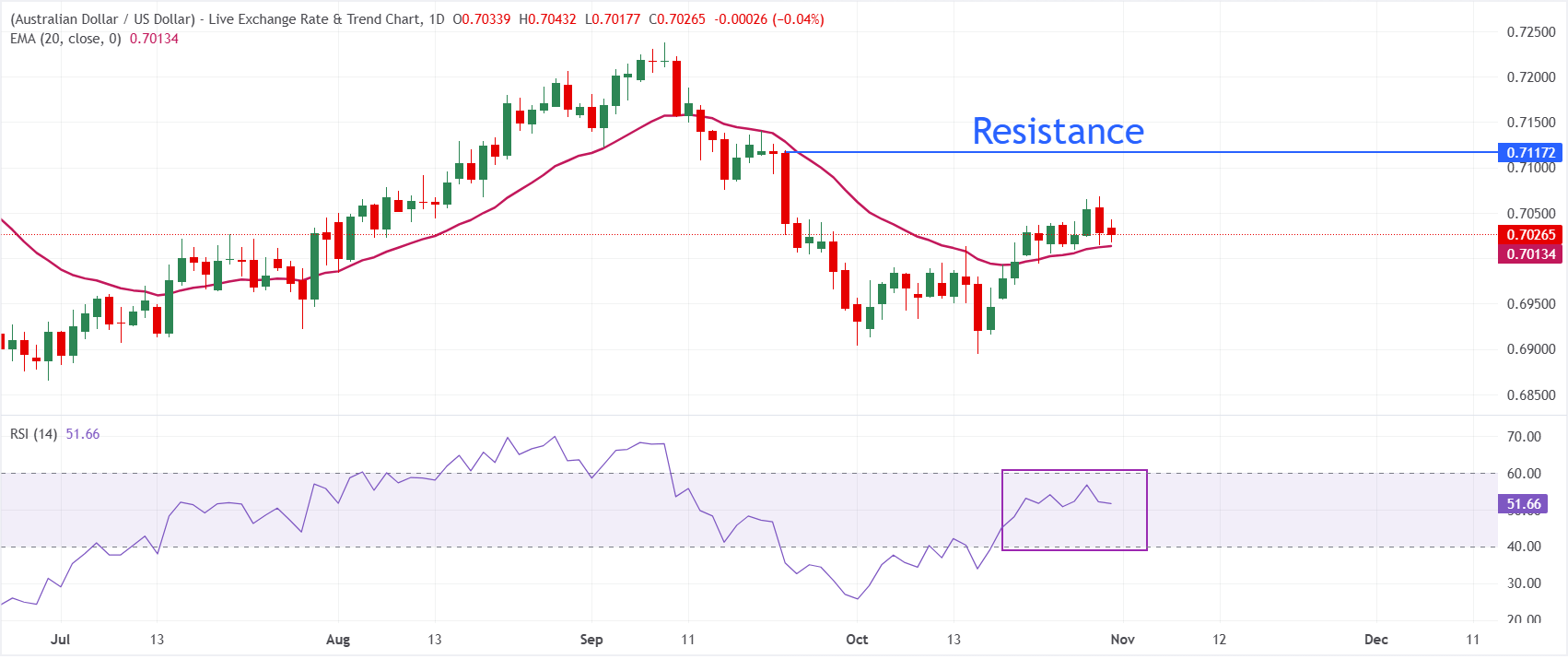
A modest bullish bias remains visible on the daily AUD/USD chart, where the pair is trading at 0.7027. Following the recent rebound from below 0.70, the price is holding marginally above the 20-period exponential moving average (EMA) at 0.7013, suggesting that underlying demand is beginning to emerge.
At 51.7, the Relative Strength Index (RSI) sits near neutral with a slight upward tilt. This points to positive, though limited, upward momentum rather than an overstretched rally.
The first upside obstacle is the 29 October high of 0.7068. A decisive move above that level would bolster the case for further gains towards the 23 September high of 0.7119. On the downside, the 20-period EMA at 0.7013 provides immediate support; if sellers retake control, the broader psychological floor lies around 0.70.
(The technical analysis of this story was written with the help of an AI tool. Know more.)
Economic Data Indicator
Consumer Price Index: Quarterly Change (QoQ)
A high Consumer Price Index (CPI) reading is generally viewed as bullish for the Australian Dollar (AUD), whereas a low reading is considered bearish. Published quarterly by the Australian Bureau of Statistics, the index tracks price changes for a fixed basket of goods and services purchased by households. Each quarterly CPI figure is calculated by averaging the three corresponding monthly CPI readings. The quarter-on-quarter (QoQ) measure compares prices in the reference quarter with those in the preceding quarter.
Find out more.Latest release: Wed 28 Oct 2026 00:30
Release frequency: Quarterly
Actual reading: 1.3%
Consensus estimate: 1.3%
Previous reading: 0.6%
Data source: Australian Bureau of Statistics
Markets and the AUD’s valuation are significantly influenced by Australia’s quarterly Consumer Price Index (CPI), released by the Australian Bureau of Statistics (ABS). To fulfil its inflation mandate, the Reserve Bank of Australia (RBA) closely monitors this measure, which carries important implications for monetary policy. Higher consumer prices generally support the AUD, as the RBA could raise interest rates to keep inflation at its target. Publication follows nearly 25 days after the end of the quarter.
POPULAR ARTICLES
1Dow Jones futures retreat amid Fed hike bets and disappointing tech earnings2Spain Consumer Price Index (MoM) in line with forecasts (0.6%) in October3Austria Gross Domestic Product (QoQ) rose from previous -0.1% to 0.2% in 3Q4Spain Harmonized Index of Consumer Prices (MoM) in line with forecasts (0.5%) in October5Spain Harmonized Index of Consumer Prices (YoY) in line with expectations (4.9%) in October6Spain Consumer Price Index (YoY) meets forecasts (4.9%) in October7Austria Producer Price Index (YoY): 6% (September) vs 4.6%8Austria Producer Price Index (MoM) increased to 1.2% in September from previous 0.9%9Spain Gross Domestic Product - Estimated (YoY) meets expectations (2.7%) in 3Q


Get Started!
Sign up and access the Global Markets in less than 3 minutes

Connect With Us









Contacts
Phone: +61 2 8036 8388
Fax: +61 2 8036 8388
Email: support@tmgm.com



The information provided on this website is of a general nature only and does not constitute personal financial advice. Before acting on any information on this website, you should consider the suitability of the information in relation to your objectives, financial situation and needs. Investing in CFDs and FX Margin Contracts carries significant risks and is not suitable for all investors. You may lose more than your initial deposit. You do not own, or have, any interest in the underlying asset. We recommend that you seek independent advice and ensure you fully understand the risks involved before trading. It is important that you read and consider the disclosure document before you acquire any product listed on the website. The information and advertisements offered on this website are not intended for use by any person in any country or jurisdiction where such use would be contrary to local laws and regulations. The Products and Services offered on this website are not intended for residents of the United States, Malaysia and Thailand.
TMGM is authorized and regulated in various jurisdictions.
Trademax Australia Limited, trading as TMGM, is regulated by the Australian Securities and Investments Commission (ASIC), AFSL no. 436416 and is located at Level 28, One International Tower, 100 Barangaroo Avenue, 2000 Sydney, NSW Australia.
Email: support@tmgm.com.au
Trademax Global Limited, trading as TMGM, is authorized and regulated by the Vanuatu Financial Services Commission (VFSC), registration number 40356 and registered at 1276, Kumul Highway, Port Vila, Vanuatu, Republic of Vanuatu.
Email: support@tmgm.com
Trademax Global Markets (SE) Limited, trading as TMGM, is authorized and regulated by the Financial Services Authority (FSA) of Seychelles, with license number SD224. The company is registered at Office No 13, Providence Estate ABIS Centre, Mahe, Seychelles.
Email: support@tmgm.com
Trademax Global Markets (International) Pty Ltd, trading as TMGM, is authorized and regulated by the Financial Services Commission, Mauritius (FSC) with license no. GB22201012, and registered at 33, Edith Cavell Street C/o IQ EQ Fund Services (Mauritius) Ltd Port Louis, 11324 Mauritius.
Email: support@tmgm.com
Copyright © TMGM. All rights reserved