

Trading
Explore a wide range of markets with competitive pricing, deep liquidity, and advanced trading tools.
Learn More 
Platform
Trade seamlessly with TMGM's powerful platform, built for speed, precision, and a superior trading experience.
Learn More Trading Platform
Academy
Learn the fundamentals of trading with beginner-friendly resources, including guides, webinars, and market insights.
Learn More News & Analysis
Get real-time market updates and expert analysis to stay ahead of trading opportunities
Learn More News & Analysis
About
Learn what sets TMGM apart — our global presence, regulatory strength, and commitment to innovation in trading.
Learn More Why Choose TMGM
Sponsorship
AUD/USD Price Forecast: Why is RBA’s dovish hike weighing on the Australian Dollar?
- AUD/USD falls steeply, with the Australian Dollar under heavy pressure following the RBA’s dovish rate hike.
- RBA guidance indicated that the threshold for a further interest rate increase remains high.
- The results of the US midterm elections are expected to have a short-lived impact that weighs on the US Dollar.
Selling pressure leaves the Australian Dollar (AUD) lagging its major currency peers on Tuesday. During European trading, it is down 0.45% against the US Dollar (USD), at around 0.6965.

Behind the Australian currency’s sharp weakness is the Reserve Bank of Australia’s (RBA) apparent reluctance to raise borrowing costs further. Earlier in the day, the central bank increased the Official Cash Rate (OCR) by 25 basis points (bps) to 4.85%.
Why is the Aussie falling despite the RBA hike as dovish signals and a weaker outlook weigh?
Describing the reaction to the decision, ING analysts say the Aussie Dollar “came under pressure this morning after the RBA hiked rates as expected to 4.85%, but delivered some dovish signals.” The bank points out that “the 6-3 split suggests lower conviction around today’s decision than in markets, which had almost fully priced in a hike (21bp),” indicating that the policy stance was less forceful than investors had expected.
Another change, according to ING, was that “the statement dropped its reference to potential further hikes for the first time since June,” while “the economic outlook was revised sharply to the downside, with a focus on falling house prices weighing on consumers and upside risks to unemployment.” Governor Michele Bullock, speaking at the press conference, “reinforced the RBA’s wait-and-see approach, stressing that monetary tightening still has to feed through to the economy.”
On the scope for additional action, ING observes that “she left the door open to further tightening, but the bar is clearly higher now,” describing the RBA as appearing “happy to assess the impact of previous hikes before acting again.” The bank concludes: “This is in line with our forecast of no further RBA hikes,”
Attention now turns to September’s Trade Balance figures, due on Thursday, as the next major catalyst for the Australian Dollar.
Caution also characterises US Dollar trading as investors await the United States (US) midterm elections in the late North American session.
Assessing the potential currency impact, ING strategists say that “we don’t expect today’s US midterm results to cause structural shifts in FX, but the Dollar may face some short-term pressure should the Democrats secure both the House (widely expected) and the Senate (close call).”
Under their base case, “markets fully price in a Republican loss of the House, but only partially a Democratic clean sweep,” leaving scope for the outcome described in their assessment that “a blue sweep can put some pressure on the Dollar.”
Among the risks, ING highlights that “fears of tougher regulation could weigh on AI stocks (we’ve recently seen how that can hit the greenback), while markets could price in greater risks of decision-making gridlock around issues such as government funding and the debt ceiling.” Nevertheless, the strategists maintain that “we doubt that’s enough to trigger a structural directional shift in the Dollar. The greenback continues to respond predominantly to the Fed story, which shouldn’t face an immediate and direct impact from the midterm result. We expect a split Congress (R-S, D-H) to have a neutral or slightly positive USD impact.”
AUD/USD Technical Analysis: Can the Pair Ease Bearish Pressure?
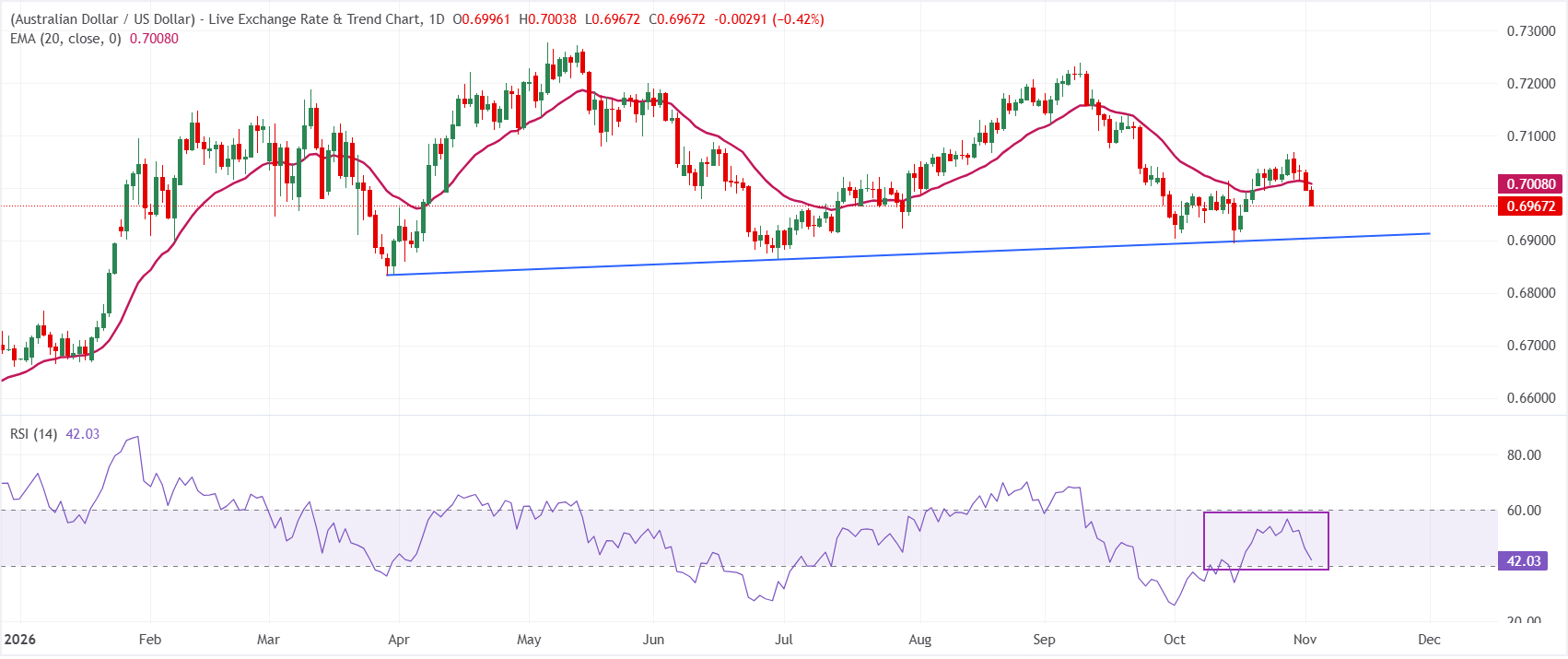
A bearish near-term outlook persists on the daily chart, where AUD/USD stands at 0.6967, below its 20-day Exponential Moving Average (EMA) of 0.7008. With the Relative Strength Index (RSI) around 42, downside momentum appears modest rather than indicative of outright oversold conditions.
The former breakout area around 0.6904 provides the first downside support, followed by the structural trend-line base near 0.6834. For any recovery, the initial hurdle is the 20-day EMA at 0.7008. Only a sustained break above that level would alleviate bearish pressure and pave the way for a more constructive rebound.
(The technical analysis of this story was written with the help of an AI tool. Know more.)
Economic Data in Focus
How Does the RBA Interest Rate Decision Affect AUD?
The Reserve Bank of Australia (RBA) publishes an interest rate decision following each of its eight scheduled meetings a year. A rate increase accompanied by a hawkish assessment of the economy’s inflation outlook is generally positive for the Australian Dollar (AUD). Conversely, a dovish assessment of the Australian economy, alongside a decision to leave rates unchanged or reduce them, is regarded as negative for AUD.
Learn more.Latest release: Tue 3 Nov 2026 03:30
Release frequency: Irregular
Reported figure: 4.85%
Consensus estimate: 4.85%
Prior reading: 4.6%
Data source: Reserve Bank of Australia
POPULAR ARTICLES
1Crypto Today: How are investor capital outflows weighing on Bitcoin, Ethereum, XRP?2Australian Dollar: Why is a dovish hike putting pressure on the aussie? – Commerzbank3Swiss Franc: Is May high in sight after gains against Euro? - Societe Generale4AUD/USD Price Forecast: Why is RBA’s dovish hike weighing on the Australian Dollar?5Bitcoin Price Forecast: Could BTC face deeper losses as pressure builds on the 200-day EMA?6Silver price today: FXStreet data show silver moving lower7Japanese Yen: Trade against US Dollar remains range-bound – UOB8Can the euro withstand pressure on EUR/CAD from rising oil prices?9Euro: How is a hawkish ECB limiting losses against the US Dollar? - ING


Get Started!
Sign up and access the Global Markets in less than 3 minutes

Connect With Us









Contacts
Phone: +61 2 8036 8388
Fax: +61 2 8036 8388
Email: support@tmgm.com



The information provided on this website is of a general nature only and does not constitute personal financial advice. Before acting on any information on this website, you should consider the suitability of the information in relation to your objectives, financial situation and needs. Investing in CFDs and FX Margin Contracts carries significant risks and is not suitable for all investors. You may lose more than your initial deposit. You do not own, or have, any interest in the underlying asset. We recommend that you seek independent advice and ensure you fully understand the risks involved before trading. It is important that you read and consider the disclosure document before you acquire any product listed on the website. The information and advertisements offered on this website are not intended for use by any person in any country or jurisdiction where such use would be contrary to local laws and regulations. The Products and Services offered on this website are not intended for residents of the United States, Malaysia and Thailand.
TMGM is authorized and regulated in various jurisdictions.
Trademax Australia Limited, trading as TMGM, is regulated by the Australian Securities and Investments Commission (ASIC), AFSL no. 436416 and is located at Level 28, One International Tower, 100 Barangaroo Avenue, 2000 Sydney, NSW Australia.
Email: support@tmgm.com.au
Trademax Global Limited, trading as TMGM, is authorized and regulated by the Vanuatu Financial Services Commission (VFSC), registration number 40356 and registered at 1276, Kumul Highway, Port Vila, Vanuatu, Republic of Vanuatu.
Email: support@tmgm.com
Trademax Global Markets (SE) Limited, trading as TMGM, is authorized and regulated by the Financial Services Authority (FSA) of Seychelles, with license number SD224. The company is registered at Office No 13, Providence Estate ABIS Centre, Mahe, Seychelles.
Email: support@tmgm.com
Trademax Global Markets (International) Pty Ltd, trading as TMGM, is authorized and regulated by the Financial Services Commission, Mauritius (FSC) with license no. GB22201012, and registered at 33, Edith Cavell Street C/o IQ EQ Fund Services (Mauritius) Ltd Port Louis, 11324 Mauritius.
Email: support@tmgm.com
Copyright © TMGM. All rights reserved