

Trading
Explore a wide range of markets with competitive pricing, deep liquidity, and advanced trading tools.
Learn More 
Platform
Trade seamlessly with TMGM's powerful platform, built for speed, precision, and a superior trading experience.
Learn More Trading Platform
Academy
Learn the fundamentals of trading with beginner-friendly resources, including guides, webinars, and market insights.
Learn More News & Analysis
Get real-time market updates and expert analysis to stay ahead of trading opportunities
Learn More News & Analysis
About
Learn what sets TMGM apart — our global presence, regulatory strength, and commitment to innovation in trading.
Learn More Why Choose TMGM
Sponsorship
Widening Fed-RBA policy divergence pushes Australian Dollar below 0.6850
- Positive market sentiment fails to support AUD/USD as it drops 0.27% to trade below 0.6850.
- Markets assign an 87% probability to a 25-basis-point Fed rate increase in December.
- Markets price in rate cuts for 2027 as the RBA is expected to halt tightening.
Pressure from expectations of further Federal Reserve tightening left the Australian Dollar 0.27% lower against the US Dollar on Wednesday, with AUD/USD trading below 0.6850. Economic releases were limited in both Australia and the US.
Why is AUD/USD extending losses as sticky US inflation strengthens Fed rate hike expectations?

Solid gains in US equities are keeping market sentiment upbeat. In currency trading, the US Dollar Index (DXY) is up 0.67% at 102.91, having eased from an 18-month peak of 102.96. The index measures the dollar against a basket of six currencies.
Tuesday’s hawkish comments from Federal Reserve (Fed) officials helped lift the US Dollar. Fed Governor Christopher Waller had indicated that a 0.3% rise in core CPI could lead him to back a 50-basis-point rate increase. The subsequent data met that condition.
October marked the third consecutive month in which underlying inflation rose 0.3% MoM. The headline CPI increase slowed from 0.6% to 0.4% MoM, although it still exceeded the 0.3% forecast.
According to the CME FedWatch Tool, money market pricing put the likelihood of a 25 bps rate increase at 87%, leaving a slim 13% probability that the Fed may opt for a 50 bps hike.
Against this backdrop, AUD/USD is drifting lower as speculation grows that the Reserve Bank of Australia (RBA) has completed its tightening cycle and will keep rates unchanged for the foreseeable future. Prime Terminal data, meanwhile, indicate expectations for 28 basis points of RBA rate cuts in 2027.
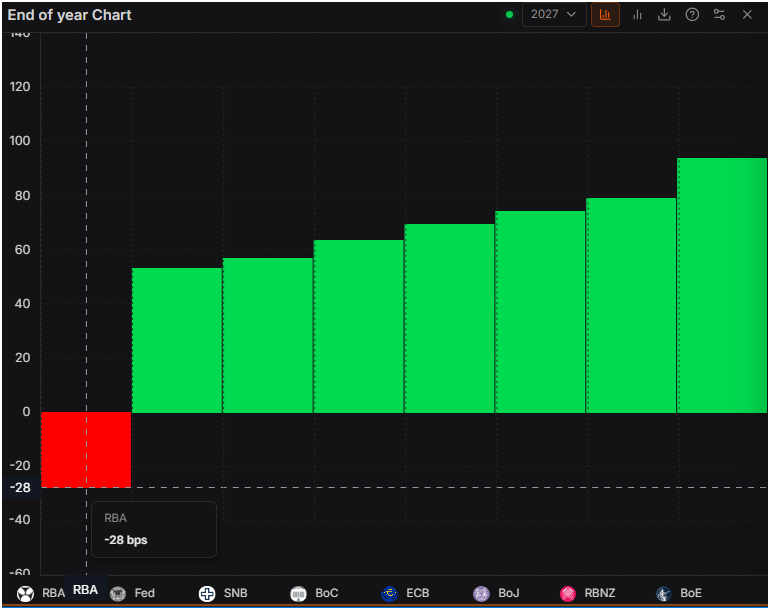
Australia’s upcoming releases include November Consumer Inflation Expectations. The October reading stood at 5.3%, compared with 4.9% in September.
For US investors, Thursday brings Initial Jobless Claims, housing figures and speeches by Fed officials, followed by the Producer Price Index (PPI) on Friday.
AUD/USD Price Forecast: What does the technical picture indicate?
At 0.6844 on the daily chart, AUD/USD retains a bearish near-term bias. The spot rate remains well below a cluster of simple moving averages (SMA) around 0.7028 and several former rising trend lines that now provide overhead resistance. A breach of the latest rising support line, now resistance near 0.6926, highlights continued downward pressure. With the Relative Strength Index (14) near 35, momentum is weak but has not yet reached oversold territory. Sellers therefore appear to retain control unless the pair recovers those broken structural levels.
A recovery would first encounter resistance around 0.6926 at the former rising trend line, followed by the convergence of the 50-, 100- and 200-day SMAs near 0.7028. To relieve immediate bearish pressure and clear a path towards 0.7135 and the horizontal barrier at 0.7198, the pair would need a daily close above that band. On the downside, solid structural support only appears around 0.6343, where the long-term descending trend line has become a base. Until AUD/USD overcomes the resistance cluster noted above, it remains exposed to further gradual losses.
(An AI tool assisted in preparing this story’s technical analysis. Learn more.)
How Is the Australian Dollar Performing Today?
The Australian Dollar recorded its strongest performance against the Swiss Franc today. The table below sets out the percentage changes in the Australian Dollar (AUD) against the major currencies listed.
| USD | EUR | GBP | JPY | CAD | AUD | NZD | CHF | |
|---|---|---|---|---|---|---|---|---|
| USD | 0.68% | 0.51% | 0.57% | 0.44% | 0.32% | 0.72% | 0.93% | |
| EUR | -0.68% | -0.17% | -0.09% | -0.24% | -0.36% | 0.03% | 0.22% | |
| GBP | -0.51% | 0.17% | 0.08% | -0.09% | -0.19% | 0.20% | 0.39% | |
| JPY | -0.57% | 0.09% | -0.08% | -0.15% | -0.25% | 0.14% | 0.34% | |
| CAD | -0.44% | 0.24% | 0.09% | 0.15% | -0.09% | 0.28% | 0.47% | |
| AUD | -0.32% | 0.36% | 0.19% | 0.25% | 0.09% | 0.40% | 0.61% | |
| NZD | -0.72% | -0.03% | -0.20% | -0.14% | -0.28% | -0.40% | 0.19% | |
| CHF | -0.93% | -0.22% | -0.39% | -0.34% | -0.47% | -0.61% | -0.19% |
Percentage movements between major currencies are displayed in the heat map. Select the base currency in the left-hand column and the quote currency in the top row. For instance, choosing the Australian Dollar on the left and following its row across to the US Dollar gives the percentage change for AUD (base)/USD (quote) in the corresponding cell.
POPULAR ARTICLES
1Widening Fed-RBA policy divergence pushes Australian Dollar below 0.68502Yen weakens towards 160.00 as markets await Fed speakers and US PPI3What will the next UK growth figures mean for a Pound at a three-week low?4NASDAQ 100 hits a one-week high as AI stocks recover5Why is the Mexican Peso resisting Fed hike bets as Banxico signals a longer pause?6Bitcoin Bull Score slides to 20 amid contraction in USDT supply – CryptoQuant7GBP/JPY Price Forecast: Can a bullish harami break through 213.00 resistance?8Ethereum Price Forecast: ETH Edges Higher After AI Stocks Recover9EUR/USD Price Forecast: Is 1.1000 next after the break below 1.1100?


Get Started!
Sign up and access the Global Markets in less than 3 minutes

Connect With Us









Contacts
Phone: +61 2 8036 8388
Fax: +61 2 8036 8388
Email: support@tmgm.com



The information provided on this website is of a general nature only and does not constitute personal financial advice. Before acting on any information on this website, you should consider the suitability of the information in relation to your objectives, financial situation and needs. Investing in CFDs and FX Margin Contracts carries significant risks and is not suitable for all investors. You may lose more than your initial deposit. You do not own, or have, any interest in the underlying asset. We recommend that you seek independent advice and ensure you fully understand the risks involved before trading. It is important that you read and consider the disclosure document before you acquire any product listed on the website. The information and advertisements offered on this website are not intended for use by any person in any country or jurisdiction where such use would be contrary to local laws and regulations. The Products and Services offered on this website are not intended for residents of the United States, Malaysia and Thailand.
TMGM is authorized and regulated in various jurisdictions.
Trademax Australia Limited, trading as TMGM, is regulated by the Australian Securities and Investments Commission (ASIC), AFSL no. 436416 and is located at Level 28, One International Tower, 100 Barangaroo Avenue, 2000 Sydney, NSW Australia.
Email: support@tmgm.com.au
Trademax Global Limited, trading as TMGM, is authorized and regulated by the Vanuatu Financial Services Commission (VFSC), registration number 40356 and registered at 1276, Kumul Highway, Port Vila, Vanuatu, Republic of Vanuatu.
Email: support@tmgm.com
Trademax Global Markets (SE) Limited, trading as TMGM, is authorized and regulated by the Financial Services Authority (FSA) of Seychelles, with license number SD224. The company is registered at Office No 13, Providence Estate ABIS Centre, Mahe, Seychelles.
Email: support@tmgm.com
Trademax Global Markets (International) Pty Ltd, trading as TMGM, is authorized and regulated by the Financial Services Commission, Mauritius (FSC) with license no. GB22201012, and registered at 33, Edith Cavell Street C/o IQ EQ Fund Services (Mauritius) Ltd Port Louis, 11324 Mauritius.
Email: support@tmgm.com
Copyright © TMGM. All rights reserved